Had so much fun sitting down with @zklaassen_md@urotoday post-ASCO to chat about the great data on Nectin- 4 ADCs presented at #ASCO26 in #BladderCancer The Past, Present, and Future https://t.co/JNfVCvpHcr
⚡️ Histological subtypes of urothelial carcinoma — micropapillary, plasmacytoid, sarcomatoid, squamous — represent biologically distinct phenotypes that do not conform to a one-size-fits-all approach.
Frequently understaged on TURBT, with variable response to standard systemic therapy.
@EuropeanUrology #BladderCancer
https://t.co/NnF32TmzJn
Cancer vaccines have a history of broken promises. Intismeran could be the start of a new era! I discussed with @natashaloder at @TheEconomist why the data are “promising for the field of melanoma and cancer as a whole.” @Merck@moderna_tx
https://t.co/2UBt902e1P
When faced with a complex diagnosis, Artie and his wife Annie sought answers to guide his cancer journey.
Through Tempus xF non-invasive liquid biopsy results, Artie's oncologist, Alan Tan, MD, was able to identify two significant mutations which opened the door to targeted treatment options tailored specifically to his profile.
Watch is full story: https://t.co/nPumsMYrLd
I have to say, when Merck called me last night with the mRNA cancer vaccine news (embargoed, of course), I literally yelped in reaction.
Consider this: Between this spring's Revolution Medicines success with a KRAS-targeted drug and now Merck and Moderna's success with an mRNA neoantigen vaccine, 2026 will go down as one of the most consequential years in cancer treatment, ever.
Incredible.
Personalized mRNA-based neoantigen vaccines + pembo are being tested in a number of randomised adjuvant cancer trials (included bladder and renal). The 1st positive trial (RIII in melanoma) was announced today. PCVs are logistically complex with limited monotherapy activity in advanced disease, but early IO combinations in MRD may overcome tumor microenvironment resistance. Patient selection or even vaccine generation could occur with ctDNA. @OncoAlert https://t.co/FUC1sDu3pn
Can pairing PARP inhibitors with AR blockers truly unlock a new frontier in prostate cancer therapy?
Dr. Rana McKay (@DrRanaMcKay), Dr. Emmanuel Antonarakis (@EAntonarakis), and Dr. Alan Tan (@alantanmd) unpack the essentials of DNA repair, the ongoing synergy debate, and how trial design and drug potency shape real-world impact.
Access the full episode in the BackTable app:
https://t.co/ok0cM8ztcz
This podcast is supported by Pfizer.
#URO314 #ONC71 #ProstateCancer #PARPInhibitor #UrologicOncology @RuchikaTalwarMD@UCSDCancer
🚨 EV+P is practice-changing in MIBC. Now we need to learn how much EV each patient actually needs.
The updated FDA label provides an important perspective on peripheral neuropathy (PN):
Perioperative MIBC (EV-303/304 pooled)
• PN: 42%
• Grade ≥2: 17%
• complete resolution: 41%
la/mUC (EV-302/103 pooled)
• PN: 67%
• Grade ≥2: 43%
• complete resolution: 13%
Reassuringly, PN appears substantially more reversible with finite perioperative EV exposure. But 59% still had residual neuropathy at last assessment, and among those, 30% remained Grade ≥2.
And Grade ≥2 PN matters—this is no longer just tingling. It can interfere with instrumental daily activities: walking longer distances, driving, working, writing/typing or other fine-motor tasks.
Importantly, median onset of Grade ≥2 PN in MIBC was 4.9 months. Given only 3–4 neoadjuvant EV cycles in EV-303/304, this timing suggests that a substantial part of clinically relevant cumulative neurotoxicity may emerge during the postoperative/adjuvant treatment period.
🎯 This raises an important question for the next generation of perioperative trials:
Does every patient need all 9 cycles of EV?
Can pCR, ctDNA/MRD, pathology or molecular biomarkers identify patients in whom EV can be safely de-escalated after surgery?
VOLGA will provide interesting complementary information because its experimental arms use EV preoperatively but not postoperatively—although it does not directly randomize adjuvant EV vs no adjuvant EV, so it cannot answer this question alone.
We have a highly effective, practice-changing regimen. Now precision oncology should help us preserve efficacy while minimizing cumulative toxicity—especially neuropathy in patients we aim to cure. 🔬
More treatment is not necessarily better treatment. The right treatment intensity for the right patient should be the next goal!
@OncoAlert@weoncologists@DrChoueiri@tompowles1@MattGalsky@apolo_andrea@UroDocAsh@urotoday@Uromigos@Markuseckstein3@katy_beckermann@ViktorGruenwald@drenriquegrande@DrYukselUrun@Uroweb
Are new ADCs and early treatment intensification redefining GU oncology standards?
@alantanmd & @katy_beckermann break down key @ASCO updates from TALAPRO-3, PROTEUS, and KEYNOTE-564.
Listen to the full episode now on the BackTable app: https://t.co/xkt3VQAOHR
#GUOnc #Oncology #MedEd #ONC76 @Kate_Baker_MD@TNOncology
@urogene I’ve had the same experience with several plasmacytoid and EVP. I have a 35 year old that had very locally advanced disease, cleared his ctDNA rapidly, he decided against cystectomy, and retained his bladder now for almost 2 years. It’s similar to sarcomatoid RCC and ipi/nivo.
Excellent Perspective on the future of ADCs in @NatureMedicine.
The next generation of ADCs will likely not be defined by a single innovation, but by integrating:
• smarter target biology
• optimized payloads & linkers
• mechanisms of resistance
• multidimensional biomarkers
• rational combination strategies
Particularly exciting is the focus on dynamic and functional biomarkers rather than static target expression alone—an area that will be highly relevant for EV and other ADCs in urothelial cancer.
Nice discussion on next-generation ADCs by @FerMosele, @jsoriamd, @FAndreMD et al.!
https://t.co/AKO7fautt8
@raffcolo@Markuseckstein3@OncoAlert@urotoday@weoncologists@drenriquegrande@DrYukselUrun@PGrivasMDPhD@PTarantinoMD
Bladder cancer space is really moving ..not only our therapeutic space but our biomarkers incl urine, tissue and AI histo. Next decade will see an explosion 💥 of precision technology I suspect and what we know now ( nicely summarized 👇 below) is just tip of the iceberg 🧊 https://t.co/jX4dOdlaZ3
Great Perspective. I completely agree that the future of ADCs lies in better biomarkers, not only better ADCs! @Markuseckstein3@raffcolo@PTarantinoMD
For EV, accumulating evidence suggests that membranous NECTIN4 may be more informative than total expression. The priority now is prospective validation and harmonized scoring—not just new constructs. @Dr_Aggen@DrRosenbergMSK@DrChoueiri
More importantly, we need biomarkers to identify patients unlikely to benefit from EV(P) who may instead derive greater benefit from other ADCs targeting HER2, TROP2, EGFR or future targets. Ultimately, biomarker-guided ADC selection and sequencing should become a cornerstone of precision oncology! @tompowles1@Uromigos
Exciting times for translational pathology and precision oncology!
@OncoAlert@weoncologists@brunolarvol@urotoday@drenriquegrande@AndreaNecchi@apolo_andrea
Results published in @NaturePortfolio demonstrate that PRISM2, a multimodal slide-level pathology foundation model developed in collaboration with researchers from Microsoft, demonstrates best-in-class performance across a wide variety of diagnostic and prognostic applications.
By combining large vision models built from pathology images with large language models, PRISM2 unlocks diagnostic-grade precision in research involving cancer detection, biomarker identification and prognosis prediction.
PRISM2 is the largest model trained on the most comprehensive dataset to date, with nearly 700,000 specimens and clinical reports, covering over 2.3 million slides and 14 million question−answer pairs.
Learn more: https://t.co/L7TJTnNd28
Thank you to @CBSNews for highlighting our #research!
For many patients with muscle-invasive #BladderCancer, the standard of care is neoadjuvant systemic therapy followed by curative surgery to remove the bladder. For selected patients, bladder-preserving approaches are already an option, and the field is working to expand who can safely benefit.
Our #research at @WeillCornell@nyphospital combines patient-derived cancer organoids with AI to create “bio-digital avatars” of each patient's cancer.
This is team science, bringing together clinicians, laboratory scientists, computational biologists and mathematicians. We envision that these technologies could eventually help predict each patient’s response to treatment. Rigorous prospective validation will be essential before they can guide routine clinical care. @Cornell@WCMGUcancer@WCMEnglanderIPM@WCM_MeyerCancer@BladderCancerUS #FaltasLab
Last day #BCAN26TT 🧡
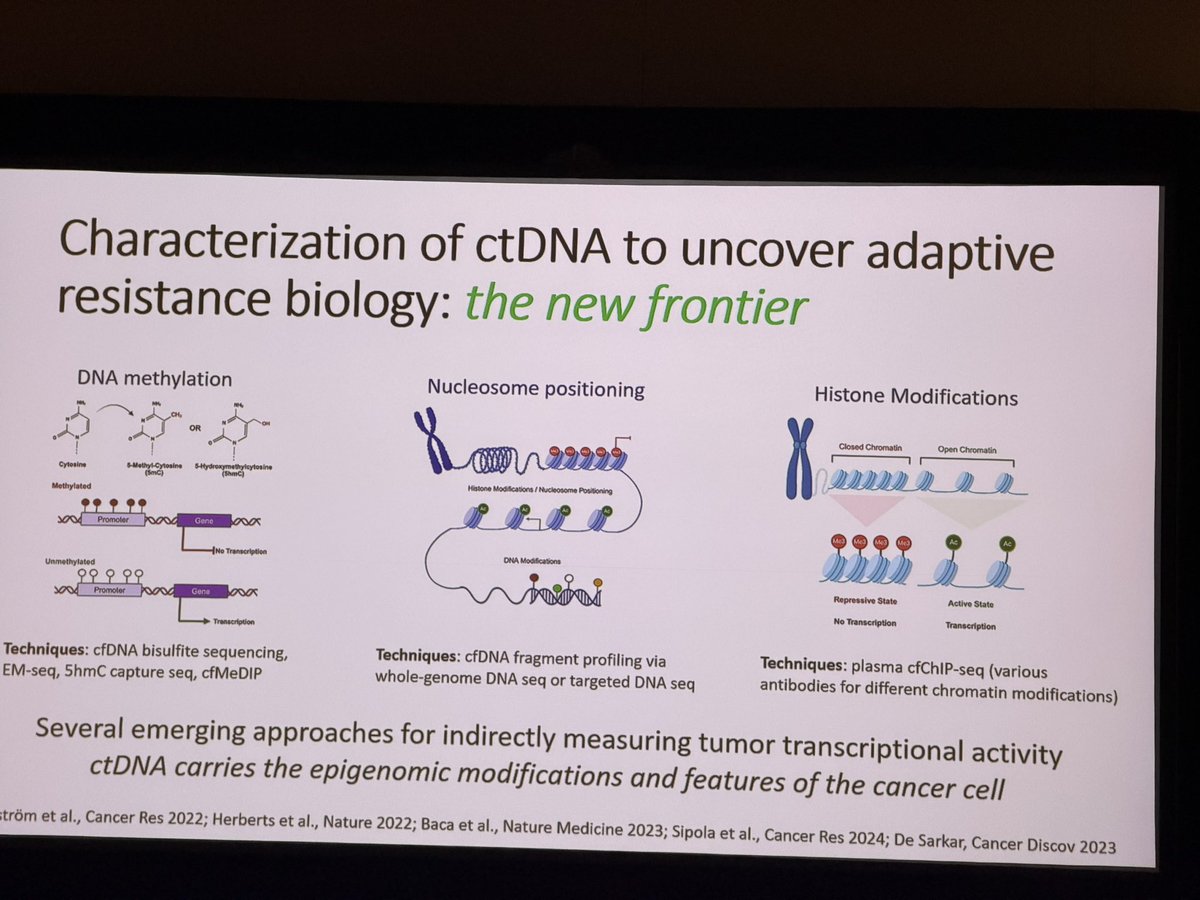
@ResearchWyatt@BCCancer on ctDNA epigenomics to track adaptive resistance in mUC 🧬
➡️ mapping DNA methylation, nucleosome positioning & histone marks
➡️ liquid biopsy can infer tumor gene expression w/o tissue biopsy
Emerging, not yet clinic-ready











![mtmdphd's tweet photo. Liquid Biopsies for Cancer: A Translational Science Review [Aug 10, 2026] Mezzanotte-Sharpe, @KatrinaPiemonte @benhopark @JAMANetwork
https://t.co/GEir4BehAQ #LiquidBiopsy #PrecisionMedicine https://t.co/2QYhYesT2K](https://pbs.twimg.com/media/HPn-E-OXUAAWqYk.jpg)