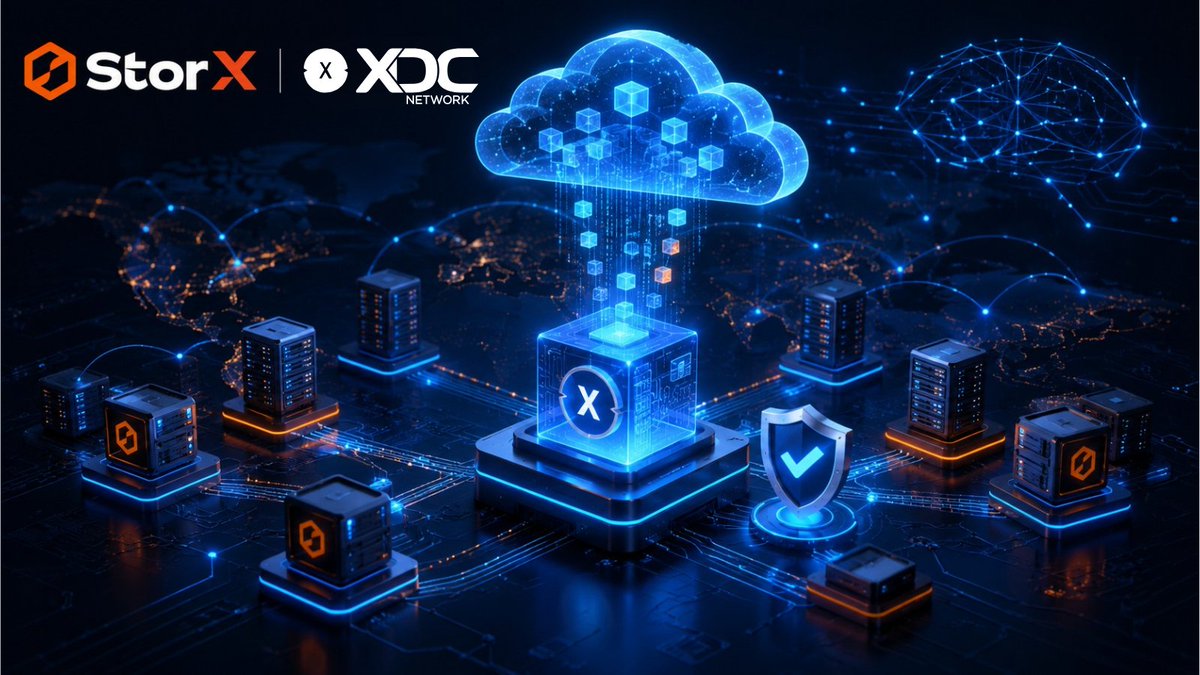
We didn't pick @XDCNetwork at random. It's built for fast, low-cost transactions and is ISO 20022-compliant — the messaging standard banks and financial institutions already use.
That mattered because node payouts and staking happen constantly, in small amounts, across thousands of operators.
A slow or expensive chain underneath that just doesn't work at this volume.
Q2 2026 is a wrap — and there's a lot to catch up on. 🚀
New tools. Podcast features. Infrastructure upgrades. Market milestones. Community celebrations.
The StorX Network Q2 2026 Newsletter covers everything that happened this quarter — the builds, the conversations, and the moves that are shaping what decentralized storage looks like in practice.
If you've been following StorX, this one's worth the read. If you're new here, this is a good place to start.
👇 Read the full Q2 2026 Newsletter here
https://t.co/MK0YZ0l2mK
#StorX #SRX #DePIN #XDCNetwork #DecentralizedStorage #DataSovereignty #Web3
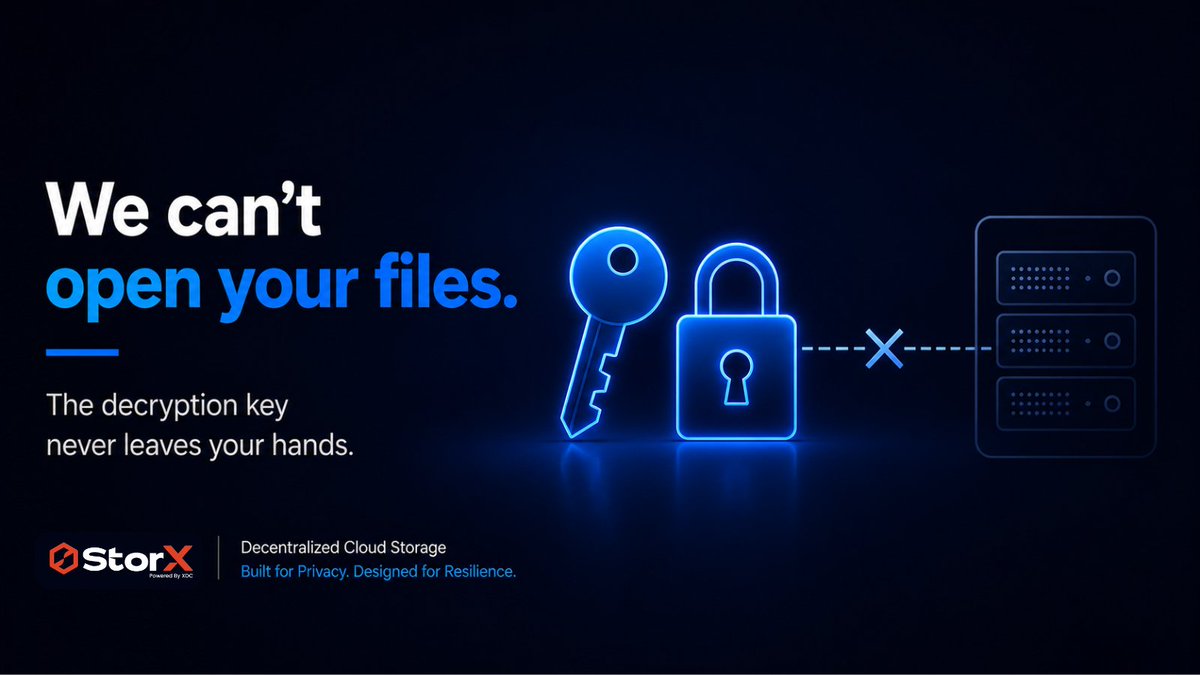
The decryption key never leaves your hands. We don't hold a copy. We don't hold a backup of it "just in case." We genuinely cannot open your files, even if someone asked us to.
That's not a privacy policy promise that depends on us keeping our word. It's just the architecture. There's nothing on our end to subpoena, hand over, or get hacked, because there's nothing on our end that opens anything.
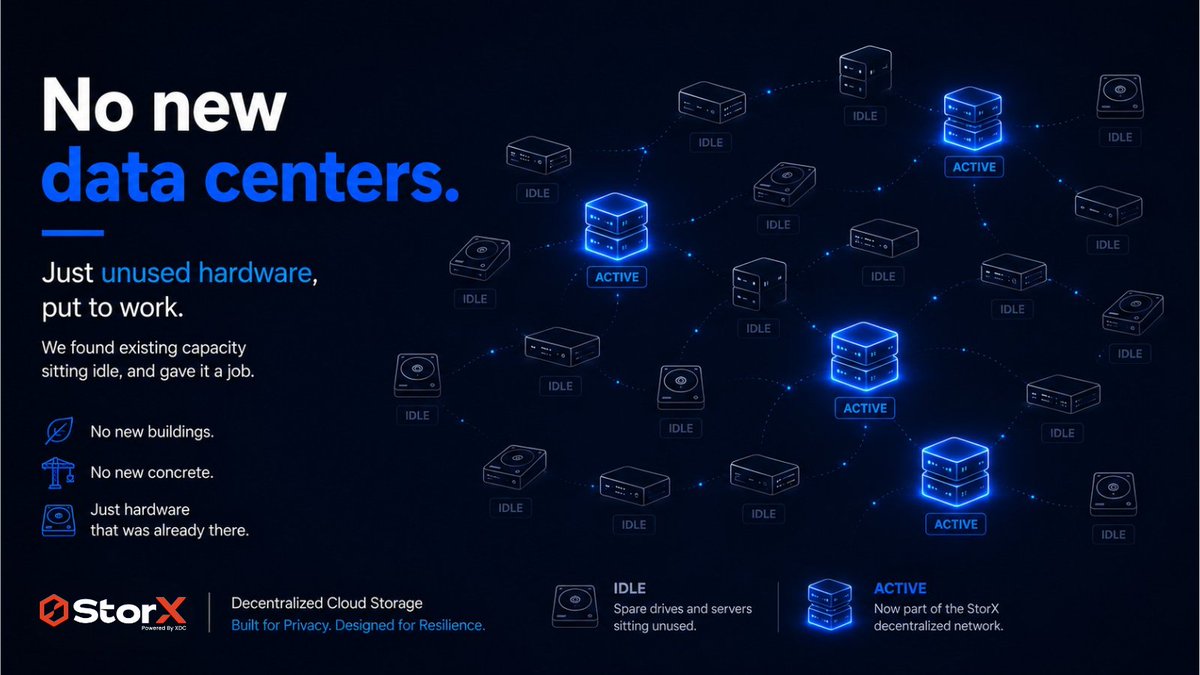
Most of the storage capacity on our network isn't sitting in a purpose-built data center. It's spare drives, idle servers, hardware that already existed and was doing nothing in particular before it joined the network.
We didn't go build new infrastructure to compete with the big data centers. Our community members sourced the capacity that already existed, sitting unused, and gave it a job.
No new buildings. No new concrete. Just hardware that was already there.
Node operators on our network don't just stop earning when their node goes offline. Their reputation score drops, and that score directly affects their share of future rewards. If a node stays down long enough, it gets removed from the reward queue entirely.
We could have made it simpler — pay everyone the same regardless of uptime. We didn't, because a network is only as reliable as its least reliable node.
We'd rather have a smaller number of nodes you can actually count on than a leaderboard padded with machines that quietly disappeared in February.
Here's what running a node on our network actually costs and pays, no rounding in our favor: roughly $30 to $80 a month in server costs if you don't already have spare hardware, a minimum stake of 40,000 SRX, and a typical reward of around 244 SRX a month at that minimum, plus 7% staking yield.
Your actual return depends on SRX's price and your node's reputation score — both of which move.
We'd rather you run those numbers yourself before staking than read a rosier estimate from us and find out the real math later.
Most redundancy in cloud storage works by making copies — save the same file two or three times in different places, hope they don't all fail at once.
We use erasure coding instead. A file is split into pieces using math that lets you reconstruct the entire original from a subset of those pieces — without needing every single one back. You can lose some pieces entirely and still get the whole file.
It's a fundamentally different kind of redundancy than "we kept a few extra copies somewhere."
Running a node doesn't require knowing how a blockchain works. There's a one-click setup script that handles the install. You should be comfortable maintaining a basic Linux server — that's really the bar.
Basic Docker knowledge helps, but plenty of operators run nodes without ever touching it directly.
The technical floor here is "can manage a VPS," not "can write smart contracts."
Most cloud storage pricing covers three things: the hardware, the data center it sits in, and the margin on top of both.
We only have one of those costs. The hardware is already out there, owned by people who joined the network — not new buildings we had to finance.
That's most of why the price difference exists. Not a discount. A different cost structure.
A few months back, we changed how node rewards work on our network. The payout per node goes down by roughly 5% every quarter, on a fixed schedule.
We'll say plainly: that's a worse pitch to a new node operator today than it would've been a year ago. Lower rewards are a harder sell.
But uncontrolled, ever-growing payouts eventually hollow out the token that's paying for them. We'd rather run a network that's worth running in three years than one that looks the most generous this quarter.
If your application already talks to Amazon S3, it already knows how to talk to StorX. Same API, same SDKs, same tooling. You change an endpoint. You don't touch your code.
The actual hard part of leaving AWS was never supposed to be rewriting your app. It was supposed to be finding somewhere else worth going. We figured the first part should at least not be the obstacle.
@CPOfficialtx@StorXNetwork@XDCNetwork This StorX update is all about deeper commitment.
The project is not only using XDC; it is now supporting XDC through masternode operations while continuing to build decentralized cloud storage.
#StorX#XDC
One trend worth watching:
DePIN projects are increasingly becoming blockchain infrastructure operators.
@StorXNetwork has begun operating @XDCNetwork Masternodes, joining infrastructure operators including Animoca Brands, Deutsche Telekom, SBI Holdings, and HashKey Cloud.
This marks its evolution from a DePIN storage app to a core participant securing the XDC blockchain.
By the numbers:
• 117,000+ users secured
• 2,150+ active storage nodes
• 50+ global locations
• 5+ PB of deployed storage capacity
• #8 storage token by market cap
• #32 DePIN token by market cap
Cryptopolitan research says AI has driven demand for secure, decentralized data storage.
So, StorX positions itself as a foundational layer for decentralized, AI-era data infrastructure, with institutional custody support from @BitGo and @FireblocksHQ, plus S3 compatibility for enterprise integration.
StorX's architecture encrypts, shards, replicates, and distributes data across independent nodes, eliminating single points of failure while reducing ransomware and centralized storage risks.
Encryption, Fragmentation, Replication, Global Distribution
No single node can ever access your file. Not even us. Guaranteed.
#StorX#DePIN#DecentralisedStorage
A file gets encrypted before it ever leaves your machine. That happens first, before anything else.
Then it's split into pieces. Not copied — split. Each piece goes to a different, independently run node, and no single one of those nodes holds enough of the file to read it or rebuild it alone.
We didn't add this as a feature on top of normal cloud storage. There was never a version of StorX that worked any other way.
The AI-era data narrative is getting real.
Businesses need storage that can support larger datasets, backup needs, and long-term retention. @StorXNetwork is leaning into this with decentralized storage and @XDCNetwork masternodes operations.
Read More: https://t.co/tnEQfUPQ4B
DePIN projects are starting to be judged by real infrastructure, not just narratives.
@StorXNetwork operating XDC masternodes adds weight to its storage network story: live users, active nodes, and now network-level participation.
Read More: https://t.co/0osBeku5NM
StorX operating XDC masternodes is a strong signal.
Not just building on @XDCNetwork, but helping support the infrastructure underneath it.
That’s how DePIN projects mature: real usage + real network participation.
#StorX#XDC#DePIN
StorX Network is strengthening its DePIN infrastructure by operating XDC masternodes on @XDCNetwork.
This expands StorX’s role from a decentralized cloud storage platform to an active infrastructure participant in the network layer that supports its ecosystem.
As AI-era data workloads grow, secure, distributed, and resilient storage becomes critical — and StorX is building deeper into the infrastructure stack powering that future.
#StorX #XDC #DePIN #AIInfrastructure
StorX Network is strengthening its DePIN infrastructure by operating XDC masternodes on @XDCNetwork.
This expands StorX’s role from a decentralized cloud storage platform to an active infrastructure participant in the network layer that supports its ecosystem.
As AI-era data workloads grow, secure, distributed, and resilient storage becomes critical — and StorX is building deeper into the infrastructure stack powering that future.
#StorX #XDC #DePIN #AIInfrastructure
Data backup is no longer just an IT checklist — it’s a business survival strategy.
In this podcast, Murphy John, Chief Growth Officer at StorX Network, discusses with @darkrhiinosec how organizations can rethink data storage, backup, recovery, and security in a world moving from on-premise systems to cloud and decentralized infrastructure.
The conversation covers:
🔐 Data privacy and compliance in decentralized systems
🛡️ Ransomware protection and data recovery
🤖 The impact of AI on cybersecurity
💾 Budgeting for reliable backup solutions
📉 The hidden cost of cloud egress fees
🌍 Why resilient, privacy-first storage matters for businesses
As data becomes more critical, enterprises need infrastructure that is secure, recoverable, cost-efficient, and future-ready.
Watch the full podcast and explore how StorX Network is building decentralized data storage for the next era of digital infrastructure.
https://t.co/qb9y2fRJ78