A Fluorescent Material Model for Non-Spectral Editing & Rendering
Belcour Laurent @_Laurent , Fichet Alban, Barla Pascal
(Intel Corp. France, Inria Bordeaux)
https://t.co/kOGBX8QDeZ
Abstract:
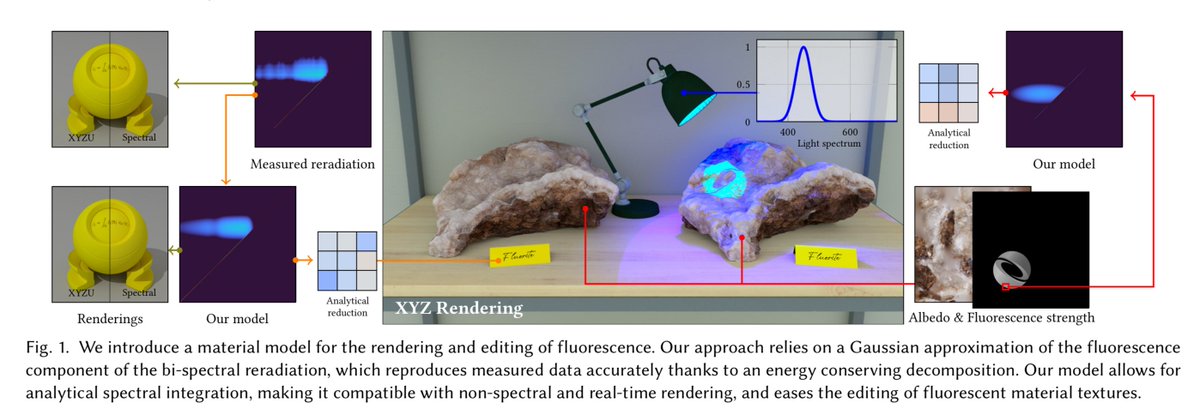
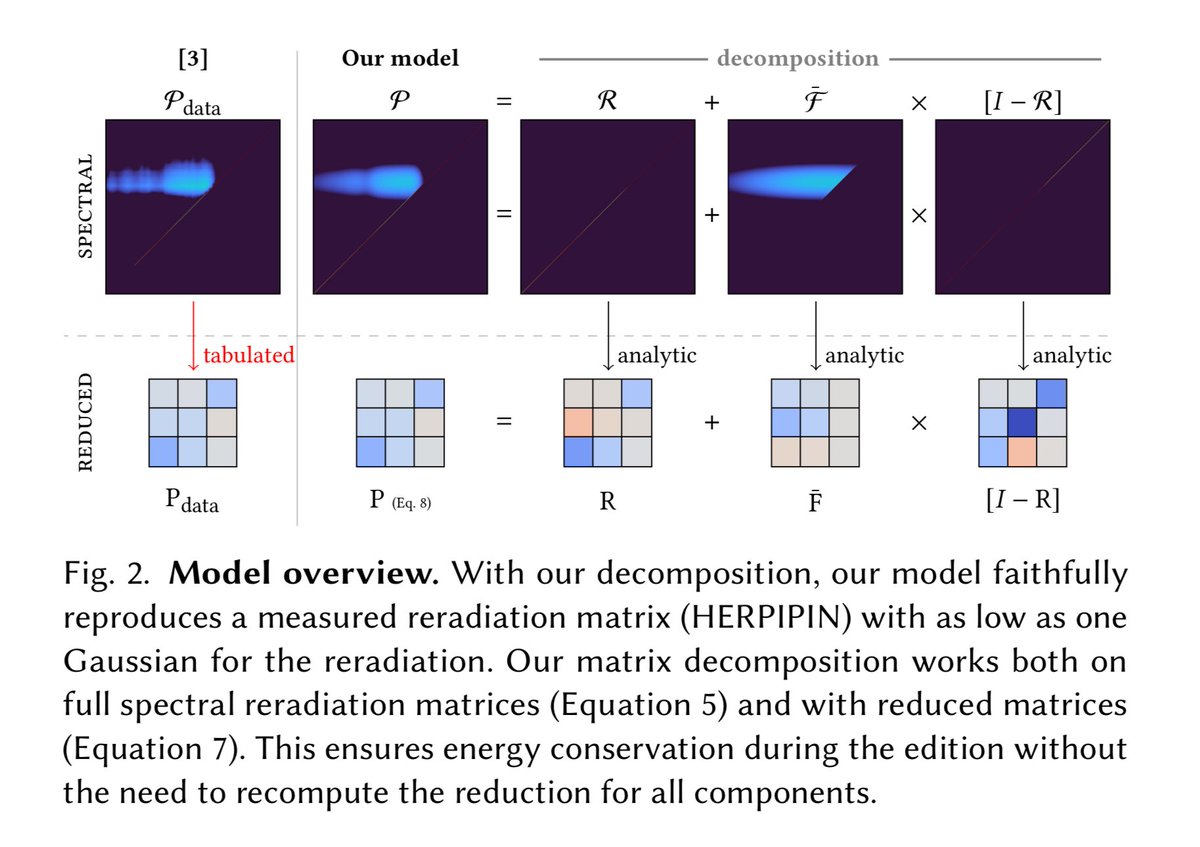
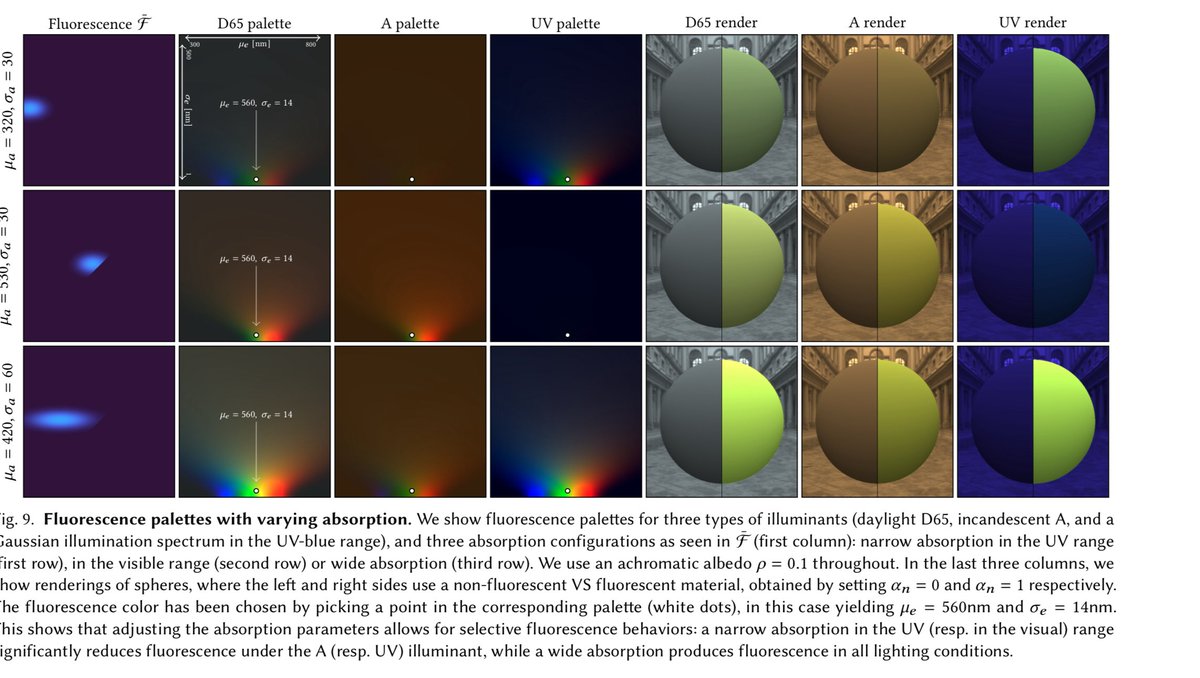
Fluorescent materials are characterized by a spectral reradiation toward longer wavelengths. Recent work [Fichet et al. 2024] has shown that the rendering of fluorescence in a non-spectral engine is possible through the use of appropriate reduced reradiation matrices. But the approach has limited expressivity, as it requires the storage of one reduced matrix per fluorescent material, and only works with measured fluorescent assets.
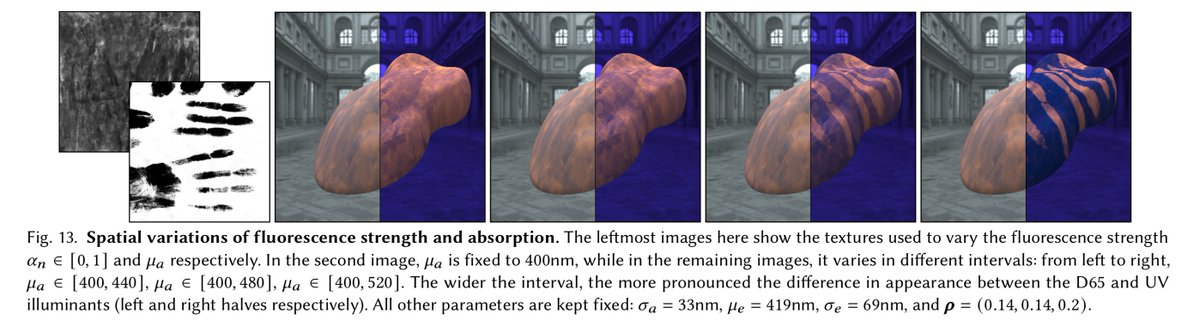
In this work, we introduce an analytical approach to the editing and rendering of fluorescence in a non-spectral engine. It is based on a decomposition of the reduced reradiation matrix, and an analytically-integrable Gaussian-based model of the fluorescent component. The model reproduces the appearance of fluorescent materials accurately, especially with the addition of a UV basis. Most importantly, it grants variations of fluorescent material parameters in real-time, either for the editing of fluorescent materials, or for the dynamic spatial variation of fluorescence properties across object surfaces. A simplified one-Gaussian fluorescence model even allows for the artist-friendly creation of plausible fluorescent materials from scratch, requiring only a few reflectance colors as input.
Excited to share 2025 update from our team, including our presence at #HPG and #SIGGRAPH: https://t.co/5TeBuVRSG0
We focus on visual efficiency and democratizing high-end visual experiences.
We're presenting at #SIGGRAPH2025! 🚀
We use adaptive tetrahedral grids (via the LEB algorithm) to GPU path trace volumetric production assets. Fewer neighbors, less memory, real-time performance—up to 30× faster than regular grids.
https://t.co/1bDAzqvBnr
If you happen to be at #GDC2025, I'll be giving a talk about Neural Texture Compression and Cooperative Vectors at Microsoft's Advanced Graphics Summit, feel free to attend!
https://t.co/subTehJL8J
Our work with @MomentsInCG on spectral image compression is now published in JCGT!
Code is available for compression and decompression from/to Spectral OpenEXR -> https://t.co/p9josGzz9a
As a follow up to our paper, I've written a blog post about the challenges of mapping an FFT-based water simulation to a planet-scale spherical asset.
https://t.co/MhpKWArYEL
Looking for a fast method to render your large-scale game components?
Our lastest @HPG_Conf paper allows to render terrains, oceans and even entire planets in realtime on any modern GPU using compute shaders. Fun fact: we use a Concurrent Binary Tree as a GPU memory manager.
Do you want fluorescence in your renderer without having to make it spectral?
I got you covered! At #EGSR2024 I will unveil with @_Laurent and Pascal Barla a reduction technique to integrate fluorescence into RGB rendering!
The method is so simple and efficient it works in real-time. With it, you can experience near-spectral quality fluorescence even with commercial game engines.
Come and join the fluorescent party!
We wrote a tiny blogpost about a nice trick to speed up VNDF importance sampling an isotropic Smith-GGX distribution. You can find it here, hope you find it useful: https://t.co/4hINmaWFo5
In our latest @I3DCONF paper, we transform any rasterizer into a differentiable one with minimal engineering and zero external dependencies.
Optimize game assets and volumes, train 3D Gaussian Splats, etc. directly within your existing engine. Compute shaders is all you need!
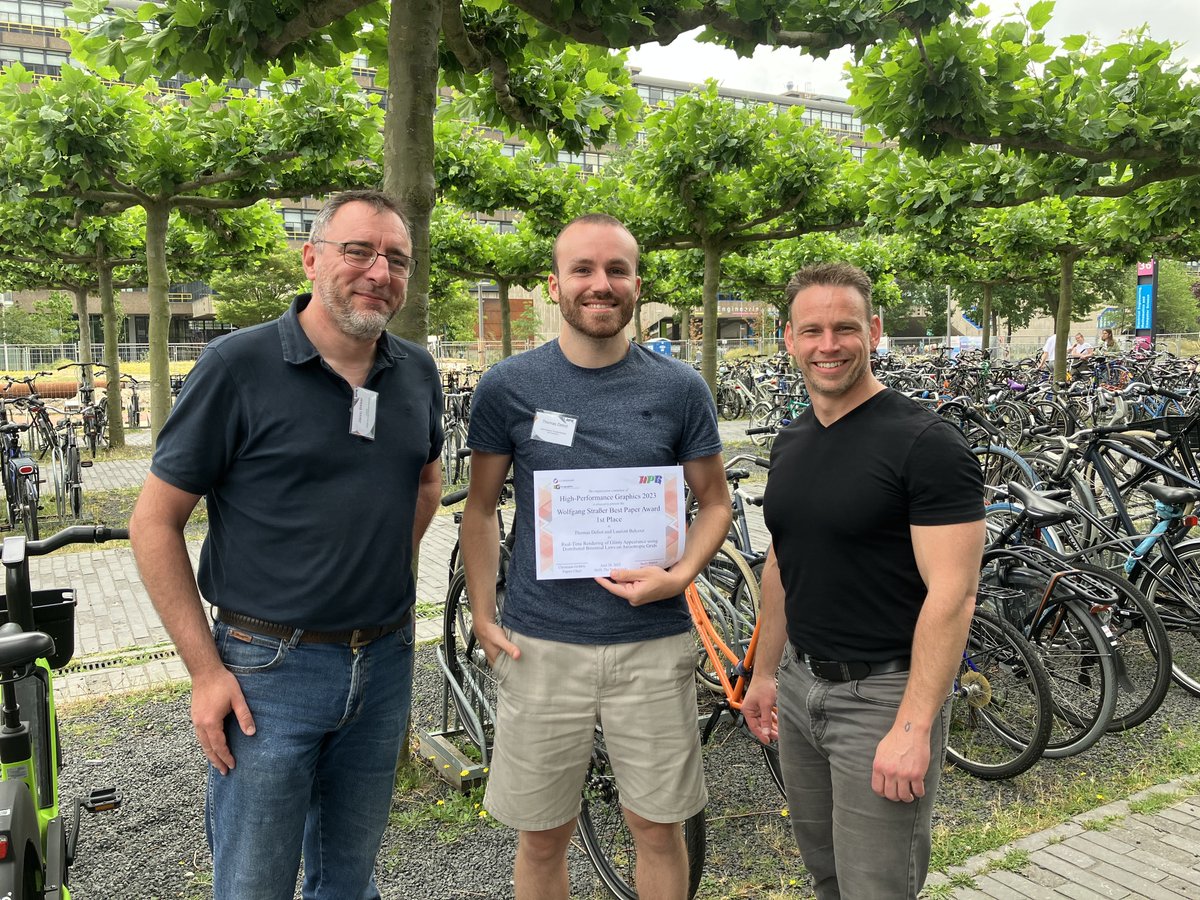
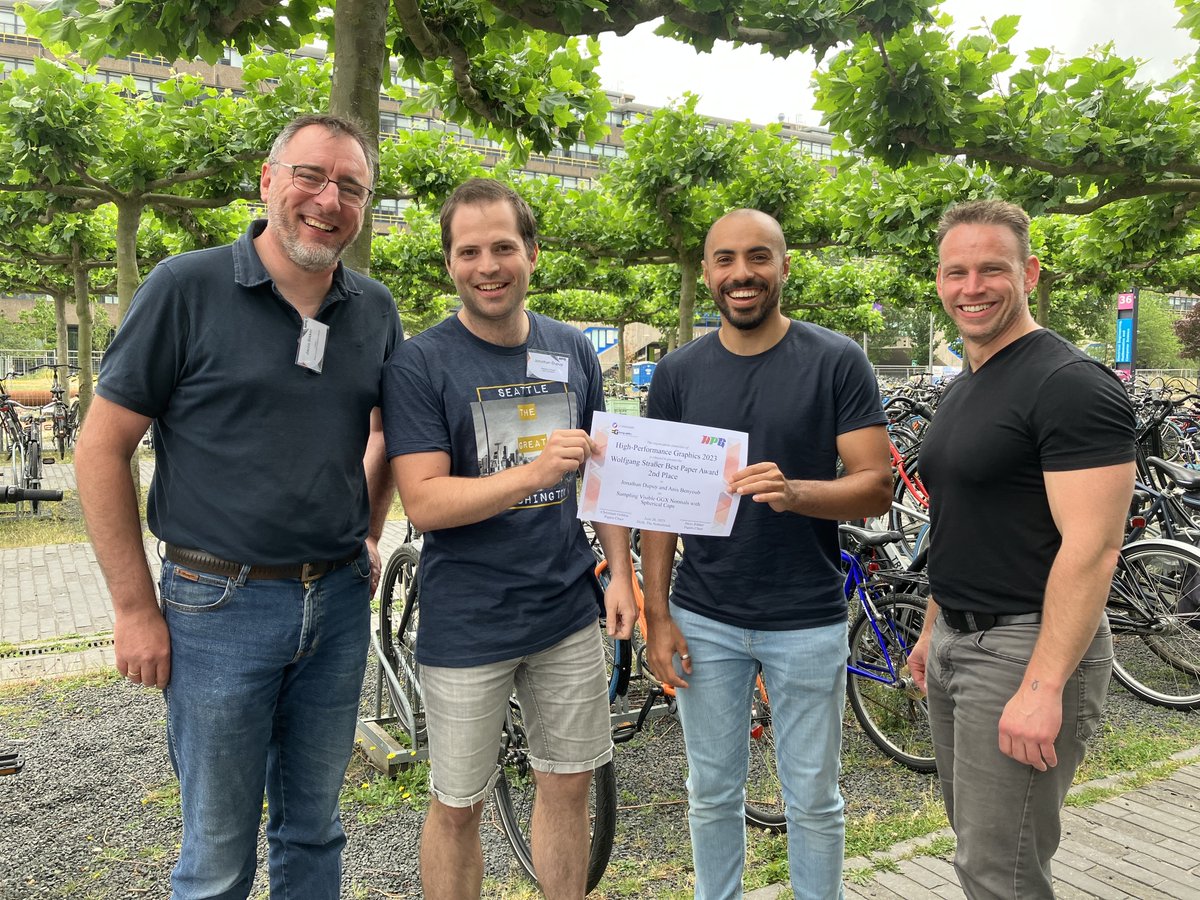
Really proud that our Grenoble Graphics team won the 1st and 2nd Best Paper Awards at @HPG_Conf 2023.
@thomasdeliot and @_Laurent won the 1st place with their real-time glints
Jonathan Dupuy and @Auzaiffe
won the 2nd place with their GGX VNDF sampling
https://t.co/4v5L9aZrqg
Intel Graphics Research is excited to share our contribution across SIGGRAPH, EGSR, HPG, and EG this summer. Low-energy path tracing, generative AI, neural graphics and more!
https://t.co/RMFbOrzXhK
Amazing work of our researchers and collaborators.
Pleased to announce our #HPG2023 paper w/@_Laurent on real-time glints:
https://t.co/EqHDwtDSaj
We improve the SOTA by introducing a correct blending operator and 1.5-5x performance improvement by natively handling anisotropic footprints at a fixed cost:
https://t.co/oOxbQE2Uqf
Did you know you could importance sample the GGX BRDF using spherical caps?
Our latest paper shows how and leads to an even simpler and faster algorithm than that of @eric_heitz.
Check it out online: https://t.co/iMqYXSyVbT
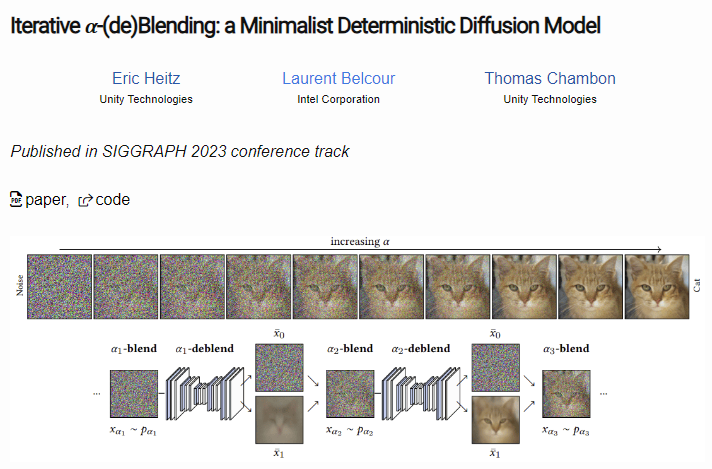
When @_Laurent and I started learning about diffusion models, we were puzzled by the amount of jargon and concepts.
So, we derived a model from scratch with our own graphics-people intuitions. Simple derivation, simple implementation, SOTA quality.
https://t.co/o9V6lbNl1o
I’m thrilled to welcome a new team in Grenoble to Intel GPU Research. These world-class researchers and engineers will help moving the needle in graphics ecosystem across games, provis, and AI https://t.co/ixRPLSHCAw
I am delighted to announce that Ray Tracing Gems II is available *now* and is *free* to download! 7 sections. 50 chapters. 90 authors from across the globe.
Download #RTGII here: https://t.co/XXdGCM85PE