Genesis World 1.0 is out!
About 10 months ago I joined Genesis AI and have since been leading the rendering team, building Nyx, a renderer purpose-built for robotics.
Watch the video. Real or sim? When does it transition?
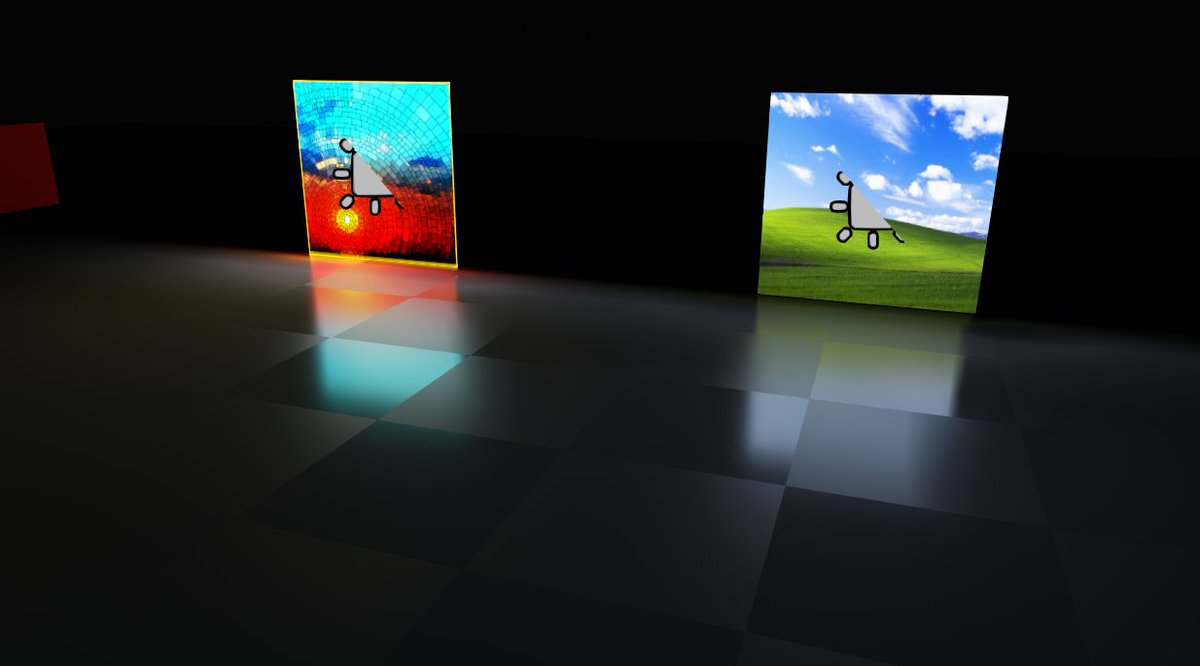
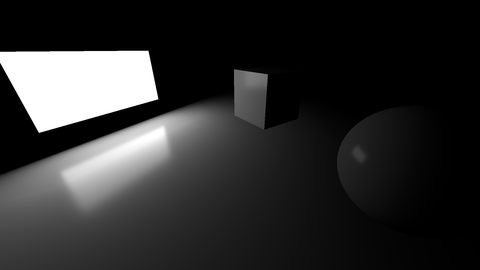
So... Textured Area Lights are ready to be reviewed - I hope they can make it into #Godot 4.7 🙈
I was able to integrate @eric_heitz's area light texture sampling into the forward renderer, lightmaps volumetric fog, and voxelGI.
#ScreenshotSaturday#GodotEngine#GameDev
@_cookieBadger For diffuse it should be the same except that you will fetch higher mipmap levels and everything will blur out.
If this configuration is diffuse and your are just missing the blurring, perhaps the vector is already correct!
Consider also coding a MC reference for debugging!
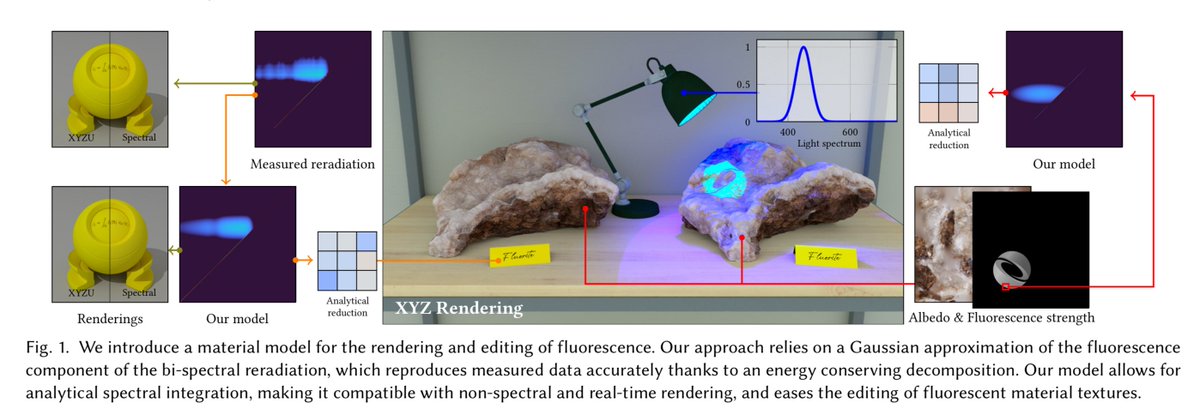
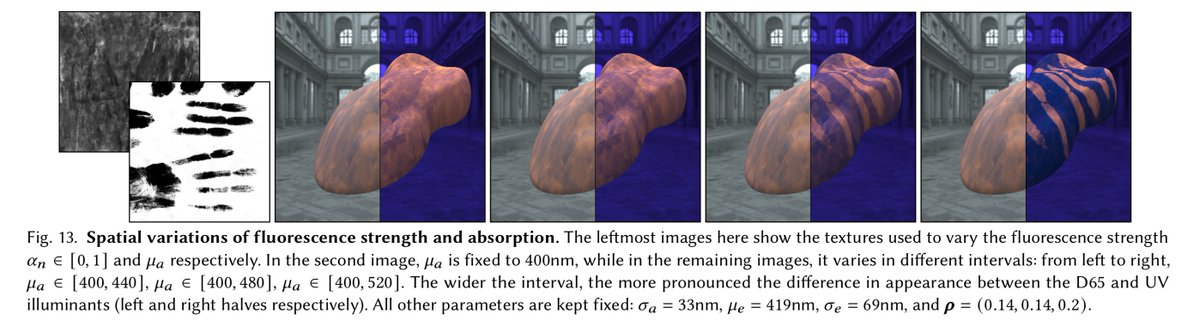
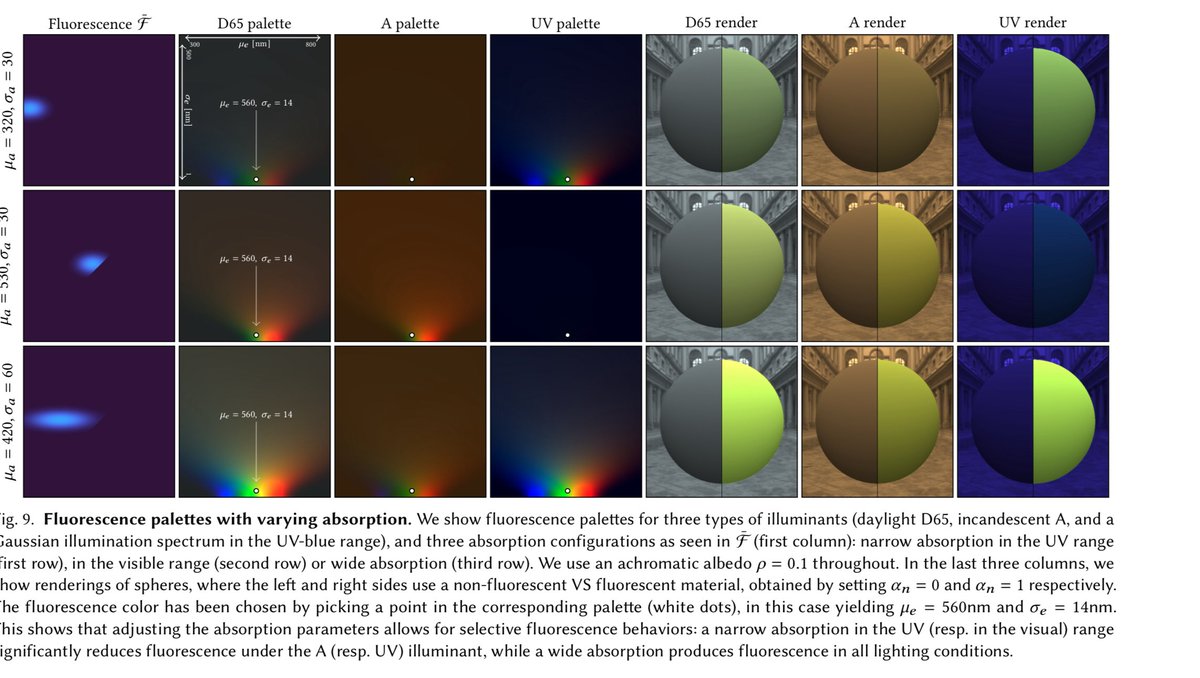
A Fluorescent Material Model for Non-Spectral Editing & Rendering
Belcour Laurent @_Laurent , Fichet Alban, Barla Pascal
(Intel Corp. France, Inria Bordeaux)
https://t.co/kOGBX8QDeZ
Abstract:
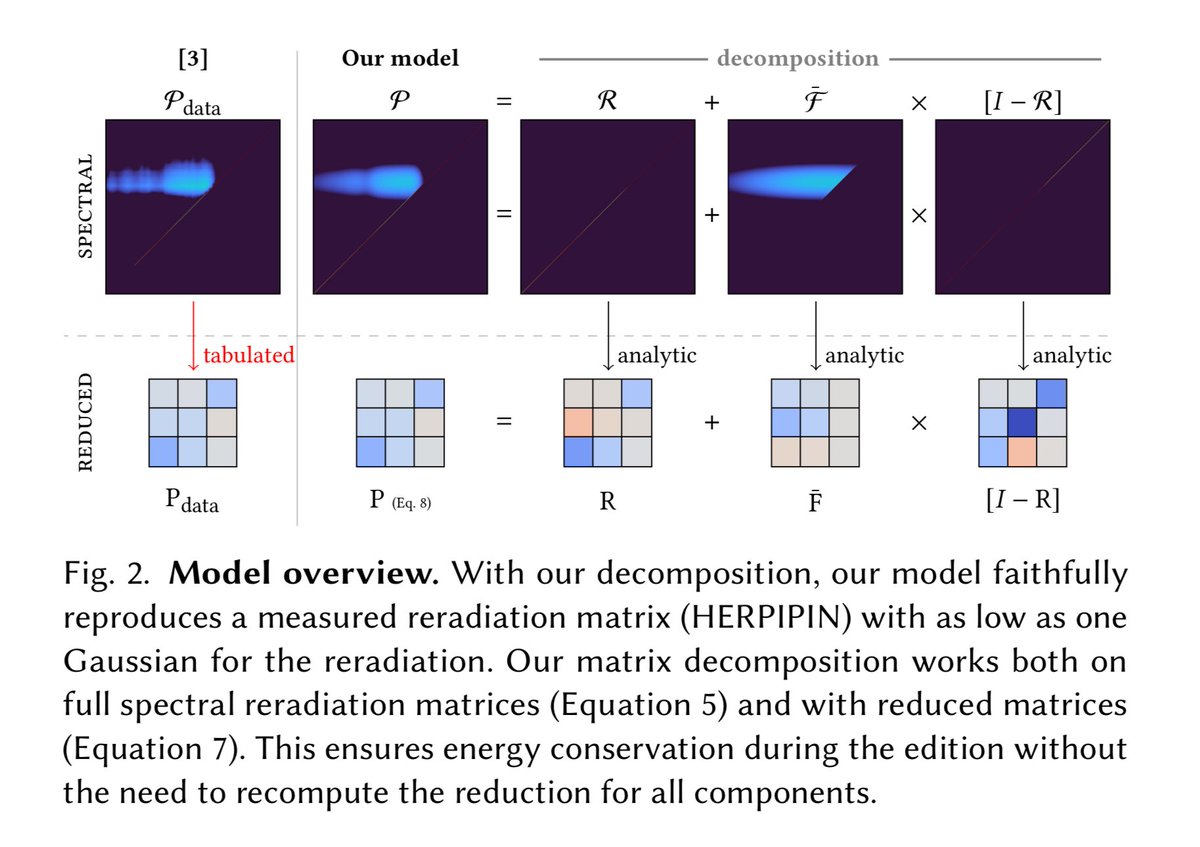
Fluorescent materials are characterized by a spectral reradiation toward longer wavelengths. Recent work [Fichet et al. 2024] has shown that the rendering of fluorescence in a non-spectral engine is possible through the use of appropriate reduced reradiation matrices. But the approach has limited expressivity, as it requires the storage of one reduced matrix per fluorescent material, and only works with measured fluorescent assets.
In this work, we introduce an analytical approach to the editing and rendering of fluorescence in a non-spectral engine. It is based on a decomposition of the reduced reradiation matrix, and an analytically-integrable Gaussian-based model of the fluorescent component. The model reproduces the appearance of fluorescent materials accurately, especially with the addition of a UV basis. Most importantly, it grants variations of fluorescent material parameters in real-time, either for the editing of fluorescent materials, or for the dynamic spatial variation of fluorescence properties across object surfaces. A simplified one-Gaussian fluorescence model even allows for the artist-friendly creation of plausible fluorescent materials from scratch, requiring only a few reflectance colors as input.
Happy to share that our paper with @_Laurent, "Hardware Accelerated Neural Block Texture Compression with Cooperative Vectors," was accepted at HPG'25!
We dive deeper into the complete subject. I'll be presenting it later this month, see you there!
🔗 https://t.co/gfjEz6ASpN
Microsoft has officially launched the Coop Vectors extension for DX12, enabling the use of matrix mul engines across vendors in a convinient way.
This opens the door for a range of new rendering algorithms, making them more practical for game dev.
https://t.co/A3IYP7EC83
I presented at MSFT’s AGS a demo that used coop vectors for NTC in smth representative of a modern RP with real texture contraints: size, quality, compression, filtering, inference overhead in ms.
The talk will soon be in the GDC Vault, in the meantime:
https://t.co/lc5GqFnPJJ
If you happen to be at #GDC2025, I'll be giving a talk about Neural Texture Compression and Cooperative Vectors at Microsoft's Advanced Graphics Summit, feel free to attend!
https://t.co/subTehJL8J
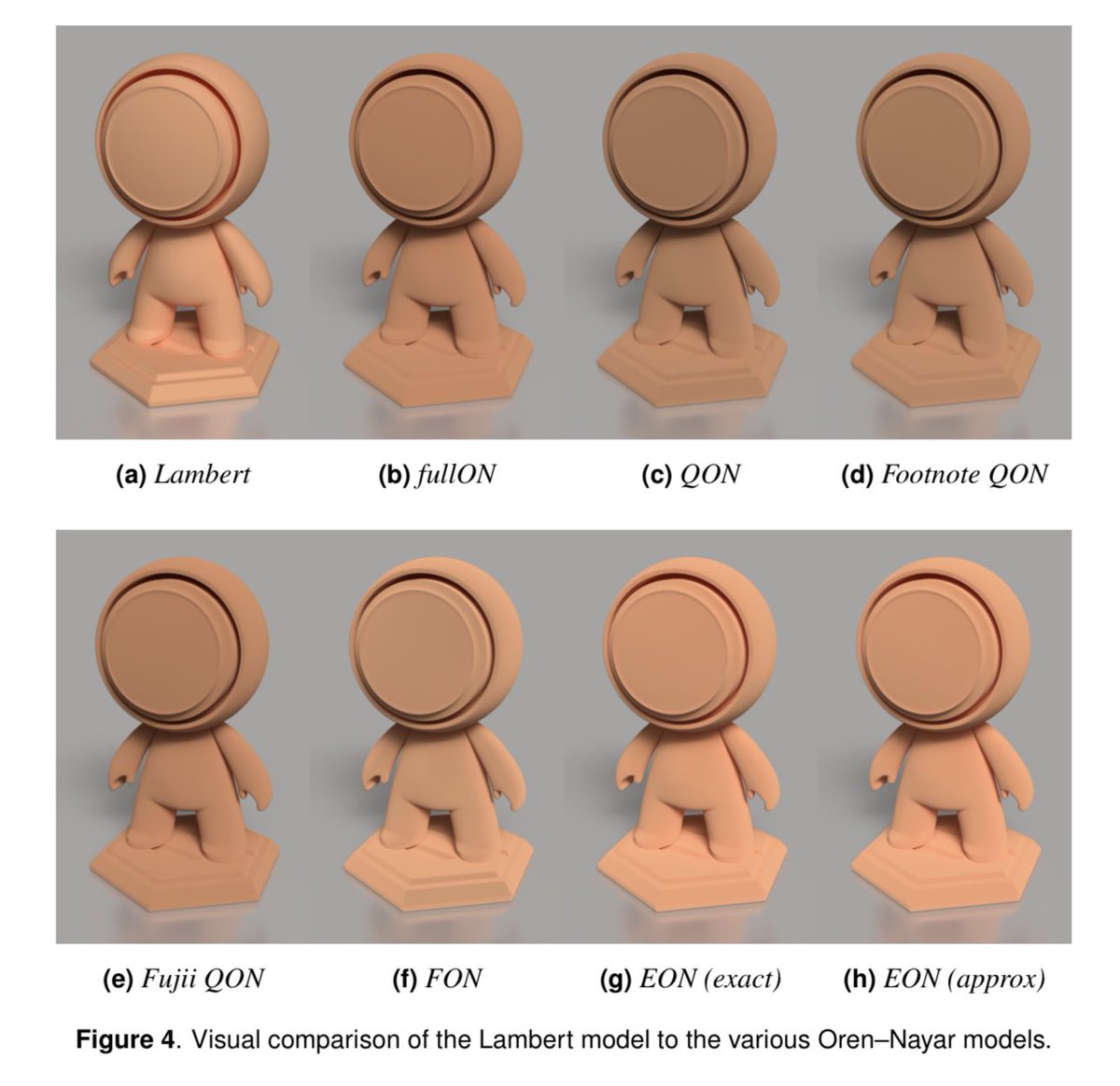
“EON: A practical energy-preserving rough diffuse BRDF”
Jamie Portsmouth, Peter Kutz, Stephen Hill
https://t.co/OZbIIjfLC9
(GLSL code in paper)
Abstract:
We introduce the "Energy-preserving Oren--Nayar" (EON) model for reflection from rough surfaces. Unlike the popular qualitative Oren--Nayar model (QON) and its variants, our model is energy-preserving via analytical energy compensation. We include self-contained GLSL source code for efficient evaluation of the new model and importance sampling based on a novel technique we term "Clipped Linearly Transformed Cosine" (CLTC) sampling.
#rendering
I can't believe we're done!
Time Ghost
A short film we on the Demo Team have been working on for a while
https://t.co/ohRuz0TA5d
Like all our team’s demos, it runs in real-time at 30fps in Unity. Over the next days I’ll be posting rendering and tech art breakdowns in this 🧵
Looking for a fast method to render your large-scale game components?
Our lastest @HPG_Conf paper allows to render terrains, oceans and even entire planets in realtime on any modern GPU using compute shaders. Fun fact: we use a Concurrent Binary Tree as a GPU memory manager.
I'm excited to share our #SIGGRAPH2024 paper on unifying stochastic representations for light transport:
https://t.co/iWrnITCOoe
We show how to use stochastic implicit surfaces to describe microfacet surfaces and participating media (and a bunch of new things in between).
Time to share our #SIGGRAPH2024 paper "N-Dimensional Gaussians for Fitting of High Dimensional Functions"!
We show that N-Dimensional Gaussian mixtures can be optimized to handle high dimensional inputs like MLPs with a fraction of the training times.
https://t.co/4edn0ZFwPr
In our latest @I3DCONF paper, we transform any rasterizer into a differentiable one with minimal engineering and zero external dependencies.
Optimize game assets and volumes, train 3D Gaussian Splats, etc. directly within your existing engine. Compute shaders is all you need!
In our latest @I3DCONF paper, we transform any rasterizer into a differentiable one with minimal engineering and zero external dependencies.
Optimize game assets and volumes, train 3D Gaussian Splats, etc. directly within your existing engine. Compute shaders is all you need!