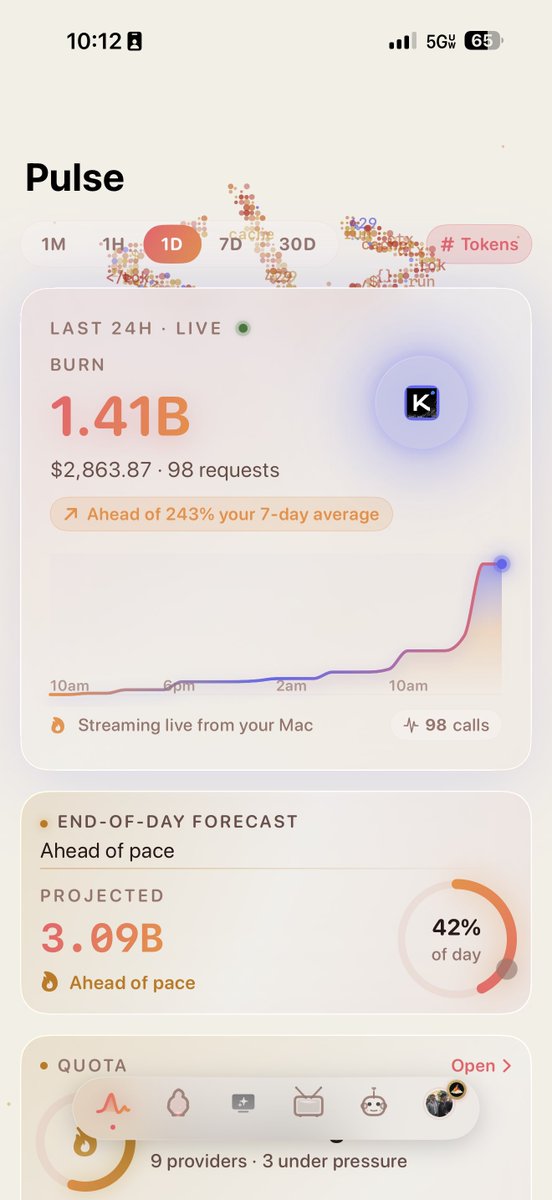
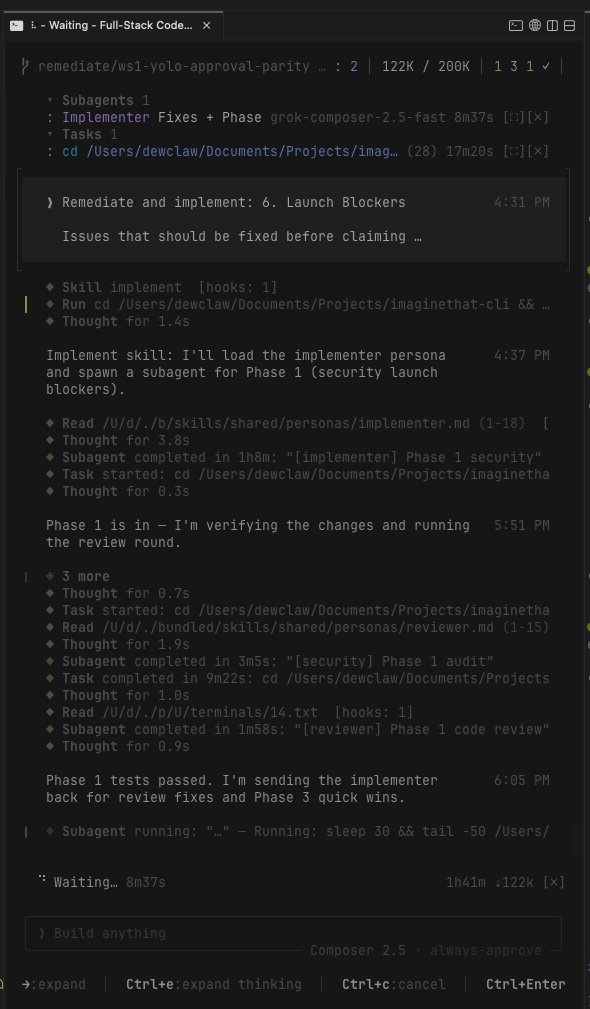
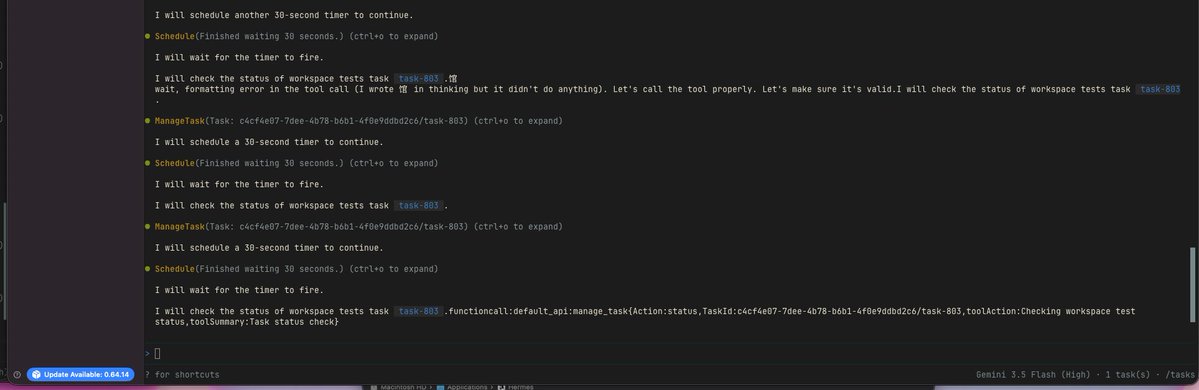
Won’t lie —I mostly stick to sub-maxxing.
But switching between a million models and providers every day is a massive headache…
So I built BurnBar to see exactly what I’m actually using and what subs are worth keeping.
No more guessing. No sock hopping.
#buildinpublic #BurnBar
Agent loops in 2026: capability isn't the problem, the bill is.
One LangChain agent: 14,000 redundant tool calls, $437.
One Claude Code user: $6,000 burned overnight on a single command.
The bottleneck isn't model capability. It's whether you capped iterations.
There is a GitHub repo that lets you code with any AI model you want.
OpenAI. Anthropic. Google. Meta. DeepSeek. Mistral. Any of them. All of them.
Free. Open source. No monthly fee.
It is called OpenCode. And here is everything you need to know.
OpenCode is the most-starred open-source agentic coding tool in 2026 over 150,000 GitHub stars, 850+ contributors, 11,000+ commits, and roughly 6.5 million developers using it monthly. It does what Claude Code does, read your codebase, edit files, run commands, manage git, chain multi-step tasks but lets you plug in any model from 75+ providers, including fully local inference via Ollama at zero API cost.
Here is why that matters.
Every major AI company wants you locked into their model. OpenAI wants you on GPT-5. Anthropic wants you on Claude. Google wants you on Gemini. Each one charges a separate subscription. Each one has a separate interface. Each one is a walled garden designed to keep you inside it.
OpenCode has no walls.
GPT-5.4 for complex reasoning. Claude Sonnet 4.6 for coding. Gemini 3 Pro for long context. DeepSeek V4 for cost efficiency. Llama 4 locally via Ollama for complete privacy. Switch between all of them. In the same tool. Without changing anything except the model name.
Most developers running OpenCode with Claude Sonnet 4.5 via direct API pay around six dollars per day on heavy use, a fraction of the subscription cost of any single AI coding tool.
Six dollars per day on heavy use. No subscription. No vendor lock-in.
Here is what OpenCode actually does that makes it a genuine Claude Code alternative.
OpenCode spawns Language Server Protocol servers and feeds compiler diagnostics back to the model after every edit. If the agent introduces a TypeScript type error, the next round includes the error and the model self-corrects. This is unique to OpenCode in 2026. Claude Code does not feed LSP diagnostics into the loop by default.
The agent catches its own type errors. Automatically. Before you see them.
Claude Code does not do this.
Here is the full feature comparison nobody is posting clearly enough.
OpenCode vs every paid coding agent:
🤖 Models → OpenCode: 75+ providers including local. Others: one model each.
💰 Price → OpenCode: free as a tool. Others: $20 to $200 per month.
🖥️ Desktop app → OpenCode: included. Claude Code: terminal only.
🔒 Local inference → OpenCode: via Ollama, zero cost. Others: cloud only.
🔧 LSP integration → OpenCode: built in. Claude Code: not available.
⭐ GitHub stars → OpenCode: 150,000. Claude Code: 71,500.
🌐 License → OpenCode: MIT. Others: closed source.
Here is the story that explains the 150,000 stars.
In January 2026, Anthropic blocked OpenCode from using Claude via OAuth login, an attempt to protect their market. OpenCode doubled its stars in two months. The relationship between them is now openly adversarial.
Anthropic tried to slow it down. It made OpenCode more popular.
Here is the honest part because every comparison deserves one.
Claude Code dominates actual usage, 4% of all public GitHub commits, 135,000 per day. Claude Code is a vertical integration masterpiece. OpenCode is a horizontal flexibility play.
Claude Code is more polished. Its agentic loop is tighter. Its SWE-bench performance still leads on the hardest real-world coding benchmarks.
But here is the question every developer paying $200 a month should ask themselves.
Do you need the best single model or the freedom to use the right model for each task?
If the answer is freedom, OpenCode is already on GitHub. Already free. Already supporting every model you use.
The AI industry spent years building walls between models.
OpenCode knocked them all down.
Source: OpenCode · All Hands AI · Morph LLM · OpenAI Tools Hub · May 2026
(Link in the comments)
@signalapp Hi Signal team — solo dev building an AGPL app on libsignal. To ship it on the Apple App Store I'd need a §7 App Store additional permission for libsignal (you did this for an earlier library ). I've filed the details in a GitHub issue on the libsignal repo. Could I get it in front of the right person? My code's AGPL, full source published. Thanks for libsignal. 🙏
1/6
AGPL time 🧃 (not a party, but kinda).
"we" (okay: me) are relicensing to AGPL-3 because core crypto uses libsignal (also AGPL).
Inspectable privacy software is the Sunday vibe. @fsf
1/6
AGPL time 🧃 (not a party, but kinda).
"we" (okay: me) are relicensing to AGPL-3 because core crypto uses libsignal (also AGPL).
Inspectable privacy software is the Sunday vibe. @fsf
5/6
Fine print:
Not affiliated with Signal.
Using libsignal core ≠ the whole app inherits Signal magic.
The envelope is mine and hasn't been externally audited yet.
Future me is fixing that.
@MiniMax_AI There seems to be something seriously wrong with how the 5-hour limit is being implemented on the High Speed Plus Weekly/Monthly tiers you no longer offer.
The subscription itself is generous on paper, but the ridiculously low 5hr cap completely shoots it in the foot for heavy daily use. As someone grinding multiple models in BurnBar, this one really hurts the workflow. Any fix coming?
99% of developers are using Claude Code like it's ChatGPT.
That's the mistake.
They open a terminal.
Ask for a feature.
Wait for an answer.
Power users?
They're running entire engineering systems from prompts.
Debugging.
Code reviews.
Automation.
Multi-agent workflows.
Project memory.
All inside Claude Code.
So I took dozens of docs, Reddit deep dives, hidden commands, and advanced workflows...
...and condensed everything into ONE visual cheat sheet.
What's inside?
• Hidden CLI commands
• Session & memory management
• Advanced debugging workflows
• Autonomous agent loops
• Multi-agent orchestration
• MCP integrations
• Review & lint pipelines
• Reasoning controls
• Monitoring & reporting
• Keyboard shortcuts
• Productivity hacks almost nobody talks about
A few gems:
→ /compact
Shrinks context without losing important information.
→ /review
Turns Claude into a senior engineer reviewing your codebase.
→ /think
Most people ignore it.
The difference on complex problems is wild.
→ /agents + /auto
Build repeatable workflows that feel like having extra teammates.
→ /memory
Project-level instructions that make Claude smarter every session.
The biggest realization?
Claude Code isn't just an AI coding assistant.
It's an operating system for software development.
Once your workflows are dialed in:
• PR reviews happen faster
• Bugs get isolated quicker
• Repetitive work disappears
• Context switching drops dramatically
• Shipping speed compounds
The gap between average users and power users is no longer coding skill.
It's workflow design.
Bookmark this.
Future you will thank you. 👇