Everybody wants to buy the dip until it’s time to buy the dip.
Your future self is counting on your current self to do the hard things today.
It’s either going to zero or going up forever. Act accordingly.
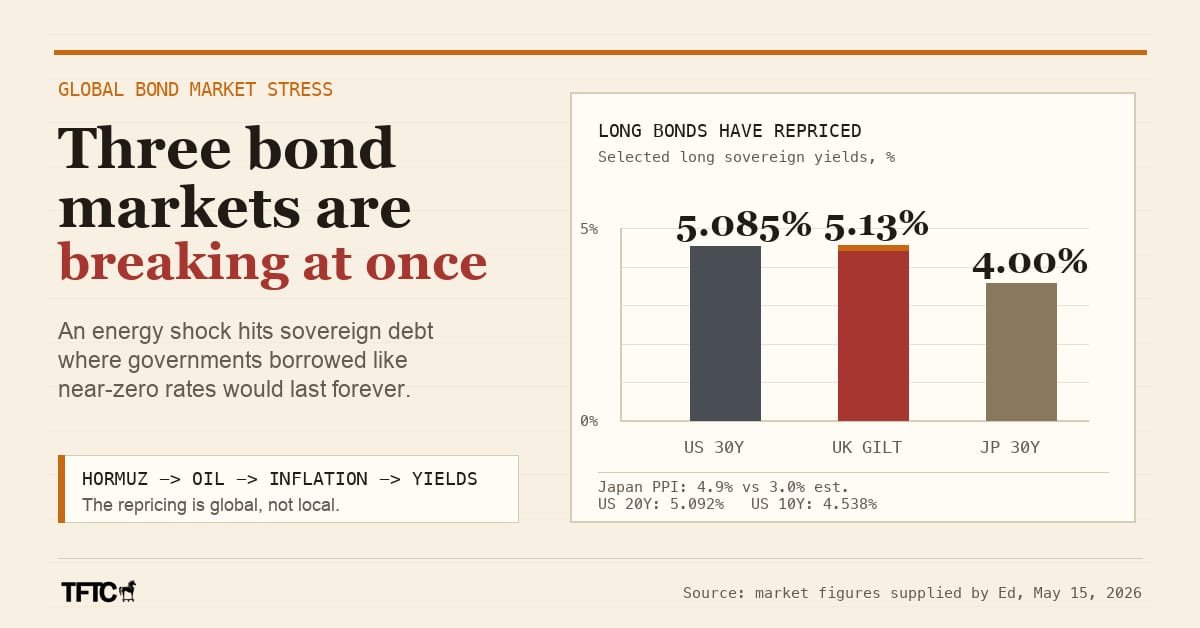
Three bond markets on three continents are breaking at the same time.
US: The 30-year yield is at 5.085%. The 20-year at 5.092%. The 10-year at 4.538%. Every maturity rising together. The government is running a $2 trillion annual deficit and borrowing more every day to fund a war.
UK: Gilt yields just hit 5.13%, the highest since 2008. A leadership challenge to the Prime Minister, combined with global inflation fears and the same energy shock, is crushing British sovereign debt.
Japan: Wholesale inflation came in at 4.9%, nearly double the 3.0% forecast. Naphtha up 79.4%. The 30-year JGB yield hit 4.00%, a record for a country that spent three decades in deflation. The Bank of Japan is under pressure to hike rates in June.
The common thread: the Strait of Hormuz closure is injecting an energy shock into every major economy simultaneously. Oil spikes, wholesale inflation follows, bond markets reprice, and governments that borrowed trillions at near-zero rates discover what 5% actually costs.
Stocks are at all-time highs because AI earnings are real. Bond yields are at multi-decade highs because sovereign debt loads are also real. Both cannot be right. And historically, it is not the bond market that is wrong.
"Professor, don't you find it curious that a new US-Iran peace deal leaks almost every time the 10y UST yield breaks 4.4% on the upside?"
"Actually, if I think about it, I don't find it curious at all."
There is literally not a single road blocked in Dubai, everyone is still on the beach and the streets are calm.
Then I come on X and it looks like Dubai is being hit with missiles.
Some of you really live in an alternate - manufactured - reality to keep you exactly where you are.
Are they going to start a war?
I don’t know.
But I do know with a high degree of conviction that wars are inflationary. History proves this.
Got sound money?
Most people think they understand how money works, but THEY DON'T!
I learned about 90% of what I know about money AFTER I started learning about Bitcoin.
If you can't answer the following questions, you won't understand Bitcoin:
- Why do all fiat currencies fail?
- Why did the Roman Empire fall?
- What is the Nixon Shock?
- Why is the US Dollar the world reserve currency?
- What is the difference between credit and debt?
- How does inflation work?
- What's the difference between CPI inflation and monetary inflation?
- Why was gold used as money for THOUSANDS of years?
- How is new money issued?
- What are the functions and ideal characteristics of money?
- What is fractional reserve banking?
The ONLY Bitcoin AND Gold/Silver investor I respect is @LawrenceLepard - message of holding both has stayed consistent.
Everyone else is a trans-Bitcoiner who spent years telling you that Bitcoin was the best and that "they understood".
Then as if by MAGIC discovered hidden long lost bags of Gold & Silver as the price started pumping after 20 years, proving themselves to be LIARS or DUMBASSES - no in-between.
If you think learning about money is difficult, consider the alternative:
At 70 years old, you're working 40+ hours a week, to pay for decisions you made in the past.
Instead, take the time to become financially literate. I almost guarantee that you won't regret it.
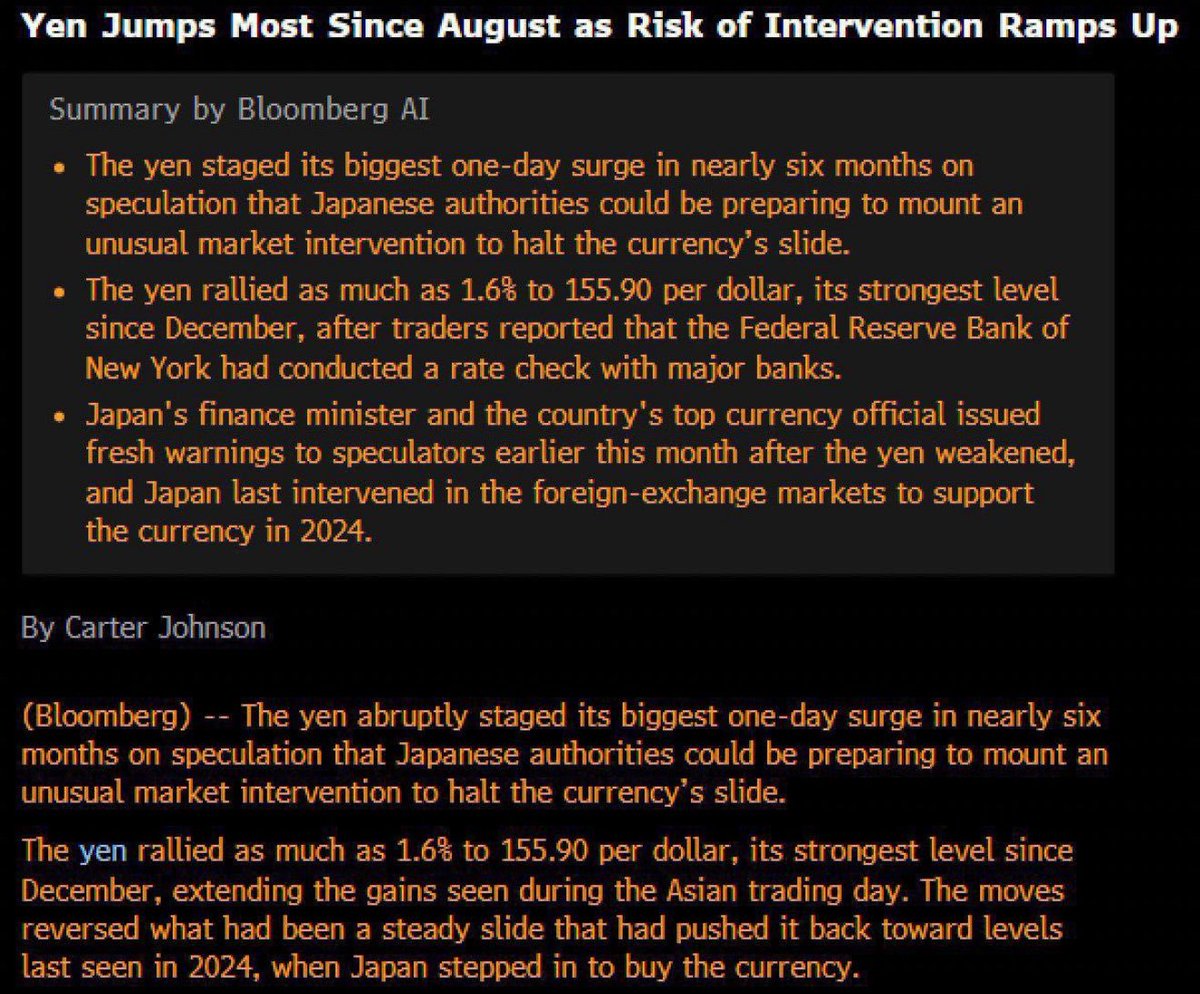
🇺🇸 THE FED IS PREPARING TO SELL U.S. DOLLARS AND BUY JAPANESE YEN FOR THE FIRST TIME THIS CENTURY.
The New York Fed has already done rate checks, which is the exact step taken before real currency intervention. That means the U.S. is preparing to sell dollars and buy yen.
This is rare. And historically, when this happens, global markets surge.
Japan is under heavy pressure. The yen has been weak for years, Japanese bond yields are at multi decade highs, and the Bank of Japan is still hawkish. Together, this creates stress not just for Japan, but for global markets. That is why central banks are now taking the situation seriously.
Japan has already tried to defend its currency many times on its own. But it failed in 2022 and 2024. Even the July 2024 intervention only worked for short time.
History is very clear on this: When Japan acts alone, it does not work. When the U.S. and Japan act together, it does.
We saw this in 1998 during the Asian Financial Crisis. Japan’s solo interventions failed, but when the U.S. joined, the yen stabilized. We saw it even more clearly in 1985 with the Plaza Accord, when coordinated action pushed the dollar down nearly 50% over two years.
That changed everything: The dollar weakened. Gold, Commodities, Non US markets all pumped.
If the Fed intervenes, this is how it'll play out :
- The Fed creates dollars, sells them, and uses those dollars to buy yen.
- That weakens the dollar and increases global liquidity.
- And whenever the dollar is intentionally weakened, asset prices usually surge.
Now look at crypto.
Bitcoin has one of the strongest inverse relationships with the dollar and one of the strongest positive relationships with the yen. Right now, BTC yen correlation is near record highs.
But there is a catch.
There is still hundreds of billions of dollars tied into the yen carry trade. People borrow cheap yen and invest in stocks and crypto. When the yen strengthens suddenly, they are forced to sell those assets to repay loans.
We saw this in August 2024: A small BOJ rate hike sent the yen higher. Bitcoin crashed from $64K to $49K in six days. Crypto lost $600B in value.
- So yen strength creates short term risk for crypto.
- But dollar weakness creates long term upside.
Now, why is this bullish for crypto ?
Because Bitcoin is still well below its 2025 peak. It is one of the few major assets that has not fully repriced for currency debasement.
If coordinated intervention actually happens and the dollar weakens, capital will look for assets that are still cheap relative to the macro shift. Historically, crypto benefits strongly from that environment.
This may become one of the most important macro setups of 2026.
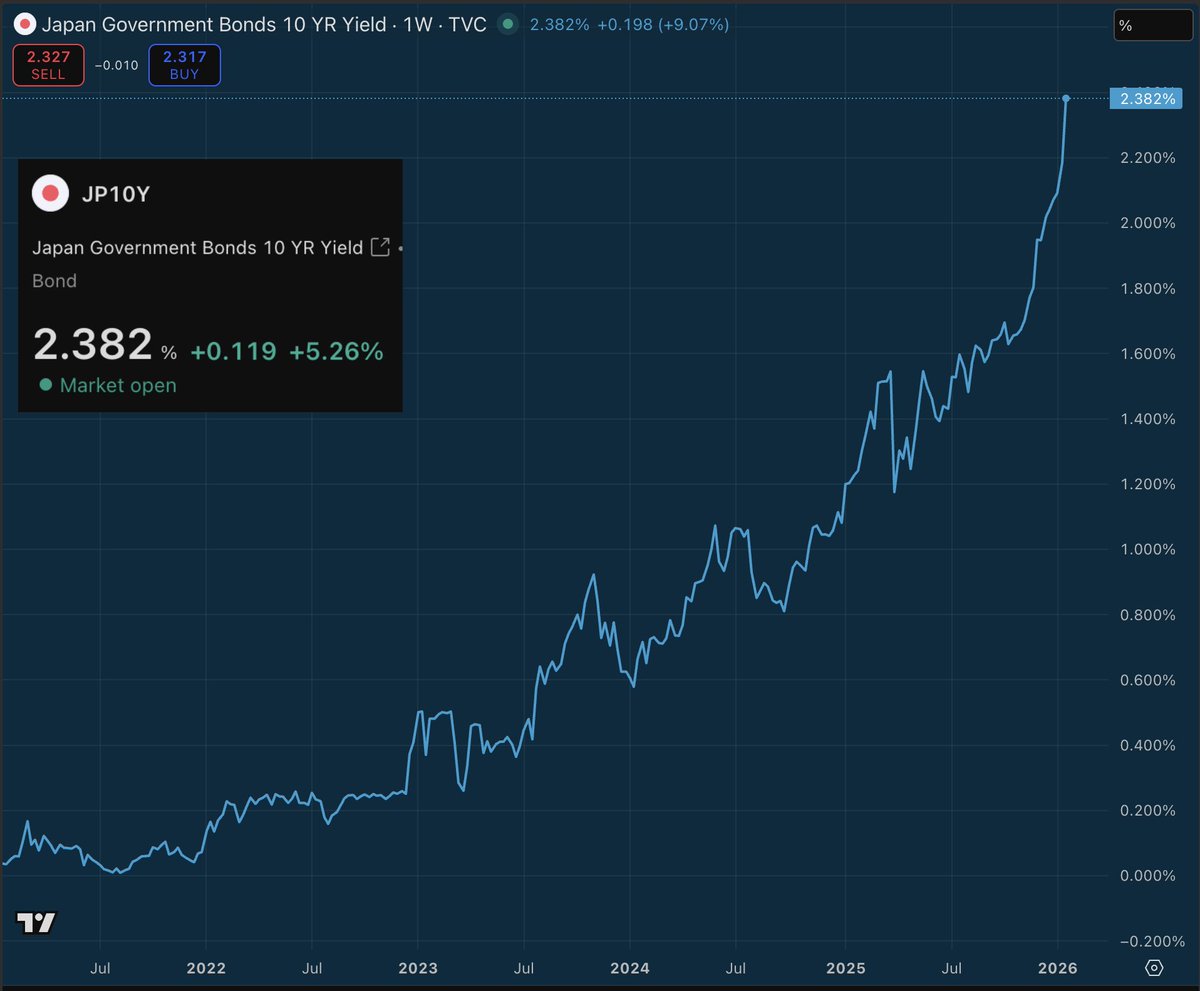
The Japanese bond market is completely unhinged
Global bond yields have been building a base at current levels since 2023.
For nearly 3 years people have been waiting for yields to fall...
"the Fed will start cutting"
"I'll refinance when rates fall"
"Trump and Bessent will lower yields"
But the US 10 year remains above 4%
What if instead of falling, yields start following Japan and break higher?
It's been clear for a while now that global sovereign debt is just a confidence game.
And confidence is failing.
Gold is telling you what's about to happen.
Anyway, konnichiwa
Most people reading this won't be able to buy 0.01 Bitcoin, not by choice, but because they won't be able to afford it.
Every 4 years, Bitcoin's price rises by orders of magnitude.
This is because every 4 years, the supply of new Bitcoin added to the economy decreases by 50% and more people figure out what it is so they buy as much as they can.
Today, 0.01 BTC ONLY costs ~$1,000 USD, because most people are ignoring it. Eventually, 0.01 BTC will cost $10,000+.
I think within 24 months, $STRC will be a 0 vol asset with a 10% yield - backed by the nuclear growth engine of Bitcoin - and wrapped by all the banks in the world as a savings account or "money market fund" and then finally it will come into it's own, you put $100 in, at any time you take $100 out. And you get $10 every year. Guaranteed.
Nvidia is valued at 51,245,901 BTC
Google is valued at 45,245,901 BTC
Apple is valued at 43,639,344 BTC
Microsoft is valued at 40,565,573 BTC
Amazon is valued at 30,106,557 BTC
In total, they are valued at 210,803,276 BTC
There are only 21,000,000 BTC in existence
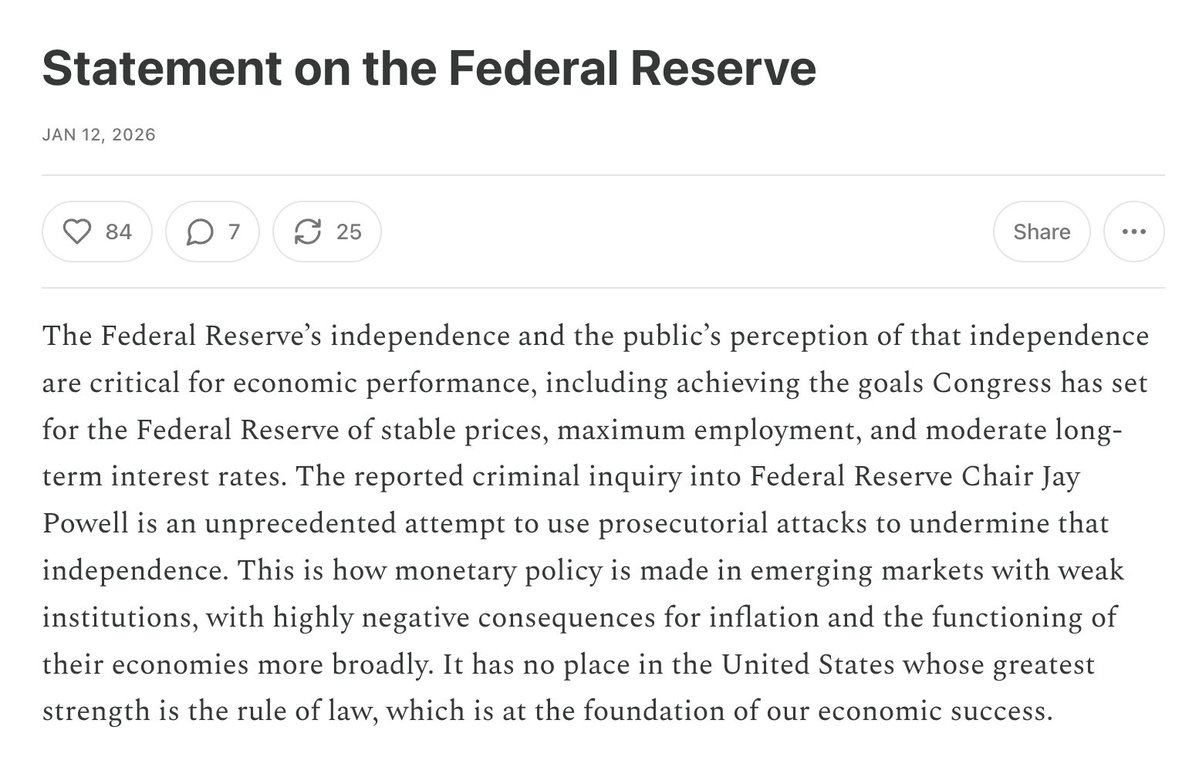
Former Fed Chairs and Treasury Secretaries are now warning us that the U.S. is “acting like an emerging market.”
The irony is thick.
The U.S. started acting like an emerging market under their direction and leadership when they debased the currency, monetized the debt, and backstopped insiders.
These are the same leaders who spent decades eroding the Fed's credibility by normalizing Fed intervention, turning monetary policy into a backstop for fiscal excess and financial markets.
They helped create an environment drowning in debt and moral hazard, and now that the politicization of the Fed becomes more overt, they’re suddenly worried about weak institutions and Fed independence?
I'm sorry but you don't get to destroy the Fed's credibility for 30+ years, then clutch your pearls when the consequences arrive.
I asked Grok to summarize the irony of these signatories lecturing us about Fed independence and inflation, and it delivered...
Alan Greenspan: The Maestro of Bubbles
Greenspan, the five-term Fed chair who spanned Reagan to Bush Jr., is the godfather of easy money.
He kept interest rates artificially low in the early 2000s, inflating the housing bubble that exploded into the 2008 financial crisis. His "Greenspan Put" essentially signaled to Wall Street that the Fed would always bail them out, encouraging reckless risk-taking.
This guy chaired the Council of Economic Advisers under Ford and basically wrote the playbook for moral hazard. Now he's signing a letter about "weak institutions" and "negative consequences for inflation"?
Bro, you created the inflation monster by flooding the system with cheap credit.
If the U.S. feels like an emerging market, it's because you treated it like one—printing to prop up cronies while savers got wrecked.
Ben Bernanke: QE King and Bailout Baron
Bernanke, two-term Fed chair and Bush's economic adviser, took Greenspan's mess and supersized it. Post-2008, he unleashed Quantitative Easing (QE), aka money printer go brrr, buying trillions in assets to bail out failing banks and prop up the stock market.
This wasn't "stabilizing" the economy; it was wealth transfer from Main Street to Wall Street, inflating asset bubbles while real wages stagnated.
Bernanke's actions politicized the Fed more than any "criminal inquiry" ever could, making it a tool for endless intervention. Now he's whining about undermining independence? You undermined it yourself, Ben—by turning the Fed into a central planner's wet dream.
Timothy Geithner and Henry Paulson: The Bailout Bros
Geithner (Obama's Treasury Secretary and NY Fed President) and Paulson (Bush's Treasury Secretary) were the dynamic duo of the 2008 bailouts.
They orchestrated TARP, funneling hundreds of billions to banks and institutions—often with no strings attached—while homeowners drowned in foreclosures.
Geithner famously argued for "foaming the runway" for banks, meaning soft landings for the elite at the expense of everyone else.
Paulson, a former Goldman CEO, basically used public funds to save his old buddies. These moves entrenched "too big to fail," making the financial system more fragile and dependent on government backstops.
Fast-forward to today: inflation from their era's policies has eroded savings, and the debt they piled on is why politicians are now meddling with the Fed. Hypocrisy level: expert.
Janet Yellen: From Fed Chair to Treasury Printer
Yellen's resume is a fiat hall of fame: Fed Chair under Obama/Trump (2014–2018), Treasury Secretary under Biden, and earlier roles under Clinton.
As Fed Chair, she inherited Bernanke's $4.5 trillion balance sheet monster from QE rounds and kept the printer humming—reinvesting maturing securities to maintain that bloated size for years, while holding rates near zero. The easy-money era she extended blew up asset bubbles, widened wealth gaps, and primed the pump for the 2020s inflation surge.
As Treasury head, she oversaw trillions in stimulus during COVID, much of it funded by Fed money creation. Remember when the Fed's balance sheet hit $9 trillion? That's Yellen's world.
Her policies directly contributed to the "highly negative consequences for inflation" she now decries. And let's not forget her flip-flopping on inflation being "transitory"—a lie that cost everyday people dearly as prices soared. Irony level: nuclear.
Just today, Yellen went on CNBC blasting threats to Fed independence as "extremely chilling" and warning that pressuring the Fed to cut rates to manage federal debt payments is "the road to a banana republic."
Ma'am, they literally paved that road under your leadership and policies. As Fed Chair, you spent years normalizing a massive, interventionist balance sheet and near-zero rates that turned the Fed into Wall Street's perpetual backstop—eroding its credibility long before any political pressure became more obvious. Peak hypocrisy.
This year, I wish you less — less information, less food, less entertainment, less communication, less stimulation. You already have too much of all that, and it stands in the way of your serenity, health, sleep, and creativity. Merry Christmas! ☦️