Check this great piece about our work on #dolphins that forage with fishermen in Laguna, southern Brazil. Written by @erica_ten and online on @NatGeo!
Be sure to check the link! You can also watch some nice #drone footage of this amazing interaction!
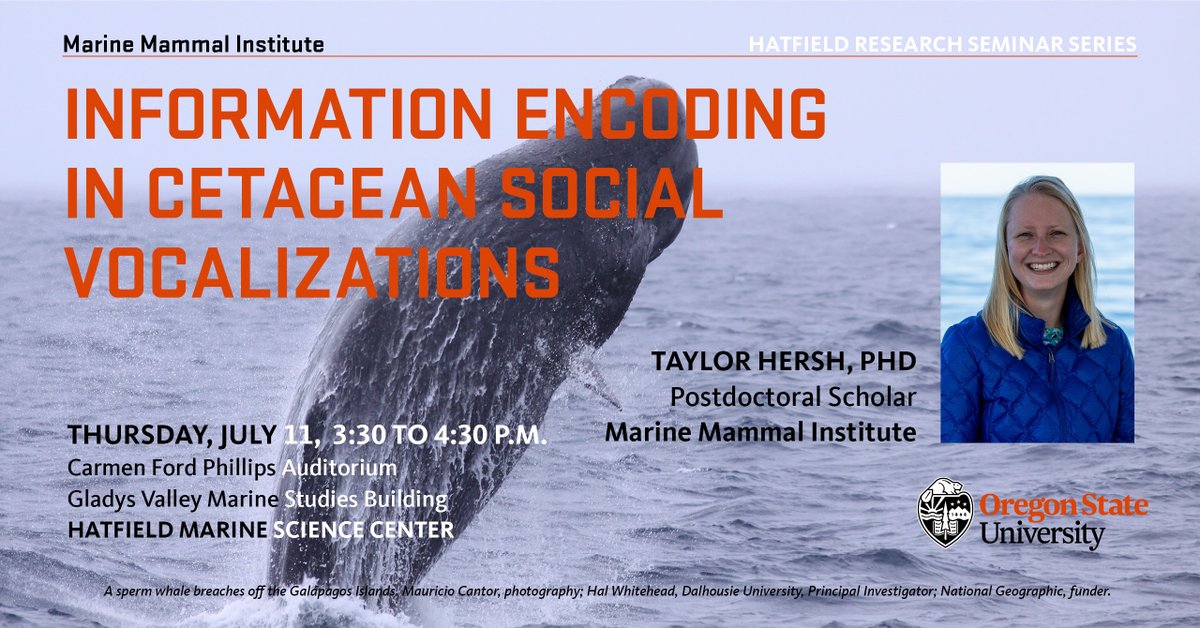
I'll be giving an @OregonState HMSC Research Seminar this Thursday from 15:30 to 16:30 PDT on information encoding in cetacean social vocalizations. It will be streamed via Zoom if you'd like to tune in! See https://t.co/ct0ODhKV5n for the link and more info.
🧶 Tradicional e reconhecida no Sul do Brasil e no mundo, parceria entre botos pescadores e homens na #pesca da tainha foi documentada de forma inédita pela ciência. Na UFSC, a equipe é liderada por Fábio Daura-Jorge (Departamento de Ecologia e Zoologia):
https://t.co/fVNUQ8XLu1
A century-old cultural practice of artisanal fishers who forage cooperatively with wild dolphins in a mutually beneficial foraging partnership has implications for the sustainability of global ecosystems. In NBC News: https://t.co/BjZMfgmNhB In PNAS: https://t.co/iwvexjPywh
Wild bottlenose #dolphins and fishers have been hunting together for over a century in Laguna, #Brazil: a #cooperation from which both benefit, but which is threatened https://t.co/1gD0NOUeT2 @MPI_animalbehav @DamienFarine
I wrote a small article for @ccmagazineindia on the back of our recent collaborative paper on safeguarding rare cases of human-wildlife cooperation. Read it here: https://t.co/MBKAehsOU1
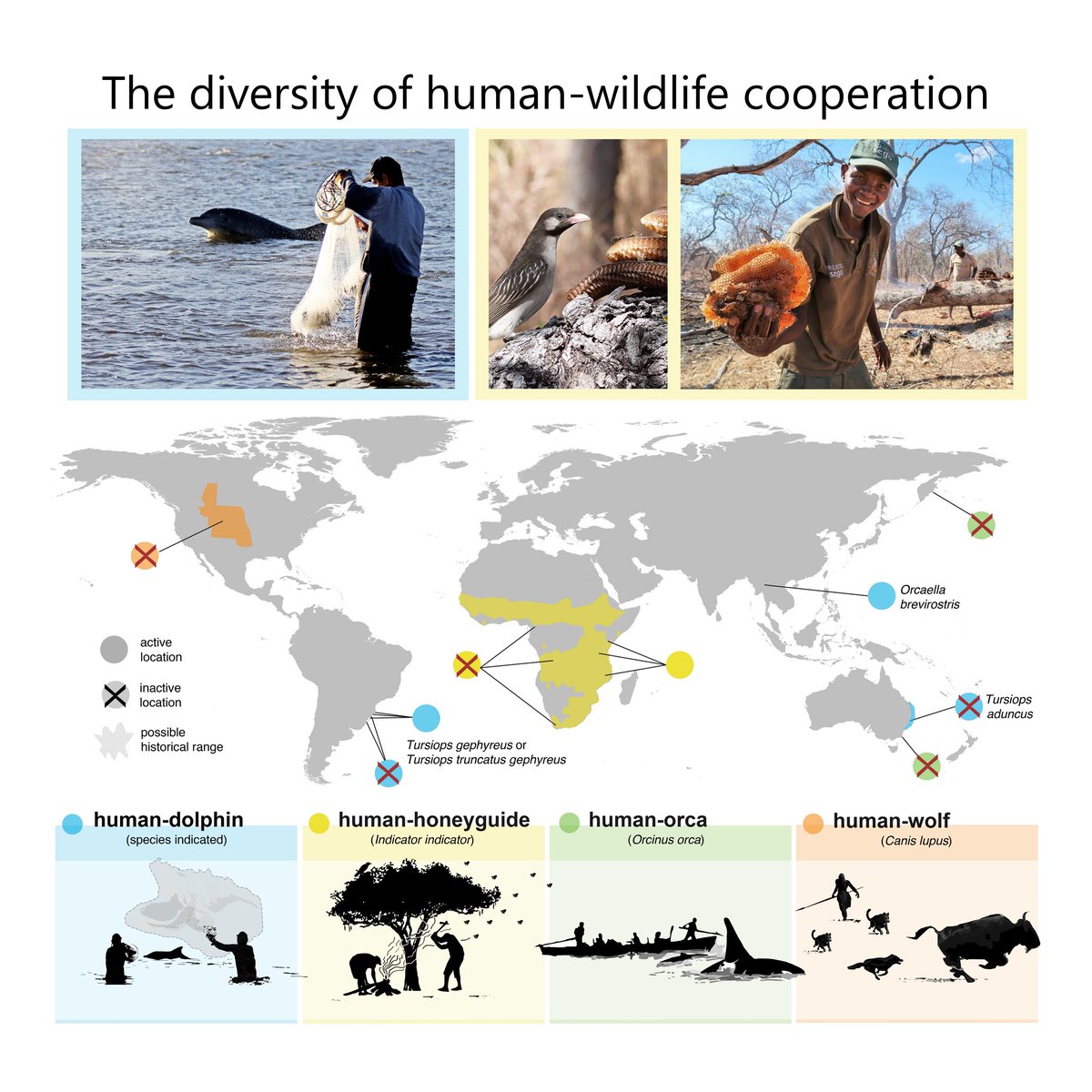
New paper! In some places, people cooperate with wild animals, without training, domestication, or captivity. Our #OA review paper published in People & Nature @PaN_BES delves into these remarkable partnerships. https://t.co/iMHxnUTqc1 (1/15)
New paper on safeguarding human-wildlife cooperation @ConLetters! In a team of 43 scientists, conservationists & human-wildlife cooperation practitioners, we review the benefits, threats & safeguarding considerations of human-wildlife cooperation: https://t.co/pYrd6GeIkj
OUT NOW: We review the within- and between-generation determinants of social dominance, describing how dominance and its determinants are part of multiple, intertwined feedback loops! 1/7
(work done with @JoshJArbon, @DamienFarine and @NeeltjeBoogert)
https://t.co/49q3v2dJWt
I’d like to share our recent article, published by @RSocPublishing: doi/10.1098/rsos.201598
Our work shows that frequencies of 24 and 48 kHz can record the echolocation of bottlenose dolphins. Then, it is possible to use these frequencies in ecological studies about this dolphin
Ah! It's really real! The first paper from my PhD, is officially published online in #EcologyLetters!
We show that #VulturineGuineafowl exhibit distinct movement behaviors when dispersing, allowing them to cover huge distances efficiently.
Check it out: https://t.co/QdK4f9vwxd
Check our recent paper in @ICES_ASC Journal of Marine Science.
We show alternative data sources can fill the gaps in data-poor #fisheries.
https://t.co/DcE53fi9Ku
#marinemammalsfacts
Baleen whales produce low-frequency sounds, which can cross oceans. They use these sounds to communicate themself. But, the other whales need to understand the sound, isn't it? That can be a problem for the “lonely” whale… 1/3