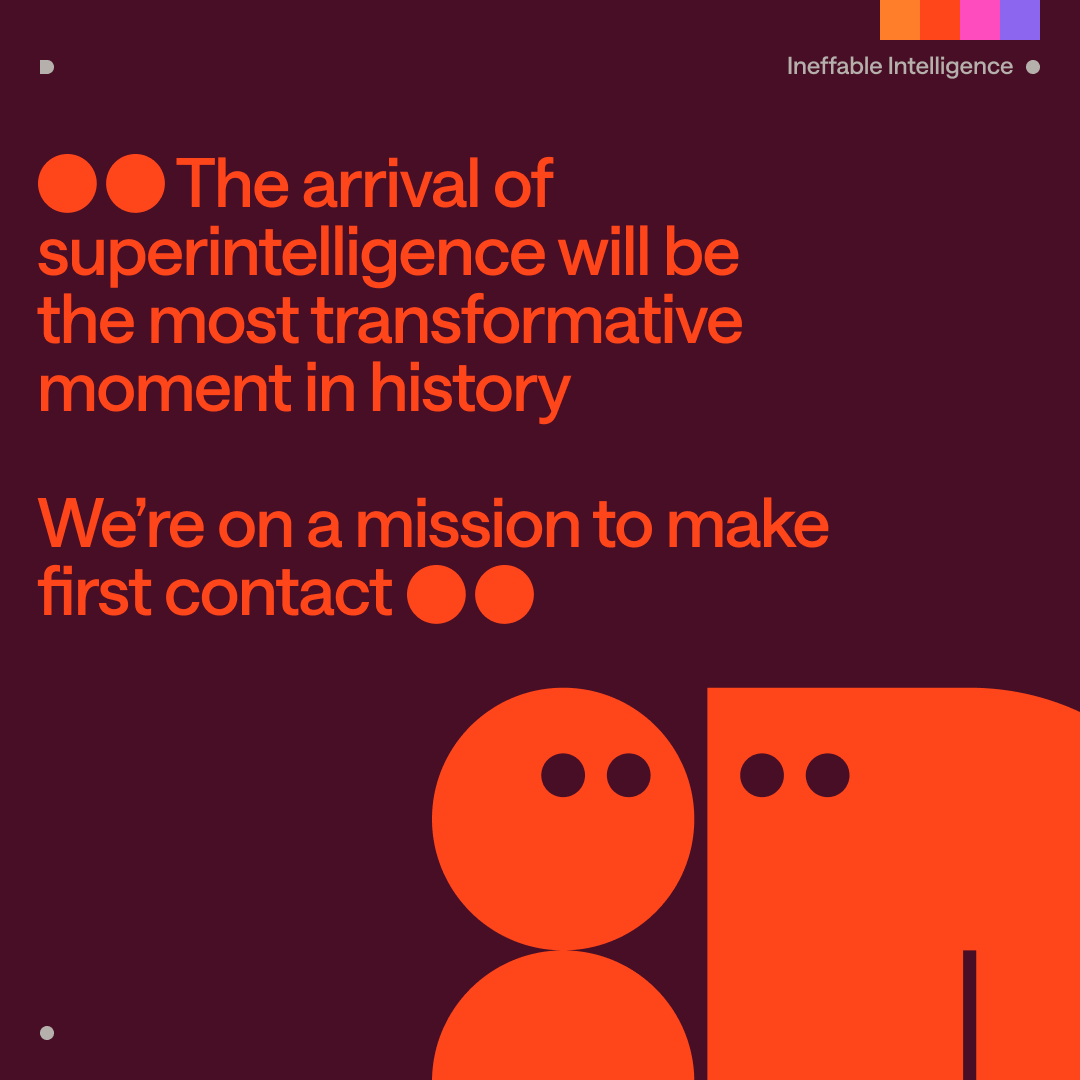
We are launching Ineffable Intelligence with David Silver and my exceptional co-founders!
We’re building a system that can discover all knowledge from its own experience, from elementary motor skills to profound intellectual breakthroughs. We expect it to rediscover, and ultimately transcend, humanity’s greatest inventions: language, science, mathematics, and technology.
We believe this can be built within years.
There is a real risk of failure, in pursuit of a small chance of extraordinary success that could change the course of AI, and with it, humanity.
If this resonates with you, join us. We’re building a world-class team in London.
https://t.co/rcjZtYNBCs
Introducing Ineffable Intelligence. Led by David Silver, we're assembling the best engineers and researchers in the world to make first contact with superintelligence. We’ll be solving the hardest problems in AI on the way. Come join us.
https://t.co/zUuvPJGmcq
how much can models remember?
there’s a neat perspective on neural networks that deserves to be more widely known
here’s how you could have invented every layer of the transformer from memory
(1/n) from my new blog post!
David Silver is one of the all-time greats. He was the creator of AlphaGo, which changed the course of history by showing that neural nets could achieve superhuman performance for the first time.
He also has a unique intuition and knack for forecasting when things will happen in AI. With computer Go, he predicted the Lee Sodol outcome 10 years before, right to the year. He got the year right for Starcraft and won a bet inside Deepmind. Same for AlphaProof. Same for the IMO.
David's prediction for superintelligence: 3 years. !!! He has a strong sense that now is the time to build a superleaner, and that superlearners are now possible, thanks to the enormous progress in compute, simulators, autoresearch, and the sophistication of technology in the stack since the AlphaGo days.
What is a “super learner”? A super learner discovers all knowledge from its own experience. Start from nothing (no internet pre-training), and go beyond human knowledge. Drop it into any stream of experience, simulated or physical, and the superlearner learns.
He expects the progress will be rapid. When you get the recipe for a superlearner just right and remove humans from the development loop altogether, a superlearner can learn extremely quickly. Just look at AlphaGo. AlphaGo took two years to develop with humans in the loop. When David and his team at @GoogleDeepMind got the formula for AlphaZero correctly, it surpassed the human-developed algorithms in just a few hours. Human data is a shortcut, but you have to let go of the human data to shoot beyond it.
In January, David left GDM to found @IneffableLabs, a research-led lab with one mission: build a "super learner" that discovers all knowledge from its own experience, and make first contact with superintelligence.
He joins us with co-founder Lasse Espeholt, who built IMPALA and SEED RL, the foundations of scaled-up RL, and now runs Ineffable's compute.
A few things we cover in this conversation.
— What a super learner is: depth (start from nothing, go beyond human knowledge) and breadth (drop it into any stream of experience, simulated or physical). The human brain is the only existence proof
— Why they're giving up human data: AlphaGo took two years with humans in the loop. AlphaZero outperformed it in a few hours. "You have to let go of the human data to shoot past the competition"
— Crucibles: simulated worlds with enough emergent complexity (physics engines, millions of interacting agents) for an agent to rediscover technology, science, maths and language on its own
— Simple rewards, emergent complexity: evolution optimized fitness and got all of life. Don't breadcrumb the objective, give the agent something simple to optimize in a world with a lot to learn about
— Go as the existence proof: one agent is the most boring game imaginable, two agents is "an infinite onion of layers of complexity"
— Why human language is probably not the endpoint for reasoning, and how training on it bakes in a flat earth and the four humors
— Can superintelligence be built in simulation? If the sim is Turing complete, computation, economics, language and maths are all expressible, and it happens 10-100x faster and safer
— Alignment: language-based monitoring is reaching its limits as agents learn to say one thing and do another. Shadow actions, superintelligences monitoring superintelligences, and building a real science of how they interact peacefully
— Accelerate in simulation, pace in the real world: Ineffable will gate real-world deployment on evidence that it goes well
— Timing as the determinant: Silver called Computer Go to the year, then StarCraft, then the IMO. He thinks this is the moment
— Predictions: True superintelligence within three years.
Timestamps:
0:00 – Introduction
1:09 – What held true from Go to today, and what the LLM era changed
3:35 – Why leave DeepMind to start a new lab
5:58 – Why "Ineffable" (and the secret second reason)
7:03 – Lasse's path: scaling RL at DeepMind and Google Brain
9:31 – Defining a super learner and first contact
12:35 – Super learners vs. LLMs that make discoveries
13:59 – Day to day: the RL stack, crucibles and human-journey milestones
16:13 – Don't breadcrumb the objective: simple rewards, emergent complexity
21:16 – What a crucible looks like
24:14 – Go: one agent is boring, two is infinite
25:41 – Will agents rediscover language?
27:22 – Removing human priors: AlphaGo to AlphaZero
32:05 – Keeping human bias out of the crucibles
33:35 – Confidence, timing and super forecasting
36:24 – Is compute the driver?
38:13 – The ceiling on simulation and Rich Sutton's objection
43:44 – Alignment and the science of superintelligence
47:45 – Monitoring agents that don't think in English
51:01 – Pacing the frontier
52:54 – The compute setup: Vera Rubin on GCP
55:18 – Training, inference, simulation and RL scaling laws
57:40 – IMPALA and SEED RL
1:00:58 – 20 people and the compute-per-person ratio
1:04:49 – A research-led culture
1:05:47 – Predictions
Great piece by my partner Konstantine, on how AI is a cognition revolution and how it compares to what we saw with the industrial revolution.
"Over the course of about two centuries, physical work went from 99% biological to 99.9% machine. [...] A century ago, 99% of cognitive work was done by humans. In the near future, 99.9% will be done by machines.
What stays economically human the longest is what was never really cognition to begin with: wanting things, choosing between them, being accountable for the choice, and being trusted by other people."
Scaling RL is hard. Keeping thousands of actors / learners fed without the hardware fighting you means solving challenges across interconnect, latency, and kernel efficiency.
We are working with NVIDIA to unlock the next scaling paradigm on their latest Vera Rubin platform!
We're working with @IneffableLabs to co-design the infrastructure for large-scale, reinforcement-learning agents and accelerate discovery across science and industry.
Our engineers have teamed up to explore how to create the training pipeline that will allow agents to discover breakthroughs across all fields of knowledge.
Learn more: https://t.co/ergHdOIAZF
We're hiring exceptional DevOps Engineers to join @ineffablelabs in London.
If you've battled with K8s at scale (1000+ GPUs, hardware failures, autoscaling, storage, scheduler) come build the infrastructure Superintelligence will run on. https://t.co/YcqTYWASpR
Our new episode of Let’s Talk Research is live 🎙️
Alex Graves unpacks our approach to Generative AI for Biology, driving our progress in proteomics and antibody design with ProtBFN and AbBFN2 🦙
Coming up next: Atomistic Modelling...
We’re back with the BFN story in Episode 2 of the Let’s Talk Research podcast.
Hear Alex Graves dive into real-world applications of Bayesian Flow Networks, including their use in protein sequencing and antibody design. 🧵⬇️
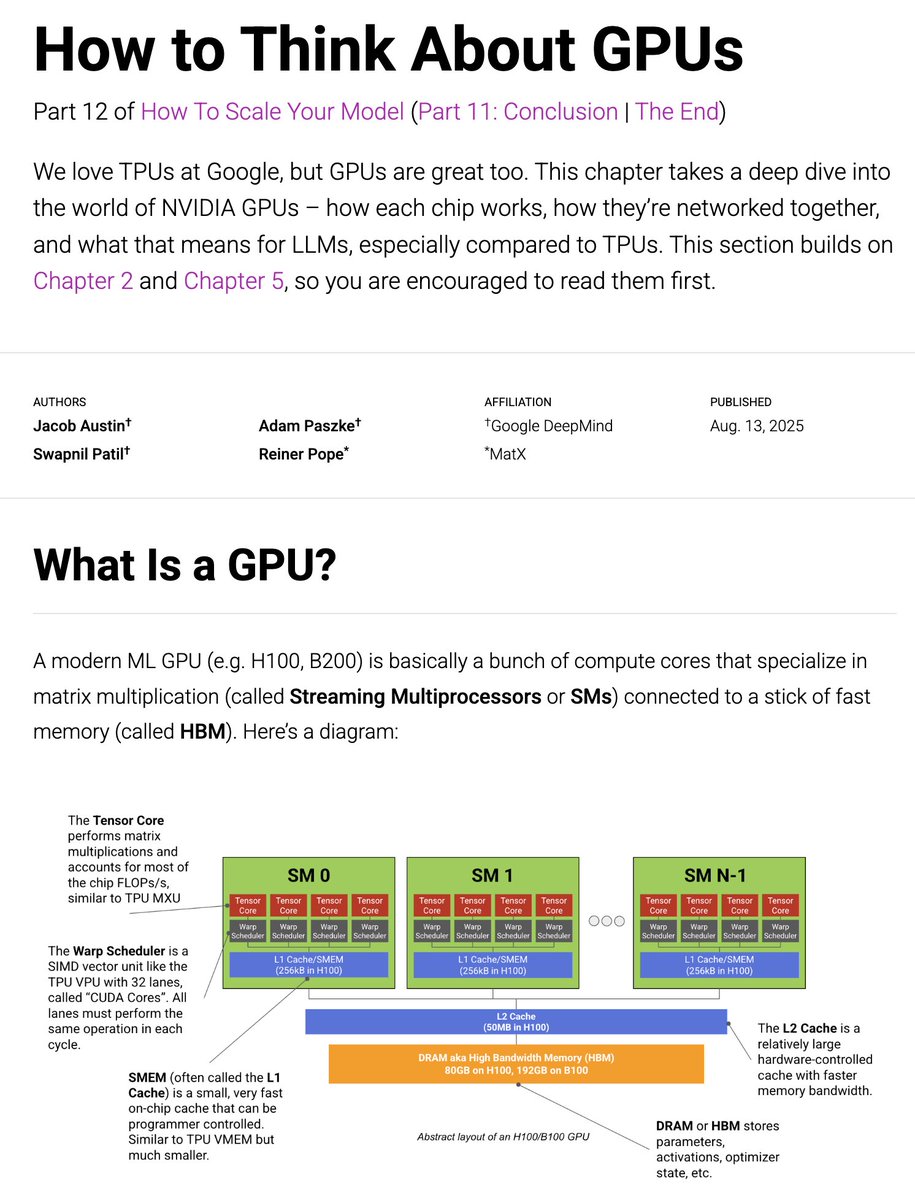
TPUs are fantastic, but most everyday workflows still run on GPUs. Great to see the scaling book broadening its scope; a must-read for our performance engineers!
Today we're putting out an update to the JAX TPU book, this time on GPUs. How do GPUs work, especially compared to TPUs? How are they networked? And how does this affect LLM training? 1/n
📆 Six months, four publications, one cover.
We’re halfway through the year and InstaDeep research is powering ahead with multiple boundary-pushing papers published in the @NaturePortfolio!
Catch up on the highlights below 🔽
We made the cover of @NatMachIntell! 🌱
ChatNT is a Conversational Agent analysing genomics sequences to answer key biological questions, assisting scientists in their work 👩🔬
Kudos to @deAlmeida_BP, @thomas_pierrot & the @instadeepai research team for this huge milestone!✨
Next Tues (6/17) at 4PM ET, we will have
Bora Guloglu and @tomdbarrett present "Flexible Antibody Design with Multimodal Bayesian Flow Networks"
Paper: https://t.co/pX5e4hIxwb
This will be followed by @BrianHie, who will give an early-career talk on Wed (6/18) at 4PM ET!