Interesting thought: in 2026, you need to be a director as much as a coder. Knowing motion styles, camera moves, and VFX is becoming as important as writing code. Algorithms took over marketing; real marketing is now content ideation.
@GarchFather , @idemishev right?
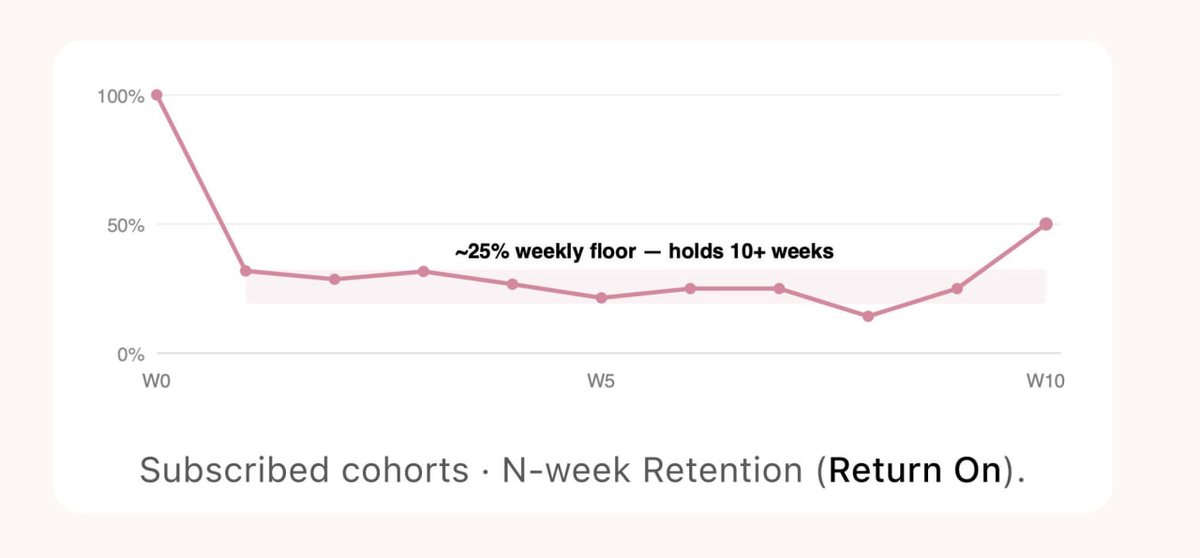
Healz(dot)ai beats any other health app on every metric. People use it daily, weekly, monthly.
So far Health co-pilot helped cancel several wrong misdiagnosis (labels that could change people lives forever), battle lyme, cancers during journeys and conceive babies 👩🍼
Building Healz - ask AI questions and, when needed, get answers verified in minutes by licensed doctors, all without a single telemedicine call.
Advisors: McKinsey, Citadel, ex-Revolut.
We use Cursor.
Would be happy to chat on angel investment.
Special link for all Cursor family to try firsthand: https://t.co/sKOwLwH03O
Pretty awesome to hear @bhorowitz and @andrewchen talking at @speedrun
I read Ben’s book, The hard thing about hard things several years before I founded @meetdexai with @harry_uglow.
It’s easily one of my favourite books, and one that took on even more significance once we founded Dex.
when consumers don't care that you're building an AI product (and might even hate it)
I'm hearing a common thread from consumer AI founders: Consumers often don't really care that your new startup product uses AI under the covers, and in fact, when they find out, they find it to be a negative.
WTF? I thought everyone was supposed to love AI.
It's simple: we've trained consumers for decades to believe that the fanciest, best customer interaction is a one-on-one human concierge doing whatever you want. Automation is seen as cutting corners. The most luxurious hotel/travel experiences involve overstaffed resorts where humans cater to your every whim. The highest level of customer service from a product company? The founder working directly with you to solve your problem. So, when consumers hear you're using product underneath, they're often repelled, associating it with low-cost, cheap service.
It's tough when you're in the business of using AI to disrupt a human-intensive industry. Think AI travel planning, dating concierge, or real estate brokers. The vision is clear: use AI to create more interactivity, answer questions quickly, and give great service. But many founders are finding that customers most value interacting with another human. How do you get around this? How do you solve the problem of building powerful AI that consumers seem to dislike?
In the end, whether your product uses AI or not, consumers just care about the results. That might mean your product is there for them 24/7, able to answer questions instead of interacting with a call center rep where it takes minutes to connect. Or maybe the detail that you're creating in your product might take a human hours, but your service can create it instantly. So maybe it's the speed, comprehensiveness, and instantaneous nature of it. Or maybe it's that the cost is incredibly low because you don't have to pay humans to do all this work. Either way, these things become the value props, not "AI." If your product uses AI, it's more of an enabling technology, something that sits underneath that ties all the capabilities together. But just as we stopped caring about megahertz, bandwidth speeds, etc, we'll stop caring about what underlying model is used. It's the question of whether the UX is better or not.
This conclusion feels obvious in some ways, but it also flies in the face of the current startup/investor mindset. Why is that?
The reason is that in the B2B market, startups are finding enterprise customers very excited and motivated to evaluate and buy AI products. That's because it's such a tech big technology trend that there is a top down drive towards utilizing AI to potentially decrease costs. As a result, everything in B2B is pulling new AI startups into their markets, and creating a ton of value along the way. However, consumers just interact with products differently. Caring less about the underlying functionality and technology trends and much more about things like brand, visual appeal, UX, and the evaluation process sometimes happens intuitively and quickly.
It's worth acknowledging that investors are pushing every new startup to bet big on AI. There are a lot of reasons for this, and some of it is circular. The good reason is that AI is a new general-purpose technology that might reinvent every product category and answer the "why now" question, so even apps that have been tried over the last 20 years can be retried with a different approach. Plus, if you don't at least pretend to have an AI strategy, some VCs simply aren't interested in even looking at the company. As a result, you have a whole generation of startups that want to yell loudly in their pitch decks about how AI-native they are, even while their consumer customers seem confused or dislike AI.
The consumer value prop for your startup can be totally different than how you talk about it with investors, employees, and partners. For consumers, the shortest path to conveying immediate value is the way to go. Describe your product with a pithy tagline so they know how they'll get value within 30 seconds.
However, investors and employees want to know how what you're doing will eventually revolutionize the world. Google might be a search engine, but its mission is to organize the world's information. An AI travel planning app might be positioned as "The quickest way to build a vacation itinerary for your family," but for investors, it's described as an "AI-native travel marketplace."
Nothing really prepared me for being a founder. Not even having done it before! But this spring Sequoia Arc helped me articulate the story of @xbow, and work through the key questions with like-minded experts and founders. It’s a game-changer! Join now:
With over $300bn in administrative spend across payors and providers in the US alone, mostly in repetitive, labor intensive processes; efficiencies and cost savings in Healthcare leads to better outcomes for patients and practitioners alike.
Read more below from @josephinekchen on some of the builders making a difference.
fun frequent convo I've been having with founders in the a16z speedrun program we're running in LA for the next 12-weeks:
the clarity of a startup's story means clarity in their strategy. The story is the strategy.
On the other hand, a confusing, rambling story means that your approach is likely complex, incoherent, and unattractive. If you've ever had someone pitch you a product idea and then needed to ask question after question to understand what they're doing, you know what I mean.
This is a skill. It takes tremendous time and effort to pare back your startup's core ideas into a short series of truths, with strong local connections in between. The process of paring down the idea requires hardcore prioritization -- knowing what parts of the idea are core and must be done right away, and what parts are irrelevant, or can be done in the future. A clear narrative forces clarity in strategic tradeoffs.
It takes no skill to have massive complexity -- we can all brainstorm a ton of ideas, throw all the exciting trendy technologies into our idea, and make a go for it. But these messy stories reflect strategic indecision and avoidance. And the resulting unclear strategy will repel potential customers, investors, employees, and partners. They don't know who you are, or what you're really doing, because you don't either.
the best stories are a form of lossy compression, where they leave out 90% of the operational detail, but still hit the emotional and strategic truth. They ring true as soon as the words leave your mouth. And not because they are obvious statements -- after all, we get tired of hearing the same things -- but rather because they make observations on the reality of the world new way that cuts through the noise. They contain a "secret" that's surprising and compelling. The best narratives tap into feelings, not just logic.
the good news is that you can often figure this all out as you go. Founders and product builders are often are guided by the intuition of what they want to see in the world. Intuition might guide you towards a solid product, even if the initial story is a bit messy. And as you understand your customers' real world use cases, plus how your own customers describe your product, it can get easier to compress down all your ideas/observations/mistakes into a simpler expression of the idea.