Germany to provide anti-stimulus of NEGATIVE €Billions to un-support its economy
(due to completely nonsensical "debt brake" #Schuldenbremse, GER with some of the lowest debt-to-GDP & < 2.3% borrowing cost cancels its battery research investments to "save money")
@HalleVerkehrt
Depends how violent the ‘adjustment’ in WTI is, I think. We live in a cartoon world (using the word ‘cartoon’ in the technical sense), so a crazy squeeze in WTI-as-a-thing would have huge repercussions across all fin’l markets. I think.
@Weatherunited1 Quite remarkable for NMME to forecast such an extreme El Nino like this, being how it takes so many different models and model members into account. It's frightening, actually, to see such agreement. I've never seen NMME show a forecast even remotely like this B4. Just Nutz
@rahmstorf We are everything but on course to keep the 2°C pledge.
But at least we are slowly turning towards the right direction. If we land at 2.5°C by 2100 we failed reaching our targets - but it's still going to be better than a 3°C or 4°C world.
Links - deutsches Mindset
Rechts - chinesische / amerikanische Mindset
Der Wille zur Veränderung, die Gier nach Fortschritt, der Drive einfach mal Auszuprobieren…
Ich liebe alles daran und es ist literally das Problem der deutschen Wirtschaft IN A NUTSHELL.
Der Gegenwind für private Solaranlagen wächst: Die Regierung will die Einspeisevergütung streichen, die Bundesnetzagentur höhere Stromgrundpreise prüfen. Beides könnte viele kleine Solaranlagen unwirtschaftlich machen. Petition unterschreiben und teilen:
https://t.co/WfB2rYyNRC
"…And he refuses to treat public fear as a PR problem. "People are worried about AI because they correctly perceive that its risks are real." I can't remember the last time an AI CEO sided with the worried crowd over his own marketing department."
Dario Amodei just published an unusually candid essay about where AI is heading.
The tl;dr with quotes.
His new piece, Policy on the AI Exponential, reads more like a warning from the person building the thing.
The core problem is timing. AI moves on an exponential. He is very clear about it. Lawmaking moves like Tolkien's Treebeard, the tree so slow it takes a full day just to say hello to another tree. By the time Congress acts, Amodei writes, AI can go from "an amusing toy to the full country of geniuses."
His timeline is short: "If these scaling laws continue for only a year or two longer, we are likely to get what I've called Powerful AI, or 'a country of geniuses in a datacenter'."
And he thinks the evidence has already turned. Pointing to the cyber risks of Claude Mythos Preview, he writes that "its broader significance is that it proves beyond doubt that AI models are now tools of global and national strategic consequence." So he wants binding rules modeled on the FAA. Mandatory third-party testing of frontier models. Government power to block or reverse a release it judges unsafe. This from the man whose own models would be the ones getting blocked.
The part I keep rereading:
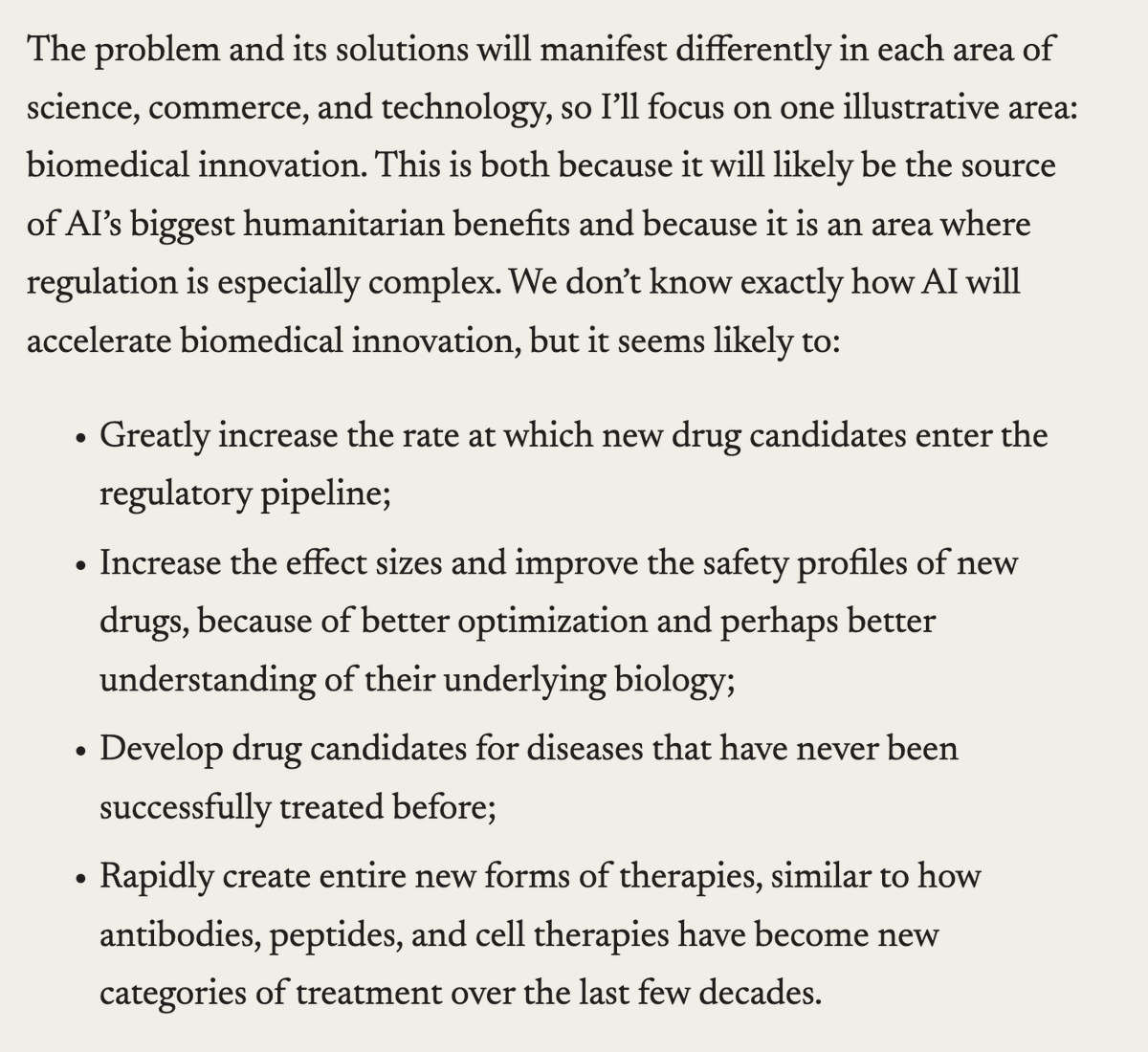
He's genuinely split on the economics. The upside he describes is enormous: "If AI achieves the ability to do most cognitive tasks far better than humans, it stands to reason that it could result in extremely rapid and robust economic growth via the acceleration of science, technology, and operational efficiency. The iterative ability of AI to build even better AI may supercharge that growth even further."
But he won't wish the other side away: "there's a decent possibility that, despite all our efforts, AI still causes significant enduring job loss- and that this may be an intrinsic property of the technology and the way it broadly replicates human cognition." His fixes run all the way to UBI and higher capital gains taxes.
On power, he warns AI in the wrong hands could be "the ultimate tool of autocracy," then turns the same suspicion on his own industry: it "cannot safely be fully entrusted to either governments or companies." Anthropic included.
And he refuses to treat public fear as a PR problem. "People are worried about AI because they correctly perceive that its risks are real." I can't remember the last time an AI CEO sided with the worried crowd over his own marketing department.
The mood throughout is urgency, not victory. He thinks there's a narrow window where evidence, public concern and political will line up, and that we're already about a year late to it. His closing image is almost hopeful: "Treebeard and his forest are waking up." The only question that matters is whether they wake up fast enough.
Dario Amodei just published an unusually candid essay about where AI is heading.
The tl;dr with quotes.
His new piece, Policy on the AI Exponential, reads more like a warning from the person building the thing.
The core problem is timing. AI moves on an exponential. He is very clear about it. Lawmaking moves like Tolkien's Treebeard, the tree so slow it takes a full day just to say hello to another tree. By the time Congress acts, Amodei writes, AI can go from "an amusing toy to the full country of geniuses."
His timeline is short: "If these scaling laws continue for only a year or two longer, we are likely to get what I've called Powerful AI, or 'a country of geniuses in a datacenter'."
And he thinks the evidence has already turned. Pointing to the cyber risks of Claude Mythos Preview, he writes that "its broader significance is that it proves beyond doubt that AI models are now tools of global and national strategic consequence." So he wants binding rules modeled on the FAA. Mandatory third-party testing of frontier models. Government power to block or reverse a release it judges unsafe. This from the man whose own models would be the ones getting blocked.
The part I keep rereading:
He's genuinely split on the economics. The upside he describes is enormous: "If AI achieves the ability to do most cognitive tasks far better than humans, it stands to reason that it could result in extremely rapid and robust economic growth via the acceleration of science, technology, and operational efficiency. The iterative ability of AI to build even better AI may supercharge that growth even further."
But he won't wish the other side away: "there's a decent possibility that, despite all our efforts, AI still causes significant enduring job loss- and that this may be an intrinsic property of the technology and the way it broadly replicates human cognition." His fixes run all the way to UBI and higher capital gains taxes.
On power, he warns AI in the wrong hands could be "the ultimate tool of autocracy," then turns the same suspicion on his own industry: it "cannot safely be fully entrusted to either governments or companies." Anthropic included.
And he refuses to treat public fear as a PR problem. "People are worried about AI because they correctly perceive that its risks are real." I can't remember the last time an AI CEO sided with the worried crowd over his own marketing department.
The mood throughout is urgency, not victory. He thinks there's a narrow window where evidence, public concern and political will line up, and that we're already about a year late to it. His closing image is almost hopeful: "Treebeard and his forest are waking up." The only question that matters is whether they wake up fast enough.
Nach vorläufigen #Ember-Daten hat #China 2025 seine Stromerzeugung um ~500 𝗧𝗪𝗵 𝗴𝗲𝘀𝘁𝗲𝗶𝗴𝗲𝗿𝘁 — fast vollständig durch #Solar (+340 TWh) und #Wind (+140 TWh).
Kohle: rückläufig.
Katherina #Reiche erklärt währenddessen, warum
Deutschland neue Gaskraftwerke braucht.
Das ist kein Technologiestreit.
Das ist ein strategisches Kompetenzgefälle.
#Erneuerbaren #Energien #Energiewende
https://t.co/jyN4yLXeJY
🇦🇱 Arnavutluk’un kuzeyinde silahlı çatışmalar çıktı.
Halk, ülkenin tek adası olan stratejik Sazan Adası’nın Trump’ın damadına verilmesine tepkili. Günlerdir süren protestolar sonunda silahlı çatışmaya dönüştü.
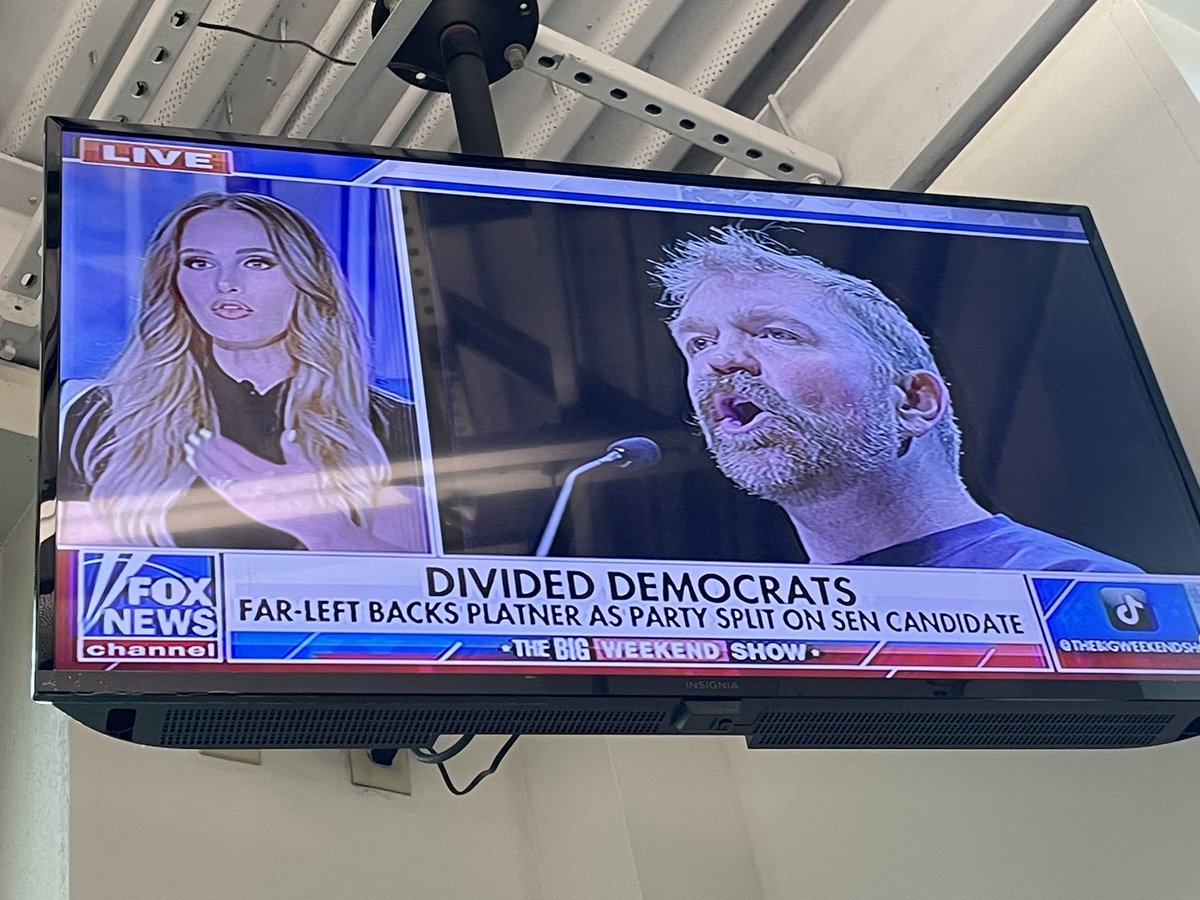
Gym teevee is on Fox and it’s astonishing how hard they are trying to bury the Iran war escalation. It’s Maine Senate race, segment after segment. To think I would live to see the day when Fox isn’t relishing a war in the Middle East.