In our last work, we strived to replace the attention mechanism on graphs with a more efficient and powerful approach. And it... worked!
Hope to see follow-up works on the edge of sequential modeling and graph learning!
State Spaces models (SSM) such as mamba have started to revolutionize languages, vision, and genomics, as a promising alternative to transformer architecture. How about graph data?
❤️🔥 Introducing Graph-Mamba, our latest innovation in Graph Learning for enhanced long-range graph context modeling!
🐍 Graph-Mamba: Towards Long-Range Graph Sequence Modeling with Selective State Spaces
AriXv: https://t.co/aNqA8vx1es
Code: https://t.co/qDKuaHM1R4
TL,DR 👇:
Graph Attention mechanisms face challenges in scaling for large graphs. Enter Graph-Mamba – integrating state space models with input-dependent node selection for efficient long-range context reasoning. Featuring special graph-centric adaptations to effectively employ SSM for non-sequential graph data.
🔑Key Contributions:
--Innovative Design: Graph-Mamba pioneers a novel graph network integrating selective SSM, capturing long-range dependencies with adaptive node selection.
--Adaptation for Graphs: Employing elegant node prioritization strategies and permutation-based training to mitigate sequence-induced biases and boost modeling power.
--Performance & Efficiency: Graph-Mamba outperforms baselines with linear-time complexity and up to 74% reduction in GPU memory consumption on large graphs.
❤️🔥 Looking Ahead: Propelling SSMs into an era of efficient pre-training on graph data with Graph-Mamba!
#GraphMamba #SSM #GraphTransformers #AIResearch #DataScience
Shoutout to Chloe Wang (@ChloeXWang1 ) for her leadership in this project and also to Oleksii Tsepa(@AlexTsepa ) and Jun Ma (@JunMa_11 ) for their invaluable contributions!
@UHNAIHUB@pmcc_ai@UHN@VectorInst@UofTCompSci@UofT_LMP
Heading to #NeurIPS23 with two papers presented by my students and me:
1. BLEEP, a pioneering transformer-based model linking H&E images to gene expression in spatial omics. This is a work led by my PhD student, Ronald Xie (@RonaldXie1 )
Paper: https://t.co/HT1txYQ6wL
Code: https://t.co/rG31TXrx8U
More details: https://t.co/vwYeTUwsHa
2. Congfu, an innovative GNN architecture for predicting drug synergy. This is a work led by my Master student, Oleksii Tsepa !
Paper: https://t.co/7dBUtxJhKR
Code: https://t.co/gOw63uh6vI
More details: https://t.co/qY0covG3z5
Excited to reconnect with old friends and meet new ones! #AIforScience
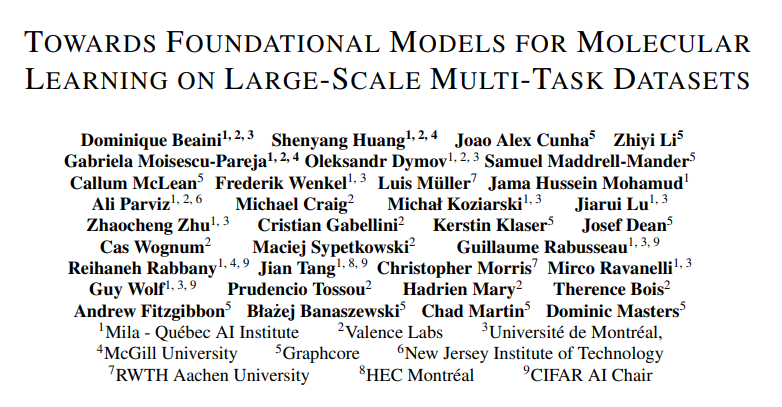
Towards Foundational Models for Molecular Learning on Large-Scale Multi-Task Datasets
Present a collection of seven novel datasets, which cover ~100M molecules and >3K sparsely defined tasks, totaling >13B labels of both quantum and biological nature
https://t.co/9r9xJQFFFK
Announcing the NeurIPS 2023 Competitions! We selected a total of 20 very strong proposals -- some of the competitions are completely new, others are familiar to the NeurIPS community.
More info on blog: https://t.co/1d3t1Aujxu
Full list on website: https://t.co/7A1l5pkyh7
Our latest work in @Nature today: #AlphaDev discovered a new faster sorting algorithm that we open sourced to the main C++ library for all developers to use. This is just the beginning of AI being used to find many more efficiencies in code in future https://t.co/tfACG2zcN6