Zatom-2: Multitask Pretraining on Atomistic Data for Generative Modeling across Domains
1 Zatom-2 is presented as a single atomistic generative model that spans molecules, periodic materials, and (via finetuning) proteins, aiming to replace domain-specific modeling stacks with one shared, scalable backbone.
2 The model is pretrained on ~5M DFT-labeled structures: OMol25 (4M molecular systems covering diverse chemistry and non-equilibrium geometries) plus OMat24 (1M periodic inorganic systems). Both provide energies and forces, enabling physics-grounded auxiliary supervision during pretraining.
3 Core architectural idea: a multiscale Transformer (U-shaped atom encoder → token trunk → atom decoder) that maintains atom-level features for local geometry and token-level features for global exchange, with pair-biased attention and adaptive normalization; it supports both atom1 tokenization (molecules/materials) and atom14 tokenization (proteins) within one framework.
4 Generative training uses conditional flow matching with velocity prediction, paired with an EDM-style sampling parameterization. Atom identities (and for materials, lattice parameters) are inferred from coordinate-based representations rather than requiring separate generative trajectories for discrete types.
5 A key capability is force conditioning: the model conditions generation and structure prediction on a global “relaxation state” descriptor (log10 mean atomic force norm). This targets datasets like OMol25/OMat24 where the same composition/topology can appear in both rattled and relaxed geometries.
6 Multitask pretraining mixes (i) generation, (ii) structure prediction (molecular conformer-like prediction given atom types/bonds when available; and material geometry+lattice given composition), and (iii) MLIP-style energy and force prediction as auxiliary objectives. The paper emphasizes careful gating to avoid leaking target forces when force conditioning is used.
7 Empirically on OMol25, Zatom-2 improves distribution fidelity over Zatom-1 (e.g., lower Atomistic Fréchet Distance and much more realistic force statistics), and force conditioning enables controllable separation of low- vs high-force regimes (reported via MAE and AUROC using UMA to evaluate forces on generated samples).
8 On established benchmarks, Zatom-2 is competitive for molecule and material generation: GEOM-Drugs unconditional generation reports 96.90% validity and strong uniqueness/PB-valid tradeoffs; on MP20, it reports a MetaSUN yield of 4.92% for unrelaxed metastable, unique, novel crystals, substantially higher than several prior baselines listed in the paper.
9 Transfer result: joint generative + predictive pretraining (including force/energy objectives) improves low-data protein backbone generation after finetuning on only 2,000 SCOPe domains, with the most notable gains in length extrapolation (129–256 residues), raising backbone designability from 67.81% (no pretraining) to 74.80% (pretrained + finetuned). The paper also links these gains to better-organized amino-acid latent structure and more localized decoding sensitivity.
💻Code: https://t.co/UbF0fVEbJM
📜Paper: https://t.co/oMpKI4Sa37
#ComputationalBiology #MachineLearning #GenerativeAI #Chemistry #MaterialsScience #ProteinDesign #Transformers #FlowMatching #DFT #AtomisticML
Excited to finally see this out!!! Glad to have contributed :D
Good homage to Zatom-1 and lots of fun easter eggs and newer results/capabilities
Try it out, let us know how you plan to use nucleus and zevals 🥳
(1/n) Excited to announce Zatom-2, a generative model trained on ~5M atomistic structures from OMol25 and OMat24!
Learning to sample from datasets spanning relaxed and distorted geometries is challenging, and we explore several training recipes and the role of force conditioning
Thrilled to announce Zatom-2, an atomistic generative model spanning molecular, material, and protein science! Special thanks to @MirunaCretu2 for leading this effort. (1/11)
🌐 Project page: https://t.co/xB2DlFcEi5
Introducing gRNAde: our own little "AlphaGo Moment" for RNA design! 🧬🚀
📝: https://t.co/vZCLiPg99O
Unlike proteins, RNA design has long relied on "wisdom of the crowd" (human experts) or the slow crawl of directed evolution — gRNAde changes that! 🧵👇
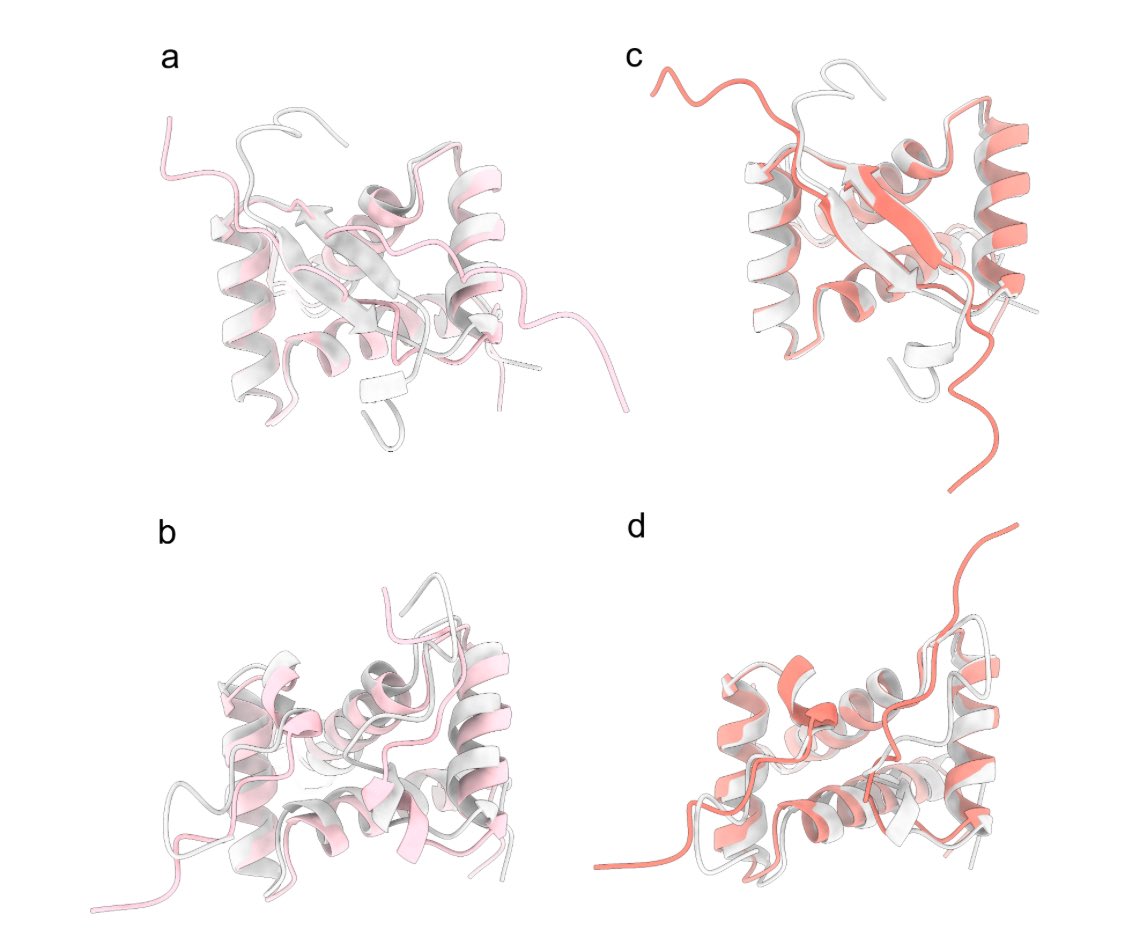
@benjfdup Congrats @benjfdup on an outstanding MPhil project! 🎉 It's been a pleasure working with you and I'm excited to take our ideas on CycLOPS forward!
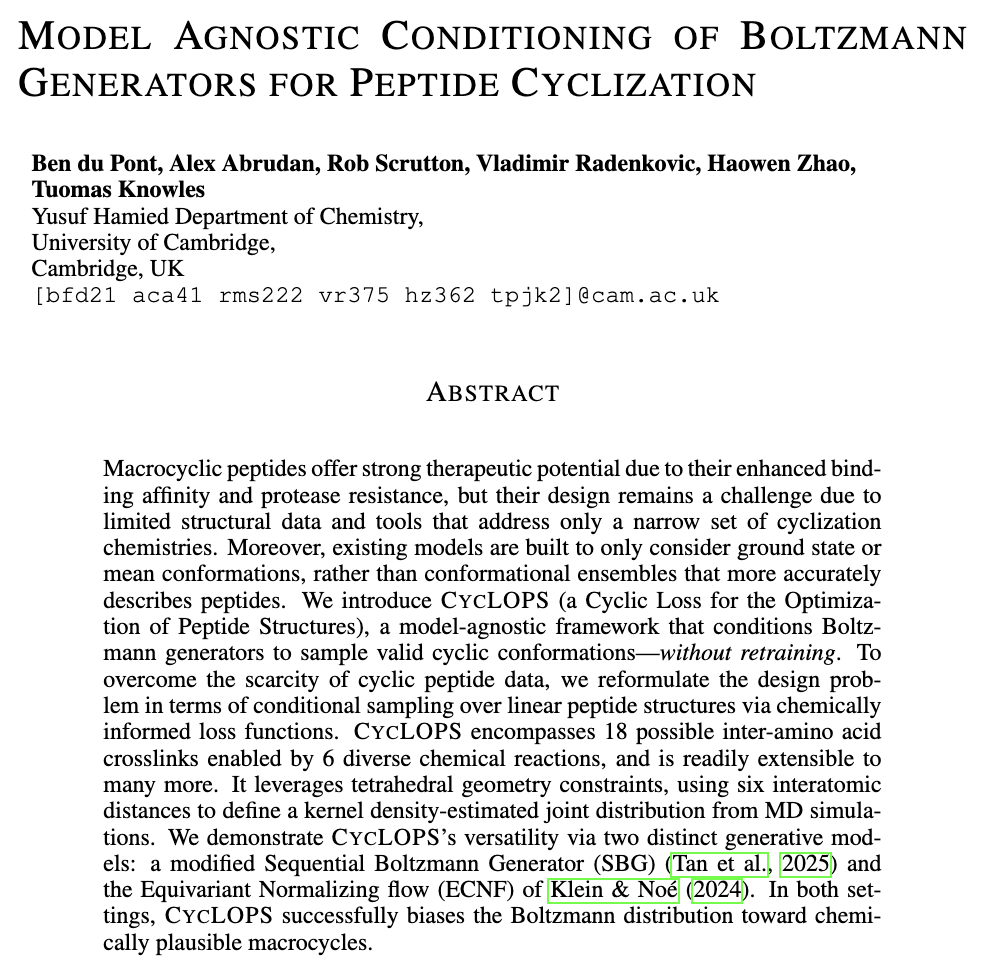
🧬Check out our new preprint “Model Agnostic Conditioning of Boltzmann Generators for Peptide Cyclization,” introducing CycLOPS (a Cyclic Loss for the Optimization of Peptide Structures)
📝Preprint: https://t.co/vVykk93nAV
Code (coming soon): https://t.co/WOD1185XVD
(🧵 1/7)
📢 I ’m thrilled to share the first pre-print of my PhD, co-authored with @rumbacarumba! Our work presents the preliminary results on
"Multi-state Protein Design with DynamicMPNN".
📄 Paper: https://t.co/fDm6bqhq66
💻 Github: https://t.co/AHoO6BN8mS
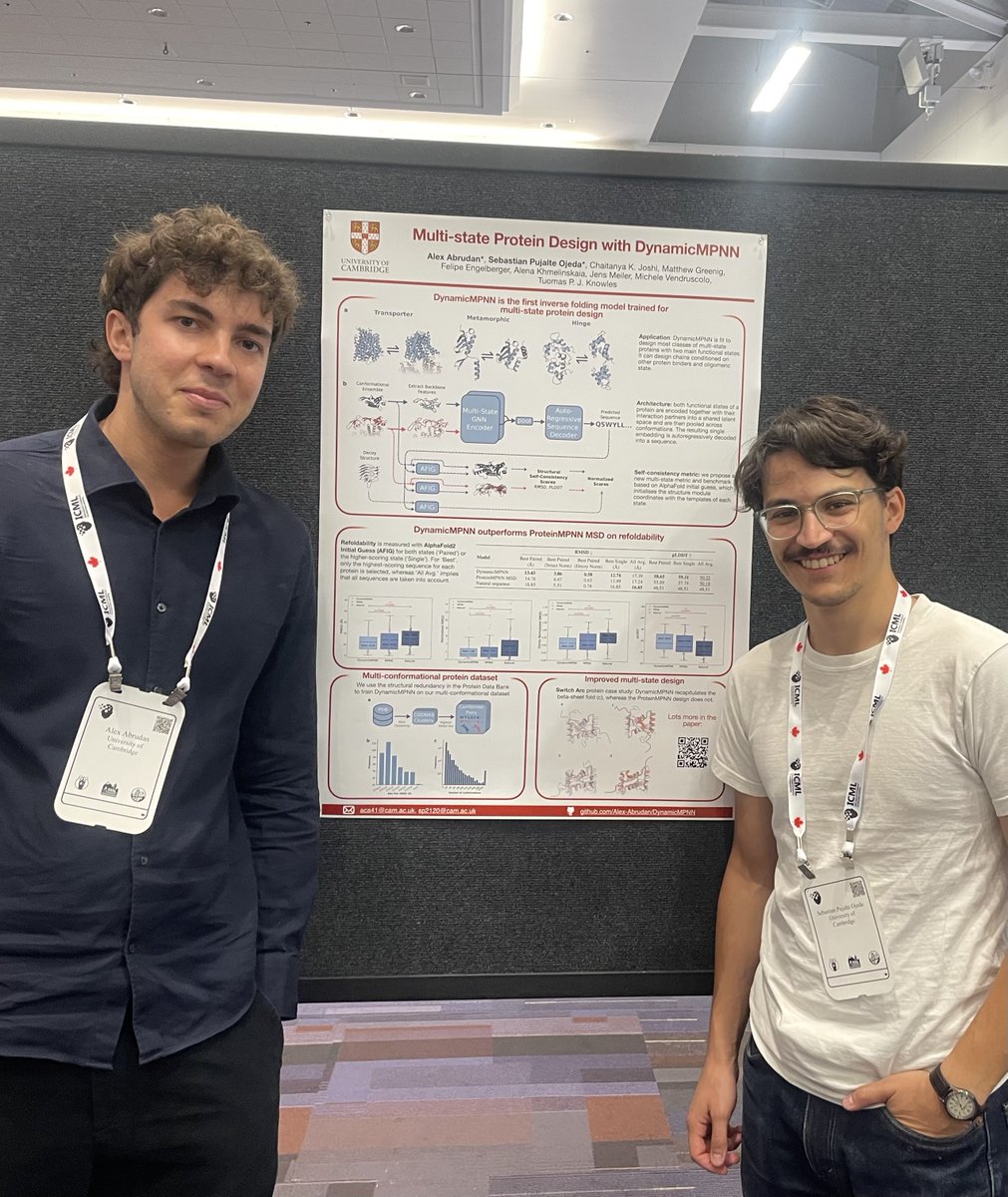
This project has been quite a journey - we reformulated our approach to multi-state protein design multiple times as we delved deeper into understanding protein dynamics and tackled the challenge of scarce multi-conformational data. We’re also excited that this work was accepted for the 🇨🇦 ICML 2025 GenBio Workshop, where we had a blast 🎉
🔴 Existing multi-state design approaches rely on post-hoc aggregation of single-state predictions, achieving poor experimental success rates compared to single-state design.
🟢 DynamicMPNN is a GNN-based inverse folding model designed to handle most classes of multi-state proteins with two main functional states. It can design chains conditioned on other protein binders and oligomeric states.
Key contributions:
• Created a new ML-ready dataset of proteins with multiple conformations using sequence redundancy in the PDB.
• Evaluated our method on a challenging test set containing 94 biologically relevant metamorphic, hinge, and transporter proteins.
• Proposed a multi-state self-consistency refoldability metric and benchmark, which we argue is superior to sequence recovery.
• 𝐃𝐲𝐧𝐚𝐦𝐢𝐜𝐌𝐏𝐍𝐍 𝐢𝐦𝐩𝐫𝐨𝐯𝐞𝐬 𝐩𝐞𝐫𝐟𝐨𝐫𝐦𝐚𝐧𝐜𝐞 𝐨𝐯𝐞𝐫 𝐏𝐫𝐨𝐭𝐞𝐢𝐧𝐌𝐏𝐍𝐍 𝐨𝐧 𝐨𝐮𝐫 𝐛𝐞𝐧𝐜𝐡𝐦𝐚𝐫𝐤 𝐛𝐲 𝐮𝐩 𝐭𝐨 𝟏𝟑% 𝐨𝐧 𝐑𝐌𝐒𝐃.
Some key lessons we’ve learned:
• For better multi-state design, the BioML community needs to develop targeted approaches for specific types of protein dynamics.
• DynamicMPNN targets proteins with clear nodes in their energy landscape, i.e. where ‘states’ can be easily discretized and their function still heavily relies on structure and their shape-complementarity with binders, just like for single-state proteins. 𝐒𝐭𝐮𝐝𝐲𝐢𝐧𝐠 𝐨𝐭𝐡𝐞𝐫 𝐤𝐢𝐧𝐝𝐬 𝐨𝐟 𝐝𝐲𝐧𝐚𝐦𝐢𝐜𝐚𝐥 𝐩𝐫𝐨𝐭𝐞𝐢𝐧𝐬 𝐥𝐢𝐤𝐞 𝐢𝐧𝐭𝐫𝐢𝐧𝐬𝐢𝐜𝐚𝐥𝐥𝐲 𝐝𝐢𝐬𝐨𝐫𝐝𝐞𝐫𝐞𝐝 𝐩𝐫𝐨𝐭𝐞𝐢𝐧𝐬 𝐫𝐞𝐪𝐮𝐢𝐫𝐞𝐬 𝐚 𝐝𝐢𝐟𝐟𝐞𝐫𝐞𝐧𝐭 𝐚𝐩𝐩𝐫𝐨𝐚𝐜𝐡.
• Care should also be taken when picking the right design targets due to the limited understanding of conformational switch mechanisms.
Huge thanks to @chaitjo for all the mentourship and insights we gained from his RNA design project gRNAde, and to all our co-authors Matt Greenig, @Felipe@fengel97, @akhmelinlab , @MeilerLab, Michele Vendruscolo, and my PhD supervisor Tuomas Knowles at @KnowlesLabCamb.
Much more to come on this exciting research direction!
Multi-state Protein Design with DynamicMPNN
1. DynamicMPNN is a groundbreaking inverse folding model that generates protein sequences compatible with multiple conformations. It outperforms ProteinMPNN by up to 13% on structure-normalized RMSD, demonstrating significant improvements in multi-state protein design.
2. The model is trained on 46,033 conformational pairs covering 75% of CATH superfamilies. It uses a novel multi-state self-consistency metric based on AlphaFold initial guess (AFIG) to evaluate the refoldability of generated sequences across multiple conformations.
3. DynamicMPNN captures sequence constraints required for multiple functional conformations by jointly learning across conformational ensembles, rather than aggregating single-state predictions. This approach is crucial for designing synthetic bioswitches and molecular machines.
4. The study provides a new benchmark for multi-state protein design, using challenging metamorphic, hinge, and transporter proteins. DynamicMPNN’s performance on this benchmark highlights its potential for engineering proteins with complex conformational changes.
5. The authors argue that refoldability, rather than sequence recovery, is a more direct and structure-grounded metric for evaluating inverse folding models. DynamicMPNN’s superior performance on this metric suggests it can generate sequences that are more likely to fold into the desired structures.
6. The model incorporates SE(3)-equivariant Geometric Vector Perception layers and conformation order-invariant pooling, ensuring computational efficiency and robustness. These features enable DynamicMPNN to handle the complexity of multi-state protein design effectively.
7. The study concludes that DynamicMPNN opens new possibilities for engineering synthetic bioswitches, allosteric regulators, and molecular machines, advancing the field of protein design and synthetic biology.
💻Code: https://t.co/QidsSbXfiR
📜Paper: https://t.co/1jyQjwG3nA
#DynamicMPNN #ProteinDesign #MultiStateProteins #MachineLearning #StructuralBiology #SyntheticBiology
@AllThingsApx We have found this interesting too - please read our Discussion section where we wonder if the best designed sequences are indeed better than the natural ones at folding into those states or if it is a metric artifact.
@AllThingsApx Thanks for sharing @AllThingsApx - I hope you find the preliminary results promising. More work following soon on this tricky area of protein design!
Proteins aren't static; why should our designs be? 🔄
🧬 DynamicMPNN trained on pairs of structures, crafting sequences that snap between states (+13% RMSD >ProteinMPNN on 94‑proteins)
What's the most exciting application? metamorphic enzymes, transporters, or hinges?? #AI4Bio #ProteinDesign
🚨 Protein designers: we keep saying we're getting really good at making static, rock-like proteins...
Introducing Dynamic MPNN - our first step towards truly multi-state and 'programmable' protein design!
Great collab with @KnowlesLabCamb, led my Alex Abrudan and @rumbacarumba
@chaitjo@KnowlesLabCamb @rumbacarumba Huge thanks @chaitjo for your mentourship and inspiring work on multi-state RNA design which was very much the starting point of building DynamicMPNN!