I really believe and pray that Kaspa will help me change my life for the better. So that I can change the lives of young children, adopt 3-5 children, give them
History repeats itself — every revolution scares the old guard. #Kaspa might be crypto's next iPhone moment! From silent films to sound, vinyl to MP3s, film to digital — change always sparks fear. Reading @MHiesboeck’s articles about Kaspa, I felt that vibe again.
#kasfam $KAS #KONI
🔥 Big news! Zealous Swap has surpassed 1,049,542 swaps! 🚀
Even better, we now have 87,600+ unique users, with many coming from other chains, bringing fresh attention and new energy to Kaspa! ⚡
Thank you all for being part of this growing community. We’re just getting started! 💥
Just dropped https://t.co/uSVITDyya8 💻⚡
Beta is live!
It’s a free platform to help the $KAS community create posts, share content, and spread the $Kaspa gospel with a more unified voice.
Built solo. No team. No budget.
Just vibes, caffeine, and stubborn optimism.
Feedback = legendary
Hate = bring snacks
@skibumtrading tell me what you think!
🚨 Kaspa x @swissborg : Listing incoming?
Following several great conversations with the @swissborg team at recent events, $KAS has been nominated by their community for a free listing on the SwissBorg app 🇨🇭
🙏Huge thanks to the SwissBorg community for their support!
Kaspa is now in the public voting phase, and only the top 5 tokens will move on to a governance vote in early June.
If you want to see this listing happen, don’t hesitate to get involved:
🗳️ Vote here: https://t.co/u1LgunAxmd
📆 Voting is open until the end of May
Vamos!
This is a message to @binance - and to the entire Kaspa community.
Kaspa isn't just another coin.
It's real tech, real people, and real belief.
We've waited long enough. Kaspa deserves a spot on the main stage.
So here's the deal:
Binance, drop a wallet address and name your price — if it's fair, we'll pay it.
No VC. No bullshit. Just community.
I'm starting with 50,000 Dollar $KAS.
Now let's see who's really with us.
Share this. Tag Binance. Make it loud. Make it viral.
Everyone gives what they can - and together, we write history.
#Kaspa #KAS #Binance #NoVC #ProofOfWork #CryptoRevolution #LetKaspaln
Hello there, $kas and $qubic fans, it's time for a little history lesson.
Our story starts from an unknown time, in the Prussian city of Königsberg (now Kaliningrad, Russia), built on both sides of the Pregel river, which divided it into two land masses and two islands.
Seven bridges were built for passage between the islands and mainlands, bridges that afforded a riddle: can a person take a walk, crossing each bridge exactly once, finishing where they started?
It is unknown for how long this question has been asked, but it is known when it was answered and by whom: 1736, Leonhard Euler.
Euler realized that we can completely forget the geometry of the town. The only information we need is a list of land masses, and the number of bridges between each two land masses. He encoded this information into what we call a graph -- a bunch of nodes connected by edges -- and quickly proved the first theorem in a field now known as graph theory: a graph can be traversed by a route starting and ending at the same point and passing through each edge exactly once if and only if each node touches an even number of edges. Solving the riddle of Königsberg's bridges in the negative.
In the years to come, and already during Euler's life and through his work, math enthusiasts considered all sorts of graphs, including ones where edges can be only traversed in one direction, and it is impossible to take a walk on the graph that ends up where it started. In other words, a directed acyclic graph, or DAG for short.
Albeit its name not yet in its final form, DAGs were used for parallel computation theory at least as early as 1972, as we can see in the seminal paper by Coffman and Graham [1].
Ideas of using DAGs in cryptocurrencies and DLTs started to emerge in the literature since the introduction of the GHOST protocol in 2013, but the idea was first thoroughly researched by Lewenberg-Sompolinsky-Zohar in the 2015 paper "Inclusive Block Chain Protocols" [2]
The first proposal for a DAG based proof-of-work DLT is usually attributed to a 2015 hypothetical protocol called DagCoin. Proposed by Sergio Demian Lerner in 2015, DagCoin was the first to propose that users rather than miners are required to engage in proof-of-work to publish their own transactions. An idea that raised a lot of criticism. In general DagCoin was an interesting proposal, but it could not provide any tangible security, which is why it never left the drawing table.
About a year later, a project called IOTA was the first to attempt building a production-grade DAG-based proof-of-work DLT, based on a protocol called Tangle invented by a guy you all heard of: first name Serguei, last name Popov. Tangle proposed to solve DagCoin's problems using a probabilistic method, but provided very little evidence that it is actually secure.
Serguei and his fellow cofounders (three other guys, one of them, confusingly enough, called Sergey) ignored warnings from fellow researchers that the understanding of DAGs in consensus is yet lacking, and that the security of the Tangle protocol against double-spends seems unclear, and rushed to implement it.
But as they tried to make the move from theory to practice while the theory is insufficient, reality knocked. Several attacks were demonstrated that in theory, could allow liveness and even double-spending attacks, forcing Iota to enrich their network with coordinators: centralized entities that resolve conflict. After years of attempting to fix Tangle and remove the coordinator requirement, Sergey left Iota to seek other ventures, while those remaining decided to scrape Tangle altogether, they started developing Tangle 2.0, a proof-of-stake reimagining of the application of DAGs to consensus.
So if anyone ever tells you that this Sergey or the other "invented DAGs", be sure to audibly laugh in their face.
Want to hear more about the history of DAGs in proof-of-work? Great! My current project is a video journey of the history of proof-of-work protocols, from Bitcoin to DAGknight. Be sure to sub to my youtube channel so that you don't miss it!
https://t.co/PJk21YkQYk
[1] https://t.co/KCoWgdK0VQ
[2] https://t.co/InKmWYZ9SR
Introducing KasView
A simple web app to view top cryptocurrencies priced in $KAS — not USD.
Try it: https://t.co/snj6lyDeis
(iOS users: use Brave browser if prices don’t load.)
Got feedback? I’d love to hear it!
Kaspa is still a rather unexplored ‘capricious child’ in the financial scene, but I agree as well that it has by far the best perspectives as it intrinsically tops the great ‘Masters’, bitcoin, gold and silver, as it offers much wider industry applications
Ethereum needs rollups. Solana needs restarts. Bitcoin needs an hour.
Kaspa?
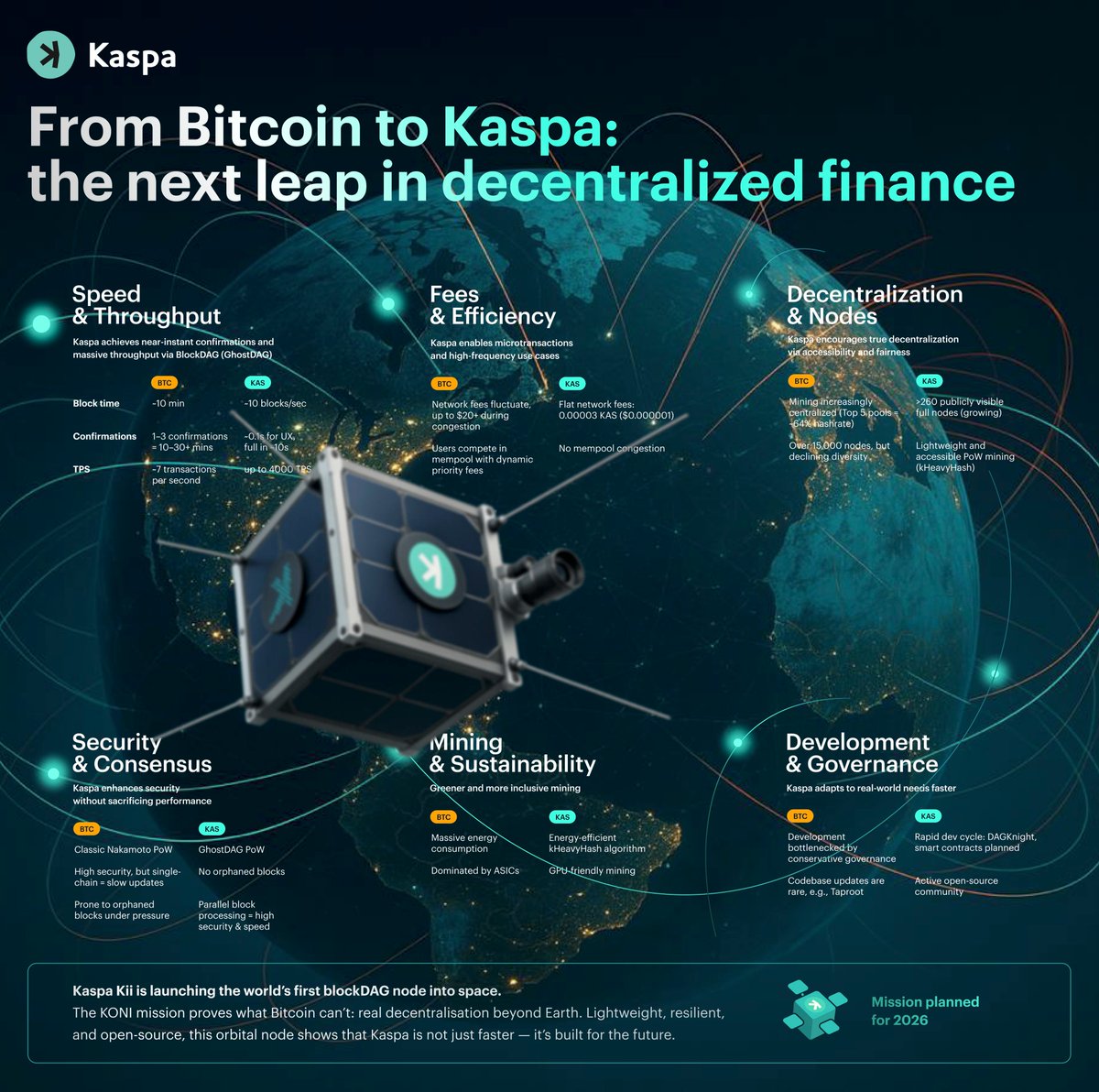
10 blocks per second. Final in 1.
No bridges. No sequencers. No excuses.
$KAS #Kaspa
Fun fact 🙂
Did you know or realize that after Crescendo upgrade $Kaspa is going to produce more blocks in 1 day than Bitcoin in its entire history since 2009?
And “they” told you that $Kaspa is not battle tested, right?
There aint no PoW with more impressive track record
Seems some are scared of price manipulation whilst others care too much about the (un)official X account of $KAS. Stop over thinking things, none of it matters long term, remember why you bought #Kaspa in the first place. Dont let anyone take your coins from you, you'll regret it