Today we're announcing a partnership with the world-class quantum algorithm and software team at @ZapataComputing to build an industry-first compilation toolchain explicitly designed for hybrid quantum-classical algorithms.
@xamnidar@CRLStweets Looks like the leftmost section has a different chirality 😀 If we view the fence as a 2d tessellation it’s symmetry group should be p4 I guess
My colleague Richard Rand is one of the world’s experts on nonlinear vibrations. He’s posted his lecture notes (free!) that include topics you won’t find anywhere else, like delay equations and fractional derivatives treated with perturbation methods. https://t.co/vNxyrsuCjo
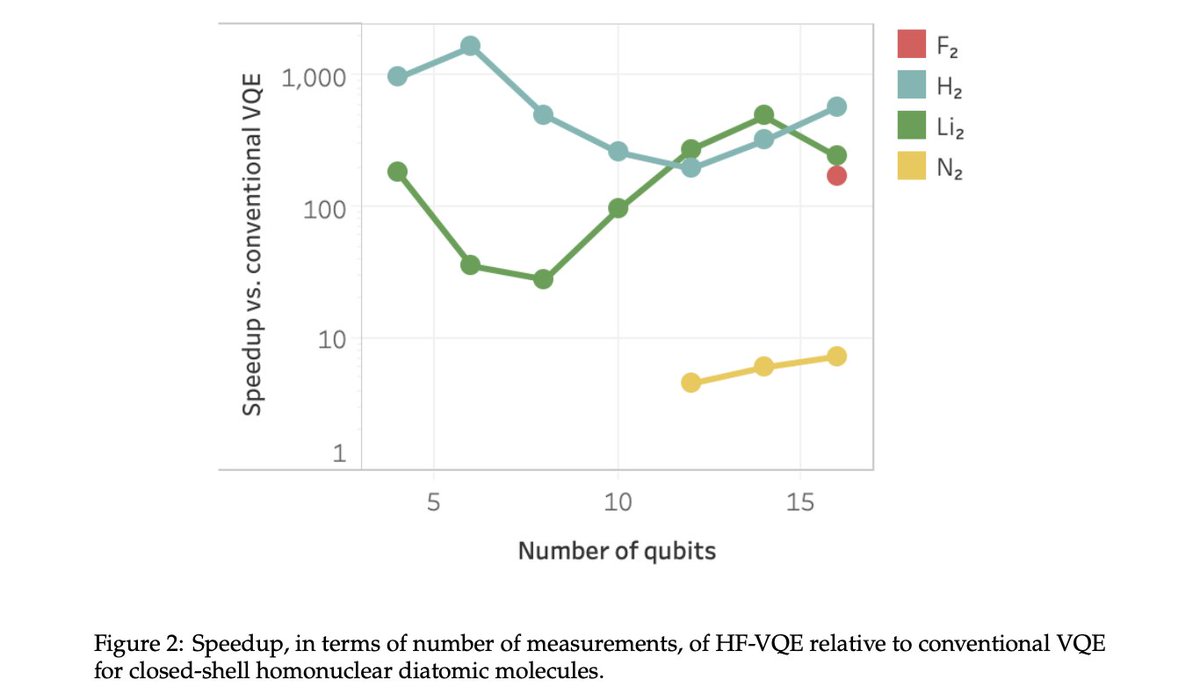
Excited to share our manuscript introducing classically-boosted VQE, a generalization of VQE that allows #quantum computers to augment, rather than replace, classical quantum-chemistry methods. 1/4
https://t.co/tQFkdPc1YP
Example of a recurrent neural network (RNN) that exhibits chaos vs. a "dynamic attractor". The RNN drives two output units trained to write the word "Chaos". At 0.16s a perturbation (much larger for the lower RNN) is applied to the RNNs. Thanks @rodlaje
"One may be skeptical about finding quantum intelligent beings in nature (and rightfully so). But it may not be so absurd to synthesize a weak form of quantum (artificial) intelligence in an experimental lab ..."
It was a great pleasure to speak about classical and quantum Fisher information in NISQ applications at the Quantum Machine Learning Journal Club @quantumlah! If you're also interested in the topic you can now watch the talk on YouTube: https://t.co/tTFx2mvy74 📽️
While @ZapataComputing has had many fantastic quantum research interns, I'm excited to say that we are now accepting applications for our first quantum software internship! #python#quantumcomputing#internship https://t.co/RZXBFI5xXh
I plan to talk about my recent implementation of methods for warm starting QAOA (https://t.co/s7yerMYKGN) and walking through some open-source code available here: https://t.co/JKDJnNpwEk .
It'll be a nice supplement to this podcast episode: https://t.co/zLSaxxA1A8
Tired of solving textbook assignments?
Reading papers and not understanding them?
Try this – plenty of diverse problems to tackle and opportunities to learn. Plus, you can see how other people approached the same problem and learn from them.
This month – QML.
Worried about the challenges in training #quantum models for applications on near-term quantum devices? Check our last work where we leverage meta-learning to mitigate the vanishing-gradients issue (a.k.a. as barren plateaus in #Quantum#MachineLearning). https://t.co/Sr2nQGisIm
It seems that Unitary Coupled Cluster theory was not meant for quantum computers, the operator is just too complicated. Yet, it is the most frequently used theory when it comes to quantum chemistry on a quantum computer. Discussion of UCC subtleties here https://t.co/MRyldsQyDF
Checkout our latest work in @IBMResearch on quantum algorithms for tackling the protein folding problem using @qiskit , published in NPJ Quantum Information https://t.co/SmMUKRd6qV