Thrilled to share our new preprint on the molecular mechanism of influenza virus cap-snatching! 🦠🧬
https://t.co/sDkPHn69ki
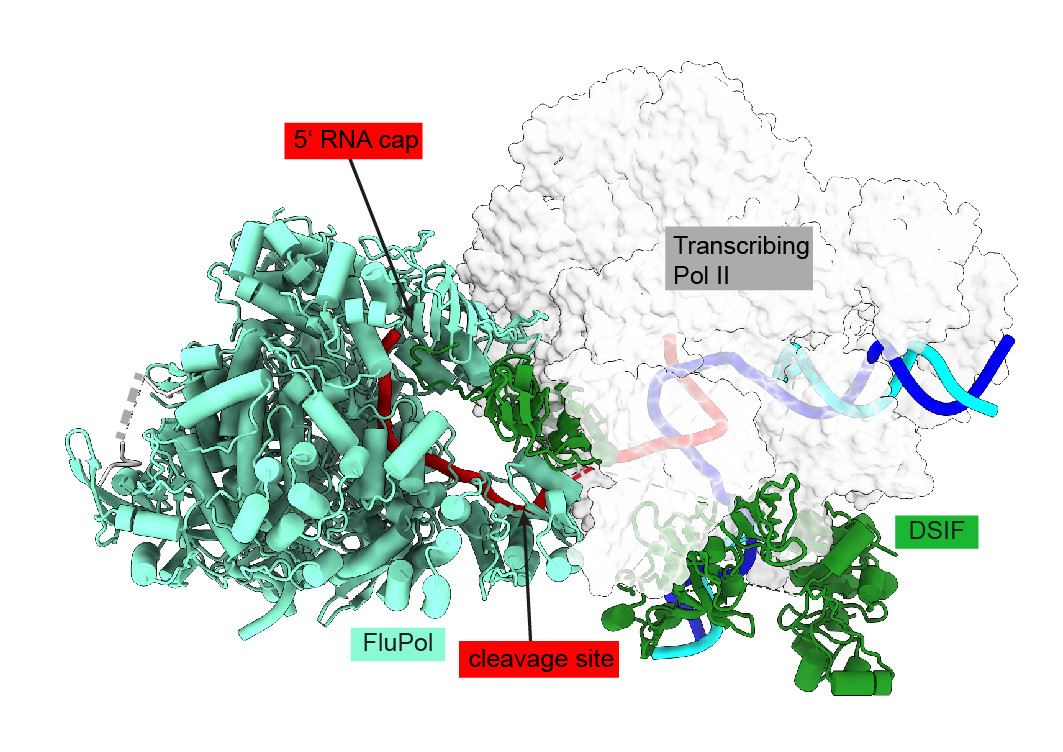
We determined structures showing how flu polymerase hijacks host RNA polymerase II to steal RNA caps, a crucial step in viral gene expression.
A research team from the Max Planck Institute for Multidisciplinary Sciences, Institut Pasteur, and EMBL has shown in a Nature paper how the influenza polymerase, a molecular thief, uses the host RNA to replicate.
Check out the MPI press release: https://t.co/dKQPReedmP
Perfect holiday reading! Dive into the exciting work on the molecular mechanism of co-transcriptional H3K36me3 by SETD2 from our fantastic postdoc @sciJamesWalshe & Moritz Ochmann! https://t.co/1FvlqoYe8f. Also check out the great related work by @LucasFarnung & @KurumizakaLab.
The second of our two new preprints addresses the question of how proteasomes can be kept dormant for instance in oocytes. This study was spearheaded by first author Sascha Amann. https://t.co/nBIXIXpTmK (1/6)🧵
We had a great time at our lab retreat at the Harnack House together with the @MariekeOudelaar lab and @mpgpresident. Exciting talks from our guest speakers Stephan Hamperl, @EddaGSchulz and @S_Grosswendt. Thanks for coming!
The pro-Trump "free speech enthusiast" owner of this platform decided to just delete the viral anti-Trump ad I posted I few days ago (and replaced it with a "This Post was deleted by the Post author" message).
So here it is again Elon, enjoy!
Excited to share our latest research on co-translational mRNA decay by the exosome in human cells! We uncover how the exosome-SKI complex is recruited to ribosomes and propose a novel role for SKI in recognizing collided disomes. @MPI_Biochem
👇👇👇
@Ella_Maru The newly described interfaces are protein-protein interfaces, which are hard to exploit in terms of drug design, but not impossible.
Since the mechanism of stealing the RNA cap from the nascent transcript is unique to influenza, I think is cannot be translated to other viruses.
Thrilled to share our new preprint on the molecular mechanism of influenza virus cap-snatching! 🦠🧬
https://t.co/sDkPHn69ki
We determined structures showing how flu polymerase hijacks host RNA polymerase II to steal RNA caps, a crucial step in viral gene expression.
Deadly kiss of polymerases: How Influenza polymerase cleaves capped nascent RNA from host Pol II to start its own transcription. Preprint from Alexander Rotsch et al. with Steven Cusack‘s lab @EMBLGrenoble.
https://t.co/DlT9iyvbUZ
Huge thanks to all co-authors! This work was a team effort, combining expertise in structural biology, biochemistry, and virology. Special shoutout to Delong Li, Maud Dupont, @krischuns, @MariaLukarska@isaac_fianu, @c_dienemann, Nadia Naffakh, Stephen Cusack and @mpgpresident.
3. We captured structures before and after RNA cleavage, revealing how the cleaved capped RNA fragment is positioned for immediate initiation of viral transcription. This provides a complete structural view of the cap-snatching mechanism.
🔬 Key findings:
1. We identified the minimal host complex required for efficient cap-snatching is an elongating Pol II complex with DSIF.
2. Cryo-EM structures reveal precise molecular interactions between flu polymerase and host machinery.
Cap-snatching is essential for flu virus replication. The virus steals caps from host mRNAs to make its own transcripts stable and translatable. Understanding this process at the molecular level is crucial for understanding influenza infection.
Es geht wieder los: Die Aufgaben zur 1. Runde der IBO 2025 stehen für euch bereit! Diesmal geht es um Honigbienen🐝, die Backhefe S. cerevisiae in der Biotechnologie🧑🔬, Organspende🫀 und das menschliche Gedächtnis 🧠. Klingt spannend? Dann erfahrt mehr auf https://t.co/5QlOHgTtMx
Extremely honoured to receive the Otto Hahn Medal and the Otto Hahn Award today from the Max Planck Society @maxplanckpress ! An amazing recognition of my work and the scientific environment and support in the @SchuhLab at the @mpi_nat ! 🔬❤️
I’m happy to announce that I was appointed a junior professor at @yourUMG. Many thanks to everyone who supported me during my journey, especially @mpgpresident and his team (@lidschreiber, @c_dienemann & K. Zumer), but also all past and present colleagues and collaborators.
The final version of our work on initiation-elongation transition by mammalian Pol II is now online! We visualized key transition steps during initiation and early elongation.
Many thanks to Patrick @mpgpresident, Christian @c_dienemann, Elisa @EOberbeckmann and the Cramer lab!