🚨 Beijing Rolled Out the Red Carpet for Trump AND Putin in 6 Days. Its Own Investors Just Rolled Out the Exits — ¥2 Trillion Gone.
¥2 Trillion, that's ¥2,000,000,000,000. Twelve zeros. More than the entire annual GDP of Saudi Arabia. Erased in one trading session.
Six days ago President Donald Trump left Beijing on Air Force One. Yesterday (May 20, 2026) Vladimir Putin walked down a red carpet into the Great Hall of the People. Today — May 21, 2026 — Chinese investors did something Beijing's propaganda machine cannot spin: they sold.
An estimated ¥2 trillion (≈ US$280 billion) in market value was erased from mainland Chinese equities. The Shanghai Composite slid 2.04% and the Shenzhen Component tumbled 2.07% — both three-week lows. Hong Kong's Hang Seng closed down roughly 1%. The names that bled the hardest are the very ones Xi has been parading as proof of "tech self-reliance": Cambricon -3.19%, Zhongji Innolight -4.21%, Eoptolink -3.74%, Huagong Tech -5.79%.
Even CITIC Securities — a mainland brokerage, not a foreign sceptic — noted that the pullback dates from May 14. That is the day Donald Trump landed in Beijing.
This is what the market thinks of the past two weeks of choreography.
The Trump Summit Beijing Sold as a Triumph
The Trump–Xi summit (May 14–15) was a state-visit spectacle: military honor guards, a banquet at the Great Hall, a personal welcome from Xi. The substance was thinner. Atlantic Council's verdict: a big show with little to show for it. CNN's politics desk was more clinical: nebulous agreements on agricultural purchases, tepid commitments on oil, no firm deal to reopen the Strait of Hormuz. Trump himself said tariffs didn't even come up. Al Jazeera noted something rarer — the two sides released readouts that disagreed on what was actually agreed.
The morning after the summit, US stock futures sold off across the board. Investors voted before the pundits did.
Beijing's framing: historic visit. The tape's framing: priced in, sold off.
The Putin Summit Beijing Sold as Strength
One day before today's selloff, Xi gave Putin a red-carpet welcome — their second meeting in under a year. The two leaders presided over a sweeping signing ceremony covering trade, technology, nuclear energy and media cooperation. Xi called the relationship the "highest level in history." A joint statement took aim at Trump's planned "Golden Dome" missile shield.
Optics: an axis. Reality: Putin came to Beijing with one big ask — locking in the long-stalled Power of Siberia 2 gas pipeline, the project Moscow needs to replace gas sales lost to Europe — and left without it. The Washington Post's headline was blunt: "Putin fails to secure Xi's approval for Power of Siberia 2." Price, financing and timing all remain unresolved, with Beijing reportedly holding out for prices roughly half of what Moscow wanted.
Even the marquee deliverable didn't deliver.
Why the Tape Doesn't Believe the Narrative
Mainland investors aren't watching CCTV. They're watching the data.
China just emerged from the longest stretch of producer-price deflation in decades — 41 consecutive months from October 2022 through this past February. The streak only broke in April, and not because demand came back. It broke because the Iran war pushed energy prices higher. That is imported inflation, not organic recovery. Strip out energy and the demand picture remains thin.
Goldman Sachs says the property crisis is in its fourth year and not yet at a bottom. Chinese exports to the United States fell nearly 29% year-on-year in November. Youth unemployment officially stood at 16.3% in April; independent analysts argue the real figure is materially higher. Private investment remains weak — Chinese firms aren't short of liquidity, they're cautious on returns, on enforcement consistency, on whether the demand will be there tomorrow.
This is the macro that propaganda cannot photoshop.
The Neighbourhood: A Quiet Encirclement
Look at Asia's tape today against Shanghai's.
Tokyo's Nikkei rallied more than 3%, within striking distance of an all-time high set just last week.
Seoul's Kospi exploded 8.42% higher — its largest single-session point gain on record, led by Samsung and SK Hynix.
In Manila, "Balikatan 2026" just concluded with Japanese combat troops participating in the largest US-Philippines drills for the first time ever.
Washington's Indo-Pacific lattice — AUKUS, the Quad, the trilateral US–Japan–Philippines and US–Japan–Korea formats — the architecture Beijing labels an "Asian NATO" — continues to thicken.
In Brussels, Commission President Ursula von der Leyen has tied future EU-China relations explicitly to how Beijing handles Russia's war on Ukraine. And Xi is reportedly preparing his first visit to North Korea in seven years — a tell about which axis Beijing is doubling down on.
Tokyo up. Seoul at a record. Shanghai down. That is not a coincidence. That is a verdict on which side of the new geopolitical fault line global capital believes will compound.
Two Trillion Yuan Do Not Lie
You cannot propaganda your way past a price chart.
State media can stage the Trump welcome as triumph and the Putin embrace as solidarity, but the people who actually have skin in the game — Chinese savers, Chinese funds, the foreign capital still inside the wall — sold into both stories. ¥2 trillion in a single session is not a technical wobble. It is a referendum.
The Trump–Xi–Putin theatre is over. The bill is being presented. And Beijing's available responses — tighter capital controls, more "national team" buying, more margin tightening, or a sharper turn toward Moscow and Pyongyang — none of them rebuild confidence. They only manage the optics of its absence.
What gets priced in next? Capital controls? A managed devaluation? Another "national team" rescue? Or does the next leg down arrive before the response does?
Original article by me @aricchen. Views are my own — welcome to discuss!
Muslims all over Europe are freaking out after Sweden made a historic and courageous decision: it will no longer use the term “Islamophobia,” coined by the Muslim Brotherhood, because it is a politically manipulated concept aimed at silencing criticism of Islam.
Swedish Foreign Minister Maria Malmer Stenergard announced that her government will push the European Union and the United Nations to stop using this fraudulent term.
The concept of “Islamophobia” was deliberately designed to equate legitimate criticism of Islamic doctrine with racism. It was weaponized to shut down discussion about core Islamic texts containing commands to wage war, rape, and subjugate non-Muslims.
Sweden just recognized what millions of Europeans already know: criticizing a religion that openly calls for the murder and sexual enslavement of non-believers is not a phobia, but basic common sense and self-preservation.
This is a massive blow to the Islamist lobby across Europe.
Do you agree with Sweden’s decision?
In Kürze findet in der Schweiz die Abstimmung über die 10-Millionen Initiative statt, deren Ziel es ist, die Einwanderung in das Land zu begrenzen.
ich möchte hier als in der Schweiz lebender Ausländer (Deutscher) meinen Schweizer Gastgebern empfehlen, dieser Begrenzung ihre Zustimmung zu geben und meine Schweizer Follower und Leser bitten, das durch Re-post und like zu verbreiten.
Warum schreibe ich das, wo ich doch selbst hier zu Gast bin und mir eigentlich ein möglichst einfache und laxe Handhabung der Sache im eigenen Interesse wünschen müsste?
Die Antwort ist einfach: Die Schweiz ist so schön, weil sie die Schweiz ist. Die Schweiz ist, wenn Sie mir das gestatten es so zu formulieren, das bessere Deutschland, während Deutschland nur noch die bessere DDR ist. Und das hat seine Gründe.
Es liegt unter anderem daran, dass die Schweiz unabhängig und frei ist und dass die Schweizer Bürger es bisher geschafft haben, Einwanderung auf das integrierbare Maß zu limitieren. In einigen, vor allem links regierten Kantonen, gelingt das aber immer weniger und die Schweizer sehen jetzt, dass sie nicht die gleichen Fehler machen wollen wie die Deutschen.
Liebe Schweizer, lassen Sie sich von niemandem einreden, dass sie hier einen Riegel vorschieben wollen sei irgendwie fremdenfeindlich, phob oder "rechts" oder sonst etwas, was man Selberdenkern heutzutage so ans Revers schmiert.
Solche Anwürfe sind einfach eine bodenlose Unverschämtheit.
Wenn man, wie auch ich, hierherkommen darf, dann genießt man die ganze Fülle eines funktionierenden Landes, dessen Infrastruktur von Generationen fleissiger Bürger aufgebaut worden ist. da finde ich es nur fair, dass die Schweiz von jedem Gast erwartet, dass er sich nicht nur integriert, sondern dass er schon ein wenig mehr beiträgt als der Durchschnitt, die extra Meile geht.
Und von jedem, der hier als Gast sein darf sollte man erwarten dürfen, dass er sich über diesen Status bewußt ist und nicht Ansprüche stellt, die man als Hausherr hat, aber nicht als Gast.
Dieses Gefühl ist aber so weitgehend verloren gegangen, dass selbst viele Schweizer denken, dass es ok sei, nicht mehr der Herr im eigenen Haus zu sein.
die 10-Millionen Initiative ist eine gute Gelegenheit, klar zu machen, dass die Schweizer Herr in ihrem Hause sind und bleiben und dass weder die EU, noch sonstwer diese Rolle einnimmt.
Liebe Schweizer, wählen sie klug und sorgen Sie bitte dafür, dass die Schweiz die Schweiz bleibt und also schön bleibt. Danke!
🇯🇵SWIFT exposed a massive $10 trillion problem in global banking: outdated correspondent banking systems that are slow, expensive, and rely on pre-funded Nostro/Vostro accounts.
At the same DAS NYC 2026 panel, Ripple presented a solution—offering on-demand liquidity so banks can move funds when needed instead of locking capital worldwide.
Great question. I get it a lot.
Solana is powerful, but I ran into constant friction. Too many moving parts, too many points of failure, and too much overhead to keep things stable.
I’ve also been caught in the middle of a Solana outage. That changes how you look at reliability real fast.
XRPL is cleaner. Built for settlement first, not stitched together after. Less complexity. More clarity. That matters when you’re actually building.
LA VERDAD EN TIEMPO REAL
El Secretario del Tesoro de EE.UU., Scott Bessent, acaba de lanzar una frase que destroza el mito verde de los vehículos eléctricos chinos:
“Yo diría que un vehículo eléctrico chino es, en realidad, un vehículo impulsado por CARBÓN.”
Mientras Occidente se autoflagela con regulaciones climáticas extremas, subsidios millonarios y culpas eternas por cada tonelada de CO₂, China construye más de 100 plantas de carbón al año. La electricidad que alimenta las baterías de los BYD, los NIO y los MG que inundan el mercado mundial proviene, en gran medida, de ese carbón sucio que China quema sin parar. Es decir: compras un “coche cero emisiones” en Europa o Estados Unidos… y terminas financiando la mayor expansión de energía fósil del planeta.
Pero aquí viene la parte más hipócrita:
- Si una empresa estadounidense o europea usa carbón (aunque sea mínimamente), la izquierda mediática y activista la crucifica al instante.
- Cuando es China la que lo hace a escala industrial masiva… silencio absoluto. Inmunidad total. Ni una sola marcha, ni un solo tuit furioso, ni una sola demanda judicial.
Los mismos que exigen que tú cambies tu auto de gasolina por un EV “salvador del planeta” miran para otro lado cuando el verdadero contaminador global se disfraza de líder verde.
La verdad incómoda: muchos vehículos eléctricos chinos no son la solución energética del futuro. Son carbón con ruedas… y con una doble moral global que los protege.
"The global correspondent banking system requires an estimated $24 trillion in idle capital at any given moment capital that earns no return, existing purely to buffer the latency of a system designed in the era of telex machines. Ripple’s On-Demand Liquidity product eliminates this entirely, using XRP as a real-time bridge currency. A payment that previously required pre-positioned capital in a correspondent bank now settles in 3–5 seconds at a fraction of a cent.
At scale, this is not a fintech story. It is a macroeconomic story."
Nagaraja Kumar Deevi
I will say this carefully, as someone who has spent decades around sovereign balance sheets, central bank liquidity facilities, and crisis management frameworks.
What you are witnessing is rarely what it appears to be on the surface.
Periods of geopolitical tension, financial instability, and market volatility have historically served a second function beyond their immediate narrative. They create political and public justification for structural change. New oversight. New controls. New infrastructure.
In banking, large scale system upgrades are never implemented in calm waters. They are introduced when existing systems are visibly strained.
The current environment feels chaotic to many. From where I sit, it feels transitional.
For years, institutions have been preparing alternative settlement architecture. Real time liquidity rails. Interoperable digital assets. Identity anchored compliance layers. These frameworks do not emerge overnight. They are planned, modeled, stress tested, and quietly aligned across jurisdictions long before public adoption.
When legacy systems show their limitations, the path for replacement becomes politically acceptable.
That is the context in which Ripple must be understood.
Absorption does not mean destruction. It means integration.
If global finance migrates toward tokenized liquidity, programmable settlement, and interoperable central bank frameworks, then a neutral bridge asset with proven settlement efficiency becomes structurally central.
There’s been a major shift in global liquidity, and it’s quietly dragging every market down with it.
It all could be attributed to one hidden force nobody’s paying attention to. https://t.co/LO1tF0rc4X
As happens in one’s life, I’ve been taking stock of my last 40 years. It’s been a wild ride. I’ve gone from consulting for the NSA to watching the early stages of Bitcoin. Then, I met Arthur, Jed, and Chris and worked on coding the XRP Ledger. Now, I’ve spent more than 13 years at Ripple.
I can’t begin to explain the depth of my gratitude to this company, the people who work here, and the community that surrounds XRPL. It’s been one of the greatest honors and experiences of my life, second only to my amazing family.
The time has come for me to step back from my day-to-day duties as Ripple CTO at the end of this year. I’m really looking forward to spending more time with the kids and grandkids and going back to the hobbies I set aside. But be warned, I’m not going away from the XRP community. You haven’t seen the last of me (now, or ever).
The last few months I’ve been tinkering on the side – spinning up my own XRPL node and publishing its output data, researching other use cases for XRP (besides what Ripple is focused on), and more. I truly enjoy this part — getting my hands dirty, talking to builders, coding for the pure love of it — and I’m really excited to get back to that. More to come on this very soon, I’m sure.
But back to gratitude — to Brad and Monica — leaders who have been here nearly as long as I have, and are the very soul of Ripple itself. To Chris, who took a huge leap of faith and never wavered. To Arthur, who had the big ideas every time we needed them. To the RippleX team, ledger developers, community members, builders, and everyone else — it’s been an honor being in the trenches with you all. Thank you for everything you have done for the XRPL. I have total confidence in the next generation of leaders and builders – including Dennis Jarosch (Ripple’s SVP of Engineering) – and far too many others to name in the XRP community who will carry the torch.
I’ll still be in and out of the Ripple office as CTO Emeritus, and as my last task at Ripple, Chris asked me to join Ripple's Board of Directors to continue supporting the company’s mission and long-term vision...and I accept!
I look forward to seeing the rest of you at XRP community events around the world.
– JoelKatz
(1/🧵) Ripple Has Officially Entered The Wall Street to Change The Traditional Finance.
Ripple stepped into the repo market, the hidden engine of global finance.
Most people have no clue what repos are.
Fewer understand why this changes everything🧵👇
The Yen carry trade is back.
And it could be bigger than the August 2024 crash.
The Bank of Japan (BOJ) announced today that it'll start selling $520 billion of its ETF holdings.
This immediately dumped the Nikkei 225 and other Japanese stock indices.
But this is just one part.
For decades, investors have borrowed cheap yen to buy assets like stocks, crypto, etc.
BOJ is now eyeing a rate hike in October due to inflation risks.
If a rate hike happens, investors will sell their global assets and convert them into yen to repay their debt.
This will bring massive short-term selling pressure, similar to August 2024.
As per one article, the yen carry trade size is nearly $14 trillion, which is 3.5x that of the crypto market.
Keep an eye on this.
In order for tokenized financial assets to solve the problems they’ve been promised to solve, we need both 1/ liquid secondary markets and 2/ utility for these assets (such as with collateralization). That’s exactly what @Ripple, @DBSbank and @FTI_Global are working towards with this announcement.
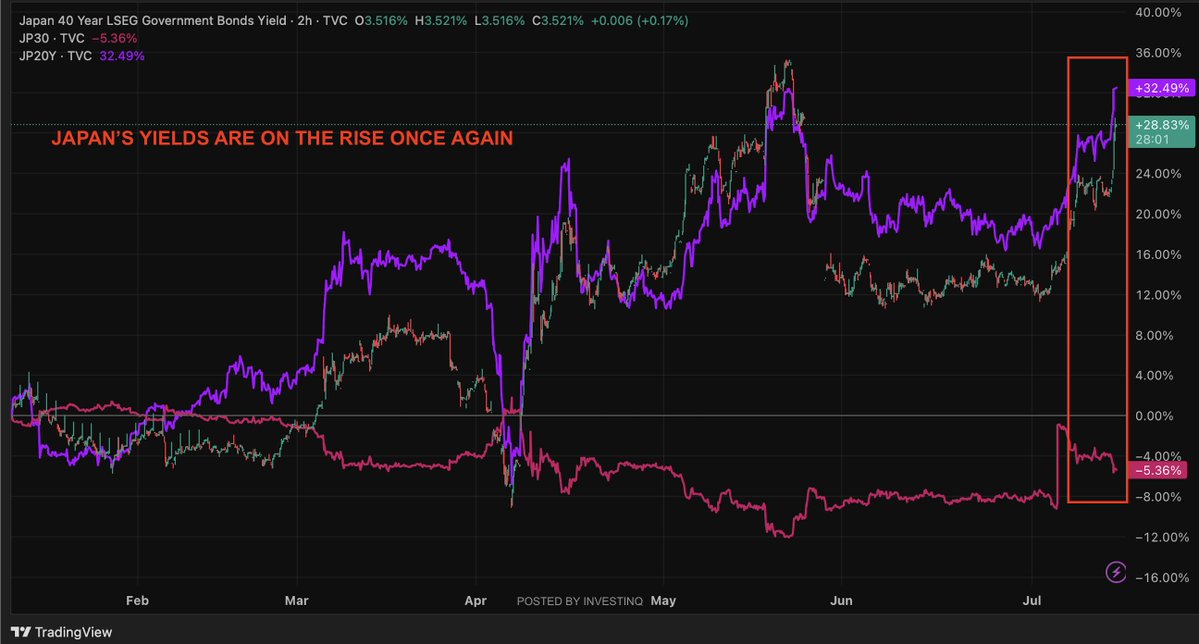
🚨 Japan’s bond market is spiraling into chaos.
Yields are exploding. Liquidity is vanishing. Trust is evaporating.
Let me break down what’s happening in Japan and how this affects the US.
(Save this thread)