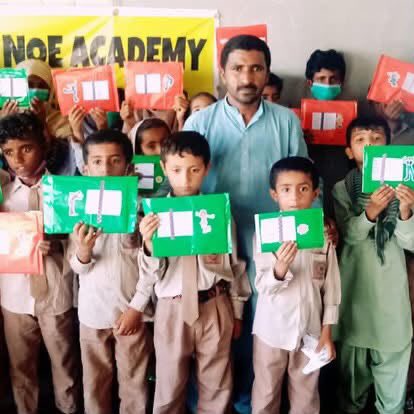
Principal of Memar-e-Nau Academy in Gwadar, Abdul Haq Baloch, Found Dead After Enforced Disappearance
Abdul Haq Baloch, the principal of Memar-e-Nau Academy in Gwadar and the younger brother of forcibly disappeared Baloch National Movement (BNM) leader Ramzan Baloch, has been found dead after months of enforced disappearance.
Abdul Haq was abducted by the Pakistani military in Gwadar in February, after which he was subjected to enforced disappearance. Today, along with two others, his body, bearing visible signs of torture, was recovered from the Panwan area of Jewani district Gwadar.
He was killed in custody and his body was dumped.
Abdul Haq Baloch held a Master’s degree in Computer Science from the University of Balochistan. He established Memar-e-Nau Academy in Mashkay to provide education to local children. However, the Pakistani military forcibly shut down the school.
Undeterred, he later founded another Memar-e-Nau Academy in Gwadar, where he continued educating children. In February, he was abducted by the Pakistani military and remained forcibly disappeared until his body was recovered.
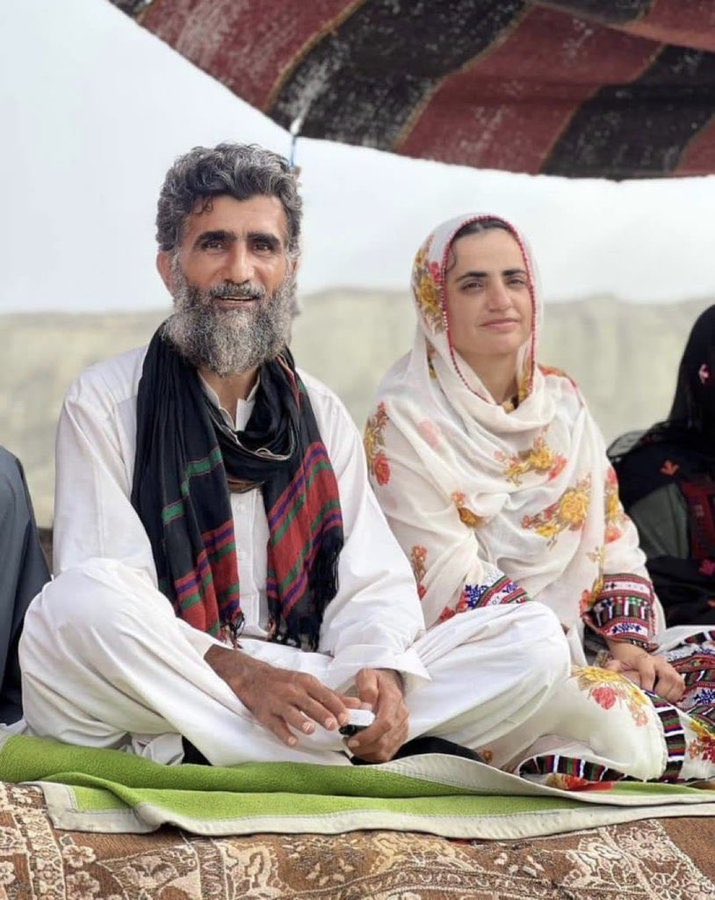
His elder brother, BNM leader Ramzan Baloch, was also forcibly disappeared on July 25, 2009. He was abducted from Zero Point in Uthal while traveling from Mashkay to Gwadar and has remained missing ever since. He is held in undisclosed detention facilities operated by the Pakistani military.
The killing of Abdul Haq Baloch is part of a broader pattern in which educators, intellectuals, and members of civil society in Balochistan have been targeted. Previously, Zahid Askani, the head of a private school in Gwadar, was also killed by state agencies.
More recently, Baloch professor Ghamkhwar Hayat was likewise killed. These incidents underscore the grave risks faced by those dedicated to education and public service in Balochistan.
No segment of society in Balochistan is safe. Teachers, students, lawyers, journalists, doctors, and human rights defenders all remain vulnerable to enforced disappearances, extrajudicial killings, arbitrary detention, and other serious human rights violations.
The widespread practice of enforced disappearances, custodial torture, and extrajudicial killings in Balochistan constitutes a serious violation of international human rights law.
We call upon the United Nations, international human rights organizations, and all relevant national and international bodies to take urgent notice of the ongoing human rights crisis in Balochistan, ensure independent, impartial, and transparent investigations into the killing of Abdul Haq Baloch and other cases of enforced disappearance and extrajudicial execution, and hold those responsible accountable.
@UN@WGEID@UN_SPExperts
" This is not normal. This is not lawful. This is not justice. This is collective punishment.
Only two weeks ago, my own sister was forced to appear in a press conference against me. She was made to speak under pressure, in front of cameras, not because she believed those words, but because the state wanted to use her as a weapon against me.
This is one of the cruelest forms of oppression. It does not only target the activist. It targets the mother, the sister, the wife, the daughter, and the whole family. It tries to turn love into fear. It tries to turn family bonds into political tools. "
Dr. Naseem Baloch
The BNM Chairman at a side event of the UN Human Rights Council's 62nd Session
Dr. Naseem Baloch, Vorsitzender der Baloch National Movement (BNM), erklärte vor den Vereinten Nationen, dass die Krise in Belutschistan nicht nur eine Menschenrechtsfrage, sondern eine grundlegende „nationale Frage“ sei. Bei einer Veranstaltung am Rande der 62. Sitzung des UN-Menschenrechtsrats betonte er, dass Themen wie Zwangskonversionen über Religion hinausgehen und eng mit Macht, Kontrolle und Unterdrückung verbunden sind.
Er beschrieb, dass Frauen – insbesondere aus Minderheiten – häufig zum Ziel von Gewalt werden, wobei ihre Körper als Mittel politischer und sozialer Kontrolle genutzt würden. In Belutschistan seien Frauen zusätzlich mit Militarisierung, Zwangsverschleppungen, kollektiver Bestrafung und staatlicher Repression konfrontiert.
Ein zentrales Thema seiner Rede war das Verschwindenlassen von Personen. Baloch erklärte, dass Frauen oft die Hauptakteurinnen im öffentlichen Kampf um Gerechtigkeit seien, indem sie jahrelang nach ihren verschwundenen Angehörigen suchen. Gleichzeitig würden Familien gezielt unter Druck gesetzt. Er schilderte auch einen persönlichen Fall, in dem seine Schwester gezwungen worden sei, öffentlich gegen ihn aufzutreten, was er als Beispiel staatlichen Zwangs bezeichnete.
Baloch stellte eine Verbindung zwischen Zwangskonversionen, erzwungenen Aussagen und politischer Unterdrückung her und bezeichnete dies als Ausdruck eines Systems, das auf Macht statt Freiheit basiert. Zudem verurteilte er die lebenslange Haftstrafe gegen die Aktivistin Dr. Mahrang Baloch und andere politische Gefangene und bezeichnete dies als Versuch, kritische Stimmen zum Schweigen zu bringen.
Er hob hervor, dass Belutschistan historisch für religiöse Toleranz bekannt gewesen sei, während Religion in Pakistan zunehmend als politisches Instrument eingesetzt werde, was Diskriminierung und Gewalt gegen Minderheiten fördere. Beispiele wie Angriffe auf religiöse Gemeinschaften in Sindh und Punjab unterstrichen laut ihm eine Kultur der Straflosigkeit.
Abschließend forderte Baloch die internationale Gemeinschaft auf, diese miteinander verbundenen Menschenrechtsverletzungen ernst zu nehmen. Er verlangte ein Ende von Zwangskonversionen, Zwangsehen, Zwangsverschleppungen und militärischer Repression, die Freilassung politischer Gefangener sowie Schutz für Frauen und Minderheiten. Zudem betonte er, dass belutschische Frauen nicht nur als Opfer, sondern als zentrale Führungspersönlichkeiten im Widerstand anerkannt werden sollten.
Er schloss mit der Vision eines freien und gerechten Belutschistans, in dem Menschen unabhängig von Religion, Geschlecht oder Herkunft gleich behandelt werden und Angst nicht als Mittel der Herrschaft dient.
#Belutschistan #Menschenrechte #UNHRC #Frauenrechte #Religionsfreiheit #Zwangskonversion #Zwangsehen #Menschenwürde #Balochistan #HumanRights #FreeMahrangBaloch #StopEnforcedDisappearances
“I do not believe that penalties deter men from the course they believe is right. History shows that penalties do not deter men when their conscience is aroused. I am prepared to pay the penalty, for freedom in one’s own land is the pinnacle of ambition. More powerful than my fear of prison is my hatred for the dreadful conditions to which my people are subjected. Whatever sentence is imposed upon me, when it has been completed I will still be moved by my conscience to take up again the struggle for the removal of injustice until it is finally abolished once and for all. I have done my duty to my people and to South Africa.”
Nelson Mandela
Another brave Baloch woman, Sayad Bibi, has been forcibly abducted and disappeared by Pakistani forces, adding yet another name to the ever-growing list of victims of enforced disappearance in Balochistan.
Silence in the face of these disappearances only emboldens the perpetrators. The international community, the United Nations, and human rights organizations must urgently take notice and press Pakistan to end the practice of enforced disappearances.
We stand with Sayad Bibi’s family and with every family still waiting for justice.
@UN@KenRoth@EUPakistan@EUCouncil
#ReleaseSayadBibi #EndEnforcedDisappearances #Balochistan #HumanRights
Yesterday in Panjgur, Pakistani security forces killed six innocent Baloch youths and brought their bodies to the District Teaching Hospital.
It is important to note that hardly a day passes in Panjgur without another innocent and unarmed person being killed.
#StopBalochGenocide
BNM Demonstration in Germany Against Pakistan’s Nuclear Tests in Chagai, Balochistan
#BNMinGermany | Saturday, 30 May 2026
Hashtag:
#NukeAftermathInBalochistan
https://t.co/X7I1qGLJsY
Köln, Germany — The Baloch National Movement (BNM) organized a demonstration in Köln, Germany, to protest against the nuclear tests conducted by Pakistan in Chagai, Balochistan, on 28 May 1998, and to highlight their long-term environmental, humanitarian, and political consequences.
Members of the Baloch diaspora participated in the protest and raised awareness about the devastating impacts of the nuclear tests on the people, environment, and future generations of Balochistan.
During the demonstration, speakers delivered speeches in both English and German, emphasizing the environmental destruction, health crises, political oppression, and humanitarian challenges faced by the residents of Chagai and surrounding areas following the nuclear tests conducted by Pakistan.
Addressing the gathering, speaker Akbar Baloch stated that the people of Balochistan remember 28 May not as a day of celebration but as a painful chapter in their history. He said that the mountains of Chagai still bear witness to the suffering caused by the nuclear explosions, whose consequences continue to affect generations. He paid tribute to Baloch martyrs, forcibly disappeared persons, political prisoners, and families enduring years of pain and uncertainty. He emphasized that nations survive through sacrifice, justice, and humanity rather than through weapons.
Mujeeb Abdullah Baloch, speaking in German, highlighted that the nuclear tests brought fear, disease, and long-term suffering to many families in Balochistan. He stressed that the environment and natural landscape of the region were severely damaged.
Speaker Asif Baloch stated that 28 May is observed in Balochistan as a day of mourning. He criticized Pakistan’s continued expansion of its nuclear weapons program and warned that such policies pose a serious threat to regional and global peace. He stated that the nuclear tests were carried out in a neglected and impoverished region without adequate safety measures, evacuation plans, or long-term health studies. According to him, local communities continue to suffer from cancer, congenital illnesses, environmental degradation, climate-related hardships, and economic devastation. He urged the international community to take a principled stand on nuclear accountability and to support efforts aimed at maintaining regional and global peace through nuclear disarmament.
Luqman Baloch stated that the people of Balochistan continue to suffer from the consequences of the nuclear explosions conducted in the Chagai Mountains. He said that the tests not only damaged the environment and natural resources but also exposed local communities to serious health risks and long-term humanitarian challenges. He stressed that nuclear weapons pose a threat not only to Balochistan but also to regional and global peace. He called for independent investigation teams from the European Union and the United Nations to be granted access to Balochistan in order to examine the humanitarian, ecological, and health impacts of the nuclear tests.
Participants chanted slogans against the Pakistani state and urged international and European organizations to conduct independent investigations and scientific research into the climatic, environmental, and humanitarian conditions in Chagai and other affected regions of Balochistan.
The organizers also distributed informational pamphlets in English and German among members of the public to further raise awareness of the issue.
The speakers reiterated their call for international attention to the suffering of the people of Balochistan and urged global human rights and environmental organizations to play an active role in addressing the consequences of nuclear testing in the region.
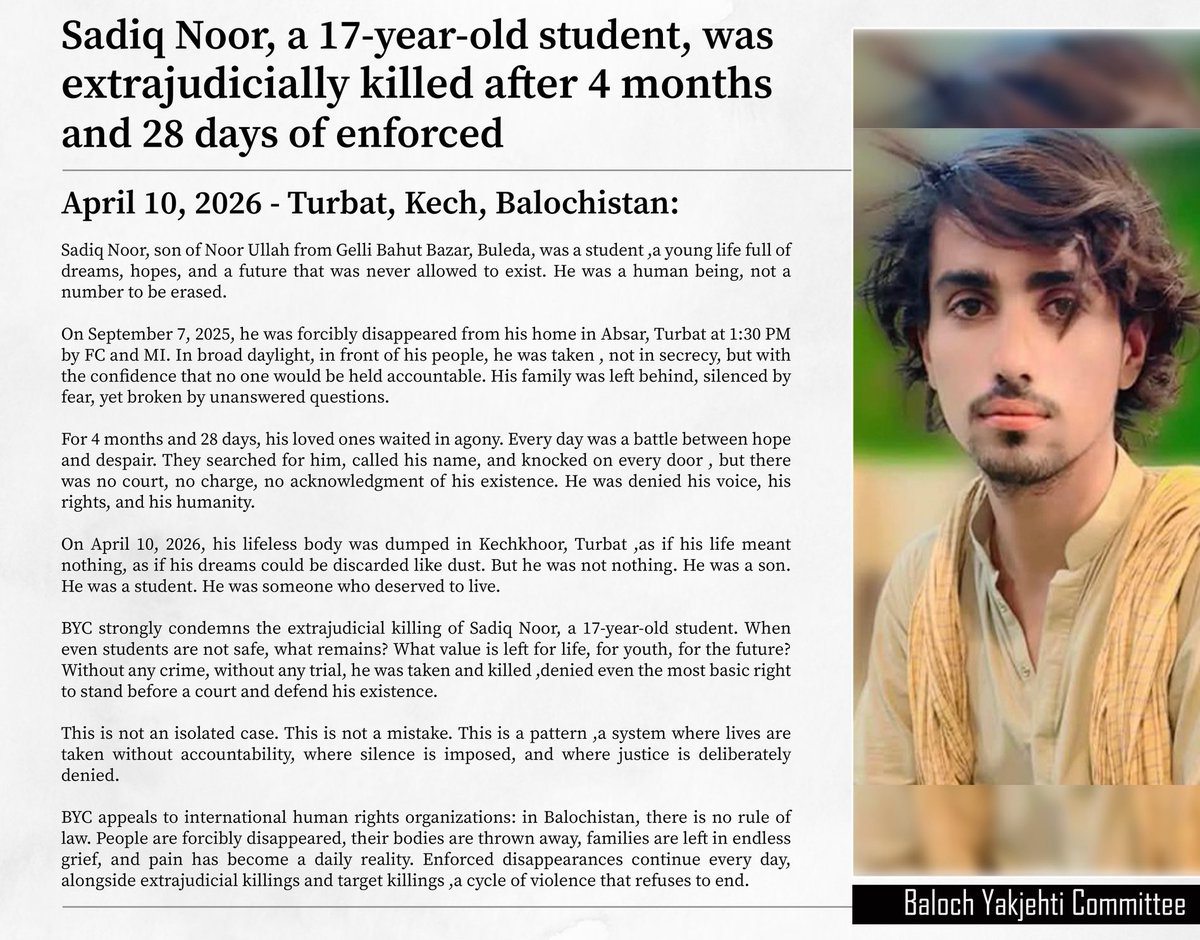
Sadiq Noor, a 17-year-old student, was forcibly disappeared for 4 months,then returned dead in #Turbat.
No charges. No trial. No justice.
When even students r not safe, what remains? #Balochistan. @amnesty#StopBalochGenocide#HumanRights
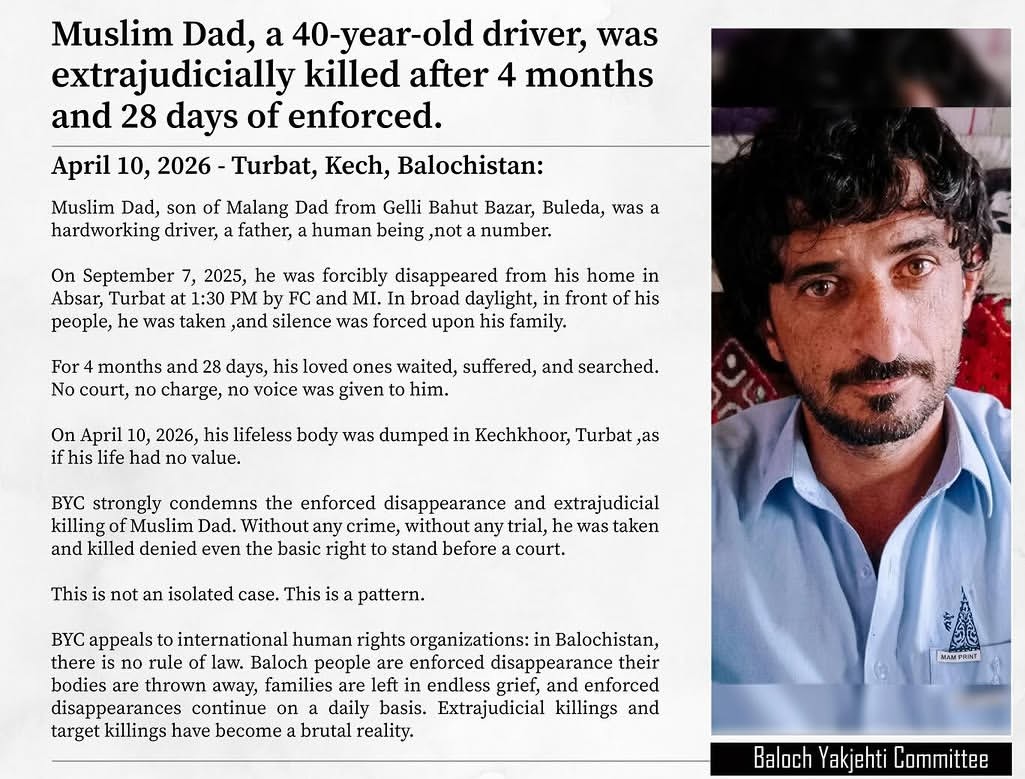
Muslim Dad, a 40-year-old driver & #father, was forcibly disappeared for 4 months,then returned dead in Turbat.
No charges. No trial. No justice.
This is a pattern in Balochistan thats formed by Pakistani Forces. @amnesty#StopBalochGenocide#HumanRights
ظلم کی انتہا ایک ہی خاندان کے نا بزرگ مرد اور خواتین کو بخشا جا جارہا ہے نا بچوں کو پورے کے پورے خاندان زندانوں کے نظر کئے جارہے اور دنیاء بلوچوں پر جاری اس ظلم پر خاموشی اختیار کئے ہوئے جو سنگین انسانی بحران کو جنم دے رہا ہے۔
Instead of confronting the Baloch freedom fighters openly active in Balochistan, the Pakistani state continues to target civilians, including the families of Baloch activists and leaders.
The abduction of @DrNaseemBaluch’s father and uncles is not just an isolated act; it is part of Pakistan’s systematic policy of collective punishment, violating basic human rights and international law. The world must take notice.
. @X Restore the handles of human rights activists. Shutting down accounts that expose injustice is censorship not moderation. @Faiz_Baluch & @PIRDAN_BALUCH exposing Pakistan military’s atrocities on Twitter (@X) from more than a decade. Respect freedom & protect human dignity.
Baloch Voice for Justice appeals to all people committed to peace and human rights across the globe to join the online campaign for Dr. Mahrang Baloch on 9th October 2025 from 9:00 PM – 12:00 AM with the hashtag #NobelPeacePrizeForMahrang
@NobelPeaceOslo