Indie Game Dev, since the mode13h on x86. Made some works on mobile console (GP32,Pda,Windows..) as ThunderZ and now working in my freetime on Mobile/PC Games.
Really love this project and article - a handmade early-mid-90s-ish FPS.
The procedural pixel art "gibbing" and particle effects are pretty cool, among other stuff
https://t.co/050NtJyLn1
New FPS game running on custom engine in 320x240 res in 256 colors - a piece of lost art, straight from the 90s. And it's coming to Steam Deck / PC soon 🤞
#retrofps
Catlantean 3D limits itself to 256 colors at 320x240 VGA Mode-X, recreating classic 90s pixel art constraints. Crafting a 768-byte palette with precise colors shows how technical limits guide asset choices for clarity and feel.
A teenager in the United States started publishing software at 14 in 1998, built the entire online infrastructure for the Occupy Wall Street movement in 2011, joined Google as a software engineer, quit in 2018, and then spent five years writing a C library that does something the entire industry said was impossible.
Then she combined it with llama.cpp and shipped the easiest way on the planet to run a large language model on any computer.
Her name is Justine Tunney.
Here is the story, because almost nobody outside the low level systems world knows what one engineer has built.
Justine was born in 1984. She started writing and publishing software at 14, back when distribution meant uploading binaries to BBS systems and chat networks. She picked up the handle jart, which she still uses on GitHub today. She did the work most teenagers her age were not doing. She read the systems programming literature. She studied compilers. She fell in love with C.
In July 2011 she registered the @occupywallst Twitter handle and the occupywallst dot org domain. Within weeks the protest movement that began in Zuccotti Park in New York had become a global phenomenon, and her infrastructure was the digital backbone of the entire thing. She handled the social media, the website, the donations, the coordination. She built the platform that pushed the movement to reach millions.
After Occupy she joined Google as a software engineer. She worked on TensorBoard, the visualization tool for TensorFlow, and on site reliability for Google infrastructure. She stayed for years. Then in 2018 she left Google Brain to work on a personal project.
The project was called Cosmopolitan Libc.
Cosmopolitan does something most C programmers would tell you is mathematically impossible. It lets you compile a C program once and have the resulting binary run natively on Linux, Windows, macOS, FreeBSD, OpenBSD, and NetBSD with no modification. One file. Six operating systems. No virtual machines. No interpreters. No recompilation. The technique she invented is called Actually Portable Executable.
The implications are wild. Cosmopolitan binaries violate every assumption about how operating systems load programs. They are at once a Windows PE file, a Linux ELF binary, a macOS Mach-O binary, and a shell script. The same bytes run on every platform.
For five years she worked on it mostly alone. She funded the development partly through Mozilla's MIECO program, which sponsored her work on Cosmopolitan 3.0, released on October 31, 2023.
A month later she shipped llamafile.
llamafile is what happens when you combine Cosmopolitan with llama.cpp. You take any LLM weights file in the standard GGUF format, you wrap it in Justine's binary, and you get a single file that runs on six operating systems without installation. No Python. No CUDA setup. No dependency hell. Just one file that you double click and it works.
Mozilla launched it as an official project of their innovation group on November 29, 2023. It went viral immediately. The repository, hosted at github .com/mozilla-ai/llamafile, now has 24,600 stars. The license is Apache 2.0.
Justine kept shipping. She added GPU support to Cosmopolitan, a task systems engineers thought would require rewriting the whole thing. She added dlopen support, another thing nobody else had figured out. She wrote whisperfile, a single file version of OpenAI's Whisper speech-to-text model based on the same architecture.
Her GitHub profile lists projects most engineers would consider impossible. sectorlisp, a Lisp interpreter that fits in a boot sector. blink, the tiniest x86-64-linux emulator on Earth. bestline, a teletypewriter command session library. redbean, a complete web server inside a single zip file.
A teenager who shipped software in 1998 grew up to write the C library that the entire local AI movement now runs on top of.
She did most of it alone, and most people scrolling AI Twitter cannot name her.
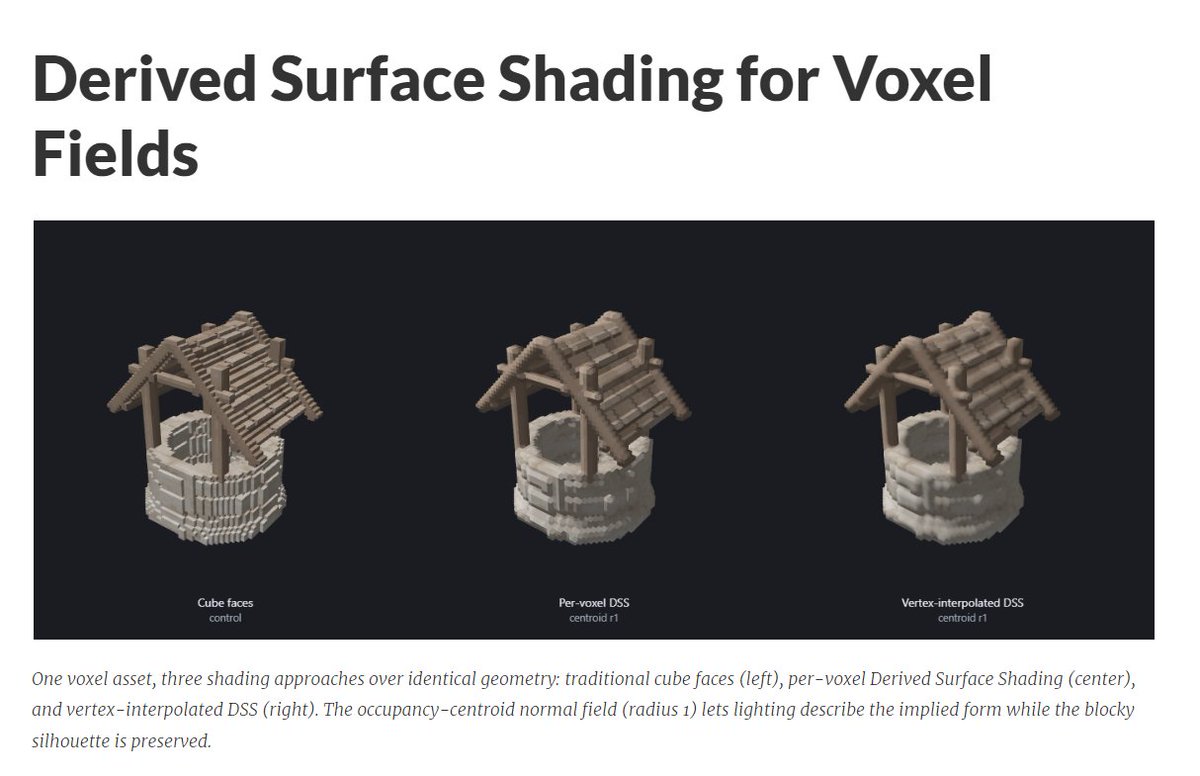
considering a voxel lighting algorithm that lights each voxel a uniform amount based on a calculated normal instead of using the cubic faces of each voxel.
Got a proof of concept working but now need better demo assets. Anyone have pixel-art quality voxel assets for me to try?
Just published the source code and research paper to this approach.
Repo also includes a demo voxel editor to try out yourself.
https://t.co/z4k0LPEwll
Following the progress of these early technical previews from @Morgerion is genuinely exciting:
Meet Shaterfall! ☄️
#MadeWithDefold 🧡💙
There’s already something special in the atmosphere, style, and total destruction in this stunning-looking RPG, and it’s still only early days!
We’ll be watching this one with great interest! 👀
#gamedev #indiedev #solodev #indiegame #pcgaming
Um dia bom é quando o que é pra funcionar, funciona.
Modo airship funcional faltando apenas setar a condição de tiles de pouso e uma sombra para ter noção exata do mapa. Tudo com as funções da PVSNESLIB
What's up, punk? Care to take to the skies? 🚀
#snes#pvsneslib#gamedev
Finally CPS3 boots on FPGA. The compiler was doing a wrong simplification breaking the logic.
This was debugged on a SiDi128 that has a broken video DAC, hence the odd colors