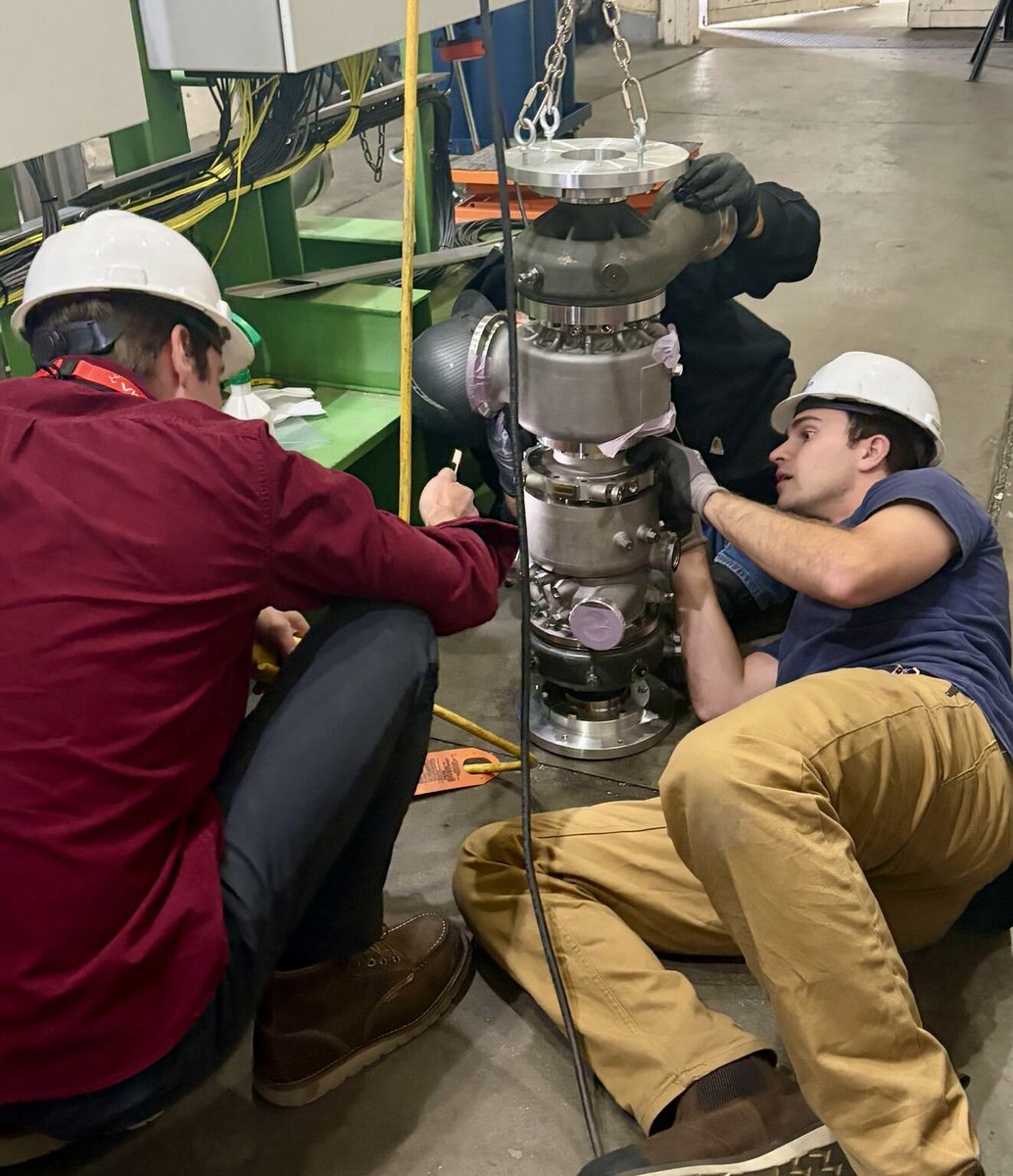
One of our team stitched this together from the test site.
Anyone who’s been out to Kelly Space Technologies in San Bernardino knows what the team has built out there. Being able to run multiple skids in parallel, multiple times a day, is a true edge. As is the efficiency of how we use our capital, thanks to Kelly (and a few other hacks).
Shout out to Allie and Eric for creating this awesome video highlighting something that’s so critical to how we operate (and why we’re sick at it). @ArborEnergyCo
Wowza!
“In all, SoftBank had reserved well in excess of 13 gigawatts of turbines, the equivalent of more than six Hoover Dams, according to people familiar with the orders.”
Here’s my hot take…this is going to open a few extra GW of turbines to the market with the orders cancelled and god knows there’s a market for them. And I don’t think this will be the last story like this.
But our estimates of turbine demand growth, even without AI point to there still being more demand than can be unlocked by late-cancels from a bubble burst. In 2008, an enormous number of homeowners went into foreclosure. But not all homeowners.
The major primes are still effectively capped around 40GW of production capacity. Pre-AI the industry was already booking 35-50GW a year in decent years just from replacements, industrial, and the rest of the world. Electrification and coal retirements can pretty easily support 25-35GW of that base going forward. Recips and BTM are already eating another 10-15+GW of near-term load because the big frames are sold out.
Even on the more moderate path in the from BNEF (US data centers from almost 35GW in 2024 to 78GW by 2035), AI is additive. SoftBank’s 13+GW is a drop in the bucket of multi-year backlogs already north of 200GW.
But a big reason the major turbine OEMs haven’t ramped up capacity to meet this surge in demand in the first place is the history of bursts… Enron, 2008 recession, mid-2010 renewable surge. As more of these dominoes fall, there will be less and less incentive for GE et al to ramp production aggressively.
Sounds like a ripe moment for an industry to be vulnerable to an upstart new prime… like @ArborEnergyCo 😉
https://t.co/JiT4TzYYti
It’s fairly common that people we are talking to want the simplest possible explanation of what we’re actually doing with oxy-combustion and sCO₂.
So we decided to record a short series of videos for the folks who truly don’t know where to begin.
Here is the first! A simple explanation of how our power cycle works differently from traditional power generation
👇🏻
If you’ve wondered how Arbor turns natural gas into clean, firm power, this is the simplest place to start.
In this short, plain-English walkthrough, our COO @Alicia_AERC follows the energy through Arbor’s power system, from fuel burning in pure oxygen inside the oxy-combustor to the supercritical CO₂ turbomachinery that generates electricity.
For a deeper look at the technology: https://t.co/CwCoNvX4fn
i know i'm an investor and see things as overly economic sometimes. but the grouping choices clearly favors resource framing . 'excess water and excess grid strain' are very easily swapped for 'higher utility/energy bills' which is also at 15%. effect on resources category makes it appear like people are voting for environmental reasons, when this likely is primarily economic and the author's choice to group water use/grid use with environmental concerns doesn't make sense.
its pretty clear to me that american's are worried DCs are getting economic incentives that they will pay for in higher energy and water bills.
tbf, they did attempt to put this in the disclaimer
In light of all the discussion around last night’s “referendum on data centers,” feels like a good moment to share this piece our CEO Brad Hartwig wrote in @_LatitudeMedia on why community impact has to be a core design requirement—not an afterthought—for these major projects.
I see the results from last night as less of a 'referendum' on the idea of power plants and data centers themselves, and more of a clear signal being sent by voters: They MUST be heard. Not as a checkbox exercise, but as a centerpiece to whether these projects can actually move forward.
Capitalism is super, but it has to be asked: If we’re not building these things in the interest of improving the world we live in--whether that is today, tomorrow, or decades from now... what is the point?
https://t.co/I3TBWb2Rk9
Lots of $$ going into turbine startups and more renders to go with them.
Meanwhile Arbor (@ArborEnergyCo) is testing their 1MW sCO2 system and scaling up to 25MW in 2027. Apply if you want to build time-to-power with a bunch of former SpaceX and GE engineers.
Sunday thoughts reading this piece, nursing a candy hangover:
“When I interview machinists and engineers who work on the factory floor, the word “muscle memory” comes up a lot. It might be the angle used to hold a tool, the timing of an operation or an adjustment for a particular machine. This is the tacit knowledge that physical AI needs to collect. And it won't be collected through data farms like robotics data.”
In the recent Field Trips episode with @schrep there’s a back-and-forth about how important the senior experience on our team is, and how there is just something in the gut simulations can’t capture. And the relationships we have with suppliers / ‘guys who know a guy’ is another point that comes up a few times.
It’s an exciting time to be thinking about building new machines and the manufacturing capability behind them. But it does strike me that the special use cases are ones with a human in the loop, technology or systems that make expertise exponential. The automation/replacement plays feel a longgggg way off. But I digress…
What is cooler IMHO is seeing the way the ecosystem is rippling outward in the wake of the hardware renaissance in SoCal, making the human reality of what makes Shenzhen’s manufacturing capability so robust. We can have the advanced technology and the vertical integration and learning acceleration AND an edge that stems from deep human relationships and a respect for every partner in the process.
Link to Field Trips Video
https://t.co/KFAIeeuZ5I
Many things to be admired about @_Pacific_Fusion approach but maybe the best pull quote…
"You can iterate so much faster when the core building block is small.
If you wanna build something that's affordable, try to build it in a modular way.” 💡
Just ran these numbers...
58.6 year cumulative experience building high efficiency gas turbines at GE
77.8 years cumulative experience building turbines and rocket engines at SpaceX
170+ years cumulative experience directly designing AND building high performance engines and propulsion systems
390 (!!) years cumulative experience building industrial plants and processes
Truly ridiculous. Find me a team with a more credible connection between power-generation rigor and rapid, integrated propulsion development. 😆
Amen to everything Ian said. Arbor is one of the most ridiculous technical teams in Lowercarbon’s entire portfolio, and when the dust settles they will be one of the defining energy companies of this era.
For scale, the estimate of over 600 million tons of CO2 emissions in this story--just from new US data centers alone--is about twice the CO2 emissions of all the volcanoes on Earth
Arbor algebra: 3D printing advancements provide an opportunity to do it a different way
+ [(Current long-lead backlogs + historic demand)*rare market opening]
*SpaceX learning acceleration + GE technical excellence
= the next great industrial power giant.
“Historically, only three or four foundries worldwide have been able to cast them at the required precision, and order books are reportedly booked out toward 2030.”
Hot-section blades and vanes are one of the tightest constraints in conventional gas-turbine production.
And it is a bottle neck that is *long-lead* and we are really seeing that play out right now.
Our co-founder and CTO, Andres, designed these blades at GE. It is incredible to learn how challenging it is to grow single-crystal blades that can survive the temperatures and stresses inside a turbine.
We are not in that supply chain.
Additive manufacturing has advanced to the point that we can print our entire system—turbines, shafts, housings, and heat exchanger—using specialized powders qualified for the pressures and temperatures of long-term operation. Those powders sit outside a number of other global bottlenecks.
3D printing and superalloy powders ftw.
https://t.co/mPK0GuH09J
This is so well deserved! If you weren't aware, @grant__gregory is Deeptech’s very own Mary Meeker.
His annual "State of Adventure Capital" report gives a fast-moving investment shift a credible shared narrative: what is changing, why it matters, and which indicators to watch.
For those of us trying to innovate at the frontier of physics, that matters enormously. Inventing the future requires capital well before the end product is obvious—and Grant’s work helps the market see the immense industrial opportunity in front of us.
A huge congrats to Grant, @IanRountree, and @cantos. Lucky to have you guys in our corner at @ArborEnergyCo.
20 Ferraris of power held in the palm of your hands. “The power plant will be safe but around here we need to break a few eggs” + your expression 😂. (Dont worry guys, the test site is safe too).
Awesome tour! Watching you and Andres go back and forth is one of my favorite past times. Excited we get to share a sliver of it with the world!!
Thank you for this series. Can’t wait to watch the other episodes.
Touring factories & labs is one of my favorite parts of this job. I could spend all day asking questions.
This time we brought cameras.
Field Trips starts with @RhodaAI, @ArborEnergyCo & @harbingermotors:
https://t.co/h1fNcxv9FM
One of my favorite things about working at @ArborEnergyCo is getting a front-row seat to some truly extraordinary engineering—and to the people figuring out how to do things that haven’t been done before.
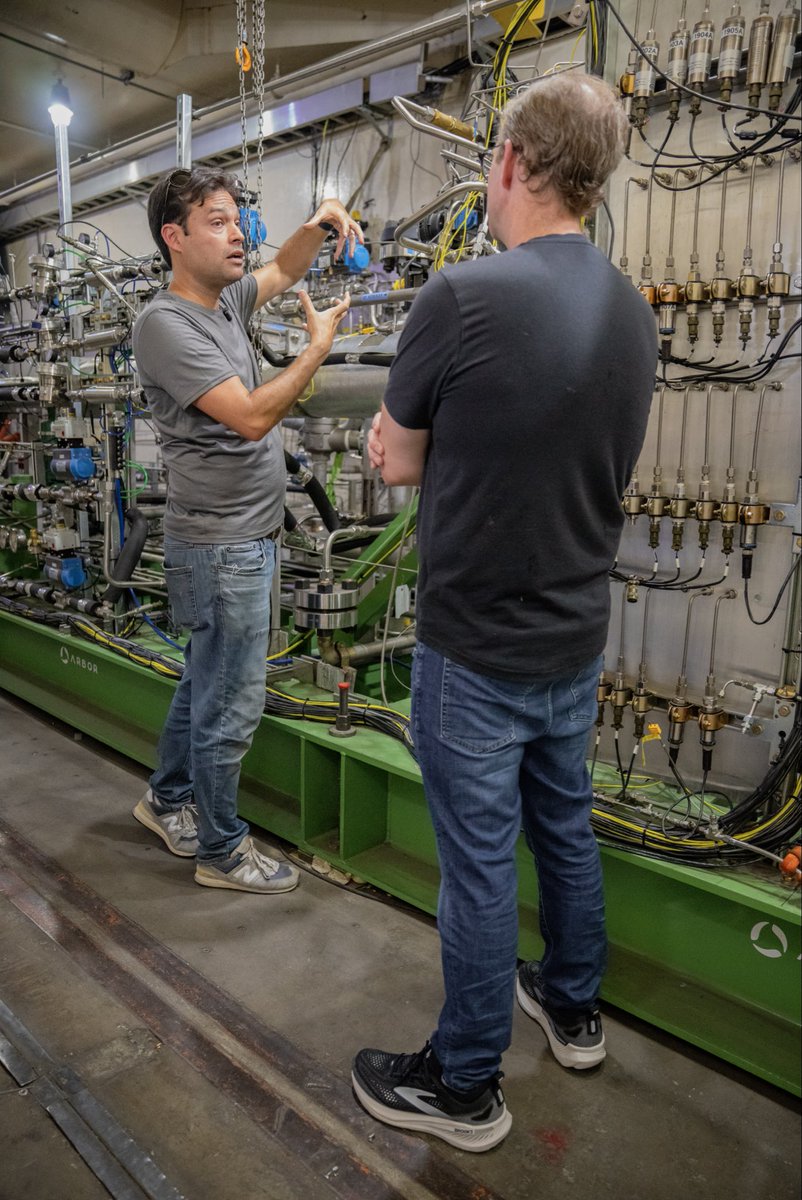
@schrep came out to our test site to get an in-depth tour of our 1MW pilot, ATLAS, and to get into the weeds with our co-founder and CTO, Andres Garcia-Clark. It’s a long one, but and incredible journey through everything you need to know about the incredible engineering happening out in San Bernardino.
https://t.co/JhMssSBOqS