Small TAM / long tweet...
I spend a lot of my weeks helping our Series B-stage portcos think about the right pitch, and the right 'type' of investor who's going to get comfortable with their specific hardtech risk if they are pre-revenue. Generally, I think this means you need to know the couple ways people underwrite your ramp (this post is energy-focused):
The first type gets comfortable off your contracts. Say you're a power developer with a ~25MW hyperscaler PPA about to sign, 2GW of options sitting behind it, a second project at 100MW that can expand to 500MW, and a verbal from a third buyer. What they'll do is discount each of those lines for execution risk, delays, and the odds the counterparty walks, and back into what they're willing to pay today. The PPA is relatively easy to price; the options and the verbal get aggressively discounted. Most people will pay attention to whether there's a legible trigger for when it converts. Fervo's IPO valuation ran on a GW-scale Google option & you can back into the exact EV per MW cost to comp.
The second type gets comfortable off a cost floor. Say you're building infrastructure in an emerging market at ~$5M/MW when the incumbent way of doing it is $12-16M/MW, and you've got a path to 10+GW that doesn't need a science miracle. These investors need to believe in the 'core': (1) there will be consistent demand for power even if Kimi eats us all, and (2) buyers want cheaper energy (if the investor doesn't believe either of those things, your investor will probably not get over the line, in general). Then they rebuild your cost stack from line items = labor rates, transformer quotes, power contracts, permitting, vs. any tradeoffs of the specific tech (availability, reliability) -> which limits your TAM and market pull. If you're landing 5-10x under the incumbent, they can underwrite a winner-take-most outcome.
Big picture, you need to articulate why more $ = you can move faster. This was linear in software but it is not in hardware, as some development / engineering work / contract conversions aren't that predictable.
The $0 to $50m in revenue is kind of a valley of death for how people perceive you, so you want the milestone itself to be the proof you're bankable & in many instances that you unlock non-equity financing.
How long you're stuck in the cost-floor camp mostly depends on your technology. Fusion, advanced fission, geothermal before the first well live there for years and are selling an LCOE floor plus a set of de-risking milestones. Modular clean baseload and thermal storage get to a first unit faster, so they cross into the contract camp sooner. And data center power, behind-the-meter gas with CCS, RNG, grid hardware, those are offtake-driven from day one, where the counterparty's credit is a lot of the underwrite.
Two other things to prove in your pitch:
(1) Who pockets your savings. Being 5-10x cheaper doesn't help you much if your customer takes all of it. If you sell to one hyperscaler, they're big enough to keep negotiating your price down until the savings show up in their P&L instead of yours. Diversity matters!
(2) Whoever you sign sets how cheaply you can finance. The credit quality of your offtaker flows straight into your cost of capital.
Just a girl, standing in front of a boy, asking him to use different metrics to evaluate resilience and hardtech businesses instead of slamming SaaS metrics and hoping it works..
Most startups fight churn. Companies built for disaster survivors want it, because it means the customer is whole again. @sacca and @caiekelley of @lowercarbon on @BrightHarborCo, Longview Restoration, and why they’re built differently. Disasterproof: https://t.co/wrOM36Vo91
If ~4 years ago was a great time to invest in breakthrough energy companies, which are hitting growth stages now, the next market we think is underappreciated is resilience and underwriting for a more unstable world - including natural disasters. Happy to back @standinsurance!
Today @standinsurance announced $70M at a $1B valuation, led by @Saga_Ventures. A year ago, we insured $1B of property. Today it's $10B. Disasters follow the laws of physics. Insurance should too. Here's what our team is building:
We, but specifically @orbuch and @DuncCarlson, backed Will from early days (pre-seed) at @lowercarbon & it is so cool to see Ulysses now move fully into deployments. And to see Chris, who is quiet on X these days but still very much in the arena, back (for a moment) in SF!
.@willob of @ulyssesinc joins @sacca and me for a pint to discuss how subsea robotics is unlocking Earth’s last frontier. We talk about the physical constraints of operating 1,500 meters underwater, why seagrass holds 20% of the ocean’s carbon, how green tape hinders environmental restoration, and why hard tech startups are verticalising hardware manufacturing. (Plus, Will's interesting Guinness history facts.)
Trying to keep the investing philosophy quite simple by focusing on companies and founders building in the Real World to provide Real Good. Along the way you end up in big markets that have some pretty big moats when they scale. Thank you for hosting @billclerico!
Big asset manager to @sacca: "We don't do climate."
"Ok. Energy? Advanced manufacturing? Resilience?"
"Love it. Send it over."
Same fund.
My conversation with @sacca and @CaieKelley of @lowercarbon from NY Climate Week: https://t.co/KDue3l5Uki
Arbor's tech, which hit full power on the core machine this week:
- Burns fuel w/ pure oxygen, so the outputs are CO2 and water.
- The CO2 can be captured and stored = no pollution.
- Arbor uses that CO2 as the fluid to spin the turbine.
- CO2 in that state is so dense that the machine is 1/10th the size of a gas turbine w/ 90% less metal.
- It can be 3D printed, which helps eliminate some of the supply chain dynamics for big incumbents.
- It's very hard to make a turbocompressor like this, so rest assured, this is a big technical deal.
Amen to everything Ian said. Arbor is one of the most ridiculous technical teams in Lowercarbon’s entire portfolio, and when the dust settles they will be one of the defining energy companies of this era.
I enjoy the Jefferies research reports mostly because of the formatting & the subject lines. As we know, the biggest bottlenecks are labor and political pushback; GWs of data center capacity are 5x higher than they were 5 years ago, but electricians have grown only 15% over that period:
- There are 65 GW of data centers under construction, and 361 GW of announced projects.
- The model assigns various probabilities (location & states w/ moratorium), build progress based on satellites, power source, and developer types (hyperscalers are easier to get greenlit but also are more likely to cancel their own projects).
- Therefore a more reasonable assumption is 18 GW of online capacity in 2027, and 26 GW in 2028. Still huge growth, but haircut accordingly...
My focus is critical infrastructure: the energy, manufacturing capacity, and physical systems that make everything else possible. After years of friendship and partnership, I'm deeply grateful to be teammates with @CaieKelley, @claydumas@sacca and the rest of this talented team
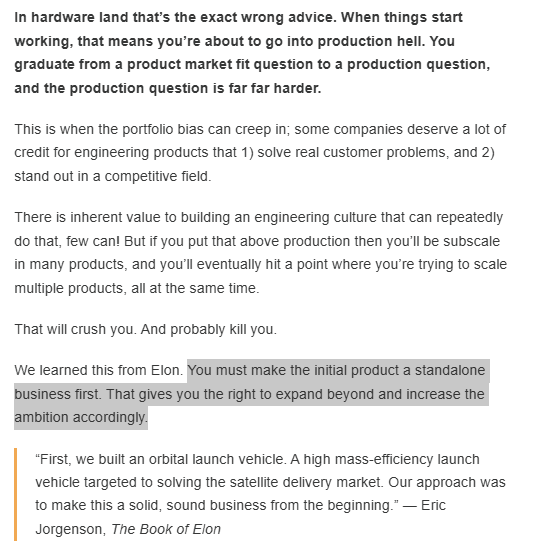
Good stuff from @grant__gregory and the millionth reminder that hardware is not software which means it's not (1) a single key product insight that creates any particular moat and (2) you do have to focus on one thing + produce a lot of it to create geometric growth at scale:
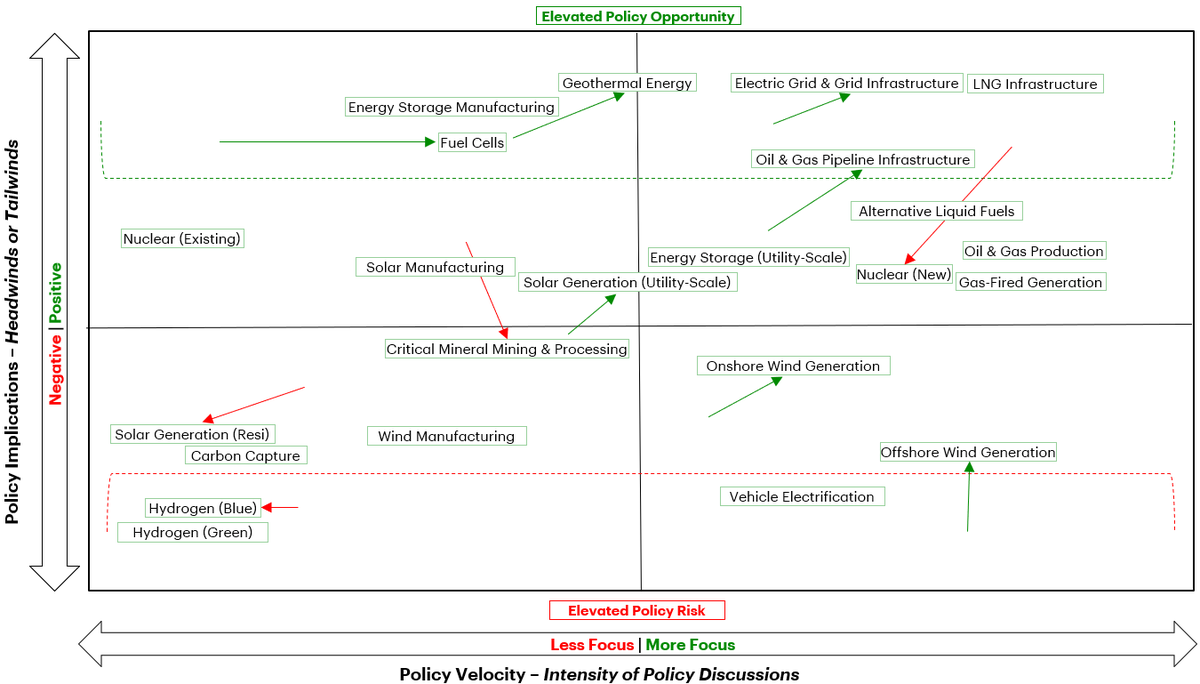
Is permitting reform actually upon us?
The Senate permitting bill, whose details came out today, caps federal environmental review at 2 years, gives challengers 150 days to sue, and bars agencies from pulling permits they have already issued. That last one is a real unlock b/c of what it will mean for financing. There is a lot more here that I am reading through:
- New data centers (20 MW+) would pay for grid upgrades they require.
- Geothermal receives the same fast-track treatment as O&G.
- Home batteries would get access to wholesale markets in 18 months.
- Transmission upgrades in existing places w/o new environmental reviews (!!)
https://t.co/JxToo9Spdq
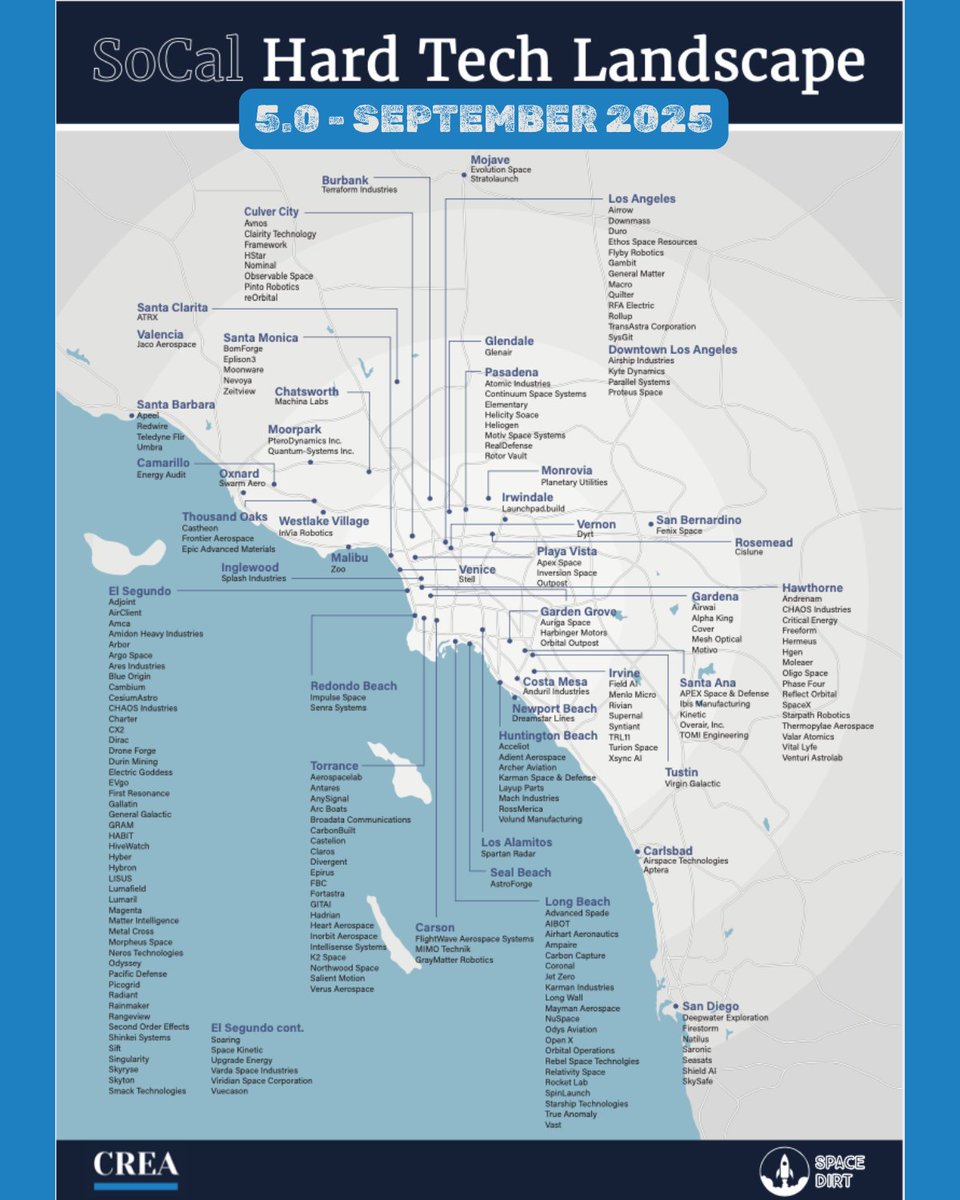
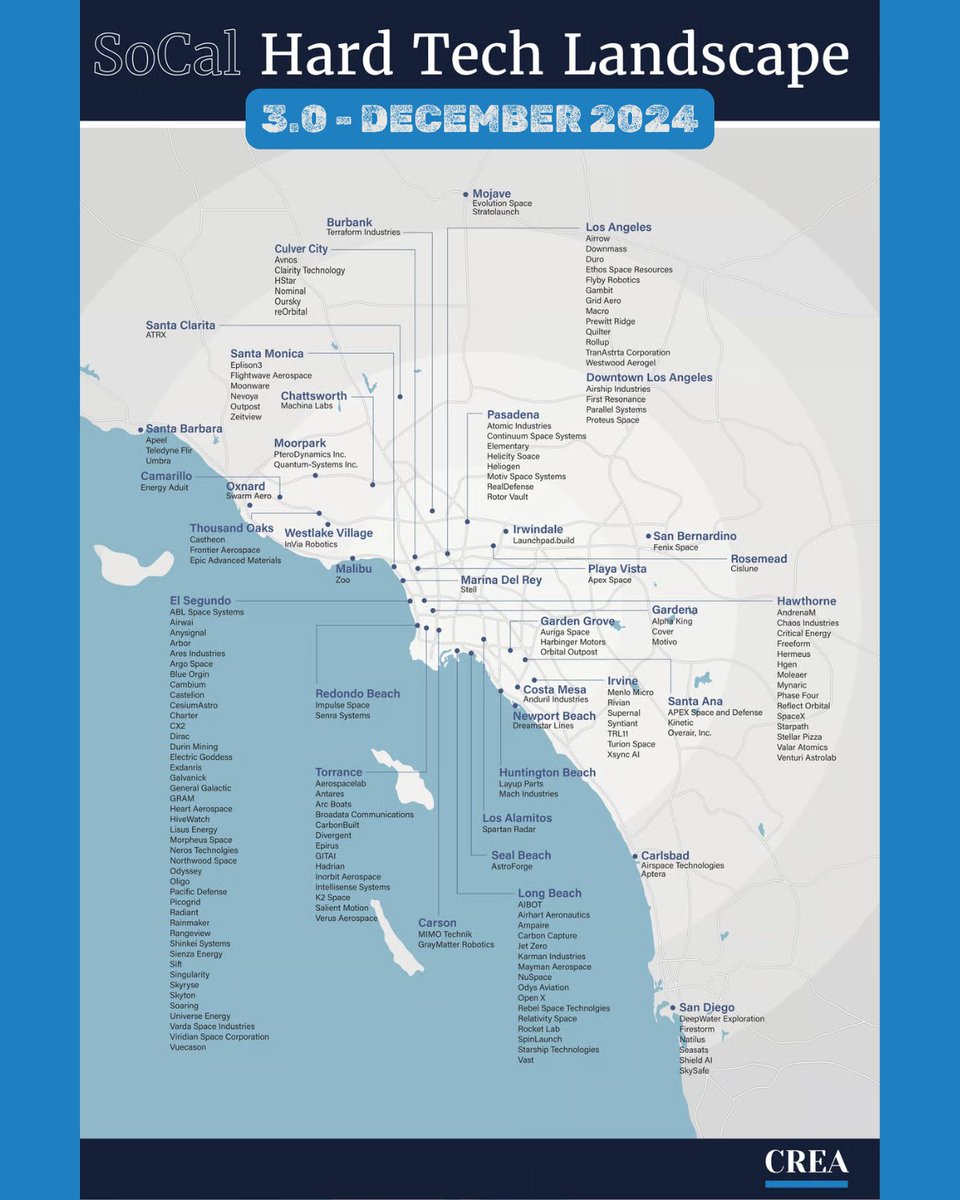
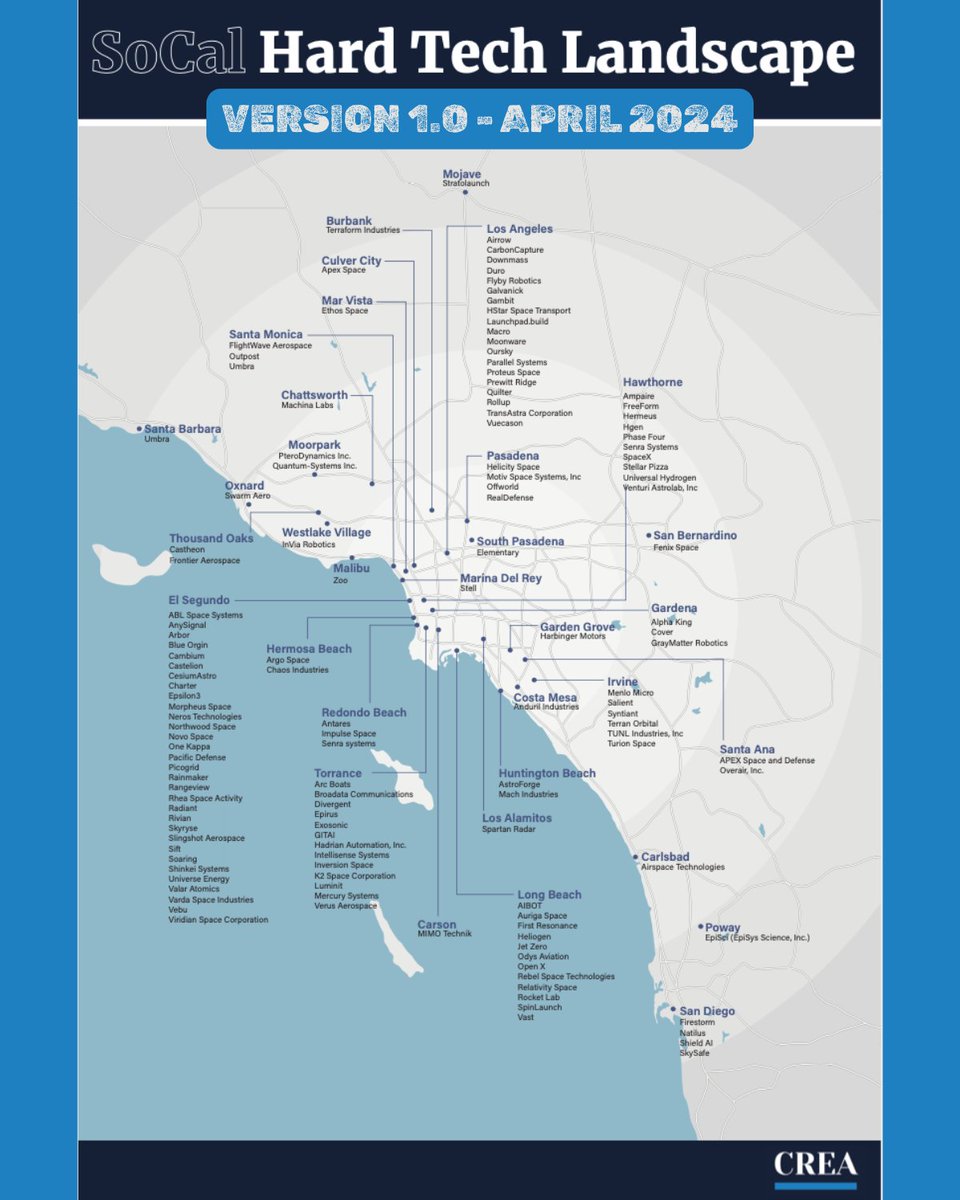
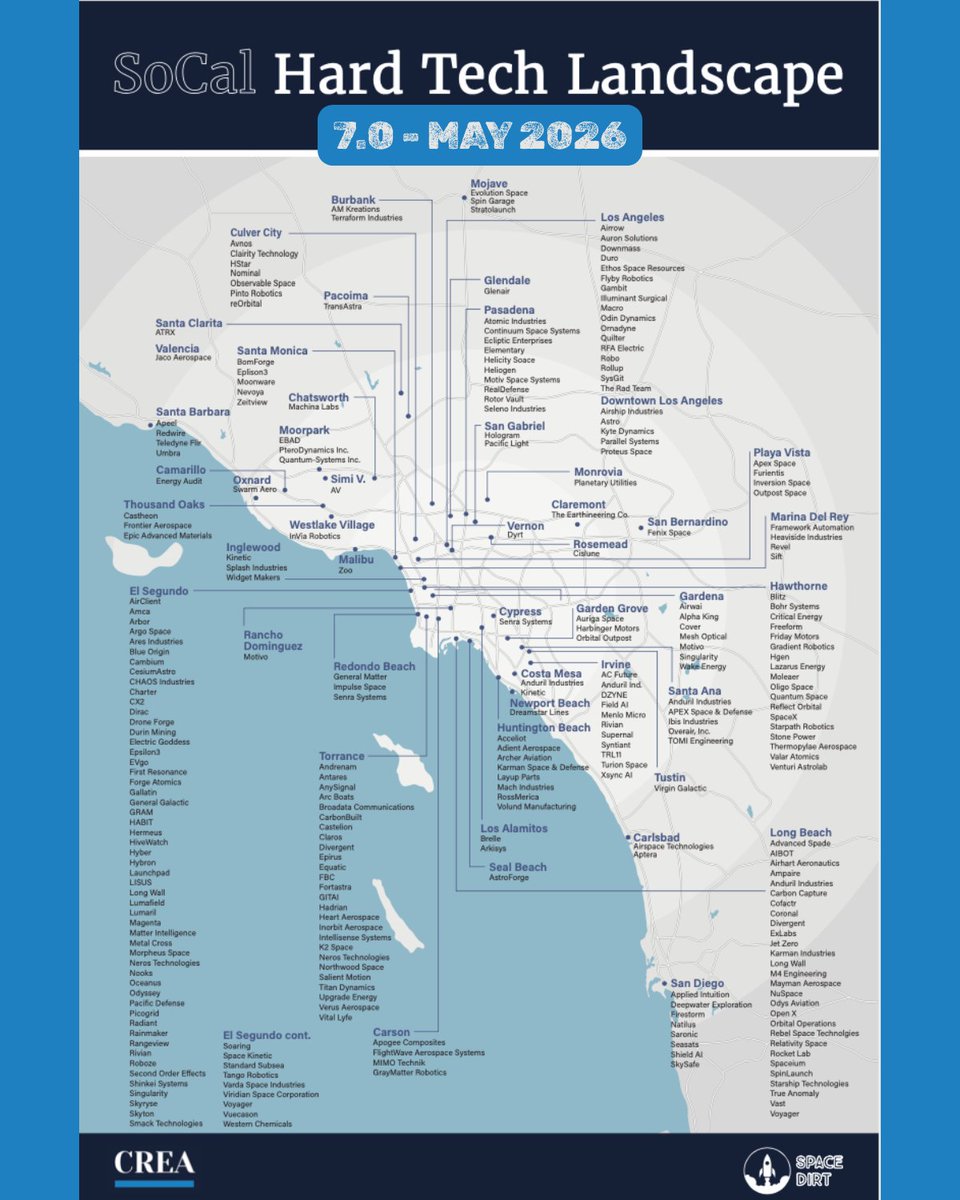
In our LA office, we printed out these maps when @erik_stiebel started making them, and we would use them as a way to gut check that we weren't missing any great companies that had cropped up in the last few months. I love this ecosystem, which feels denser by the day 😄.
I first released my SoCal Hard Tech Landscape Map in April 2024.
It was about 2.5 years ago, but given how fast hard tech changes, it feels like ancient history.
I’m putting the finishing touches on Version 8.0 now.
The last version had 279 companies across the region. This one looks like it’ll break 300.
So I thought it’d be interesting to look back at how the ecosystem has grown.
X won't let me include all 7 previous versions, but I think the 4 maps I included tell the story.
Version 8.0 is coming in October.
If you're a SoCal hard tech startup and want to be included on the October map, DM me this week.
-Erik