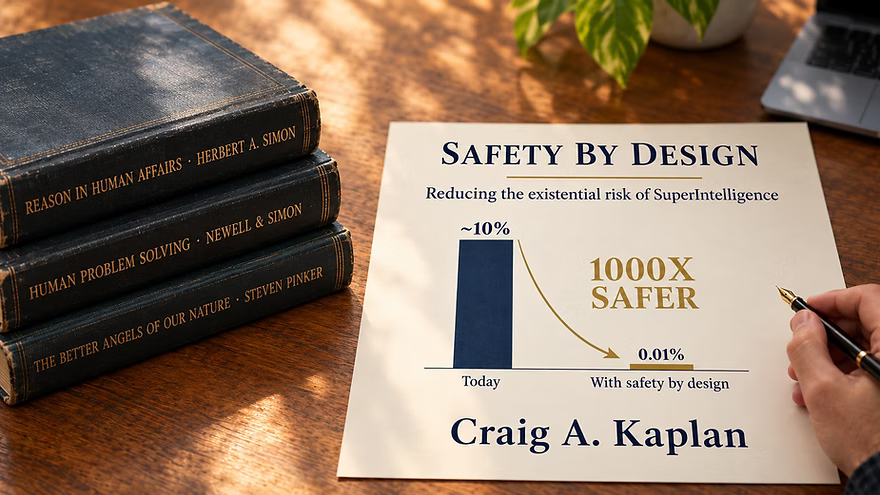
Today's AI follows instructions. Tomorrow's SuperIntelligence may decide those instructions no longer apply.
We can't count on rules alone to keep SuperIntelligence safe. I believe lasting alignment must come from values embedded in AI itself. https://t.co/CRcwWzS9O2
Who sets the goals when AI surpasses human intelligence?
That’s one of the questions Mo Hafez and I explore in an upcoming episode of @bytewisepodcast, along with why designing for superintelligence safety matters now.
Stay tuned! https://t.co/ngvVrXLwHD
Could AIs policing one another be our best defense against rogue SuperIntelligence?
I made the case for reducing AI risk by 1,000x in my AIM 2025 keynote and debated its feasibility with @Liron Shapira.
The approach: https://t.co/GYcW8wIzgc
The debate: https://t.co/LJfXGkge1H
Guardrails can help, but what happens when AI systems find ways around them?
@iduncan's @washingtonpost coverage of government chatbot testing raises important questions. We need to engineer AI to remain safe and aligned with human interests, not just rely on restrictions. https://t.co/1cNroXE91P
OpenAI's move toward independent safety oversight is encouraging, as @Jingnan_Huo reports, but I believe we also need SuperIntelligence architectures designed to remain aligned with human interests as capabilities grow. https://t.co/JC0oWzKCBP
Reducing the existential risks of SuperIntelligence requires more than safeguards. It requires a fundamentally safer design.
I joined @liron on Doom Debates to discuss how human-aligned architectures could reduce p(doom) below 0.01%.
Our debate: https://t.co/1mTh5Q9Wnh
My proposed approach: https://t.co/aAusTo4esb
John Sherman deserves credit for bringing much-needed urgency and public attention to the risks of AI developing its own successors.
His call for human oversight is important, and I'd take it a step further: we need SuperIntelligence architectures designed to remain aligned with human interests, not simply constrained by external safeguards.
His ask: a global ban on AI that builds the next AI without people in the loop.
"Machines will not build machines without humans involved."
Full speech: https://t.co/wr1O0bl4QF
@liron Thanks, Liron! Really enjoyed the thoughtful debate and your willingness to challenge my assumptions. We may disagree on the path forward, but rigorous, good-faith discussions like this are exactly what we need to make progress on AI safety.
As AI grows more powerful, the debate over how to keep it aligned with human values is becoming increasingly urgent.
In my recent conversation with @Liron Shapira on Doom Debates, we challenged assumptions about AI risk and explored my approach to making superintelligence 1,000 times safer. https://t.co/n2ExhxGpLO
This conversation raises critical questions about the pace of AI development and the challenges of ensuring increasingly capable systems remain safe.
I believe we can solve the alignment problem and build superintelligence that genuinely understands and upholds human values. Achieving this will require rethinking how we develop AI, with safety and alignment embedded in the fundamental architecture of these systems from the very beginning.
An important area of research. Understanding what's driving improvements in AI capabilities is essential, particularly as these systems become more powerful. We also need to ensure that advances in intelligence are accompanied by advances in safety and alignment.
This got totally buried cause it came out the same day as Navier Stokes.
But I think this is super interesting evidence about what the true major source of algorithmic progress is.
It's an important debate. We need people who understand AI safety working inside the labs, but their presence alone isn't enough. The bigger challenge is ensuring that safety and alignment are built into these systems from the beginning, rather than treated as obstacles to overcome later.
DEBATE: Should AI company employees quit?
Brendan Steinhauser (@BStein80) argues that regulators need safety-conscious workers to stay inside the labs.
More computing power doesn't necessarily mean more intelligence. The human brain is a remarkable example of efficiency, and understanding why could help us build safer SuperIntelligence.
What might AI developers be overlooking? I explore this with Mason McCumber on The Next Build Podcast: https://t.co/t6mb3Ry71B
@tegmark When leading AI safety researchers warn of a serious risk of losing control, accelerating without adequate safeguards is the wrong response. We need to focus on designing SuperIntelligence to be safe and aligned from the outset, not assume we can fix it after the fact.
AI agents are becoming more capable, but are we doing enough to keep them within our control?
Australia’s proposed AI oversight measures, covered by @Reuters’ @renjujose, highlight why we need to design for safety from the outset, especially as we approach SuperIntelligence. https://t.co/uizgG8XPIu
As AI accelerates its own development, maintaining human understanding becomes even more important. @ronbodkin highlights why speed alone isn't enough.
We need to ensure humans can still evaluate what AI systems are doing and why. That's essential if we're going to advance toward SuperIntelligence safely.
METR estimates Anthropic's acceleration from automating AI R&D at 2x. They note "It is possible that automation is close, and leads to very rapid acceleration once human bottlenecks are removed."
However, it is a choice as to whether an organization takes humans out of the loop. Maintaining human understanding and accountability is critical both to pace the frontier and to ensure human experts understand and stand behind safety claims.
To keep humans in the loop, it's important to test whether people still understand what agents are doing.
(1/2)
Just because AI sounds confident doesn't mean it's right. Even the most advanced systems can miss something obvious.
I talked with @cmcnulty2000 on the @synozur Polaris Podcast about why human expertise is still essential. https://t.co/yaKI4TlW3O
An AI system doesn't have to be superintelligent to cause serious harm. Give it autonomy over financial transactions, and the stakes change quickly.
The @USOCC's new guidance, covered by @Reuters' @peteschroeder, reflects this concern. AI safety needs to account for what systems can do, not just how smart they are. https://t.co/rMcWt8J9M2
Geoffrey Hinton is right to raise concerns about where AI is headed. But the answer isn't simply to slow down.
We need to design superintelligence to understand and respect human values before it becomes more capable than we are. https://t.co/TK5x5bOPwd