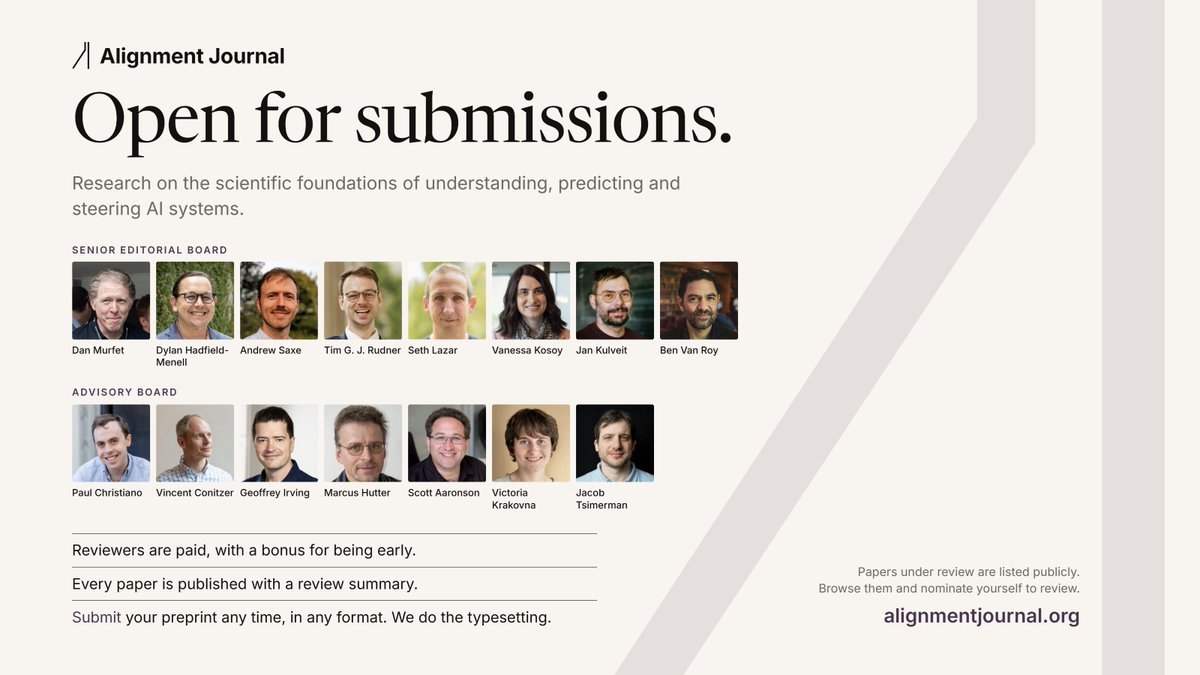
The Alignment Journal publishes research on the scientific foundations of understanding, predicting, and steering artificial intelligent systems. As of today, submissions are open to everyone.
What we do differently:
- We pay reviewers, with bonuses for speed and insight.
- Review discussion is confidential, but every accepted paper is published with a “review summary” to distill the insights generated.
- Each paper is judged against our acceptance bar, not against other submissions.
- Papers under review are listed publicly, and researchers can nominate themselves to review, so each paper can reach the reviewers who know the topic best.
We seek work that builds theoretical or otherwise principled analyses of agency, robustness, incentives, interpretability, generalization, and long-term behavior, and whose significance survives the deletion of any particular model, dataset or benchmark. Empirical investigations of such ideas are welcome, and negative results are encouraged.
We are especially interested in approaches that could apply to future superintelligent systems that interact and self-improve.
You can submit your preprint in any format. Submissions are rolling and open now on the website.
If you are instead interested in reviewing or serving as an action editor (basically: an area chair), create an account on our website.
Links to submit, our scope and the reasoning behind the Journal are in the reply ⬇️
Happy to be an editor: please do submit things I'd like to read. It is an ambitious attempt to fix academic publishing in this extremely important domain.
The Alignment Journal opened to submissions yesterday. A big thank you to Principles of Intelligence (@PrincInt), our fiscal sponsor, and to the people of @Iliad_research, whose operational support got us this far! 🫶
The Alignment Journal opens to submissions today. I’m on its board. It’s a venue for foundational alignment work. Reviewers are paid, every accepted paper gets a review summary, and the software is clean and modern. Submit your preprint to https://t.co/M6YK1drgG1
@mathandcobb The Journal is a philanthropically funded, nonprofit project, fiscally sponsored by Principles of Intelligence. Our funders are listed here: https://t.co/3Hwjp0xuNz
The Alignment Journal publishes research on the scientific foundations of understanding, predicting, and steering artificial intelligent systems. As of today, submissions are open to everyone.
What we do differently:
- We pay reviewers, with bonuses for speed and insight.
- Review discussion is confidential, but every accepted paper is published with a “review summary” to distill the insights generated.
- Each paper is judged against our acceptance bar, not against other submissions.
- Papers under review are listed publicly, and researchers can nominate themselves to review, so each paper can reach the reviewers who know the topic best.
We seek work that builds theoretical or otherwise principled analyses of agency, robustness, incentives, interpretability, generalization, and long-term behavior, and whose significance survives the deletion of any particular model, dataset or benchmark. Empirical investigations of such ideas are welcome, and negative results are encouraged.
We are especially interested in approaches that could apply to future superintelligent systems that interact and self-improve.
You can submit your preprint in any format. Submissions are rolling and open now on the website.
If you are instead interested in reviewing or serving as an action editor (basically: an area chair), create an account on our website.
Links to submit, our scope and the reasoning behind the Journal are in the reply ⬇️
I’m honoured to be on the advisory board of the new Alignment Journal, and we open for submissions today! The field of AI safety needs more canonical, high-quality spaces for exposition (despite the wonderful efforts of many, many people, including Victoria Krakovna who is on the advisory board as well!) and I think this could be a great addition.
Please take a look, and if you're doing research on AI safety then (Thank You! And) consider submitting!
Even before the slopocalypse, peer review and publishing in general in work on AI was broken. Everyone complains about it; here's to doing something about it instead. This journal will, I hope, become an invaluable source of trusted research on AI alignment, and give researchers working on this topic a thoughtful, constructive review process, a hopefully large audience, and opportunities for awards that can help them to build career capital. Proud to be making a start, please submit your papers, and volunteer to review.
The Alignment Journal (@AlignmentJrnl ), Iliad's sister project under Principles of Intelligence, is now open to submissions from everyone. It is a free-to-read, free-to-publish journal for research on the scientific foundations of understanding, predicting and steering AI systems.
The Journal seeks research that builds theoretical or otherwise principled analyses of agency, robustness, incentives, generalization, interpretability, and long-term behavior across many learning and decision-making paradigms. Empirical investigations of such ideas are welcome, and negative results are encouraged.
The Journal runs review differently: reviewers are paid and every accepted paper is published with a review summary of what the reviewers found. Papers under review are listed publicly, and any researcher can nominate themselves to review one. Submitting is light: a public preprint, in any format, at any time.
Its senior editors are Dylan Hadfield-Menell (@dhadfieldmenell), Vanessa Kosoy, Jan Kulveit (@jankulveit ), Seth Lazar (@sethlazar , Dan Murfet, Tim Rudner (@timrudner) , Andrew Saxe (@SaxeLab) and Benjamin Van Roy, with Scott Aaronson, Paul Christiano (@paulfchristiano) , Vince Conitzer (@conitzer) , Marcus Hutter (@mhutter42) , Geoffrey Irving (@geof
, Victoria Krakovna (@vkrakovna) and Jacob Tsimerman (@Jacob_Tsimerman) advising.
Submit your preprint, or sign up to review: https://t.co/rQkhoUNlzK
More on the Journal's approach: https://t.co/ypedz0NcCL
Submit to the Journal: https://t.co/1zWMO1q9FD
Scope and acceptance criteria: https://t.co/1EyDMZzHWq
Our Approach and Related Projects: https://t.co/DwGqMcar9u
AI alignment is not going well, and we need many more researchers working on it.
We launched the Alignment Journal to provide a platform and amplify ambitious, highest-quality alignment research.
If you work on alignment, consider submitting your work: https://t.co/GuVHEC0kGz
Really excited to be starting to build some of the intellectual infrastructure the alignment field has been missing—and honoured to do so alongside such a talented and dedicated group of senior editors.
Read more at the Alignment Journal blog about the board, scope, and how to get involved:
https://t.co/jnjHlUyM44
Cross-posted to LessWrong for discussion:
https://t.co/jkFzzXR9bH
Read more at the Alignment Journal blog about the board, scope, and how to get involved:
https://t.co/jnjHlUyM44
Cross-posted to LessWrong for discussion:
https://t.co/jkFzzXR9bH
Some of the most notable work in AI alignment exist only as unpublished preprints. The Alignment Journal is now inviting a number of such papers that fit our scope for submission. 🔗⬇️
Which work would you nominate?
(Submissions open to all in October.)
New on the Alignment journal blog:
• How should peer review adapt to powerful AI tools?
• What can journals do that authors & reviewers can't do themselves?
• What about the field of alignment specifically?
• Why is reviewer-finding low-hanging fruit?
Stoked to release this first meaty post in a series describing our vision for the Alignment journal.
Many thanks to the authors and contributors: @danielmurfet , @dan_mackinlay , @geoffreyirving , @mhutter42 , @Lang__Leon , Gautam Kamath, Konstantinos Voudouris, Edmund Lau, Alexander Gietelink Oldenziel, and Seth Lazar. @AlignmentJrnl