D-Day Minus 1 has begun in England. Ike is feeling the pressure like no other can. These are the most stressful hours of his life. A journalist notes he is "bowed down with worry...as though each of the four stars on either shoulder weighed a ton." He has a constant ringing in his right ear. Almost frantic with nervous exhaustion, he lights cigarette after cigarette, some 60 filterless a day. He has a palsy in his hand from signing so many orders. The fate of the free world rests with him and him alone. See more at https://t.co/91MLInspp6
On this day, 4 June 1942, the Battle of Midway began.
>4 Japanese fleet carriers sunk
>The core of Japan’s naval aviation shattered
>The strategic initiative changed hands
>The Pacific War transformed
A battle fought beyond the horizon.
Just a few minutes of violence that altered the course of a war.
Before Midway, Japan dictated events.
After Midway, it reacted to them.
Rare, incredible foofage of the easternmost landing on Sword Beach during D-Day (June 6, 1944), located near Ouistreham in Normandy. British soldiers from the 3rd Infantry Division had been tasked with securing the left flank and advancing toward Caen.
What a waste 🕊
Kaga was the giant of the Japanese carrier fleet. Born a battleship, she was converted to a carrier after the Washington Naval Treaty killed her original design, and by 1942 she was a veteran of China, Pearl Harbor, and every victory since. She carried the largest air group of Nagumo's four carriers. On June 4, she died first, and hardest.
Like Akagi, she was caught at the worst possible moment: hangars packed with fueled planes and roughly 80,000 pounds of munitions sitting where they shouldn't have been, the result of Nagumo's frantic rearming reversals. Her Zeros were down at sea level, finishing off the American torpedo squadrons.
At about 10:22, the sky fell on her. Some 25 Dauntlesses from the Enterprise, nearly the entire formation, rolled into their dives on Kaga alone. Lt. Earl Gallaher, who had watched the Arizona burn at Pearl Harbor six months earlier, planted the first hit and reportedly thought: Arizona, I remember you.
At least four bombs struck home in under two minutes. One hit the forward elevator, one the aft section of the hangar, one amidships, punching down into the packed hangar deck and setting off chain explosions in the stacked ordnance. The cruelest hit landed just forward of the island, detonating a fuel cart and wiping out the bridge. Captain Jisaku Okada and nearly the entire senior command staff died instantly. The biggest carrier in the fleet was leaderless, on fire from bow to stern, within minutes of the first bomb.
A junior officer, Commander Amagai, took what command there was to take, but the fires were beyond anyone. Burning gasoline poured through the hangars, ammunition cooked off for hours, and the ship that had launched planes against Pearl Harbor became an inferno drifting in the Pacific.
Then came one of the strangest episodes of the battle. Around midday the American submarine Nautilus, which had been doggedly stalking the fleet all morning, fired a spread of torpedoes into the burning Kaga. One hit squarely, and failed to explode. The torpedo broke apart on impact, and its buoyant air flask bobbed to the surface, where Japanese sailors blown overboard by the explosions clung to it as a life raft. The Americans' notoriously defective torpedoes had, for once, saved lives on both sides.
By late afternoon it was over. Survivors were taken off by the destroyers Hagikaze and Maikaze, and at 19:25 Hagikaze put two torpedoes into the burning hulk. Kaga went down with over 800 of her crew, the heaviest loss of any carrier, on either side, in the entire battle.
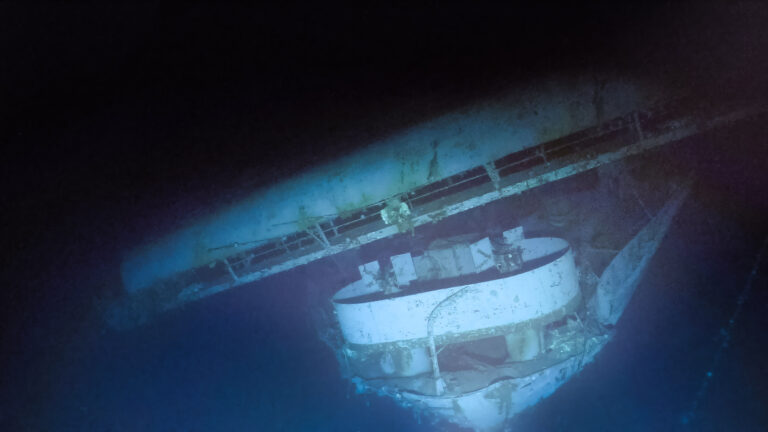
She was also the first of the lost Midway carriers ever found. A deep-sea expedition located debris from her in 1999, and in October 2019 the research vessel Petrel found her main wreck more than 5,000 meters down, three weeks before it found Akagi.
On the morning of June 4, 1942, a US Navy pilot strapped into his dive bomber, took a breath from his oxygen canister, and inhaled caustic soda fumes.
The canister was defective. His lungs were already burning.
He flew the mission anyway.
By sunset, Dick Best had done something no pilot in history has done before or since. And he paid for it with everything.
Best was 31, commander of Bombing Squadron Six aboard USS Enterprise. Six months after Pearl Harbor, America was losing the Pacific. Four Japanese carriers, the same fleet that had attacked Hawaii, were steaming toward Midway to finish the US Navy for good.
His air group launched that morning and found nothing but empty ocean. Fuel running low, the formation was minutes from turning back when group commander Wade McClusky spotted a lone Japanese destroyer racing north at full speed. He made a gut call: follow it.
The destroyer led them straight to the entire Japanese fleet.
Then came the mistake that almost ruined everything. Doctrine said McClusky's group should take the far carrier and Best's squadron the near one. Instead, nearly all 30 dive bombers poured down on the same ship, Kaga.
Best watched his own squadron dive past him onto the wrong target. So he pulled out, signaled his two wingmen, and went after the other carrier with 3 planes instead of 15.
That carrier was Akagi. The flagship. The ship that had launched the attack on Pearl Harbor.
Best rolled into his dive through anti-aircraft fire and put a 1,000 lb bomb through the flight deck near the midship elevator. It exploded in the hangar below, packed with fueled and armed torpedo planes. The blast set off a chain reaction that no one aboard could stop.
One bomb. One hit. Akagi was finished.
In roughly five minutes that morning, three of Japan's four carriers were burning wrecks. Historians call it the most decisive five minutes of the entire war.
But one carrier was left. That afternoon, coughing and getting worse, Best climbed back into his cockpit and flew again. His squadron found Hiryu at dusk and sent her to the bottom too.
Two carriers in one day. The only pilot ever to do it.
That night, Best was coughing blood. The caustic fumes had activated latent tuberculosis in his ruined lungs. He spent 32 months in hospitals and never flew again.
June 4, 1942 was his last flight.
Japan never recovered. The empire that had been undefeated for centuries lost the initiative in a single morning and spent the rest of the war in retreat.
And the most consequential single bomb dropped before Hiroshima was delivered by a man who was slowly suffocating as he aimed it.
84 years ago today.
Yorktown should not have been at Midway at all. A month earlier at Coral Sea, a Japanese bomb had torn through her decks, and the estimate to fix her ran to 90 days. Japan crossed her off as sunk. Admiral Nimitz gave Pearl Harbor's shipyard 72 hours. Some 1,400 workers swarmed her around the clock, welders still aboard as she steamed out to the ambush. Her presence at Midway was itself a kind of resurrection. She would need two more.
On the morning of June 4, her air group earned its keep: her dive bombers destroyed Soryu, and her torpedo squadron's sacrifice helped pull the Japanese fighters out of position for the killing blow. But by midday, one Japanese carrier was left alive. Hiryu, under the ferocious Admiral Yamaguchi, found Yorktown first.
The first strike came around noon: dive bombers, eighteen launched, most shot down on the way in, but three bombs got through. One burst near the island, one went down the smokestack and knocked out five of her nine boilers, one punched through the flight deck. Dead in the water and burning, she should have been finished.
She wasn't. Her damage control crews patched the deck with timbers and steel plate, relit the boilers, and within two hours she was making 19 knots and refueling fighters. The repair was so complete that when Hiryu's second strike arrived, the Japanese pilots reported attacking a different, undamaged carrier. Japan would end the battle believing it had knocked out two American carriers. It had hit the same unkillable ship twice.
That second strike was led by Lt. Joichi Tomonaga, whose plane's left fuel tank had been shot through that morning over Midway and could not be refilled. He led the mission anyway, knowing it was one way. His torpedo bombers bored in through everything Yorktown's escorts could throw at them, and two torpedoes slammed into her port side, jamming the rudder and cutting all power. Tomonaga did not return. Yorktown rolled into a 26-degree list, and with capsizing looking imminent, Captain Elliott Buckmaster gave the order no captain wants to give. The crew went over the side in good order. American doctrine, unlike the Japanese tradition that kept captains on burning bridges, expected Buckmaster to live; he left the ship last, sliding down a line into the sea.
And still she floated. All night, all the next day, the list never worsened. So on June 6 Buckmaster came back with a hand-picked salvage crew, the destroyer Hammann lashed alongside providing power, and they began to win: fires out, the list reducing, a tow rigged. Yorktown was coming home a third time.
Then, that afternoon, the Japanese submarine I-168, having slipped through the destroyer screen after a patient day-long approach, fired four torpedoes from inside the escort ring. One broke Hammann in half; she sank in four minutes, and as she went down her own depth charges detonated, killing men in the water. About 80 of her crew died. Two more torpedoes hit Yorktown.
Even then she refused to go quickly. She lingered through the night, and at dawn on June 7 the men on the surrounding destroyers stood at attention, ships' flags at half mast, as she rolled onto her port side and sank into three miles of water. The battle had ended days of fighting with a strange symmetry: four Japanese carriers and one American, all on the same patch of ocean floor.
In May 1998, Robert Ballard, the man who found the Titanic, found her: upright, intact, her guns still trained skyward, her hull number still visible, three miles down and almost untouched by time.
82 years ago today, eight American sailors jumped onto a sinking Nazi submarine in the middle of the Atlantic.
What they pulled out of it changed the war. And the Navy buried the whole story for years.
First, you need to know that U-505 was already cursed. German sailors called her the unluckiest boat in the fleet. In October 1943, during a brutal British depth-charge attack, her own captain shot himself in the head in the control room, in front of his crew. He remains the only submarine commander in history known to have killed himself underwater in combat. His second-in-command calmly took over, rode out the attack, and sailed her home.
Eight months later, her luck ran out completely.
June 4, 1944. Two days before D-Day. Captain Daniel Gallery's hunter-killer group, built around the escort carrier USS Guadalcanal, had been stalking U-boats off West Africa. Gallery had an idea his superiors considered borderline insane: don't sink the next one. Capture it. No US Navy crew had boarded and taken an enemy warship on the high seas since 1815.
The destroyer escort USS Chatelain caught U-505 on sonar and fired a salvo of hedgehog bombs. The U-boat broke the surface 700 yards away. Gunfire raked the conning tower, wounding her captain. He gave the order to abandon ship.
The Germans rushed out so fast they botched the scuttling. The sub was flooding, but her engines were still running. She was circling the battle at six knots, empty, sinking, and very possibly rigged with demolition charges.
So Lt. Albert David and eight men from USS Pillsbury chased her down in a whaleboat, leaped aboard, and climbed down the hatch into a dark, flooding submarine that could explode or go under at any second. They shut the scuttling valves, disarmed the charges, and stopped the flooding.
Down there they found the prize: Enigma cipher machines and roughly 900 pounds of codebooks and charts. Current settings. The keys to the German navy's secret communications.
But here's the catch. The treasure was only valuable if Germany never found out. One leak and Berlin changes every code overnight.
So the Navy ran one of the great cover-ups of the war. The sub was towed 1,700 miles to Bermuda and given a fake American name: USS Nemo. Around 3,000 sailors were sworn to total silence. The 58 captured German crewmen vanished into a POW camp in rural Louisiana, hidden even from the Red Cross. Germany declared U-505 lost with all hands and notified the families. The dead men were alive in Louisiana, and their boat was working for the US Navy.
The secret held until the war ended.
Lt. David received the Medal of Honor, the only one awarded in the Atlantic Fleet in all of WWII.
And the submarine? In 1954, Chicagoans raised $250,000 to bring her home. She was towed across Lake Michigan and dragged through the streets of Chicago to the Museum of Science and Industry.
She's still sitting there right now. You can walk through her.
Lee Iacocca had everything. Then he lost it. Ford Motor Company. Thirty-two years of work. Countless promotions.
The creation of the Ford Mustang. A reputation as one of the most successful executives in America. Then it ended. Henry Ford II called him into his office and fired him.
No dramatic explanation. No public celebration of his achievements. Just out. The humiliation was enormous. Iacocca had spent decades helping build Ford into a powerhouse. Now he was unemployed. Many people assumed his career was over.
Then the phone rang. Chrysler wanted him. Most executives would have run the other direction. The company was collapsing. Losses exceeded $1 billion. Factories were shutting down.
Workers were losing jobs. Dealers were disappearing. Cash was running out. Some believed bankruptcy was only a matter of time. Lee Iacocca accepted anyway. When he arrived, the situation was worse than expected.
The company was drowning. Bills were piling up. Money was disappearing. Time was running out. Desperate situations require desperate decisions. Iacocca went to Washington.
He stood before Congress and asked for help. Critics attacked him. Some called Chrysler a lost cause. Others argued taxpayers should never help a private company.
The criticism was relentless. Still, he kept pushing. Eventually, the government approved loan guarantees. The conditions were harsh. Workers took cuts.
Executives took cuts. Iacocca reduced his own salary to one dollar a year. Most people expected Chrysler to fail anyway. They were wrong. New vehicles arrived. Sales improved. Factories reopened. Employees returned.
The company slowly came back to life. Then came the moment nobody expected. August 15, 1983. Lee Iacocca walked into a room carrying a check. Eight hundred million dollars. The remaining government-backed debt. Paid in full. Seven years ahead of schedule.
The executive who had been fired. Mocked. Written off. Had just completed one of the greatest business turnarounds in American history. Some people quit after humiliation. Lee Iacocca used it as fuel.
BUTCH O'HARE and QUIET INTEGRITY. On February 20, 1942, a 28-year-old Navy pilot looked at his fuel gauge and realized someone had made a mistake.
His tank wasn't full. He didn't have enough fuel to complete the mission and return to the carrier.
His commander ordered him back immediately. Butch O'Hare turned around, frustrated, heading toward the ship alone.
Then he saw them.
A squadron of Japanese bombers racing toward the American fleet. The entire division was out on the mission. The fleet was defenseless.
Butch had no way to warn them. No way to bring back his squadron.
He had a choice. Continue to safety with his limited fuel. Or do something about it.
Butch dove into the Japanese formation alone. He fired until his guns emptied. Then he dove at enemy aircraft, trying to clip their wings and send them spiraling down.
One pilot against an entire squadron.
The Japanese, stunned and confused, changed direction. The fleet survived.
When Butch landed, the gun-camera footage told the story. Five enemy aircraft shot down. He became the Navy's first flying ace of World War II and the first Naval Aviator to receive the Congressional Medal of Honor.
A year later, Butch O'Hare was killed in combat. He was 29.
Today, Chicago's O'Hare Airport bears his name.
Here's what stays with me about this story: Butch wasn't trying to become a hero that day. He was just a pilot heading back to the ship because of a fuel tank mistake. No one would have blamed him for continuing home.
But in that small moment of decision, with no one watching and nothing to gain, his character showed up.
That's what quiet integrity looks like. It's not the grand gestures people plan for. It's what you do in the moments no one expects anything from you.
Small choices reveal who we really are. And sometimes, those choices change everything.
#OTD in 1903, Theodore Roosevelt stood at Lincoln's Tomb in Springfield, Illinois — and used the moment to say something he believed to his core.
Roosevelt noticed that the guard around Lincoln's tomb was made up of African American soldiers, and it moved him. He had served beside Black troops at Santiago in Cuba five years earlier, and he never forgot it. Standing there, he said: "A man who is good enough to shed his blood for the country is good enough to be given a square deal afterward. More than that no man is entitled to, and less than that no man shall have."
That phrase — the square deal — became one of the defining ideas of his presidency. It wasn't a promise that everyone would succeed. It was a promise that everyone would get a fair chance and an honest hand: no crookedness in the dealing.
There was real weight in saying it on that spot — Lincoln's tomb, in Lincoln's hometown, with Lincoln's legacy of union and freedom all around. Roosevelt was placing his own creed in that long line, and tying it directly to the men who had earned it under fire.
It was the next-to-last day of a 14,000-mile journey. Of all the hundreds of things he said on that tour, these are among the words best worth remembering.
#OTD #OnThisDay #TheodoreRoosevelt #SquareDeal #Lincoln #DareGreatly
@CathPrep1@JWMediaDC Auburn, Tuscaloosa, Oxford, Starkville, Clemson, Athens, Charlottesville, Gainesville, College Station, etc… all smaller DMAs than ECU. 52,000 stadium for reason. East Carolina’s base Raleigh, Greensboro, Charlotte, TidewaterVA, OBX. Regional just like SEC/ACC towns listed above
On this day in 1942, U.S. warships ambush a Japanese task force at Midway. Japan loses four carriers and nearly 250 warplanes in the ensuing battle. It's a turning point in the Pacific War.
In Romania, To encourage exercise & wellness riders can travel for free on local bus by doing 20 squats. A device counts the squats and then issues a free ticket.
What do you think of this idea? Are you Squatting? 😂
Bushwhacked!
MIDWAY
June 4-7 1942
The Doolittle raid horrified Japan. For the first time ever an enemy had struck at her homeland. The ears of the divine emperor had been profaned by the sound of American bombs exploding. Admiral Yamamoto was so mortified that he went to the Imperial Palace and apologized to Hirohito. "Never again, " Yamamoto thundered, "The Americans must be driven so far back that they could never again even think of insulting the emperor!"
Admiral Chester Nimitz took command in December 1941, he was a calm and careful sailor with the courage to take risks. The code breakers of "Magic" and the Navy's traffic analysts informed him of Yamamoto's Midway Operation.
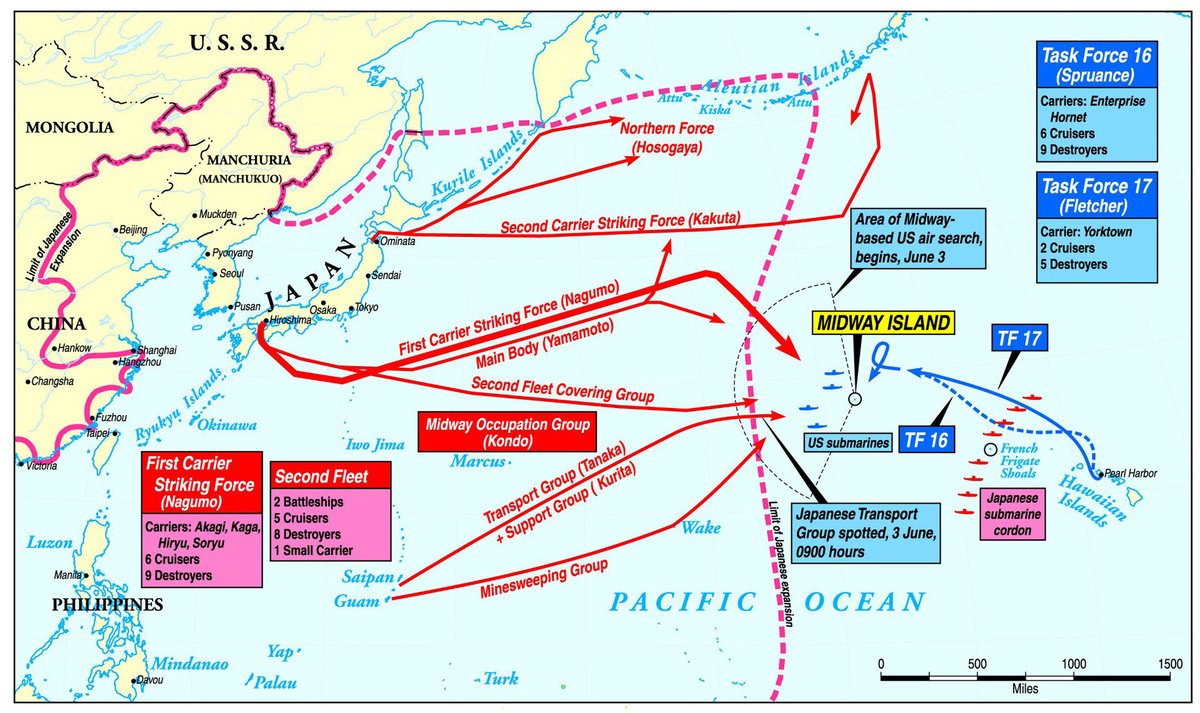
Almost all of the combined Fleet was at sea. Yamamoto had collected 162 ships with the small force heading to the Aleutian Islands hoping to lure the Americans in that direction. The large one heading to Midway, and it included transports carrying troops for an amphibious invasion. The striking force of four big carriers: Akagi, Kaga, Hiryu and Soryu, all veterans of Pearl Harbor, was led by Admiral Nagumo. Far to the rear was the main body commanded by Yamamoto himself sailing in his flagship Yamato, the mightiest ship afloat.
Because of his foreknowledge of Japanese plans, Nimitz refused the Aleutian bait and concentrated his vastly inferior forces of 76 ships north of Midway. He planned to hit the enemy carriers on their flank. His own carriers included Enterprise, Hornet and the patched-up Yorktown with supporting ships. Task Force 16 was commanded by Admiral Spruance (Halsey was suffering from a skin disease) with Enterprise and Hornet and Task force 17 included Yorktown and supporting ships commanded by Jack Fletcher who stopped the Japanese at the Battle of Coral Sea.
On June 4, the great Battle of Midway commenced with Nagumo launching his bombers to strike and soften the Islands defenses. A Squadron of Marine war birds roared aloft to intercept while the American anti-aircraft fire was superb. One third of Nagumo's 108 aircraft were shot down with many more limping back to their carriers. Nagumo ordered a second strike.
This was the moment to hit the Japanese while their carriers were rearming and refueling with bombs on the deck and gasoline lines running. In came 15 Devastator torpedo bombers attacking without fighter cover. They were all shot down. Next 14 more Devastators attacked and 10 were shot down. A dozen more followed with only 4 surviving. For a moment, Nagumo thought he had won the war.
But flying high above him were 37 Dauntless' who had been searching for him led by Lt. Com. Clarence McClusky of Enterprise. Over the radio came, "Attack! Attack!" McClusky led half of his dive bombers down on Kaga while Lt. Earl Gallaher took the other half hurtling down on Akagi. They sank them both.
Next, 17 Dauntlesses from Yorktown under Lt. Cmdr. Max Leslie fell upon Soryu and left her a wreck to be finished off later by the submarine Nautilus.
In 6 minutes, Admiral Nagumo lost his flagship and two other carriers, so he was in a rage of despair cursing his officers and finally was transferred to another ship where he had the satisfaction of hearing that Yorktown had been destroyed. But while Japanese Kates were breaking through Yorktown's AA defenses, putting 3 torpedoes in her hull, 24 Dauntlesses Led by the formidable Gallaher found Hiryu, fell upon her and sent her to the bottom.
Far to the rear aboard Yamato, Isoroku Yamamoto was engulfed in black despair. Each time a report came in he groaned aloud in anguish. On the following day he ordered a general retirement. For the first time in 350 years Japan had suffered a naval defeat. In a single days fighting all the advantages gained at Pearl Harbor lay with his 4 sunken carriers at the bottom of the sea with over 3,000 sailors and the cream of Japan's naval aviators had been lost.
The United States lost the carrier Yorktown and the destroyer Hammann and 307 had been killed.
The Japanese victory flood had been checked 6 months after it begun. Although the tide had been turned it was now time for the Americans to go on the offensive to be fought on an Island in the Southwest Pacific.
Guadalcanal.
The simple 60 second test that helps predicts your health and longevity.
CEOs, surgeons, founders — those who lead at the highest level.
Most can't hit 60 seconds on day one.
Here's what is is — and how to fix it:
= Thread =
The first land battle of the Civil War was such a blowout that newspapers refused to call it a battle. They called it "the Philippi Races," because the Confederates literally ran. Some fled in their nightclothes.
It happened 165 years ago today. Nobody died. And yet it changed millions of lives. Here's how.
June 3, 1861. Two Union columns march all night through a freezing rainstorm to trap 800 untrained Confederate recruits in a small Virginia town. The signal to attack was supposed to be a pistol shot.
A local woman fired a pistol at Union soldiers to protect her son, setting the whole attack off early. The cannons opened up at dawn anyway, and the Confederates sprinted south without firing back.
Total battle time: about 20 minutes.
But the third cannonball fired found an 18 year old named James Hanger, a college dropout who had enlisted exactly two days earlier. He was sleeping in a hayloft. The shot ricocheted and shattered his left leg.
A Union surgeon amputated it on the spot, seven inches below the hip. The first amputation of a war that would produce 60,000 more.
Hanger went home and locked himself in an upstairs room for three months. His family thought he was wasting away in depression.
He wasn't. He was whittling.
He had asked for oak barrel staves, metal, leather, and rubber. Behind that door he built himself something that didn't exist yet: an artificial leg with a hinged knee and a flexible foot. Then he walked downstairs on it.
Virginia commissioned him to build legs for other wounded veterans. He patented his design, and the company he founded, Hanger Inc., is still the largest prosthetics company in America. 165 years later, it puts people back together every single day.
The first battle of the war lasted 20 minutes and killed no one. Its only real casualty was a teenager who spent the next 58 years making sure no amputee had to suffer the way he did.