Founded in 2020 by Toby Maclean to address the urgent need to decarbonise the built environment with a particular emphasis on carbon embodied in structures
It feels a bit wrong here on ex-Twitter for some reason so we're moving to Mastodon. Please find us at @[email protected].
We'll check in here occasionally.
@nigelbagshaw Thanks for the reply @nigelbagshaw . Do you know if a carbon assessment is planned or who may know more on this? We'd suggest that the CO2 emissions are a fairly critical part of any assessment of a transport scheme's sustainability credentials.
We may have found a use for the new low-rent Twitter. Who can identify this drain-dwelling creature? There is no apparent access to the drain other than from the sewers or via surface gullies...
@nigelbagshaw . @nigelbagshaw Are you aware of any figures for the embodied carbon emitted to atmosphere from the construction of the tram infrastructure? If so, please let us know.
@andyheald "Also important that cities like Edinburgh with net zero commitments, properly account for embodied carbon"
Yep - we'd like to see a whole life carbon assessment of the tram system in Edinburgh, esp any proposed new routes.
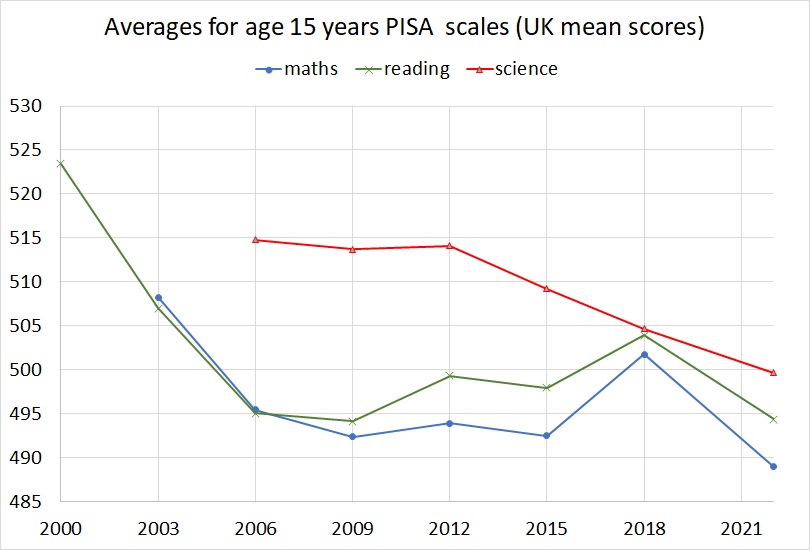
@GillianKeegan@Conservatives A reminder that this seems to be concentrating on relative and not absolute performance. The figures quoted might support an idea that other countries have got worse faster. The actual data (regardless of the quality of that data) below shows a decline in absolute terms in the UK
@GillianKeegan@Conservatives The figures show a decline in science since 2009, a smaller decline in maths and no change in reading. The graph below uses the same #OECDPISA data as quoted. Have you mistaken performance relative to other countries with absolute performance within a country?
@10DowningStreet This claim seems to mistake relative performance against other countries with an absolute improvement. The #OECDPISA figures for the UK actually show a decline in absolute standards. Graph below. Data from https://t.co/CG3P96NT0k
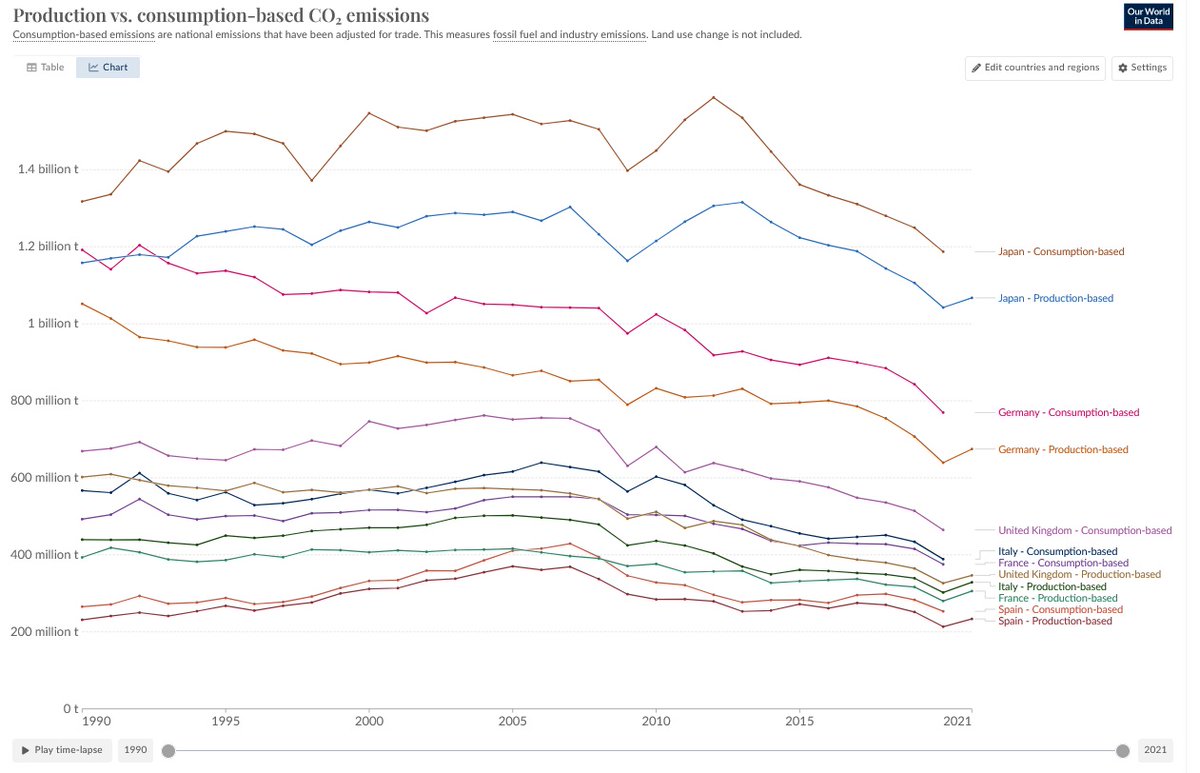
@10DowningStreet UK *production* CO2 since 1990 have reduced fast (c. 40% not 48%) because of Thatcher's war on coal & manufacturing. UK *consumption* CO2 since 1990 are down only 23%. UK CO2 reductions since 2010 are mediocre. Full info: https://t.co/QbmIi4MlkS
We'd like to correct the @10DowningStreet statement yesterday that the UK has "reduced carbon emissions in this country faster than any other major economy". See graph below for a selection of countries. On a consumption basis we can't spot a steeper downward curve for the UK.
We'd like to correct the @10DowningStreet statement yesterday that the UK has "reduced carbon emissions in this country faster than any other major economy". See graph below for a selection of countries. On a consumption basis we can't spot a steeper downward curve for the UK.
@MarkSiddallRIBA@SebLaanLomas@tom_bray Yes - good point, assuming all HW is by ASHP rather than direct electric, then that certainly helps shift the balance.
@MarkSiddallRIBA@SebLaanLomas@tom_bray Yes, if the average grid intensity were 90g CO2/kWh rather than 80g CO2/kWh it makes a c. 2 year difference on "payback". But the range of FES2021 averages over next 20 years is c. 50 to 70g CO2/kWh and EEP2019 was 95g CO2/kWh. That is, we don't know the figure to within 10g.
@MarkSiddallRIBA@SebLaanLomas@tom_bray Some info on cradle to grave CO2 for electricity production methods:
https://t.co/Mtt7D4cxGH
https://t.co/94A6Uzeaer
“Renewables“ are c. 5-20g CO2/kWh. This is likely smaller than margin of error on guess at the avg grid intensity over next 20yrs in our example (80gCO2/kWh).
@MarkPlackett1 Thanks. And here is a fun fact: c. 3 billion m3 of straw production annually is enough for the walls of 500 million 80m2 detached houses. (Ignoring a host of practicalities etc etc but some estimates are 7 billion tonnes of straw per year)
@MarkSiddallRIBA@SebLaanLomas@tom_bray We're not saying ASHPs are a bad idea. We are saying there may be cases where not having an ASHP is not a bad idea.
@MarkSiddallRIBA@SebLaanLomas@tom_bray The boundaries taken are narrow; a list of exclusions and considerations is here: https://t.co/Hoc1eqPhdS.
Reducing overall energy requirements will be important for faster decarbonisation of the grid but the GWP/kWh of production *should* be fairly independent of grid capacity
@SebLaanLomas@MarkSiddallRIBA@tom_bray Figures are sensitive to heat load required, embodied carbon of the alternative option and of the ASHP, risk of ASHP refrigerant escape, ignores maintenance CO2, grid CO2 intensity, and are only relevant to carbon not other important things like energy use and cost.