Post-Covid-19 inflation was predominantly driven by unexpectedly strong demand forces, both in the United States and in the Euro Area, from @DomenicoGiannon and @gprimice https://t.co/oksj22bZX8
Many years ago, while researching a paper on U.S. monetary policy, I read the testimony before Congress of several extremely prominent economists during the 1960s and 1970s.
I was somewhat saddened to discover that they did not follow standard stabilization principles. When the economy was weak, they recommended expansionary fiscal and monetary policy (the right advice in that scenario). But when the economy was booming, they never supported contractionary fiscal and monetary policy (also the right advice in that situation) because they did not want to “kill the expansion.”
No, sorry. If you want to manage aggregate demand (and I believe we should), you need to understand that this is a balancing act and, even more importantly, that fiscal policy has to be sustainable. Keynes himself was extremely clear about this. Gösta Rehn (1913–1996) and Rudolf Meidner (1914–2005) were even clearer: the government should run a surplus on average to have enough fiscal space to respond to large shocks (wars, financial crises, etc.). It is precisely because we care about those most vulnerable in society that you want to run a surplus. The cries against “austerity” are nearly always a mix of demagoguery and irresponsibility.
I suspect that many of those who defend Keynes most ardently in the public debate are the ones who least appreciate how good an economist he was.
New working paper: "Do Modern Difference-in-Differences Estimators Change Published Findings in Business Research?"
Peter Hull's recent meta-analysis found that in economics, two-way fixed effects and heterogeneity-robust DiD estimators rarely disagree. Using Claude, I ran his protocol on seven business journals, screening 1,829 papers, and re-estimated every eligible design in Management Science and Marketing Science, the two with public replication archives. That gave 355 published staggered-adoption specifications from 40 papers, re-estimated with Callaway-Sant'Anna (CS) and Borusyak-Jaravel-Spiess (BJS). On the comparisons that pass Hull's leverage screen, from 28 (CS) and 29 (BJS) papers:
- Correlations between TWFE and modern estimates are 0.61 and 0.70, against 0.88 and 0.93 in economics.
- Estimates change sign in 25 and 18 percent of comparisons, and 10 and 7 percent show a statistically significant difference.
- Modern standard errors are 1.6 and 1.3 times those of TWFE.
- Disagreement concentrates in unbalanced panels and in designs without never-treated units.
Every table and figure rebuilds from the public repository; re-estimating a specification from scratch requires the journal's replication package.
Paper: https://t.co/Df3VSmBoiQ
Code, protocol, and estimates: https://t.co/JCaZ5H6OTN
The Five Differential Operators of Physics
Five operators built from one symbol, nabla, all moving at once.
Divergence: div F = dFx/dx + dFy/dy + dFz/dz, the net flux out of a tiny closed surface (source or sink strength).
Gradient: grad phi = (dphi/dx, dphi/dy, dphi/dz) points to the steepest increase of phi, always at a right angle to the contour lines, and is longest where they are tightest.
Curl: curl F measures the spin of the field around a point. The vector stands on the axis of the whirl, and flips when the whirl reverses.
Laplacian: the sum of the second derivatives. On the bowl z = x^2 + y^2 the Laplacian is 4, so the average around any circle of radius r sits exactly r^2 above its centre.
D'Alembertian: box F = (1/c^2) d^2F/dt^2 - Laplacian F. A wave running at speed c makes it zero, which is why it appears in the wave equation and in relativity.
A famous quote by Milton Friedman says that “inflation is always and everywhere a monetary phenomenon.” A natural question, then, is whether money supply growth is a reliable predictor of inflation. A new analysis covers this topic https://t.co/X4GKMHk9Nu
Zaman serisi ile çalışanlar için yeni bir açık kaynak kütüphane: tsecon.
Birim kök testlerinden ARIMA ve GARCH'a, VAR/SVAR'dan yerel projeksiyonlara, Bayesçi VAR'dan nowcasting'e kadar 206 fonksiyonu tek Python paketinde topluyor.
Tahminciler mümkün olan yerde statsmodels, arch ve linearmodels sonuçlarıyla karşılaştırılarak doğrulanıyor. Üstelik yanında ücretsiz, 16 bölümlük bir zaman serisi kılavuzu da var.
Geliştirilmeye devam ediyor. Takip etmeye değer
🔗 https://t.co/fNnj1uyuCE
Which teachers reduce their students’ future crime? This paper uses new methods to show it's not those who raise test scores, but those who improve attendance and behavior. @evankrose@yotamshemtov
https://t.co/vlHCq1JQPd
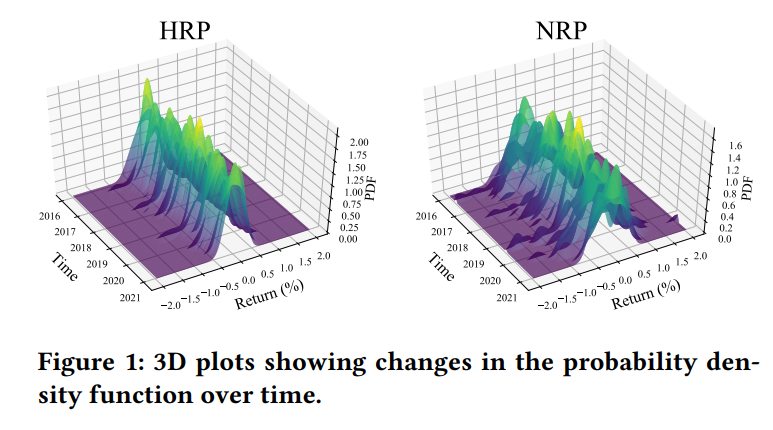
The paper relies on built-in XGBoost feature importance. Such importance measures can be misleading when features are correlated, as they are here (volatility, downside deviation, drawdown, covariance eigenvalues...)
Super interesting!
"A Quantitative Theory of Trade in Services" by Benny Kleinman and Tamar Yerushalmi.
"Trade in services accounts for a large and growing share of global trade, with recent growth driven entirely by “modern services” (information, communication, financial, and professional services). We revisit classic questions in trade theory in an environment that captures a defining feature of these sectors: their intensive use of non-rival assets (e.g., software, data, and intellectual property). We develop a dynamic multi-sector model in which sectors differ in their intensity of non-rival assets, and measure this intensity by computing sectoral expenditure on non-rival asset production. We show that non-rivalry is central to understanding trade patterns and the gains from trade. First, it helps rationalize the observed specialization of rich countries in modern services through its interaction with heterogeneous demand patterns. Second, non-rivalry increases the gains from integration through an amplified capital multiplier, while tilting those gains toward high-income countries. Third, it gives rise to heterogeneous timing of consumption gains following global shocks, rationalizing the observed relationship between sectoral specialization and current account imbalances. Finally, we illustrate the importance of non-rival assets for evaluating barriers to services trade by applying our framework to a leading example: China’s Great Firewall."
https://t.co/DLhhXRBjxq
Super interesting!
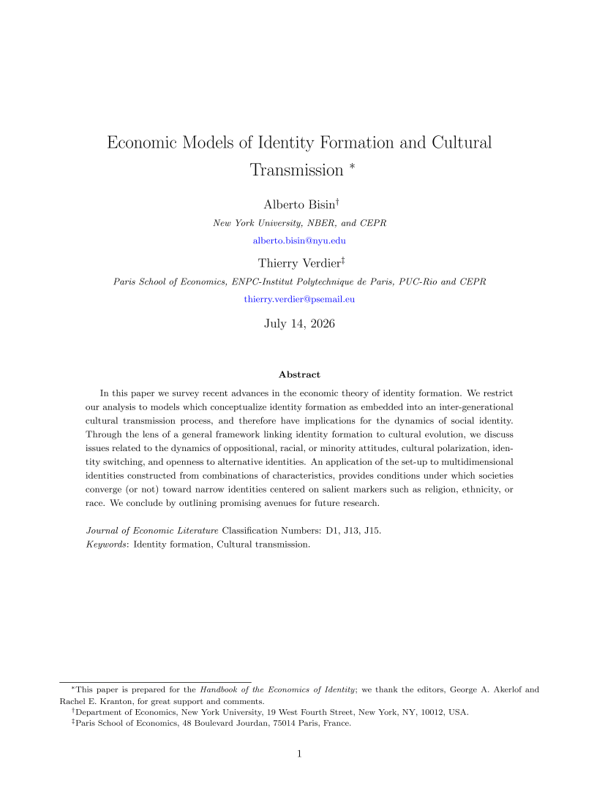
"Economic Models of Identity Formation and Cultural Transmission" by Alberto Bisin and Thierry Verdier.
"In this paper we survey recent advances in the economic theory of identity formation. We restrict our analysis to models which conceptualize identity formation as embedded into an inter-generational cultural transmission process, and therefore have implications for the dynamics of social identity. Through the lens of a general framework linking identity formation to cultural evolution, we discuss issues related to the dynamics of oppositional, racial, or minority attitudes, cultural polarization, identity switching, and openness to alternative identities. An application of the set-up to multidimensional identities constructed from combinations of characteristics, provides conditions under which societies converge (or not) toward narrow identities centered on salient markers such as religion, ethnicity, or race. We conclude by outlining promising avenues for future research."
https://t.co/71Ytx6Pwbf
This fantastic figure by @jburnmurdoch is Exhibit 1 of what an aging society means for the political game: public investment, which is choosing future rewards over present consumption, gets squeezed out.
Still not convinced this is a first-order challenge?
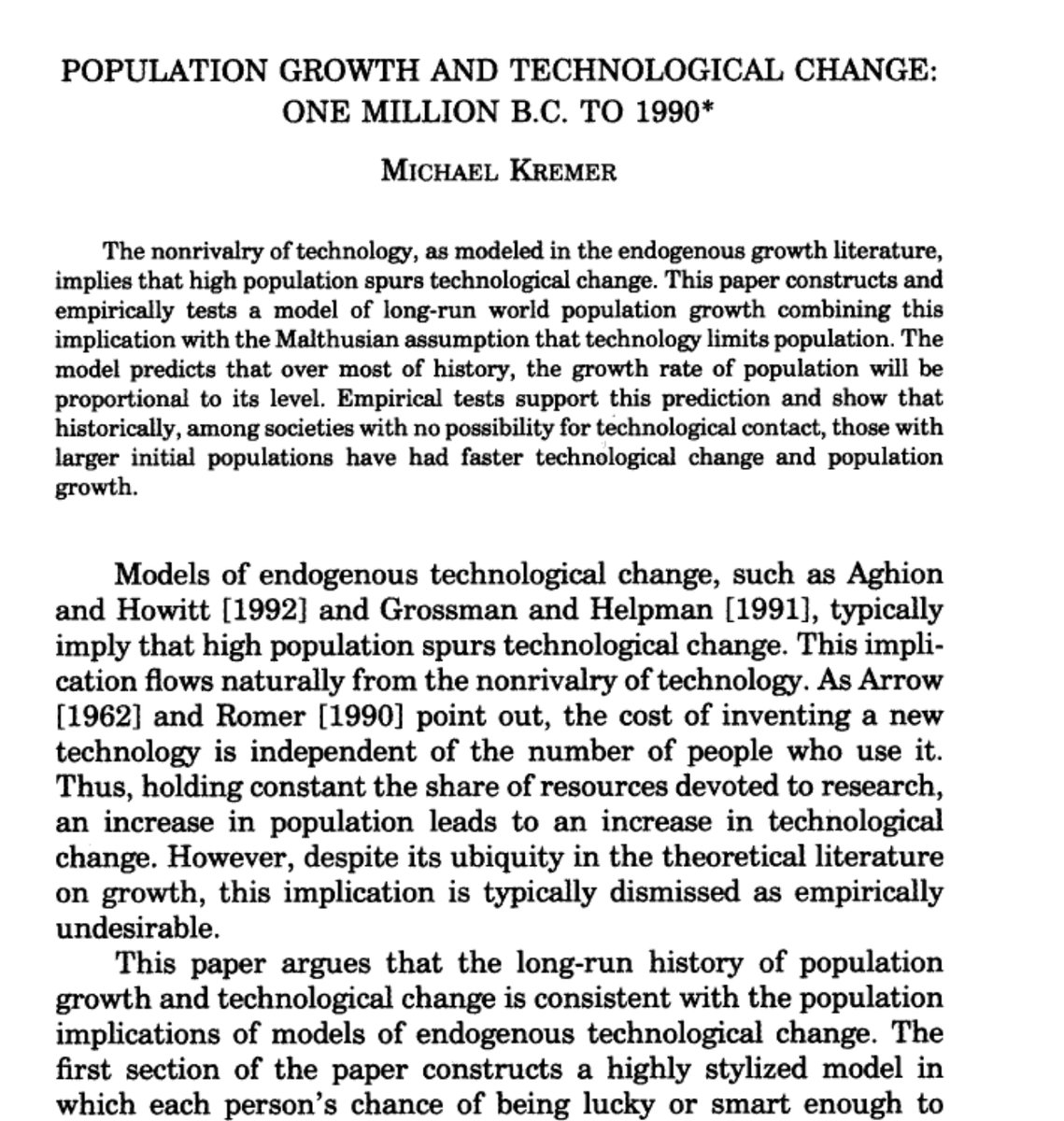
Since I am working on a new paper on demographics and growth (big surprise!), I have just reread Michael Kremer’s “Population Growth and Technological Change: One Million B.C. to 1990.”
I read it as an undergraduate. I read it again as a graduate student preparing for my growth prelim in Minnesota. And I read it years later, when I taught growth theory to undergraduates at Penn, where I even put together slides that I still use regularly for my economic history course.
And yet, however often I go back to it, I am still amazed at how elegant the paper and its argument are. As Italo Calvino once remarked:
“Every rereading of a classic is as much a voyage of discovery as the first reading.”
(Perché leggere i classici, 1981)
Kremer’s paper is exactly that. Oh, how I wish I could write papers like it!
By the way, read Calvino’s essay as well. In English here:
https://t.co/PlcWsl3kAy
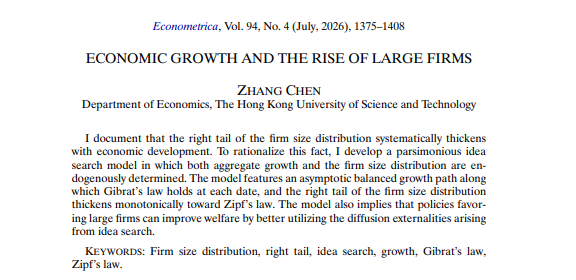
En Econométrica se publico un paper polémico: dejar de subsidiar pymes y favorecer a las grandes empresas es lo que genera crecimiento de la economía... muy en linea con los debates de la diaria de Argentina
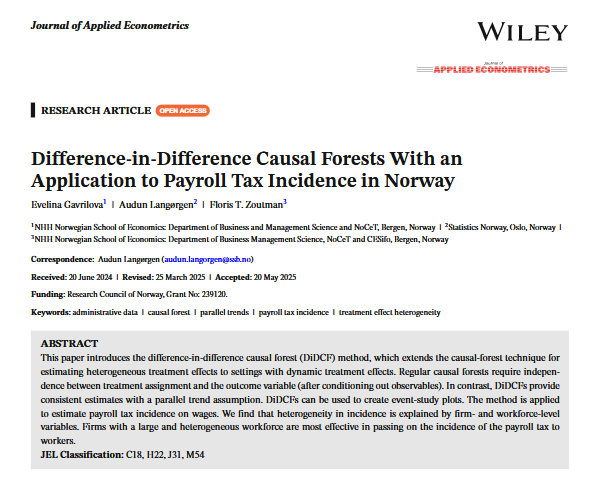
Causal Forest ile Difference-in-Differences'ı birleştiren yeni bir yöntem: DiDCF.
Wager ve Athey'in yaklaşımını paralel trendler altında panel veriye taşıyor. Heterojen etkileri zaman içinde tahmin etmek mümkün.
Açık erişim👇
https://t.co/bG7TM2vCyJ
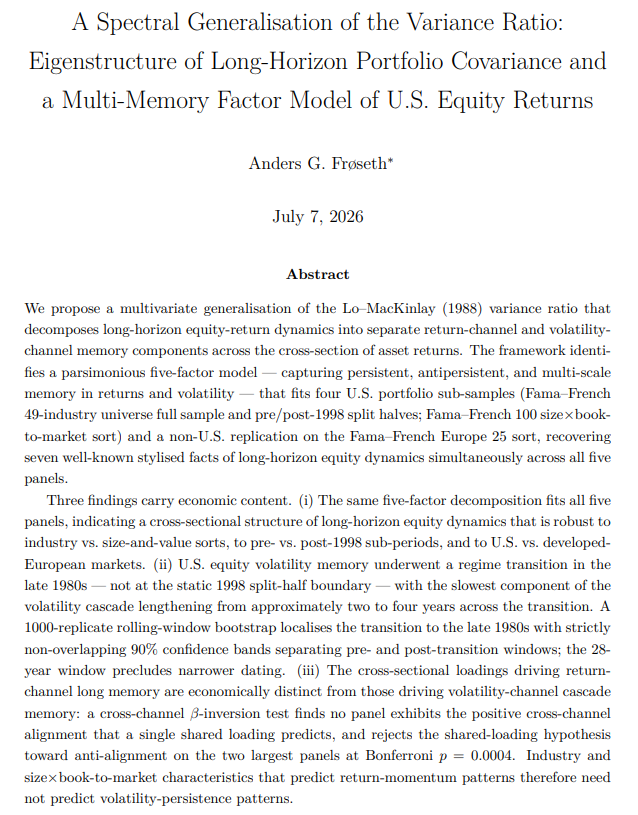
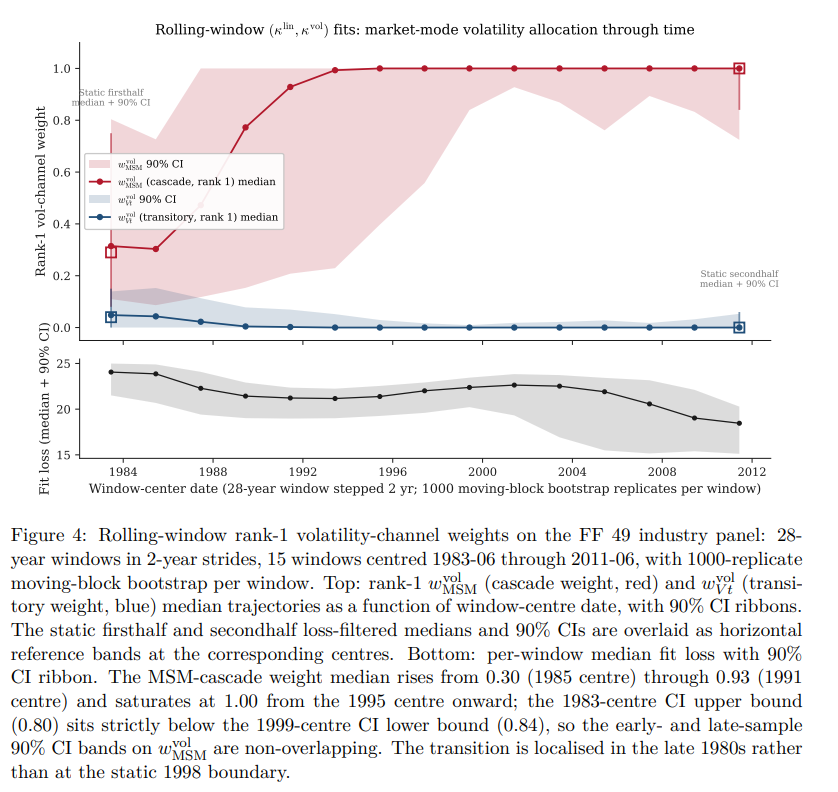
At the 5-year horizon, the paper itself notes that the effective number of independent observations is about 11 for the FF49 sample, even though the covariance is computed from overlapping returns. That means the deep-rank eigenvalues at long horizons are close to the random-matrix noise floor. So any claim about deep modes are much less reliable.
This is a subtle but thought-provoking paper that I think everyone should read. Ordinarily, we assume some way that firms compete, whether on prices or quantities. What happens if the choice of competition is itself chosen? Monetary policy might fail us when we need it most. 1/
Fertility has fallen in the United States. At the same time, housing has gotten substantially more expensive. Are these related? How so? Benjamin Couillard attributes fully half of the fertility decline of the 2000s and 2010s to housing prices, a loss of 13 million children! 1/
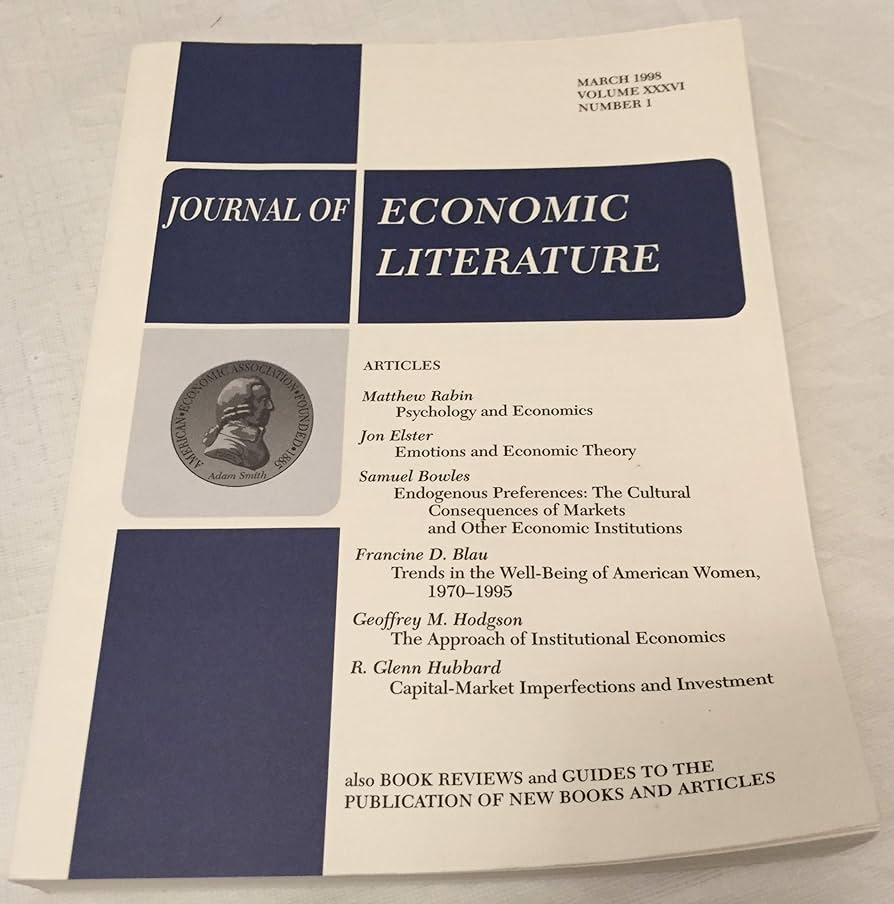
By now, I have published a fair number of papers, and one more acceptance would have close to zero marginal impact on anything that matters professionally. But getting my survey on “Deep Learning for Solving Models” accepted into the Journal of Economic Literature made me genuinely happy, for reasons that have nothing to do with my CV.
I had the misfortune of studying my undergraduate degree in economics at a quite awful institution. Two professors, David Taguas and Alfredo Arahuetes, were outstanding, and I owe them a great deal. The rest were well below any reasonable professional level, and some violated the basic standards of ethical conduct. They had no business teaching economics at any level, let alone at a university that charged tuition and claimed to prepare students for professional life.
I had to work out most of my education on my own. The surveys published in the Journal of Economic Literature were how I did it. I spent hours in the library’s reading room going through one survey after another on topics I had never been properly taught. Some helped more than others, but collectively they gave me a solid enough foundation that, when I arrived at Minnesota for my PhD, I discovered, to my considerable surprise, that I was ahead of nearly all the other first-year students, including some who held master’s degrees, despite the fact that I had finished my undergraduate degree just six weeks before. I owe the Journal of Economic Literature a debt I will never be able to repay. Publishing a survey there is the closest I can come to trying.
So, the thought that some student somewhere, working on her own in a library or on a laptop, might find my survey useful gives me tremendous satisfaction.
But there is a broader point worth making. Even in the world of AI, the profession has an important mission in making educational material widely available. Textbooks, surveys, teaching slides, these are public goods in the economist’s sense: high social value, insufficient private incentive to produce. This is also why I post all my slides and teaching material online:
https://t.co/jcFH9WK9Qu
We do not reward these activities nearly enough, and their supply is well below what any reasonable social planner would choose. I do not have a good proposal for changing this, and I would welcome suggestions.
What I do find heartbreaking is that many of the great economists of the past couple of generations never wrote textbooks on their areas of expertise. I do not mean this as criticism. All of them maximize, and perhaps they all suffer from the same bias I suffer from: the belief that one can always do it next year. But I often think about the hours of pure intellectual pleasure I would have had reading “Time Series Econometrics: An Advanced Textbook” by Chris Sims or “Methods in Structural Estimation” by Pat Bajari. Those books do not exist. They should.