Happy to share our new work showing how social emotions such as anger and gratitude establish an interindividual form of actor-critic learning, which leads to the emergence of norms in groups of interacting individuals.
Now published at @APA_Journals: https://t.co/NRGVorqea7
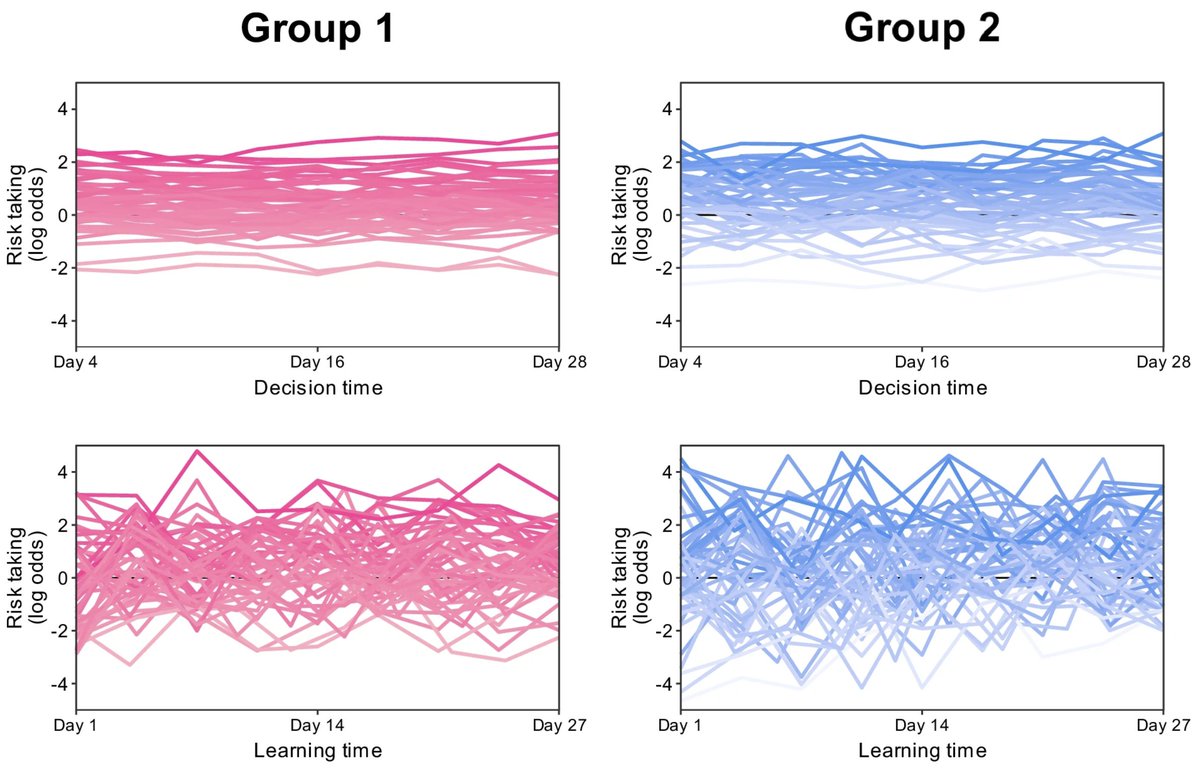
Is risk-taking shaped by decision-making or by learning? In a new @NatureComms paper led by @AlonErdman, we show that in experience-based risk-taking, very little variance is explained by decision-making (top), but a lot is explained by learning (bottom). https://t.co/nhrSNVvNB0
A new Science paper found dopamine implements learning of *backward* predictions in rodents @vijay_mkn. In 4 preregistered studies (n=1201), I and @eraneldar find humans also learn these & adaptively switch their learning and planning direction 🧵(1/n) https://t.co/vC62QHzZUb
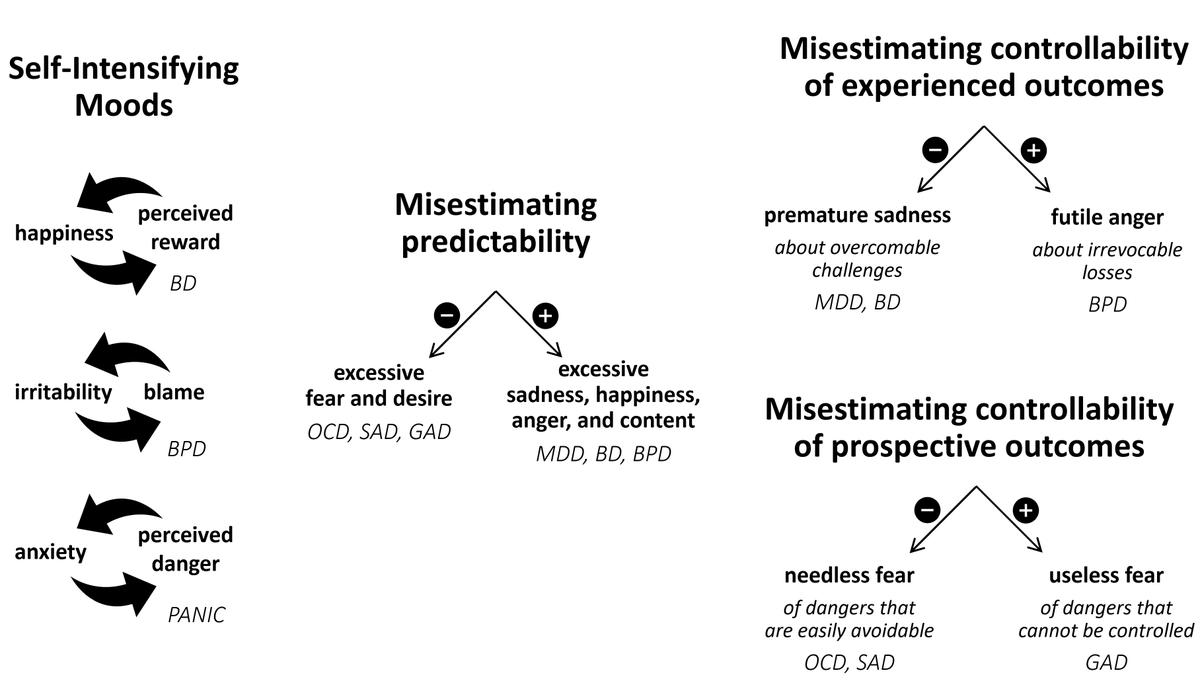
Variations in each of these factors could shape individuals' tendencies to experience different exaggerated emotions. We discuss the roles these factors may play in different psychopathologies, and how understanding these roles could help improve current treatments.
Can we use computational accounts of emotions to better understand emotional disturbances? In our new paper (https://t.co/bHVT8oYVNx), @eraneldar and I expand the "emotions as computations" framework /1
(https://t.co/AZxqbu1l4L) and propose three computational factors that could give rise to maladaptive emotions: (1) self-intensifying affective biases, and misestimations of how (2) predictable or (3) controllable the world is. /2
Very excited to share 📢🎉 my first first-author paper out in @PLOSCompBiol, where @eraneldar , @paul_b_sharp and I demonstrate that the way humans encode preferences is adapted to the diversity of experiences offered by the immediate learning context.
https://t.co/wtg8ANrcpu
🧵What are, in fact, emotions and moods? In a new work (https://t.co/t52vQ8vYcW), @EmanuelAviv and I identify three computations that emotional states represent /1