@borjaperfra Ok. Gracias por responder. Top tier españolas entiendo.
Basado en mi experiencia en Fang o tier 2 Americanas les da lo mismo que seas graduado de ADE o de Filología si ya tienes una experiencia larga en puestos de desarrollo y eres capaz de pasar las pruebas.
@jlhortelano@david_bonilla Hace ya casi 10 añitos trabaje en una empresita que os había contratado. Técnología del futuro y made in Spain. Me alegra ver que seguís más mejor.
AI will become our interface to the world.
It will sit higher in the stack than the OS. It will collapse current SaaS layers, chat, communications, apps, app creation, into a single new kind of interface that doesn't exist yet.
It's got to be open. It's got to be a cypherpunk solution that makes privacy and security the number one priority.
If a closed source solution wins this layer, it's a disaster for the world. Especially if it's built by a single company with a single closed source model.
Why?
Because what we share with AI will be more intimate than anything we've ever shared with a machine.
It will be our friend, our sounding board, our advisor. It will know our business ideas before we've told anyone. Our medical issues. Our financial picture. We'll talk about the fight we had with our partner. About feeling lost or depressed. Our kids will talk to it about problems at school, about bullying, about heartbreak, things they won't tell us.
It will know us more intimately than we know ourselves.
Right now the world runs on a surveillance economy. We traded free stuff for apps that peer deeply into our lives.
If we replicate that model in the AI era, it's not just surveillance economy 2.0. It's surveillance economy squared. Social scoring. Legal conversations you thought were privileged showing up in court. Random people making $2 bucks an hour on the backend from God knows where reading the most intimate details of your life. Every insecurity, every fear, every half-formed thought you whispered to your AI buddy at 2 AM, sitting in a database somewhere, searchable.
This interface might eventually become an OS, like the OS in Her. But it will take a long time to reach down to that layer and it will require a fundamentally new kind of operating system design. You can't retrofit this onto Linux or Windows or Android or iOS. It's a new layer of the stack entirely.
And whoever controls that layer controls our lives.
We've got to make sure it's us. Not them.
You can’t outwork the whole world. There’s always going to be someone somewhere willing to work as hard as you. Someone just as hungry. Or hungrier.
Assuming you can work harder and longer than someone else is giving yourself too much credit for your effort and not enough for theirs. Putting in 1,001 hours to someone else’s 1,000 isn’t going to tip the scale in your favor.
What’s worse is when management holds up certain people as having a great “work ethic” because they’re always around, always available, always working. That’s a terrible example of a work ethic and a great example of someone who’s overworked.
A great work ethic isn’t about working whenever you’re called upon. It’s about doing what you say you’re going to do, putting in a fair day’s work, respecting the work, respecting the customer, respecting coworkers, not wasting time, not creating unnecessary work for other people, and not being a bottleneck. Work ethic is about being a fundamentally good person that others can count on and enjoy working with.
So how do people get ahead if it’s not about outworking everyone else?
People make it because they’re talented, they’re lucky, they’re in the right place at the right time, they know how to work with other people, they know how to sell an idea, they know what moves people, they can tell a story, they know which details matter and which don’t, they can see the big and small pictures in every situation, and they know how to do something with an opportunity. And for so many other reasons.
So get the outwork myth out of your head. Stop equating work ethic with excessive work hours. Neither is going to get you ahead or help you find calm.
[The Outwork Myth — It Doesn't Have To Be Crazy At Work, 2018]
¿Es el problema de la corrupción en España solo de reglas o de nuestros políticos? No. Tenemos reglas horrorosas, sí, y una selección de élites pésimas, pero cualquiera que pasee por una calle de una ciudad española comprobará cómo muchos españoles (españoles de España, para que no haya duda) se saltan constantemente las reglas, aparcando donde les da la gana, tirando basura donde no corresponde o llevando al perro sin cadena en sitios donde no se puede (ejemplos que vi en solo dos días de noviembre, la última vez que fui a Madrid).
Ya sé lo que me van a decir: estas son anécdotas, no es evidencia seria. Pero resulta que sí tenemos evidencia seria.
Hasta 2002, los diplomáticos de las Naciones Unidas tenían inmunidad diplomática respecto de las multas de aparcamiento en Manhattan, por lo que podían aparcar donde quisieran, sin más límite que las normas culturales de sus países (o las reglas internas de las embajadas).
A dos economistas, Raymond Fisman y Edward Miguel, se les ocurrió considerar las multas de aparcamiento impagas de los diplomáticos de cada país como una medida de la corrupción en ese país. Si los diplomáticos “pasaban” de las reglas de aparcamiento porque no había consecuencias, era una medida de lo corrupto de ese país (o al menos de un grupo de élite, que son sus diplomáticos).
El resultado es un artículo muy famoso, “Corruption, Norms, and Legal Enforcement: Evidence from Diplomatic Parking Tickets”, publicado en una de las mejores revistas de economía del mundo.
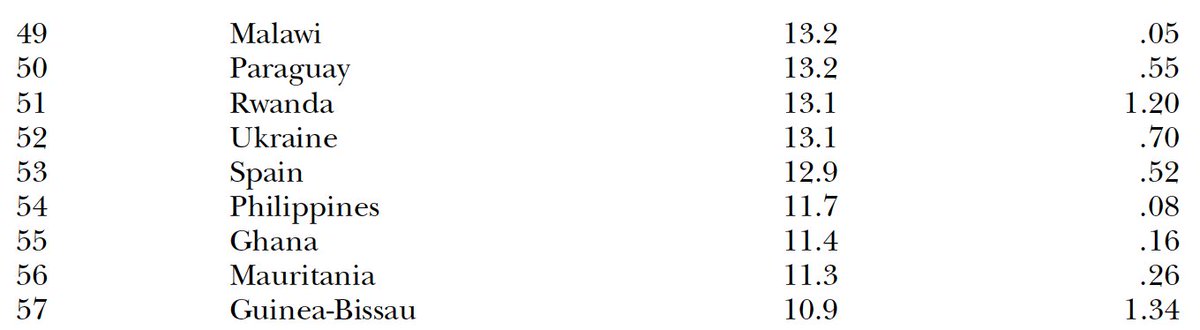
¿Cómo salen los diplomáticos españoles? Mal. El diplomático español medio acumuló 12,9 multas sin pagar por año en cada uno de los cinco años del estudio, es decir, algo más de una multa al mes (como referencia, en 1998 había 15 diplomáticos españoles acreditados en las Naciones Unidas en Manhattan). Como se ve en la tabla, España está al nivel de Ruanda o Ghana.
En comparación, los diplomáticos de Noruega o Suecia no acumularon ninguna multa impaga. Como me contó uno de los autores del trabajo: cuando un diplomático sueco vio el estudio, le respondió que una multa de tráfico no pagada hubiera sido un escándalo tan grande en Suecia que el ministerio de asuntos exteriores entero tendría que haber dimitido.
Para contrastar, una vez un alto funcionario español, trabajando en Estados Unidos (no político, funcionario de los de oposición rimbombante), me explicó, ante mi sorpresa: ¡Estar en las Naciones Unidas es fantástico (bueno, empleó otra palabra más fea), puedes aparcar donde te salga de las narices!
Pero lo interesante es que cuando las reglas cambiaron en 2002 y los diplomáticos perdieron su inmunidad, las multas de tráfico de los diplomáticos españoles cayeron a 0,5 de media al año.
¿Cuáles son las conclusiones que saco de este artículo?
Primero, España es un país con una cultura de normas pobre. Un grupo de élite, los diplomáticos en las Naciones Unidas, abusaba, en promedio, de manera descarada del sistema (me imagino que habría mucha heterogeneidad, con algunos diplomáticos con pocas multas y otros con centenares). Y encima presumían de ello.
Segundo, los cambios en las reglas funcionan: las multas cayeron de 12,9 a 0,5.
Tercero, a largo plazo probablemente el cambio de reglas llevaría a que cambiara la cultura.
Orgs are laying people off "because of AI" and I (and the entire industry) need to talk about how insane all of this is.
I build AI tools. I like AI. This isn't an anti-AI rant. This is an anti-stupidity rant.
Buckle up. Spicy takes galore!
🧵1
Orgs are laying people off "because of AI" and I (and the entire industry) need to talk about how insane all of this is.
I build AI tools. I like AI. This isn't an anti-AI rant. This is an anti-stupidity rant.
Buckle up. Spicy takes galore!
🧵1
@jlhortelano Las automatizaciones eran viables, pero tenian costes y mant. muy altos. Estamos de acuerdo que para ciertas herramientas internas y automatizaciones, los LLM son una bendicion, por los bajos costes. Pero se esta vendiendo que los SaSS van a desaparecer... me parece exagerado.
@barckcode Como siempre, la respuesta mas correcta esta en el medio. Estamos de acuerdo. Ni todo local, ni todo en el cloud. Perdon por la falta de acentos.
@dhh@TimSweeneyEpic Hey @dhh Does your sim rig run Windows (that's why you use Moonlight instead of Apollo?
And why using Artemis instead of Sunshine?
thanks!
@hammer_mt@TaylorPearsonMe These LLMs don't possess the same judgement and autonomous guidance people can provide.
Comparing it nowadays is pretty naive.
Eli Goldratt's book, The Goal, was famous for its (then unpopular argument) that keeping every machine running 24 hours a day, the metric most plant managers cared about, was actively making factories worse. I suspect we're seeing the same fallacy in how many people are using AI agents.
Goldratt's point was that machine utilization isn't throughput. What you want from a manufacturing plants is making good widgets as cost-effectively as possible.
It doesn't necessarily follow that running your machines all the times optimizes that.
Picture a three-station assembly line. Stations 1 and 2 each crank out 200 widgets an hour. Station 3 can only handle 100. Running stations 1 and 2 around the clock doesn't ship more product. It just piles up half-finished widgets in front of station 3, ties up cash in inventory, and creates more work managing the pile.
He developed the Theory of Constraints to point out that what matters is solving the bottleneck in the system, not increasing machine utilization.
I suspect a lot of agent usage right now is the same fallacy at higher resolution. Running 20 Claude Code sessions in parallel can feel productive because something is always happening. But, if the bottleneck in your work is judgment about what's worth doing, more agents just generate more output for you to wade through.
This is not to say there aren't workflows running 20 agents in parallel very effectively, I'm sure there are. And, I suspect there's a general retraining we all need to do around evolving historical workflows. But....
The constraint for most knowledge work is deciding what's worth executing and no one is task switching between 20 things at the same time effectively I don't think. I find I can run maybe 2 or 3 things in parallel with maybe 1 or 2 admin-y type things on the side and that is only if I'm very locked in.
Últimamente no he colgado nada en español porque la situación en España me deprime bastante.
Un ejemplo es este anuncio del PP sobre ocho medidas si llega al gobierno, que aquí incluyo.
Fijémonos en estas ocho medidas. Una, la ley sobre ELA, afecta a una minoría muy pequeña del país. Sí, tener esta enfermedad es una desgracia, pero estamos hablando de 900 casos al año en un país que se acerca ya a los 50 millones de habitantes. Es “buenismo” en su manifestación más mediocre. Otra, bajar el IVA de los productos básicos, es demagógica y en contra de la teoría económica básica. Modificar la Ley Presupuestaria para que haya un mayor control sobre el gasto en defensa y seguridad resulta irrelevante. Y las otras varían entre lo necesario pero no muy importante (la independencia del CIS) y lo esperpéntico (modificar la Ley de Costas).
España tiene cuatro problemas existenciales:
1) Fecundidad.
2) Inmigración.
3) Falta de crecimiento de los salarios reales.
4) Vivienda.
Ni una de estas medidas tiene nada que ver con 1)-4) (excepto, de pasada, la ley antiocupación). ¿Por qué? Porque cualquier cosa que de verdad contribuya a la solución de 1)-4) implicaría sacrificios para los votantes del PP: personas de más de 55 años que quieren dejar todo como está. De hecho, la ley antiocupación se menciona porque protege los derechos de propiedad de los mayores.
Feijóo y el PP, más en general, tienen la idea del futuro de España de una ameba porque a sus votantes el futuro de España les trae el fresco mientras su pensión se pague y el precio de su piso no caiga.
Y nada de lo que yo (o cualquier otro) pueda decir será capaz de mover ese macizo carpetovetónico.