Similarly, it took the bourgeoisie some 500 years to defeat the monarchs, princes, and feudal lords. Communism remains our common future if we organize to win it.
"Stalinismus" ist ein bürgerlicher Kampfbegriff, mit dem jeglicher positive Bezug auf sie Soviet Union, DDR oder den Marxismus-Leninismus im Kern mundtot gemacht werden sollen.
Some of y'all think socialism means "living comfortably". Both Marx and Lenin were describing an ongoing class struggle. If you are okay with exploiting the global South to have free healthcare, you're not socialist. You just want the ugliness of ur capitalism hidden from view.
"Herbert Marcuse: The Philosophy of the Dead End", written by the Egyptian Marxist thinker Mahmoud Amin El Alim, was one of the most important books I read in my youth and it helped me understand what I see as the ideological emptiness of the Frankfurt School and to highlight its distance from Marxism. It shows how most of its leading figures operate within a comfortable intellectual space from which they look out onto the misery of capitalism and the violence of imperialism without ever leaving the secure position of observation toward any real engagement in social struggle. For this reason, their critique however profound it may appear remains a form of passive adaptation to reality and a discourse that is ultimately historically and geographically confined.
Mahmoud Amin al-Alim’s writings hold an important position within Marxist thought, but they have only been partially translated, limiting their accessibility and visibility to audiences outside the Arab world and North Africa.
Die lebt echt den Traum von so manchem Sadisten hier. Größtenteils konsequenzlos (Hör- und Geleitschutz) vielen anderen Menschen in direkter Umgebung Schaden zufügen: Hilflosigkeit und Wut auslösen und körperliche Gewalt austeilen (lassen). Und mit Zustimmung belohnt werden.
Die Berliner Polizei schubst den Weg frei, damit die rechte Influencerin Karoline Preisler (FDP) mit ihrer Prospekthülle und Deutschland-Israel-Flaggencombo durch die Sonnenallee marschieren kann. Typisch Herrenmenschgehabe der ostdeutschen Politikerin.
📹 Oday_Hribat Instagram
Streets of Havana right now.
Full blackout across the entire island.
Hospitals, nursing homes, people's lives....all in total darkness.
For US imperialism.
"On the 14th of March, at a quarter to three in the afternoon, the greatest living thinker ceased to think. He had been left alone for scarcely two minutes, and when we came back we found him in his armchair, peacefully gone to sleep -- but for ever."
USA u Israel verwandeln Teheran in Hölle: Die Zerstörung der Öldepots hat führt dazu, dass es ölkontaminiert regnet. Erdöl gelangt ins Trinkwasser, welches knapp ist. Millionen Menschen atmen vergiftete Luft ein und müssen vergiftetes Wasser trinken. Monster führen diesen Krieg.
In his eyeglasses with a strap so he doesn't lose them and his cute hedgehog water bottle is a morbid reflection of our depravity and moral cowardice. Every child these pedophile bastards have killed was loved dearly. This nation is a 250-year stain on humanity.
URGENT: Comrade Booker Ngesa Omole — one of the most principled leaders I have the privilege of knowing — has been detained. Full solidarity. He must be released immediately.
🚨 🚨🚨🚨 UPDATE 🚨🚨🚨
Comrade Booker Ngesa Omole has been found.
He is being unlawfully held at Mlolongo Police Station, and the police have refused all access to him. No lawyers. No comrades. No family.
This is illegal detention. This is repression.
In light of the recent attacks on 'campism', I want to offer a few thoughts on internationalism. However shrivelled in practice and withered in theory, internationalism is not about 'solidarity' in the abstract. It is not about standing against 'bad actors', whatever that might mean. It is not even about opposing 'state repression' or 'violence' or 'war' — not when our conceptions of these things are abstracted from an assessment of the contradictions both domestic and international that give them shape. Internationalism is not a moral category. Nor is it a set of cookie-cutter principles against which political forces and social formations can be measured and judged.
Instead, internationalism is an extended historical tradition whose key pivot occurred with the October Revolution and the subsequent boom in anti-colonial nationalism across the Third World. The theories that took shape in this process reveal three key things. One, that the division of the world among the major capitalist powers means that the main contradiction within capitalism is not between the workers and factory owners in Manchester, but between the imperialists and the oppressed globally. Two, that the super-profits produced by the exploitation of the global periphery enable the imperialists to buy the consent of their working class and sustain the imperialist project. And therefore, three, that the motor force of the global liberation struggle is to be found in the global periphery. It is by severing the arteries of imperial plunder at the source of exploitation — in the colonies and neo-colonies — that capitalism can finally be defeated at the global scale.
These are material categories. They do not adjudicate — as many post-colonial thinkers are wont to do — between 'good' anti-colonial struggles and 'bad' anti-colonial struggles. They do not even attempt to make the moral claim that, whether you are 'good' or 'bad', you should not be colonized, starved, or bombed — apparently a controversial position among 'campism's' most ardent adversaries. Instead, they concern the structure of the international system. They make a set of historical and dialectical claims about the nature of imperialism in the present conjuncture. First, that imperialism operates through mechanisms — from sanctions to debt to war to genocide — designed to deflate incomes, shorten lives, fragment states, and weaken anti-hegemonic forces in the Global South, policies that eventually find their way back to the working people of the Global North. Second, that preventing the expansion of that agenda is a historical necessity and a question of our collective survival, something that the genocide in Palestine has made abundantly clear. Third, that the internal contradictions within spaces resisting that agenda are shaped and distorted by the external pressures they face — and should not be overemphasized.
Indeed, no one says that the actions of the anti-hegemonic front is immune from critique. To be sure, the national class struggle threads in millions of ways through the international anti-imperialist struggle. But is it useful for the Cuban revolutionary project that Steve in North Carolina thinks its government arrested too many people? Is it useful for Iran that Ulrich from Baden-Württemberg thinks its security forces should have handed out roses to armed rioters ransacking shops, mosques and hospitals across the country? There is an ideological front to the imperialist war, and 'critiques' cannot be abstracted from the broader propaganda apparatus that wields them to throttle solidarities with countries facing assault.
People must be given the space to settle their own contradictions. The state, while it undoubtedly exists as an instrument of oppression, also happens to be a vehicle for consensus-formation and collective decision-making. For this, sovereignty and stability are a precondition. A state's oppressive functions heighten in a time of war. Indeed, that is one of the strategies of contemporary imperialist hybrid war: to delegitimize the state, challenge its monopoly on violence, and foreclose avenues for the peaceful resolution of its internal contradictions. It is immeasurably more difficult to demand more bread and higher wages of a state under suffocating sanctions that privilege its capitalist class. And it is all but impossible to take to the streets in protest when your protest faces sabotage by armed reactionaries cooked up in Washington's death factory.
The premise of the so-called 'campist' is simple. States that find themselves structurally opposed to imperialism face a full-blown assault by a war machine whose agenda is balkanization, privatization, immiseration, extraction, exploitation, dislocation, and ultimately mass death — policies shrouded and whitewashed through a comprehensive ideological and propaganda apparatus designed to secure our consent. Those of us sitting in North Carolina or Baden-Württemberg would do well to oppose our states' role in that agenda rather than fixating on the shortcomings and contradictions of the forces seeking to defend themselves and, by extension, all of humanity against that assault.
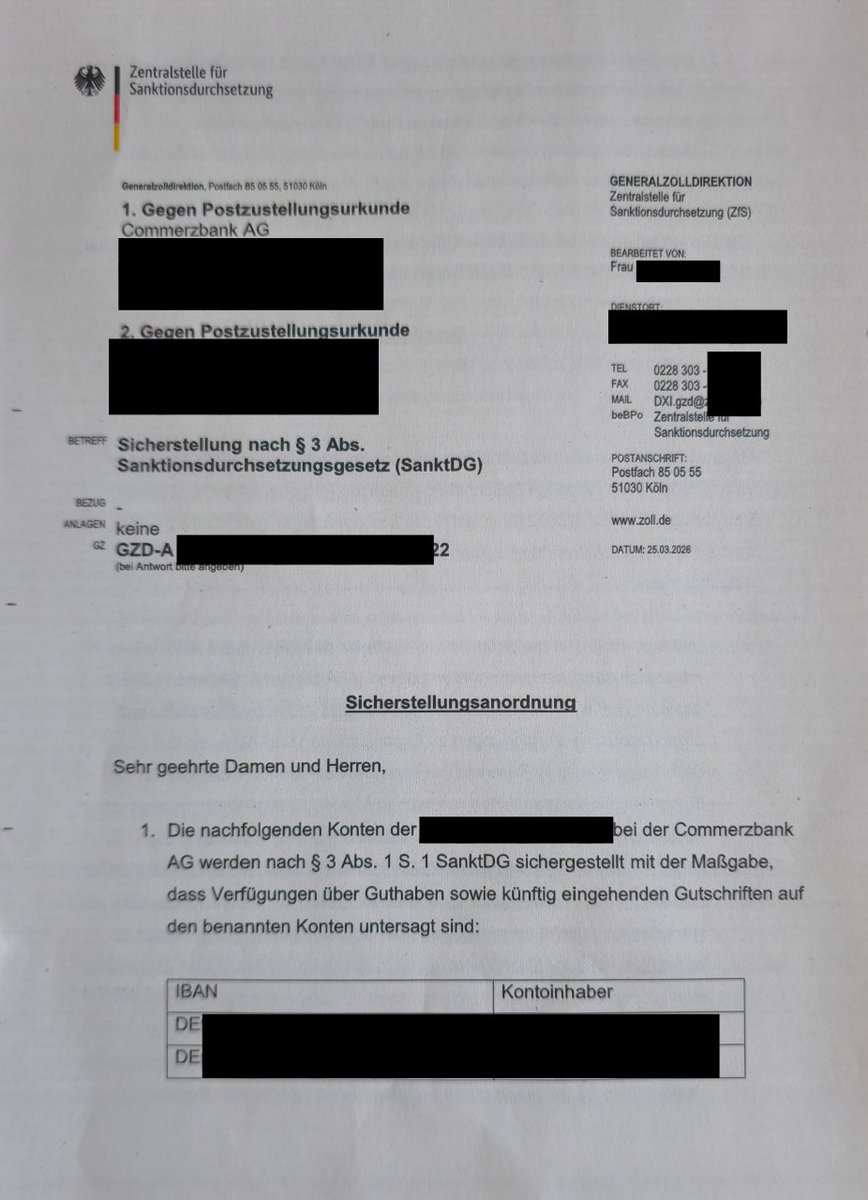
It has now been over a week that I’ve been trying to survive without any money. My bank @comdirect won’t respond to my lawyer or unfreeze my account. This humanitarian situation seems to concern neither the broader media nor most politicians, journalists’ unions, or NGOs.