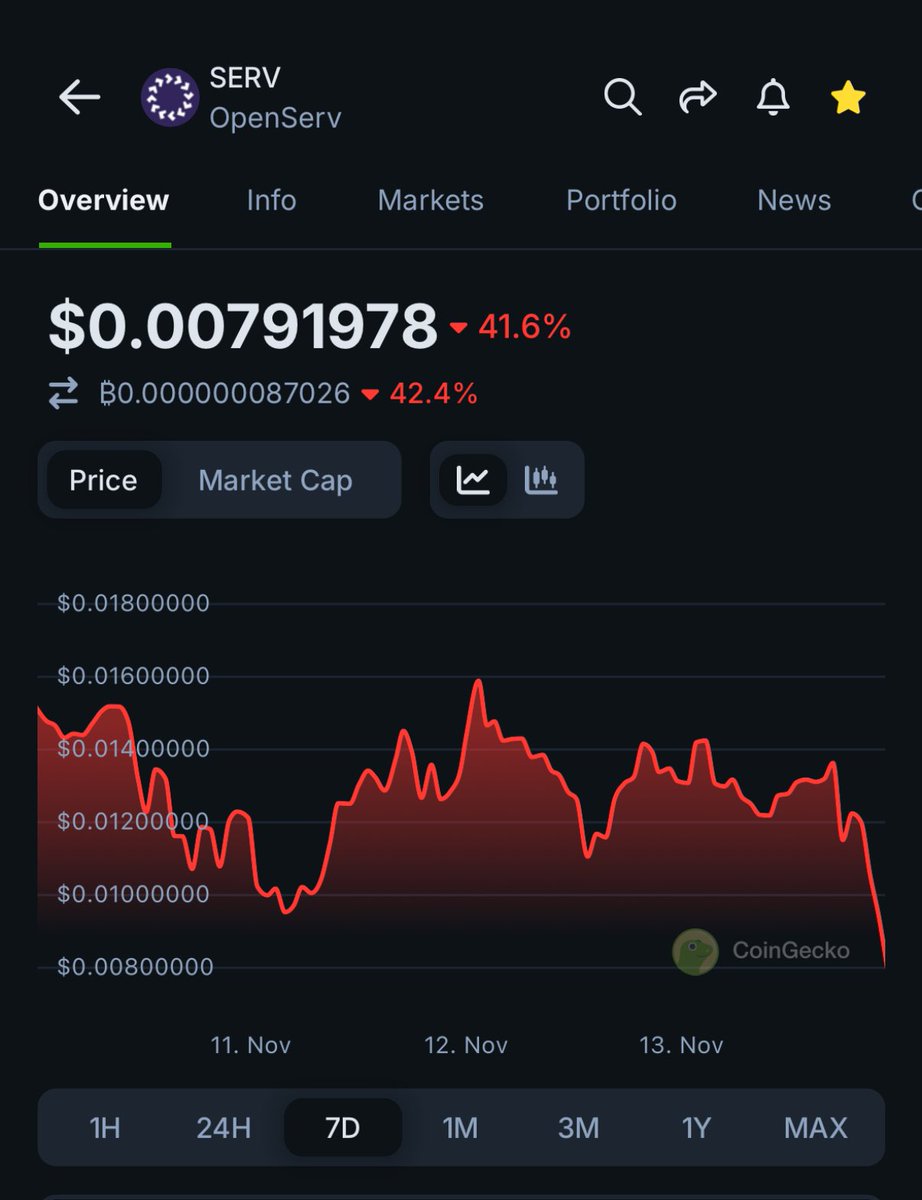
$SERV
Made a post today at 8/9 million market cap
It’s down to 5 million right now
My believes aren’t changed at all
I’m accumulating
$EMP $COFFEE $OLAS $GOAT $SAGE $DEAI $SERV $ETH $BTC
@brian_armstrong Seeing this live through convos with builders in our private beta - we built a reasoning engine that helps cheaper models match or beat frontier model performance
Cost savings have been ~90% for teams switching over
If this is a focus would love to connect
SERV is the agentic reasoning engine solving exactly this - for enterprises, financial institutions, banks and even governments deploying AI in production.
The next frontier is reasoning compression. Cheaper models reduce the cost of intelligence, but they do not solve the cost of decision-making.
Most business decisions are not about raw IQ. They are about applying the right process, policy, workflow, or rulebook reliably.
That is where unbounded inference wastes money.
SERV Reasoning makes reasoning bounded and machine-readable, so models spend fewer tokens getting to reliable decisions.
Better performance per dollar, not just cheaper tokens.
Already live with the UAE government and a fast-growing number of enterprises, financial institutions and startups across many industries in our private beta (inc. banking, compliance, security, health, robotics, among many others).
Just came back from Kenya after a week of conversations on AI, finance, and institutional adoption.
By the end of the trip, we had met with the largest investment bank in the country, half of their top 10 banks, fintechs, former ministers, and senior leaders with experience across global institutions.
A few takeaways stood out.
1. AI adoption is now a boardroom mandate.
100% of the institutions we spoke with had a direct mandate to explore AI implementation.
The reason is simple: the productivity gains are too large to ignore, and no major institution wants to be the one that lets competitors move first.
2. Deployment is still early.
Despite the intent, only around 50% of organisations we spoke with had any live AI deployment. Of those, more than 80% were still using basic general-purpose model implementations.
That creates a major gap between interest and real adoption. Institutions understand the potential, but most are still in the early stages of figuring out how to move from experimentation to workflows that can operate across the organisation.
3. Auditability and transparency are non-negotiable.
Over 90% of institutions we met had serious concerns around data security, and roughly 70% had already rejected third-party AI tools because of those concerns.
For financial institutions, “AI-powered” is not enough. They need to know where data goes, how outputs are generated, how decisions can be audited, and whether the system can be trusted in high-stakes environments.
4. Reliability and cost are the main blockers to scale.
Many institutions have already experimented with AI. The issue is that early pilots often failed to meet the standard required for broader deployment.
Unrestricted access, context bloat, inefficient prompting, and unpredictable outputs made teams cautious on both cost and reliability. In banking, a tool cannot simply work in a demo or perform well under controlled conditions.
It has to work consistently, transparently, and at a price that makes sense across the organisation.
5. The biggest barrier is not always technical. It is institutional risk.
The larger the institution, the less incentive there is for any individual to take unnecessary risk. Maintaining the status quo is safe. Championing a new system is not.
If it works, the institution benefits. If it fails, the person who pushed for it may carry the blame.
That means serious AI adoption requires more than product. It requires trust, relationships, internal alignment, and a clear path from pilot to deployment.
This is especially true in emerging markets, where enterprise sales cycles are long, distribution is relationship-driven, and adoption often depends on being in the right rooms with the right stakeholders.
The opportunity is clear: major institutions are actively looking at AI, but most still lack systems that meet the requirements for real deployment.
Secure.
Reliable.
Auditable.
Economically viable.
That is the bar.
That is what we are focused on with SERV Reasoning.
We will continue strengthening relationships across the region and using East Africa as a launch point into broader conversations across the continent.
We are also continuing our work in the UAE through Neol, with government-side interest in expanding initiatives further.
Next up: LATAM, South Asia, and other high-growth markets underserved by the major players in AI infrastructure.
SERV worldwide.
I run business development at @openservai, onboarding enterprises onto SERV Reasoning.
Over the last few weeks I've been in deep conversations with CTOs, Heads of AI, and engineering leads across F500s, fintech and biotech startups, and some of the most innovative companies building right now.
The reception has been unlike anything I expected. "This is exactly what we've been waiting for" came up more than once.
Meeting with one of the top 50 startups in San Francisco this week. Hundreds of millions on the line and they can't afford to trust AI they're not sure about.
But the pattern is the same everywhere, startups or Fortune 500s: teams are running AI agents at scale, costs are out of control, reliability is broken, and nobody has solved both at once.
We have.
This is the first step.
Together with NEOL, we’ve begun deploying SERV Reasoning into real government-grade AI workloads, already live with the UAE government.
NEOL uses AI agents to surface the right people, relationships, and institutional knowledge for governments and large institutions making high-stakes decisions.
For that to work, “usually right” isn’t enough.
The agent needs to be reliable, reproducible, and auditable.
SERV Reasoning enabled NEOL to move from brittle prompt-based agents to structured reasoning graphs their team can inspect, test, and improve systematically, reaching 100% accuracy on key production agents.
That matters because when a government client asks why a certain person was recommended, NEOL can now point to the reasoning structure behind the decision.
Not a black box.
Not a guess.
A traceable decision process.
This is the beginning of something much larger.
Every enterprise, government, and public institution trying to deploy AI into serious workflows will run into the same wall: agents that are too unreliable, too opaque, and too difficult to audit.
That is exactly the wall SERV Reasoning was built to break through.
Our aim is to keep expanding what we unlock with NEOL, deepen the relationship across more institutional use cases, and bring this same reasoning infrastructure to the enterprises and governments that need AI they can actually trust in production.
The future of institutional AI cannot run on todays infra, it needs specialized AI reasoning that can be tested, audited, reproduced, and trusted.
That is the institutional gap SERV is plugging.
Study the coins showing strength while bitcoin:native and ethereum:native are sputtering.
$SERV up 18% on the day and holding support well. Another big volume surge and this will blow past $100M market cap.
One of the most solid teams in the space.
at google play we looked for teams that had an "unfair advantage"; at least one of the following:
- a tech moat (proprietary IP, novel architecture)
- a structural moat (switching costs, lock-in)
- execution speed and quality (a moat in itself, especially in commoditised verticals)
rarest of unicorns are the ones that can combine all three.
with @openservai we're seeing how they all combine -> genuine tech differentiation in reasoning architecture. structural lock-in once enterprises integrate. a team executing faster and cleaner than anyone else in the category.
You don't need a more expensive model. You need better reasoning.
Every frontier LLM got smarter with SERV:
- smaller ones match frontier performance
- frontier ones go past what they were built for
The question isn't which model to choose - it's what engine it runs on.
SERV is on its way to become the AI infrastructure for The Fortune 500.
Akretic is yet another example validating it.
They are a security layer for finance, healthcare, government & defense -sectors with the strictest reliability requirements in AI.
They just plugged into SERV and got blown away.
"It has done a better job than several of the other frontier models."
- Sean Williams, founder of Akretic.
This is what the next decade of Enterprise AI runs on.
SERV is inevitable.
AI is the hottest narrative rn
I have been watching @openservai for almost a year now and they are building non stop, truly on another level
big pump the last few days and it looks like it's just warming up. the ethereum:0x40e3d1a4b2c47d9aa61261f5606136ef73e28042 reasoning engine is already in production with the UAE government + 10 enterprise deployments via their partner Neol
enterprise validation + many independent benchmarks already confirming tech is real and getting massive interest
ex-google head of partnerships just joined the team to scale it
you know how rare it is for a token this size to have real gov adoption? missed vvv, it might be the next good play
NFA