Following the $6.3B Binance security incident, attributed by the FBI to North Korea's TraderTraitor group, I took a public AlienVault OTX pulse containing 38 related IOCs:
- 5 domains
- 1 IP address
-32 file hashes
I built detection logic using:
GitHub: https://t.co/w13vQ3kEx4
Part 2 of my Splunk lab: deploying Splunk and ingesting Apache logs.
Once the data is in, you can start hunting for suspicious web requests.
Walkthrough 👇
https://t.co/tGuKrTrO3R
#Splunk#ThreatHunting#SOC
First lab for learning log ingestion: set up an Apache web server and forward its logs to Splunk.
Then you can search web traffic the way an analyst would.
Part 1 👇
https://t.co/kBcVDp3gKQ
#Splunk#SIEM#BlueTeam
@WilliamInCyber 1. Who is the admin account that created it.
2. Whose account was created. It is a service account or User account.
3. Where was it created on (Server or AD)
4. Why was it created?
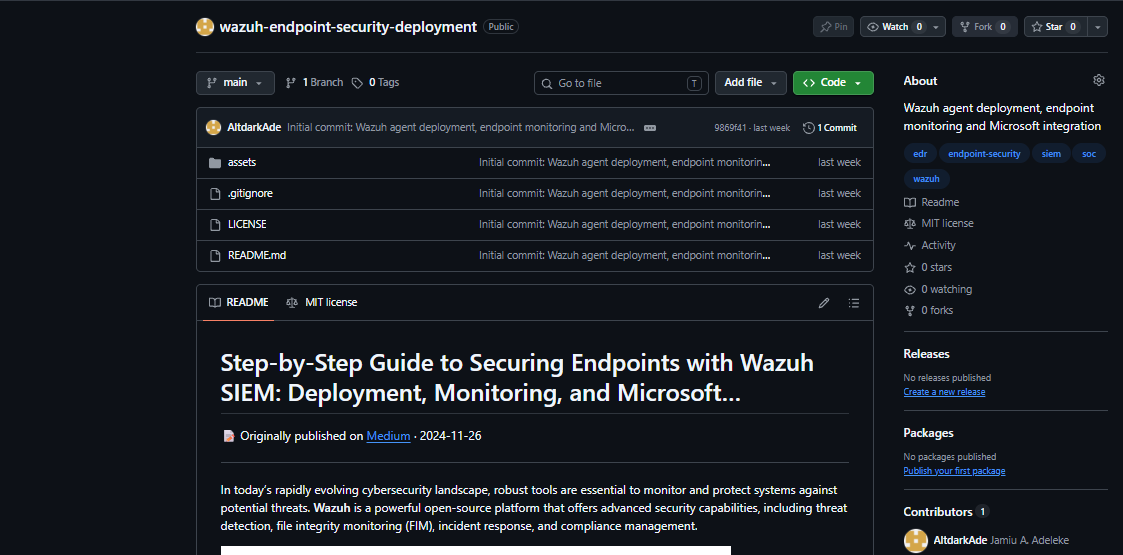
Deploying Wazuh agents across endpoints, monitoring them, and bringing Microsoft into the picture.
A step-by-step guide for analysts who want a working SIEM, not just theory.
Guide 👇
https://t.co/QSAT1sBGZi
#Wazuh#EndpointSecurity#SOC
In 2015, I built an AI that detects early cancer.
It’s still running across hundreds of hospitals in the US today.
It was the most fulfilling work of my life, and I was building in AI years before everyone called it “AI”.
Building in AI then was a dream.
Now It feels like we’ve taken a turn for the worse.
It started when i was in undergrad.
I built my first company: AI models that made the political data transparent to voters.
At 21, I was offered six figures for it, but the buyers wanted to use it for reasons I couldn't ethically support.
So we turned down the offer and shut down the company instead.
In 2014, I moved into deep learning research on language models, for the Intelligence Community and Goldman Sachs.
Then HCA Healthcare came to us.
They put me in a competition against 10 people from IBM Watson. It was just me and the tools I’d built.
Our job was to build an AI model that can catch the cancer that slips through the cracks in hospitals.
It was the most intense 30 days of my life. Multiple all nighters.
My models won. That turned into a $5M deal, and later its own company, Azra AI.
Then the world caught on.
ChatGPT and Claude arrived, and AI costs exploded.
Building in AI in 2015 felt novel.
We were using it to find cancer tumours and save lives.
Now the biggest tech companies have turned AI into a money extraction machine.
That’s when I decided to make a change.
We raised $8.5M to build a better future for AI.
On Wednesday, we’re launching Rayline.
AI shouldn’t be locked inside a few labs’ models, prices and clouds. It should be open, transparent and decentralized.
More on Wednesday.
HTTPS only protects data while it travels between your browser and a website. It does not protect the data at either end, which is where most theft happens.
The main ways data is still stolen:
→ Server-side vulnerabilities. Flaws such as SQL injection or misconfigured databases let attackers reach stored data directly. By that point, the encryption has already ended and the data is readable.
→ Compromised devices. Malware or malicious browser extensions can capture keystrokes before encryption, or read page content after decryption.
→ Phishing sites. HTTPS verifies that a connection is encrypted, not that the site is legitimate. Fraudulent sites can obtain valid certificates and display the padlock.
→ Stolen credentials. Reused or leaked passwords allow attackers to log in as the user, and the traffic appears completely normal.
→ Third-party scripts. If an external script loaded by a website is compromised, it can skim data directly from the page. Magecart attacks on checkout forms work this way.
HTTPS prevents eavesdropping on the network. It was never designed to secure the website, the device, or the user's own choices.