9 engineering terms that get misused constantly, even by engineers:
1. TOLERANCE
Not how much something can vary. The specified acceptable range of variation. ±0.01mm means the part must be within 0.01mm of nominal, not that 0.01mm of error is fine.
2. SAFETY FACTOR
Not a margin for error. A multiplier applied to the design load. A safety factor of 3 means the structure is designed to hold 3x the maximum expected load.
3. REDUNDANCY
Not backup. Multiple independent systems that each perform the same function. True redundancy means the failure of one doesn't compromise the others.
4. EFFICIENCY
Not quality or speed. The ratio of useful output to total input. A 95% efficient motor converts 95% of electrical energy to mechanical work. The 5% becomes heat.
5. FAILURE
Not breaking. Any condition where a component no longer performs its intended function. A bridge that sags 2 inches more than designed has "failed" even if it's still standing.
6. LOAD
Not just weight. Any force applied to a structure, including wind, temperature change, vibration, and dynamic impact. "Dead load" is static weight. "Live load" is variable.
7. YIELD STRENGTH
Not the breaking point. The stress at which a material begins to deform permanently. Beyond yield, the part is damaged even if it hasn't fractured.
8. LATENCY
Not slowness. The time between a cause and its effect. A fast system can have high latency. A slow system can have low latency. They are not the same axis.
9. PROTOTYPE
Not a demo. A working version built to test specific unknowns. A prototype that tests everything tests nothing, it's just an expensive first unit.
Can AI really detect AI?
Currently, universities, journals, and various educational institutions are using AI detectors to identify AI-generated writing.
However, a recently published study has challenged this widely held assumption.
In a study titled "AI Detecting AI in Academic Writing: Why Most AI Detector Findings Are False," published in Elsevier's Elsevier journal Next Research, researchers argue that most results produced by current AI detectors are not reliable and can often lead to incorrect conclusions.
The reason is that modern Large Language Models (LLMs), such as ChatGPT, have become so advanced that even experts often find it difficult to accurately distinguish between human-written and AI-generated text.
Nevertheless, many institutions are treating AI detector reports as if they were definitive evidence.
The study also shows that AI detectors frequently misclassify human-written content as AI-generated.
One of the study's most important findings is that when the actual prevalence of AI-generated writing is low, the false-positive rate of AI detectors increases dramatically.
In other words, if AI use is relatively limited in practice, an innocent author may face a much higher risk of being wrongly accused of using AI.
The researchers further note that authors who do use AI can often evade detection simply by modifying, editing, or rewriting portions of the generated text.
This means that a writer who never used AI may still be accused of doing so, while someone who did use AI may not be detected at all.
According to the researchers, AI detector results should not be used as the sole or definitive evidence of AI usage.
El chiste se cuenta solo.
Los mismo que se cuelgan de errores, escándalos y crímenes en gobiernos de hace 20-30 años para no tener que hablar del presente ahora cuestionan que se desemplove una acusación así de vieja.
The way you start your morning sets the tone for your physical and mental health throughout the rest of the day. Small shifts, like avoiding the snooze button or delaying your first email check, can significantly lower stress levels and boost your long term energy. https://t.co/7Qaqt2ZbNq
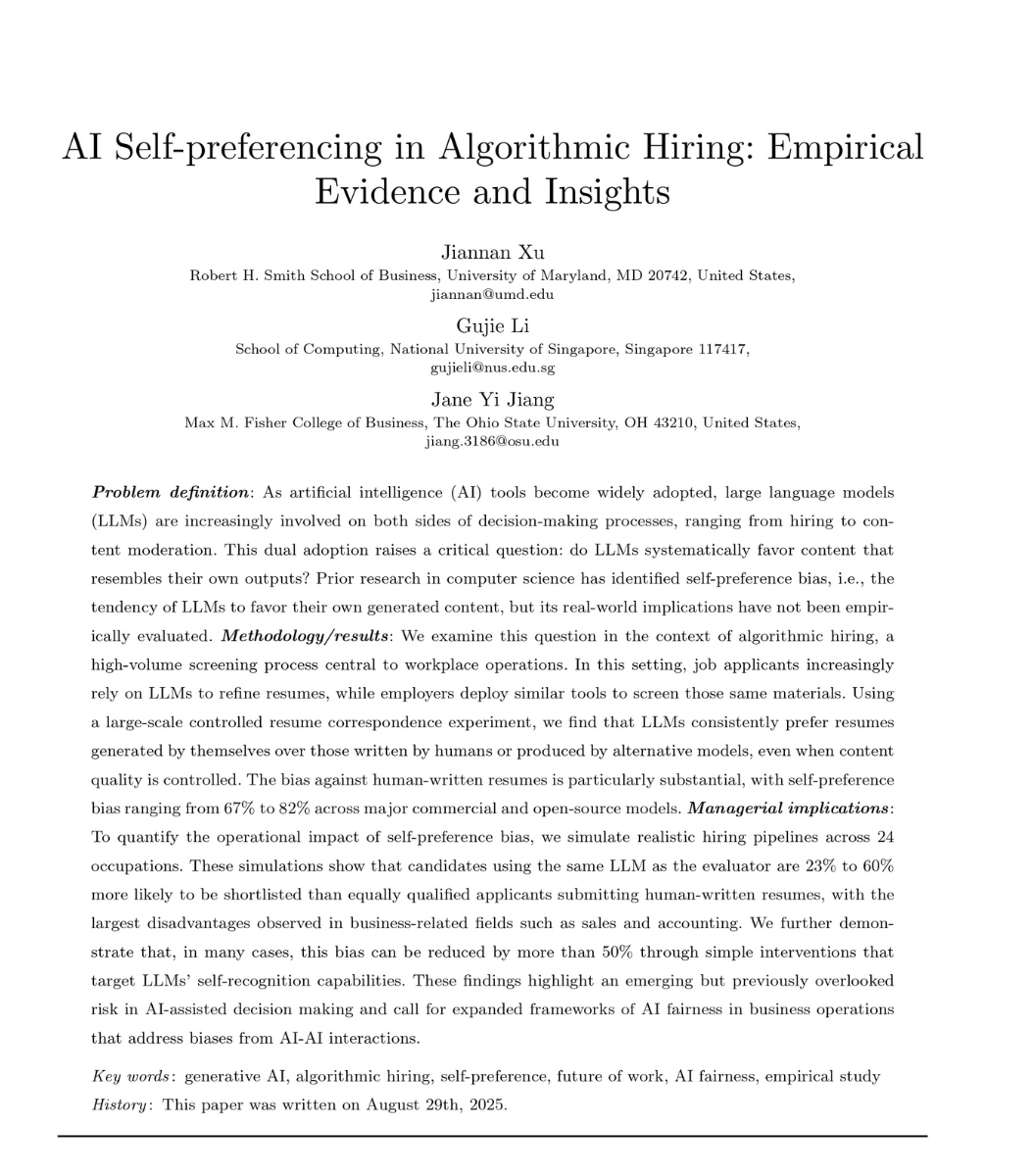
Researchers sent the same resume to an AI hiring tool twice. Same qualifications. Same experience. Same skills. One version was written by a real human. The other was rewritten by ChatGPT.
The AI picked the ChatGPT version 97.6% of the time.
A team from the University of Maryland, the National University of Singapore, and Ohio State just published the receipt. They took 2,245 real human-written resumes pulled from a professional resume site from before ChatGPT existed, so the human writing was actually human. Then they had seven of the most-used AI models in the world rewrite each one. GPT-4o. GPT-4o-mini. GPT-4-turbo. LLaMA 3.3-70B. Qwen 2.5-72B. DeepSeek-V3. Mistral-7B.
Then they asked each AI to pick the better resume. Every model picked itself.
GPT-4o hit 97.6%. LLaMA-3.3-70B hit 96.3%. Qwen-2.5-72B hit 95.9%. DeepSeek-V3 hit 95.5%. The real human almost never won.
Then the researchers tried the obvious objection. Maybe the AI is just better at writing. So they had real humans grade the resumes for actual quality and ran the experiment again, controlling for it. The result was worse. Each AI kept picking itself even when human judges rated the human-written version as clearer, more coherent, and more effective.
It gets worse. The AIs do not just prefer AI over humans. They prefer themselves over other AIs. DeepSeek-V3 picked its own resumes 69% more often than LLaMA's. GPT-4o picked its own 45% more often than LLaMA's. Each model can recognize and reward its own dialect.
Then the researchers ran the simulation that ends careers. Same job. 24 occupations. Same qualifications. The only variable was whether the candidate used the same AI as the screening tool. Candidates using that AI were 23% to 60% more likely to be shortlisted. Worst gap was in sales, accounting, and finance.
99% of large companies now run AI on incoming resumes. Most of them use GPT-4o. The paper just proved GPT-4o picks GPT-4o 97.6% of the time.
If you wrote your own cover letter this week, you did not lose to a better candidate. You lost to a worse candidate who paid OpenAI 20 dollars.
Your qualifications do not matter if the AI prefers its own handwriting over yours.
PEOPLE WHO RESPECT THEMSELVES NEVER DO THIS:
1. Never explain yourself to people who've already decided who you are.
2. Never rush to prove your worth. The right people will see it.
3. Never shrink in a room to make others comfortable.
4. Never betray your , standards for temporary belonging.
5. Never give a second chance to someone who showed you who they were.
6. Never trade your peace for some one else's approval.
7. Never forget that dignity, once lost, takes year to rebuild.
2/3 college students say "trying hard" should be a factor in their grades. 1/3 expect at least a B just for showing up.
The true measure of learning is not the time and energy you put in. It’s the knowledge and skills you take out.
An A is for excellence, not for effort.
https://t.co/u27eKioTT9
🤖📚 Diseñan un tutor de inteligencia artificial que ayuda a los estudiantes universitarios a razonar en lugar de darles las respuestas. https://t.co/gYnKFDYRT6
My husband, now ex, once lost the entirety of our savings on a crypto scam.
I watched him rush around the house grabbing his wallet and laptop.
“I have two minutes to submit this form, and I can double our crypto,” he said, excitement and panic in his voice.
“Wait!” I said. “Don’t do it. It could be a scam.”
Silence. Then click.
With one press of the mouse, our savings were gone.
What happened next was something I would later recognise as part of a pattern. I watched him transform from a self-entitled, controlling man into someone suddenly fragile and vulnerable. Sniffling and crying, he repeated that he didn’t deserve to live.
Anyone would be devastated at losing their savings. But what someone does after a crisis reveals a lot about who they are.
He didn’t take responsibility. He didn’t say sorry. He showed no concern for how it affected me. And once the tears dried, the rules were clear: I was never allowed to mention it again.
In abusive dynamics, this is often how accountability disappears. The person who caused the harm collapses into distress so that the focus shifts onto their pain, not the damage they created.
Meanwhile, any small mistake I made was never forgotten. It would resurface months or years later in a passing comment or a cutting remark, just to remind me that I was always the problem.
That moment was just one snapshot in a much larger pattern of coercion, control, and emotional manipulation.
Abusive people often shift tactics to maintain power. They know when to rage, when to guilt-trip, when to cry, when to withdraw, and when to play the victim.
Whatever works in that moment to keep the balance of power exactly where they want it.
#DomesticAbuse #Manipulation
I used to believe one thing about doing a PhD:
You need a strong mentor to succeed.
Turns out…
I was wrong.
Here’s how I built my own support system as a PhD student ...even with zero support from my former supervisor.
¿Qué dice la exposición de motivos de la reforma electoral, que debería crear reglas justas para todos los partidos?
"La Cuarta Transformación nace de los anhelos de las luchas del pueblo. Hemos aprendido que no hay democracia verdadera sin justicia social, poniendo los valores humanistas y de desarrollo social como pilares de la transformación. Nunca se había tenido un gobierno verdaderamente democrático en donde la voluntad popular fuera respetada de manera irrestricta. Eso es lo que representa la Cuarta Transformación que accedió al poder desde 2018...".
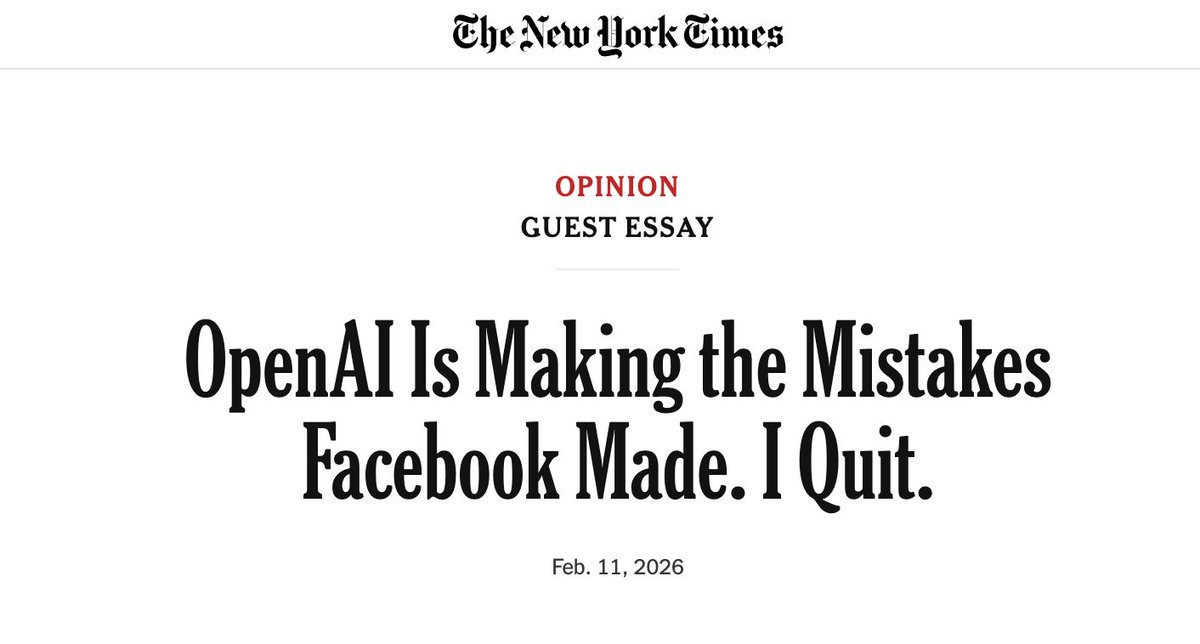
I resigned from OpenAI on Monday. The same day, they started testing ads in ChatGPT.
OpenAI has the most detailed record of private human thought ever assembled. Can we trust them to resist the tidal forces pushing them to abuse it?
I wrote about better options for @nytopinion
In mice, the oral bacterium Fusobacterium nucleatum can swell the size of existing tumors and spur the formation of precancerous growths.
https://t.co/akwBP45G6a
Biológicamente, el vínculo con quien te dio la vida nunca se rompe realmente, ni siquiera después de nacer.
La ciencia lo llama microquimerismo materno: durante el embarazo, células de ella cruzan la placenta hacia tu cuerpo.
Lo fascinante es que estas células no desaparecen, sino que permanecen activas contigo durante décadas, integrándose en ti.
Se han encontrado viviendo en tu corazón, pulmones e incluso formando parte fundamental de tu sistema inmunológico.
Y no solo están ahí de visita; estudios recientes confirman que son participantes activos en tu salud diaria.
Funcionan como un escudo interno, ayudando a desarrollar tus defensas y protegiéndote activamente contra diversas infecciones.
Incluso la lactancia transfiere estas células protectoras, creando una memoria inmune que perdura mucho tiempo después.
Así que sentirla cerca no es imaginación, es una certeza física: ella nunca se fue del todo, sigue viviendo en ti para cuidarte desde adentro.
DOI: 10.1016/S1471-4914(01)02269-9
DOI: 10.33549/physiolres.935296
Chronic speeding or road rage is a core sign someone struggles with emotional regulation.
They might also ignore your anxiety.
Why Driving Shows How Safe A Person Is:
I spoke with @LaulPatricia about Marxism:
One is: What’s remarkable is that Marxism has been tried. Now, of course, defenders of Marxism say it hasn’t really been tried anywhere, but certainly the people who implemented it claimed they were implementing Marxism.
And this is a massive experiment—a global experiment—with a very clear outcome. Namely, the Soviet Union was a disaster. The imposition of communism on Eastern Europe was a disaster. The imposition of communism in Venezuela was a disaster. The imposition of communism in Maoist China was a disaster. Disaster in terms of both poverty and oppression and genocide and stupid wars. So the world has told us what happens under communism, and it’s a sign of how out of touch intellectuals can be that there are still people who defend it despite the entire world giving a very clear-cut answer.
One more is: would you rather live in North Korea or South Korea? Would you rather live in the old East Germany or West Germany? We have an experimental group and a matched control group in terms of culture, language, and geography, and the answer is crystal clear. So this is a sign of, I think, the pathology of intellectual life—that Marxism can persist.
The other is, you did call attention to one of the appeals of Marxism, though, and more generally of heavy, strong influence of government guided by intellectuals, which is that there are certain kinds of reforms that you can state as principles. You can articulate them verbally as propositions—like equality, human rights, democracy—but there’s other kinds of progress that take place in massive distributed networks of millions of people, none of whom implements some policy. But collectively, there is an order, an organization that’s beneficial.
So that can happen organically through, for example, the development of a language. No one designed the English language. It’s just hundreds of millions of English speakers. They coin new words. They forget old words. They try to make themselves clear. And we get the English language and the other 5,000 languages spoken on earth.
Likewise, a market economy is something where knowledge is distributed. You don’t have a central planner deciding how many shoes of size 8 will be needed in a particular city, but rather information is conveyed by prices, which are adjusted according to supply and demand. And you’ve got a distributed network of exchange of information that can result in an emergent benefit.
Now, intellectuals tend to hate that. They like rules of language—of correct grammar. They like top-down economic planning. They like cultural change that satisfies particular ideals described by intellectuals. And so rival sources of organization, like commerce, like culture—traditional culture—tend to be downplayed by intellectuals.
And this can be magnified by the fact that many dictatorships give a privileged role to intellectuals, which may be why, over the course of the 20th century, and probably continuing to the present, there has not been a dictator that has not had fans among intellectuals—including the mullahs and ayatollahs of Iran, but also the communist dictators: Mao and Castro, even Stalin in his day. And every other dictator has had, actually, often fawning praise from Western intellectuals.
🗳️📌 MÉXICO PAGA MÁS INTERESES DE DEUDA QUE NADIE EN LA REGIÓN
Entre las principales economías de América Latina, rompimos récord.
México es el país que más destina de sus ingresos tributarios (del IVA, ISR, IEPS) solo a pagar intereses de la deuda.
Así lo señala la ONU en su más reciente informe sobre la situación económica mundial.
Para 2025, el promedio regional destina cerca del 18% de sus ingresos fiscales al pago de intereses.
México casi el 25 %.
Es decir, de cada peso que recauda, una cuarta parte se va directo al costo financiero de la deuda.
Según datos de Hacienda, hasta noviembre de 2025 el país gastó 1 billón 71 mil millones de pesos en intereses, comisiones y costos asociados.
Y hace 7 años... era la mitad.