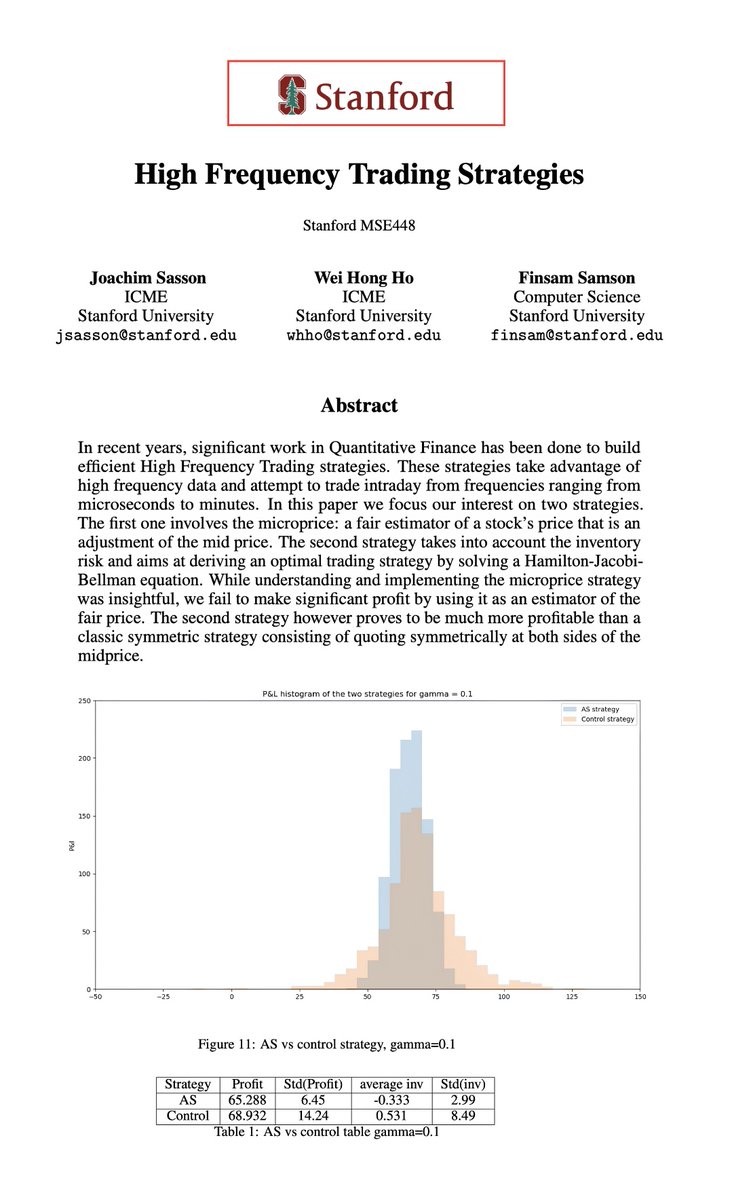
As someone who builds institutional level quant systems, this Stanford paper is the closest thing to an HFT desk I have ever seen publicly shared.
14 pages. Top Trading Strategies. Bookmark & get this, then read the article below before someone takes it down.
Citadel CEO Ken Griffin sat down with the man running Norway's $1.7T sovereign fund - the largest pool of capital on the planet
two of the biggest money figures alive talking openly about the AI bubble, Citadel culture, recruiting, and what's coming next
45-min and you'll hear how the people who actually move global markets actually think
bookmark & watch - this is the only podcast where both guests together move markets just by changing their minds
A lot of people here ask me about whether private equity or hedge fund is the right fit for them if they want to be in an investing seat
Here is how I would think about the decision based on your personality and interests
Private equity
> better caters to someone who enjoys having control over their destiny. You will own majority stakes in businesses and be actively involved in putting together a management team and plan to run the business
> good for someone who wants to run operations, not just investing. You will have to figure out value creation levers in the company to improve revenue and margins. You will have to understand capital structures and how much debt a business can support. You will be present in the Board discussions to see how the “sausage gets made” behind the scenes
> good for someone who wants continuity of the hierarchy in banking. Private equity is set up to be much more of an apprenticeship model from a org structure standpoint. You will have layers of VPs and MDs above you before any direct interaction with PMs or IC members in most firms
> much more relationship and face time heavy. You will have to coordinate with lawyers, consultants, accountants and third party vendors on diligence as you underwrite a business. You will have to gather bids from lenders and help them through their diligence. Many deals will have bankers running a process. Private equity, as a business, is much more relationship heavy than public market roles
> stability. This one doesn’t get talked about enough but private equity inherently offers better career stability than most hedge funds. The career ladder is laid out for you and you know where you stand on it. It’s hard to get abruptly fired in PE land, which is something that happens quite often in public market world
Hedge fund
> caters to people who enjoy the immediate feedback loop of public markets. You like finding edge and figuring out analysis that the rest of the market has missed
> better for folks who hate hierarchy and want flatter org structures. Most hedge funds tend to be relatively flat with direct line of access to PMs, even at the junior analyst level
> less relationship driven but still matters since you will spend a lot of time talking to management and sellside research analysts
> better for someone who wants to track a name or stock for long periods of time with changing your thesis along the way. In private equity, you might see one company come across for a transaction every 3-5 years. At a hedge fund, you underwrite the same business every quarter, or month for that matter, as new information comes out and you re-underwrite what you know
> better for someone who is okay with career and earnings volatility. Hedge fund comp will swing widely every single year, even at the same firm, depending on how your fund performs. In good years, you might be making in the millions on your bonus but bad years will much worse vs your private equity peers. You are somewhat beholden to the broader market, especially for more beta strategies. Need to be okay with having to move firms every few years if things don’t go as expected
> this is an odd one but all of my friends who enjoy their hedge fund seats also really enjoy poker. There are a lot of similarities between poker and investing in public markets, so thought I’d add this one in
Two Anthropic engineers spent 24 minutes exposing every Claude Code feature you didn't know existed.
Most people will scroll past this. Don't be most people.
ANTHROPIC JUST PROVED MOST PEOPLE HAVE NO IDEA HOW TO PROMPT CLAUDE.
Their applied AI team dropped a 24 minute free workshop.
Not a creator who reverse engineered it.
Not a Reddit thread.
ANTHROPIC.
The people who wrote the weights.
And what they showed is uncomfortable.
There are 6 elements to a properly structured Claude prompt.
Most people are using 1.
Maybe 2.
That is not a skill issue.
That is an information issue.
And it has been quietly costing you every single day.
The outputs that felt slightly off.
The responses you had to rewrite 4 times.
The prompts that worked once and never again.
All of it traces back to the same 6 missing elements.
The people who watch this 24 minute workshop tonight will understand something about Claude that most daily users still do not know exists.
The people who skip it will keep getting 30% of what the tool is actually capable of and wonder why the results never quite land.
I watched it twice.
Then I built a Claude Skill that applies all 6 elements to every prompt automatically.
No more thinking about structure.
No more guessing what Claude needs.
The framework runs in the background every single time.
Full breakdown and skill setup is below.
Bookmark this now.
Watch the workshop first.
Then read the guide.
This is the one that compounds.
Follow @cyrilXBT for the exact prompt architecture, Claude skills, and systems I use to get outputs most people do not believe came from one person working alone.
EPISODE 151: The Myth of Michael Milken
@JTLonsdale talks with Richard Sandler -- Michael Milken's long-time lawyer -- about his powerful new book: "Witness to a Prosecution: The Myth of Michael Milken"
(00:00) Episode intro
(01:35) Richard's career & Michael Milken's legacy
(06:25) Why write this book?
(08:00) How Michael Milken transformed finance
(14:00) Why did they go after Michael?
(19:30) Using RICO to bring down Drexel
(22:30) Prosecutorial abuse & the power of government
(26:30) Why did Michael agree to a plea deal?
(33:25) Trump grants Michael a full pardon
(35:00) Lessons on government power, media influence & Michael's resilience
I get asked fairly often on how to secure reservations at NYC's hottest & hardest to get restaurants, nothing is for certain, I do believe knowing their reservation policies, and WHEN to try, will help. Here's a list of the hardest reservations to secure, and when to try and make your reservation.
In 2019, MIT professor Patrick Winston gave a legendary 1-hour lecture called “How to Speak.”
It has 18M+ views for a reason.
His frameworks:
• Your ideas are like your children
• The 5-minute rule for job talks
• Why jokes fail at the start
15 lessons on communication: