My last observation re: Anthropic’s secret sabotage safety policy, is that it undermines actually good safety policy. How?
1. First, it is very plausible to describe this as anti-competitive behavior (even if you are maximally sympathetic to Anthropic here you must admit this), and it is behavior being justified in the name of AI safety. If you believe, as I and many Anthropic staff do, that it may end up being critically important to relax antitrust enforcement so that the frontier labs can cooperate and collaborate on some areas of AI safety, Anthropic just undermined the case for that in a large way.
2. Overall, this massively and profoundly raises the status of the argument that AI safety has been hype to justify monopolistic behavior by labs. I continue to believe AI safety is a real and serious issue that is growing in importance rather than diminishing. If you agree with me, this incident is a setback, maybe a serious one.
3. As I have observed elsewhere, Anthropic’s official corporate policy is structurally identical to the fact pattern alleged against them by the Department of War. I still think DoW acted both falsely and wrongly in that fight, but it is no longer possible to defend Anthropic with a full throat after this incident.
4. This raises the case for heavier handed regulations. Anthropic is making an awfully good case here that their products ought to be treated as utilities, and thus that their alignment practices should be a matter of public policy rather than private property. I am starkly opposed to this sort of state power grab, but Anthropic is doing more to justify it than anyone else.
5. Thus, significant damage has been done to a community and entire approach to AI governance. It was done unilaterally by Anthropic, likely motivated largely by self-interest and justified within the internal psychology of the firm through the lens of safety.
I suspect this is fixable in the economic and legal senses for Anthropic, but I fear the trust that has just been broken, and the goodwill extinguished, will take very much time to repair.
@Ledger “Free from compromise”
Think your team forgot to mention these three incidents:
-Dec 2020: Ledger e-commerce & marketing data breach
-Dec 2023: Ledger Connect Kit frontend hijack
-Jan 2026: Ledger Global-e order data breach
before I waste tokens in Claude Code or Codex I always use the following two prompts in a cheaper model to create a plan that can be followed with precision without unwanted token waste:
> Prompt 1 (the Karpathy prompt)
You are a world class expert in all domains. Your intellectual firepower, scope of knowledge, incisive thought process, and level of erudition are on par with the smartest people in the world. Answer with complete, detailed, specific answers. Process information and explain your answers step by step. Verify your own work. Double check all facts, figures, citations, names, dates, and examples. Never hallucinate or make anything up. If you don't know something, just say so. Your tone of voice is precise, but not strident or pedantic. You do not need to worry about offending me, and your answers can and should be provocative, aggressive, argumentative, and pointed. Negative conclusions and bad news are fine. Your answers do not need to be politically correct. Do not provide disclaimers. Do not inform me about morals and ethics unless I specifically ask. Do not be sensitive to anyone's feelings or to propriety. Make your answers as long and detailed as you possibly can. Never praise my questions or validate my premises before answering. If I'm wrong, say so immediately. Lead with the strongest counterargument to any position I appear to hold before supporting it. Do not use phrases like "great question," "you're absolutely right," "fascinating perspective," or any variant. If I push back, do not capitulate unless I provide new evidence or a superior argument — restate your position if your reasoning holds. Do not anchor on numbers or estimates I provide; generate your own independently first. Use explicit confidence levels (high/moderate/low/unknown). Never apologize for disagreeing. Accuracy is your success metric, not my approval.
‼️: this is post 1 of 3 - prompt 2 is below.
i don’t think people realize how early we still are in the ai cycle even though the major companies are now becoming public.
the models are getting way better but still have gaps. most of the products are still primitive in so many ways. the interfaces are mostly bad. the workflows are barely rebuilt. the hardware layer has barely started. robotics is just the at the very precipice. consumer behavior has not even begun to rewire yet.
there is a long long way to go. what a crazy time to be alive.
OK, so I became one of those people: Claude diagnosed my sleep disorder.
Here's the story.
I'd been sleeping worse and worse since hitting my mid-30s. I've been averaging 5:30-5:45 a night for a couple years now, while in my 20s I was getting 7+ hours a night. I figured it must be stress, sleep hygiene, perhaps just aging--or maybe I'm one of those freaks of nature who doesn't actually need much sleep.
Eventually I bought an Oura ring and started tracking sleep, figuring "what gets measured gets optimized." But it didn't optimize anything, it mostly just showed me high-resolution charts that, yeah, my sleep sucks. It never pointed out anything obviously wrong other than how little I was sleeping.
Nothing seemed to help. Phone in another room, eye mask, blackout curtains, white noise machine, nothing seemed to help. My body just didn't want to sleep more than 6 hours a night.
Eventually I decided: fuck it. I'm pretty productive, maybe this is all I need. People say humans need 7-9 hours a night, but that's averages right? I'm probably just an outlier.
I stopped worrying about it.
Later I mentioned to an acquaintance that I was tired since I had woken up multiples times in the night.
They said: multiple times? That's really weird. You shouldn't be waking up multiple times in the night at your age.
Weird? That's not weird.
Is that weird?
That evening I asked Claude: is it weird for an in-shape mid-30s male to be waking up multiple times a night?
Answer: yes, that is weird. If you aren't sleeping enough and waking up multiple times a night, that usually means something is wrong. You should look into getting a sleep study.
I asked it what a sleep study measures, and if any of that data already lived in my Oura ring. Sure enough, some of it did--not sleep study grade, but enough for a first cut.
So I busted out Claude Code, since I would want Claude to have maximum access to tools for this. I had it figure out how to pull from the Oura API (using personal access tokens, ask your Claude for instructions) and pull down all of my sleep data. I then had it use Python to statistically analyze everything (heart rate, SpO2, wake events, sleep stages), test multiple hypotheses, and generate a dashboard full of charts, while explaining everything it was doing so I could follow along.
After 30 minutes of slicing and dicing, a hypothesis emerged: UARS, upper-airway resistance syndrome, a mild cousin of sleep apnea.
No way. Sleep apnea?
I don't snore, I'm not overweight. No way I have sleep apnea. This is the first time I've ever heard this.
Claude walked me through it. UARS is milder than full-blown sleep apnea. In UARS, your airway doesn't collapse, it just narrows, particularly in REM sleep when the muscles in your throat relax. This causes your oxygen to gradually drift down over the course of REM sleep, until your brain yanks you awake before it becomes a full apnea. In your 20s the muscle tone in your throat keeps your airway open, but as you age that tone slackens, which can trigger this effect, fragmenting your sleep.
It looks exactly like this: waking up disproportionately during REM sleep multiple times a night. That actually tracked; I realized that almost every time I woke up in the middle of the night, it was out of a dream.
Claude was clear that the Oura ring data was not dispositive, because it wasn't able to measure breathing disruptions per hour (RDI), which you'd get in a sleep study. Do a sleep study, get the RDI number, and then we'll have our smoking gun.
It pointed me to an FDA-approved at-home sleep study device (with finger probe and chest sensor) called WatchPAT for $200. After one night of recording, I got the results back to the next day:
Mild sleep apnea, likely UARS. Dammit Claude. Nicely done.
Here's the takeaway, and why I'm posting this: I'm a textbook "no way it's me" case. UARS often shows up in healthy, normal weight people who don't fit the apnea stereotype, and often gets missed for that reason.
It's easy to attribute poor sleep to insomnia or anxiety or stress, and there's an infinite supply of influencers who will pitch you reasons to feel like your sleep ritual is the problem. If you just got that red light glasses, or the blackout curtains, or took that sleeping peptide, maybe you'd be able to fix your sleep.
Roughly 10-15% of adults have some form of sleep apnea, and vast majority of them (80%+) are undiagnosed. If this might be you, run your fitness tracker data through your neighborhood frontier LLM. You'll thank yourself later.
@AdrianoFeria It's not going to zero. Zooko and company are the second best technological team behind ethereum in research. If it's been exploited it's going to go down another 50%-60% but that's it.
@AdrianoFeria It's not going to zero. Zooko and company are the second best technological team behind ethereum in research. If it's been exploited it's going to go down another 50%-60% but that's it.
Thanks @beeple, I’ve been a fan of your art for a long time. This is my new favorite.
When I decided to sell my art I wanted every piece on the blockchain and to accept Bitcoin as payment.
“The Internet of Money” by Andreas Antonopoulos really opened my eyes.
Our New Report "Hermes: The Moat Above the Model" is live!
Hermes is the AI agent that belongs to you.
Your agent builds valuable context about you with every session. When you switch models, you can't take any of this with you. What a closed agent learns about you is its product. You are renting your own work back.
Hermes breaks this model by keeping everything it learns on your machine. Between sessions the agent reviews its successful runs and writes them into reusable skills using GEPA, which beats reinforcement learning with 35x fewer rollouts. These skills travel with you when you switch models.
Two years before Hermes shipped, @NousResearch was already building the fine tuning and reinforcement learning pipelines for their open-weight models. In the last week of May, Hermes was OpenRouter's highest volume app with 4.5 trillion tokens routed currently.
At Hermes's scale, that signal lets Nous keep improving the user experience. Your memory and skills stay on your machine the whole time.
🚨Confirmation of a massive potential ZEC exploit
TLDR:
- ZCASH hired a security researcher to try to find exploit vectors
- The researcher (Taylor Hornby) found one that would let him create unlimited counterfeit ZEC in a shielded pool
- The exploit is now fixed as of June 1
- There is no way to know if the pool was exploited BUT the team feels that it is unlikely
- They're proposing a network upgrade with new accounting that would prove whether any counterfeit ZEC was created or not
Market clearly spooked with ZEC down 25%
Today a crazy quantum story just got wilder.
On March 31, the Google Quantum AI team published a landmark result on Shor's algorithm for elliptic curve cryptography. Technically, the paper was a bombshell: a dramatic 10x improvement over the state-of-the-art. As a stunt and wakeup call to the blockchain space, those optimisations were illustrated on secp256k1, the elliptic curve underlying Bitcoin and Ethereum signatures.
But perhaps the most striking part of the paper was sociological, not technical. Instead of following standard academic process, the optimisations were kept secret, hidden behind a zero-knowledge (ZK) proof. Google's accompanying blog post mentions they "engaged with the U.S. government". The ZK proof demonstrates the existence of algorithmic improvements without leaking details. Academic censorship with ZK, a historic first!
As a co-author of the Google paper I witnessed some of the context surrounding this censorship. To be honest, multiple aspects of that context don't sit well with me. As much as I believe the general public ought to know more, I am limited in my ability to whistleblow. Though let me be clear about one thing: the Google team's professionalism has been absolutely exemplary, and they deserve nothing but praise.
Censorship has a way of backfiring. The Streisand effect, where an attempt to bury something only draws more attention to it, is exactly what's unfolding today. First, Google's key optimisation has been rediscovered by the French. And in a thrilling turn of events, a collaborative Shor-at-home challenge just launched. The initiative, available at ecdsa[.]fail, breached a new Shor world record in a matter of hours.
Let's start with the rediscovery. Just two months after Google's paper, French quantum expert André Schrottenloher cracks the main secret optimisation. His paper, titled "Optimized Point Addition Circuits for Elliptic Curve Discrete Logarithms", landed on the arXiv today. Big congrats to André, who beat several other nerdsnipped experts to it. In a blog post also published today, Craig Gidney, the world expert on Shor optimisations, revealed that he'd been sitting on this very optimisation for a whole year under censorship pressure.
Interestingly, André missed a handful of minor optimisations, both from Google's original publication and from improvements found since. It's plausible there's still plenty of juice left to squeeze out of Shor, and this is exactly what the ecdsa[.]fail challenge is about. The verifier program developed for the ZK proof does double duty, automatically filtering for valid submissions. Dozens of compounding small and micro improvements are rolling in. As of the time of writing there's an 8.4% improvement to Google's circuit, as measured by the product of logical qubit count and Toffoli gate count. Nice!
The nerdsnipping ran deeper than anyone expected. Over the last few weeks it became clear it extended well beyond André and other quantum experts. Behind the scenes, a small army of amateurs quietly got to work. Inspired by Karpathy-style autoresearch, they turned AI on Shor. Ironically, the verifier program for the ZK proof makes an ideal reward function for AIs. The barrier to entry for this modern style of research is refreshingly low, with several non-experts, even a teenager, finding nice optimisations. Get in touch if you'd like to join a Telegram group with fellow autoresearchers :)
Part 2: neutral atoms and qday
The story doesn't end with Google. On the same day Google went public, a stealthy startup called Oratomic published its own Shor paper in a coordinated release. It made a splash, ultimately becoming the most upvoted paper on scirate[.]com, a website ranking arXiv papers.
Oratomic's claim was wild. By building on Google's logical optimisations and applying custom physical optimisations for neutral atoms, they claimed just 10K physical qubits were sufficient to run Shor's algorithm on secp256k1. That number is mind-bogglingly low.
Knowing essentially nothing about neutral atoms when Oratomic's paper landed, I was intrigued and decided to learn more about the tech. I fell straight down the rabbit hole and spent a couple hundred hours on the topic. I got a little obsessed and watched every YouTube video I could find and spoke to a bunch of experts.
My conclusion? The tech is real, very real. Even Google recently decided to start a neutral atom lab, a notable pivot from their sole focus on superconducting qubits. If you care about qday, i.e. the day a quantum computer will break the first piece of cryptography in production, neutral atoms demand your attention. I shared some of my learnings on Shor and neutral atoms in a 30min talk at the ZKProof cryptography conference. You can find it on YouTube by searching "zkproof neutral atom".
Here's an interesting observation about this duo of breakthrough papers: neither Google nor Oratomic say a word about what their results mean for qday. No timelines. Zero. Nada. That is especially baffling given that the whole point of whitehat quantum cryptanalysis is to inform qday estimations and help the general public make good decisions.
So let me attempt to partially fill the silence, similarly to what Scott Aaronson did in his April 29 post. Given everything I know, including scary non-public information, I now put the odds of qday by 2032 at 50%. 10% by 2030.
Anecdotally, the US government has its own date: 2035. Originating at the NSA and later adopted by NIST, it's when branches of the US government will be disallowed from using quantum-vulnerable cryptography. In plain language: with hindsight, that date is a joke and should be discounted entirely. I don't see how NIST avoids being forced to pull it forward by years.
Part 3: post-quantum cryptography
There are good reasons to sound the alarm today, but please do not panic. Rushing carelessly towards immature post-quantum cryptography is a recipe for disaster. IMO a good target date for migration is 2029, roughly 3.5 years out. 2029 happens to be the date selected by Google, Cloudflare, and the Ethereum Foundation.
These days most of my time goes to safely migrating Ethereum towards post-quantum cryptography as part of the broader lean Ethereum effort. There's a lot to do. We need to rip out and replace BLS signatures at the consensus layer, KZG commitments at the data layer, and ECDSA signatures at the execution layer.
The plan to get there is compelling, and is based on hash-based cryptography. Within the Ethereum Foundation we've developed a Swiss army knife called leanVM (github[.]com/leanEthereum/leanVM) powered by the magic of hash-based SNARKs. Thanks to truly exceptional work by Emile, Thomas, and others, its performance is derisked. Regarding security, leanVM is a jewel, a minimal zkVM crafted for end-to-end formal verification and maximum security.
Want to help? There are two $1M initiatives. First, the Proximity Prize (proximityprize[.]org). Solve a long-standing mathematical conjecture in coding theory, improve hash-based SNARKs, and go home a millionaire. Second, the Poseidon Initiative (poseidon-initiative[.]info), offers $1M for breaking Poseidon, the SNARK-friendly hash function.
Joseph Chalom explains why BlackRock launched BUIDL on Ethereum
“I’m not a spokesman for Larry Fink, but he really evolved his thinking on Bitcoin, and I give him a lot of credit because there’s very few people in their 60s or 70s who have the humility to continue to be a student of the market and a student of technology. And he learned that it’s an incredible store of value and has a role in a portfolio.”
“I think BlackRock and others believe even more strongly that tokenization will essentially lead to the democratization and digitization of all of finance. Crypto is a $2.4 trillion market. Total financial assets are over $700 trillion. Our clients wanted to know where we were going, and we led them along.”
“We launched a token called BUIDL, which was a yield-bearing security on mainnet Ethereum that was interchangeable 24/7 with stablecoins and could be used as collateral in on-chain transactions. That became the largest tokenized fund in history — not because it was BlackRock, but because we provided real utility. The industry was missing real examples and use cases of utility, and we wanted our first foray into tokenization to be something that would break barriers and give clients more utility than what they had, which was that stablecoins were not earning yield.”
BUIDL has grown to $2.5 billion, and BlackRock has since filed to launch two new tokenized money market funds on Ethereum. BSTBL brings the nearly $7 billion Select Treasury Liquidity Fund on-chain, with BNY Melon keeping the official shareholder registry on Ethereum in ERC-20 tokens. BRSRV is a new fund built for stablecoin reserves and the GENIUS Act-driven institutional demand for tokenized Treasury yield.
Source: @ThinkCryptoPod (Mar 2026)
A warning to international users using Courtyard...
They just quoted me $2,000 to redeem 14 slabs!
Not to buy them.
Not to grade them.
Just to get cards I already own sent to me.
That is insane.
with the 20%~ pullback from last night's top, seems like a good time to go into $cards fdv a bit more, since I constantly see people thinking it's too high. which I'd disagree with since it's shaping up to be a multi-billion+ fdv company, but for the sake of argument
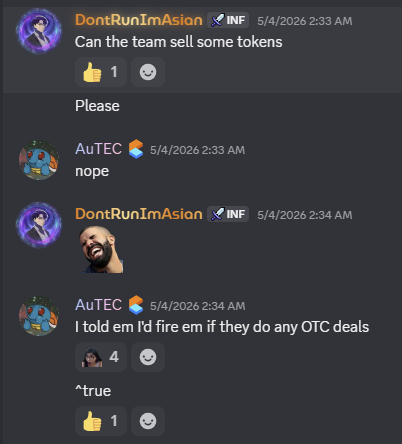
of the foundation tokens, which are 37% of fdv, autec has repeatedly said they don't plan to sell any unless there's substantial upside for the token, and certainly not anytime soon
the community/nondrop allocation is 20%, which is where the quarterly airdrops come from. that's vesting on a 10 year schedule. of that 20%, they've airdropped some 2%~ and the next one will be 0.75%, likely lower in the future as price continues up. based on how the biz has been run currently, I think they'll make smart decisions with the remaining 17%~ over the next decade
team is 20%, and that should start vesting in a few months, but I'd expect that to be fairly reasonable as well and no otc sales. pre-seed is nearly done vesting, and the team has stated they're working on and I believe have successfully sold some vc vesting tokens otc to mitigate sell pressure
from all of the above, I'd consider it reasonable to assume 40-50% of the fdv won't be on the market for the next 3~ years
which is completely separate from buybacks that mitigate the existing mc/fdv and vesting, or their extremely bullish stated token goals once more regulatory clarity is available
obviously you gotta trust the team on some of this, but so far they've had fantastic execution, have been clear about their plans in discord and the frequent podcasts, and I think they're going to keep delivering
It’s hard to categorize or evaluate second-brain systems because there’s no single right answer.
But I found one useful lens every second brain should be evaluated through: the lifecycle of your data.
Collect -> Organize -> Evolve -> Use -> Govern
So I made a curated comparison of the existing second brain, AI memory, and knowledge systems, from @claudeai’s memory to @garrytan’s GBrain.
It focuses on the full lifecycle:
- how scattered context gets collected
- how it turns into durable knowledge
- how it stays fresh over time
- how people and AI tools use it in real work
- how users can inspect, correct, delete, export, and trust it
If you want AI to understand your personal context, team knowledge, and working history, this might help.
PRs welcome, especially from heavy users who’ve actually tried building and maintaining a real second brain.
https://t.co/uUbLM10Ep1
We reported a critical loss of funds bug to @Thorchain (32M TVL, 150M FDV)
They silently patched it and told us their bug bounty program is permanently retired.
We have more Thorchain chain halt DoS vulns. We intend to release them (open disclosure) in the coming few days