David Deutsch (@DavidDeutschOxf) and I discuss AGIs and subjectivity on the Joe Walker Podcast (@JosephNWalker):
David Deutsch:
I think it’s inevitable that AGIs will be capable of having internal subjectivity and qualia, because that’s all included in the letter G in the middle of the name of the technology.
Me:
Well, not necessarily, because the G could be general computational power, the ability to solve problems, and there could be no one at all who’s actually human.
David Deutsch:
But there ain’t nothing here but computation. It’s not like in Star Trek: Data lacks the emotion chip, and it has to be plugged in. But there’s nothing possibly in that chip apart from more circuitry like he’s already got.
Me:
But, of course, the episode that you’re referring to is one in which the question arose: Is it moral to reverse engineer Data by dismantling him, therefore stopping the computation? Is that disassembling a machine, or is it snuffing out a consciousness? Because there is an alternative view that subjectivity depends also on whatever biochemical substrate our particular computation runs on. And I think there’s no way of ever knowing.
David Deutsch:
I think we can answer that question before we ever do any experiments, even today, because there’s no difference in principle between a computer that runs partly by electricity and partly by chemicals and one that runs entirely on silicon chips. Because the latter can simulate the former with arbitrary accuracy.
Me:
Well, we don’t have to solve the problem this afternoon in our conversation, but, in fact, I think it is not solvable. But the simulation doesn’t necessarily mean that it has subjectivity. It could just mean it’s a simulation; that is, it’s going through all the motions. It might even do it better than we do, but, you know, there’s no one home. There’s no one actually being hurt.
David Deutsch:
Well, you can be a dualist. You can say that there is mind in addition to all the physical stuff. But if you want to be a physicalist, then there’s this thought experiment where you remove one neuron at a time and replace it with a silicon chip, and you wouldn’t notice.
Me:
Well, that’s the question. An external observer wouldn’t notice. How do we know that, from the point of view of the brain being replaced—every neuron by a chip—it’s like falling asleep? That when it’s done and every last neuron is replaced by a chip, you’re dead, subjectively, even though your body is still making noise?
David Deutsch:
That means that when your subjectivity is—there is something happening in addition to the computation. And that’s dualism.
Me:
I mean, again, I don’t have an opinion one way or another, which is exactly my point. I don’t think it’s a decidable problem. But it could be that that extra something is not ghostly substance. It could be that the stuff that the brain is made of is responsible for that extra ingredient of subjective experience, as opposed to intelligent behavior. I think we’re going to be having the same debate a hundred years from now.
David Deutsch:
Yeah, maybe one of the AGIs will be participating in the debate by then.
Announcing Amazon Nova, a new generation of foundation models that have state-of-the-art intelligence across a wide range of tasks, & industry-leading price performance.
Learn more about the new Amazon Nova models available in Amazon Bedrock: https://t.co/W87nCxmoMq #AWSreInvent
It's been very exciting to be part of the team over the last two years to deliver Amazon Nova, the latest state-of-the-art foundation models! Congrats to all my colleagues in the AGI and the rest of @AmazonScience. https://t.co/7RNz1CZPRR
Today, Amazon announced its Trusted AI Challenge, which involves university students competing to securely advance large language models (LLMs) that code, and where $700,000 in cash prizes will be allocated across the top four performing teams. Learn more about the challenge and how to apply: https://t.co/aPfPg4OAo4 #ResponsibleAI #GenAI
@a_karvonen @jam3scampbell@willdepue@jeremyphoward@GrantSlatton Thanks for the post, really interesting work. I wonder if you have a reason to use a 512x2 + softmax for a binary task which would've been possible with a 512x1 + sigmoid?
How can we unify Large Language Models (🤖) with Knowledge Graphs for question answering?
We introduce KAPING, Knowledge-Augmented language model PromptING, in #ACL2023 workshop, done during internship at @AmazonScience with @AlhamFikri and @AmirSaffari.
https://t.co/H4dsGLhRtE
Regroove is an AI-powered, expressive drum sequencer device.
I released Regroove 2 some weeks ago, after a few open feedback cycles I'm happy to share this with you all!
This is an on-going project so i'm happy to hear your thoughts, music coming soon!
https://t.co/GRJlMVKU4J
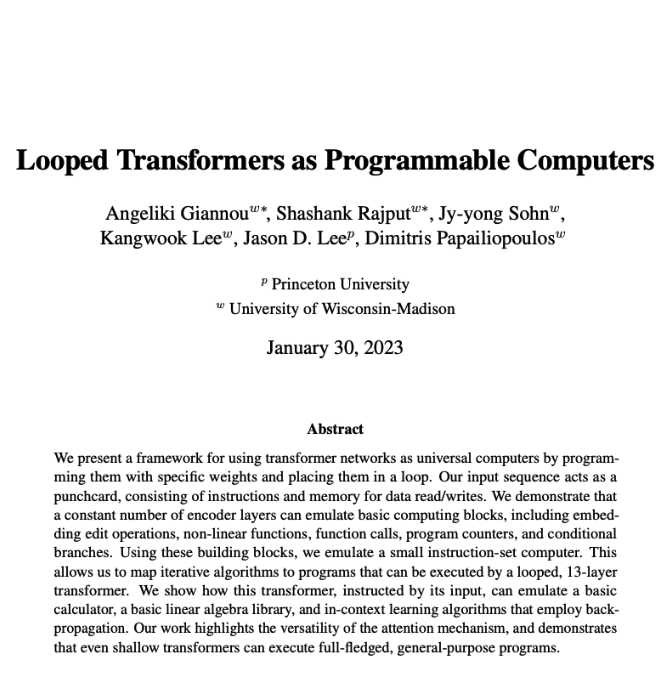
"Looped Transformers as Programmable Computers"
Shipped today, long thread with arxiv link tomorrow.
This paper marks a significant shift in my group's research, that I'm very excited about.
🚨We’ve been working on better retrieval-augmented models & thrilled to present Atlas, led by @gizacard@EXGRV & myself🚨
Atlas is a end2end pretrained "RAG"-like model, beats models 50x its size on fewshot QA, sets numerous SotA on knowledge-intensive NLP https://t.co/6yBHlHJBdZ
With an encoder-decoder architecture, rather than decoder only, the 20-billion-parameter Alexa Teacher Model outperforms language models with hundreds of billions of parameters—including GPT-3—on few-shot tasks such as summarization and machine translation. Learn more. #NLP#AI
DDSP-VST! Realtime Neural Audio Synthesis as an audio plugin. Excited to finally release this fun way to explore new sounds.
🔊 Plugin: https://t.co/AwvDgr4VN9
🚂Train Models: https://t.co/sFLNtVeEnZ
🎮Discord: https://t.co/gBAx2rOiia
📝Blog: https://t.co/bQUwiuP7wF
1/
At @emnlpmeeting, Amazon researchers proposed two extensions of end-to-end knowledge-graph-based question answering: one replaces burdensome hand annotation with a machine learning component, and the other enables multiple-entity queries: https://t.co/WXozDbjMa9 #EMNLP2021
Our two EMNLP papers on extending differentiable KGs to learn end-to-end QA models by (1) using intersection operation as part of multi-hop reasoning https://t.co/9rjLuUATwy and (2) integrating an entity resolution component learnt with weak supervision https://t.co/aUAoJPGbaj
We just integrated our state-of-the-art model for Complex Query Answering on large-scale Knowledge Graphs (https://t.co/eWA2QlskUr, ICLR 2021, Outstanding Paper Award) in the SNAP KGReasoning library: https://t.co/aVK1DhjCpG -- check it out! 🚀🧑💻 Any feedback is very welcome 🙂