What Hindus need is NOT some imaginary utopian Hindu Rashtra. Hindus need equal religious, economic, cultural and educational rights on par with those given to Minorities by Constitution and freeing of their Temples from government kabja, which is a perfectly secular demand.
Is Shintō the Japanese Localisation of Sindhu (Hindu) Civilisation?
Shintō is widely regarded as Japan's indigenous religion, distinct from the religious traditions of the Indian subcontinent. Yet this familiar understanding leaves important questions unanswered. Why do Sanskrit, the Siddhaṃscript, sacred syllables (bīja), maṇḍalas, mudrās, and numerous Hindu devatās occupy an enduring place in Japanese religious life? Rather than treating these as isolated borrowings, this article argues that they form a coherent civilisational pattern. Shintō is better understood as the Japanese localisation of Hindu civilisation and, perhaps, even preserves the older civilisational designation Sindhu.
The historical significance of Sindhuextends beyond its original reference to the Indus River. As the civilisation centred on the river developed, the name came to denote not only a geographical region but also the civilisation, its people, and their religious tradition. In this broader sense, Sindhu designated a cultural world united by Sanātana Dharma, Sanskrit learning, sacred literature, ritual practice, and a shared philosophical outlook. Long before the modern terms Hindu and India emerged, Sindhu was the recognised designation of this civilisational order. Through regular phonetic change, it gave rise to forms such as Hindu in the Prakrits of northwestern India and neighbouring Persian, and later India in European languages.
Wherever Hindu civilisation spread, it carried far more than religious belief. It transmitted philosophy, ritual, law, literature, architecture, music, temple culture, and systems of learning as parts of a single civilisational tradition. Sanskrit served as its common sacred and intellectual language, while local languages expressed the same tradition in regional forms.
Unlike the historical expansion of the Abrahamic religions, Hindu civilisation neither sought to replace existing religious traditions nor impose cultural uniformity. Wherever it took root, it was expressed through local cultures while preserving its religious foundations. Indigenous languages, customs, and artistic traditions continued to flourish, giving rise to regional expressions of Sanātana Dharma. The traditions of Bali, Nepal, Cambodia, Java, and Sri Lanka differ in language, architecture, ritual, and artistic expression, yet all remain rooted in Sanātana Dharma, reflecting local historical and cultural conditions rather than independent religious origins. Japan should be understood within this same historical framework.
Japan belongs within this broader history. Conventional scholarship explains the presence of Sanskrit, the Siddhaṃ script, Hindu devatās, sacred symbols, and ritual traditions in Japan as later additions to an otherwise independent indigenous religion. While this interpretation accounts for their presence, it does not explain their coherence or enduring place within Japanese religious life. A civilisational perspective offers a different explanation. Rather than receiving isolated religious elements, Japan participated in the same process through which Hindu civilisation assumed regional forms elsewhere. Shintō is therefore better understood as the Japanese localisation of Sanātana Dharma than as an indigenous religion that later absorbed Hindu traditions.
This civilisational perspective also invites a reconsideration of Buddhism's historical expansion. Buddhism arose within the already established civilisation of Sanātana Dharma and inherited its philosophical vocabulary, sacred geography, cosmology, ritual culture, and religious symbolism. Buddhism did not extend beyond the geographical sphere of Hindu civilisation but spread within it, following the same civilisational, commercial, and religious networks through which Sanskrit, temple traditions, philosophy, and sacred learning had already travelled. The historical spread of Buddhism may therefore be understood not as the creation of a distinct civilisational world beyond the geographical sphere of Hindu civilisation but as the transmission of a reformulated religious tradition within an already existing Hindu civilisation. Japan therefore received Buddhism not as the origin of Hindu civilisation in Japan but as one historical vehicle through which the already established civilisation of Sanātana Dharma was transmitted.
The religious worldview of Shintō closely corresponds to that of Sanātana Dharma. Both regard the universe as permeated by sacred presence rather than divided between the sacred and the secular. Mountains, rivers, forests, waterfalls, rocks, and trees are revered because they manifest a transcendent reality. Human beings participate in this sacred order through reverence, worship, and ethical conduct, maintaining harmony with the natural world rather than exercising dominion over it. Shintō expresses this vision through the kami and Japan's sacred landscapes, while Sanātana Dharma expresses it through its own theological vocabulary. The language differs, but both traditions understand nature as a manifestation of the sacred rather than something separate from it.
This continuity is equally evident in ritual life. Purification precedes worship because communion with the divine requires ritual and moral purity. Ceremonial cleansing, offerings, seasonal festivals, pilgrimage, and the veneration of ancestors all affirm that religious life depends upon maintaining harmony among humanity, the natural world, the ancestors, and the divine. These practices are integral to Shintō, not secondary additions, and they embody principles long established within Sanātana Dharma while expressing them through Japanese ritual forms.
The same historical continuity is reflected in Japan's sacred language and ritual symbolism. Sanskrit acquired enduring religious significance, and the Siddhaṃ script continued in ritual use long after it had ceased to function as an ordinary writing system elsewhere. Sacred syllables (bīja), maṇḍalas, mudrās, and ritual formulae became established elements of Japanese religious practice, preserving not merely their outward forms but their religious significance. Their continued use demonstrates that Sanskrit was received as a sacred language whose ritual efficacy transcended linguistic boundaries.
The transformation of Saraswati into Benzaiten, Ganesa into Kangiten, Indra into Taishakuten, Brahmā into Bonten, Lakshmi into Kisshōten, and Mahakala into Daikokuten exemplifies the historical localisation of Sanātana Dharma in Japan. These devatās assumed Japanese names, artistic forms, and devotional contexts while retaining their religious identity, as they did wherever Hindu civilisation took root.
Taken together, the religious worldview, ritual principles, sacred language, symbolic system, and localised devatāspreserved in Japan form a coherent historical pattern more plausibly explained as the Japanese localisation of Sanātana Dharma than as an independent religion that selectively incorporated foreign practices. Shintō therefore represents not a parallel religious development but the Japanese localisation of the civilisation historically known as Sindhu.
The historical interpretation advanced here also invites a reconsideration of the etymology of Shintō. Conventional scholarship derives the word from the Sino-Japanese reading of Shéndào, usually translated as "the way of the gods." While this explains the later written form of the name, it need not determine its earliest origin. Names transmitted across linguistic boundaries were frequently adapted to the phonological systems of different languages before acquiring new written representations. It therefore remains possible that Shintōpreserves an earlier form that was subsequently interpreted through the Chinese expression Shéndào.
If Shintō represents the Japanese localisation of the civilisation historically known as Sindhu, the name itself may preserve an eastern linguistic development of that older civilisational designation. This hypothesis does not deny the historical significance of the Chinese interpretation but suggests that Shéndàomay constitute a later semantic explanation of an inherited name whose origin lay elsewhere. Such reinterpretation is well attested in historical linguistics, where inherited names often acquire new meanings after entering another linguistic tradition. The close phonetic resemblance between Sindhu and Shintō further warrants investigation.
The proposed relationship between Sindhuand Shintō remains a linguistic hypothesis rather than an established conclusion. It requires further historical and linguistic investigation. Yet if Japan preserved the sacred language, ritual traditions, and localised devatāsof the civilisation historically known as Sindhu, perhaps it also preserved its name.
@MrSamrat05 Rohit vemula की माँ ने किया था।
पर उनकी याचिका में ये कहा लिखा था कि किसी भी सामान्य वर्ग के विद्यार्थी पर झूठा आरोप लगाने पर अरक्षित वर्ग को कुछ नहीं होगा।
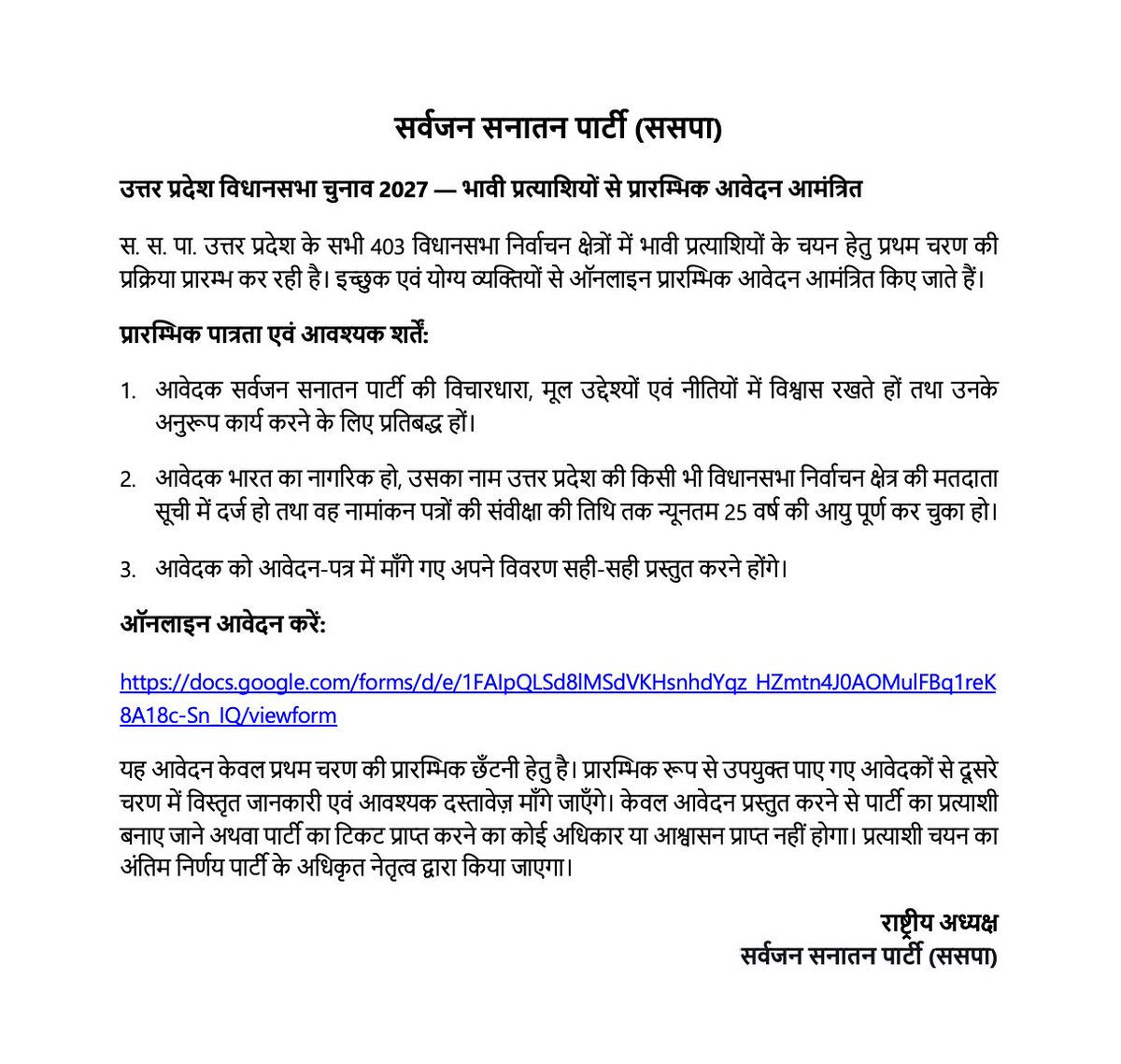
उत्तर प्रदेश विधानसभा चुनाव 2027 — भावी प्रत्याशियों से प्रारम्भिक आवेदन आमंत्रित
सर्वजन सनातन पार्टी (ससपा) उत्तर प्रदेश के सभी 403 विधानसभा निर्वाचन क्षेत्रों में भावी प्रत्याशियों के चयन हेतु प्रथम चरण की प्रक्रिया प्रारम्भ कर रही है। इच्छुक एवं योग्य व्यक्तियों से ऑनलाइन प्रारम्भिक आवेदन आमंत्रित किए जाते हैं।
प्रारम्भिक पात्रता एवं आवश्यक शर्तें:
1. आवेदक सर्वजन सनातन पार्टी की विचारधारा, मूल उद्देश्यों एवं नीतियों में विश्वास रखते हों तथा उनके अनुरूप कार्य करने के लिए प्रतिबद्ध हों।
2. आवेदक भारत का नागरिक हो, उसका नाम उत्तर प्रदेश की किसी भी विधानसभा निर्वाचन क्षेत्र की मतदाता सूची में दर्ज हो तथा वह नामांकन पत्रों की संवीक्षा की तिथि तक न्यूनतम 25 वर्ष की आयु पूर्ण कर चुका हो।
3. आवेदक को आवेदन-पत्र में माँगे गए अपने विवरण सही-सही प्रस्तुत करने होंगे।
ऑनलाइन आवेदन करें:
https://t.co/72J3DCUMfh
यह आवेदन केवल प्रथम चरण की प्रारम्भिक छँटनी हेतु है। प्रारम्भिक रूप से उपयुक्त पाए गए आवेदकों से दूसरे चरण में विस्तृत जानकारी एवं आवश्यक दस्तावेज़ माँगे जाएँगे। केवल आवेदन प्रस्तुत करने से पार्टी का प्रत्याशी बनाए जाने अथवा पार्टी का टिकट प्राप्त करने का कोई अधिकार या आश्वासन प्राप्त नहीं होगा। प्रत्याशी चयन का अंतिम निर्णय पार्टी के अधिकृत नेतृत्व द्वारा किया जाएगा।
#SarvjanSanatanParty
#SSP
#UPElections2027
#भावीप्रत्याशी
@venzq Don't be a fool by expecting someone to do a job for free.
Learn compete and do what you expecting from others.
Evolution is a continuous process bro
No one is fighting your fight
SC has cancelled polls in 13 Patiala wards: opposition candidates were blocked from filing nominations in Dec 2024.All 13 are wards where AAP was declared winner unopposed.CJP has time for Punjab school PR before polls, not one word on this.
Saving paw-paw > saving democracy 🤡
So the article's factual assumption is that child sex abuse is more likely or likelier in poor, non-general castes and religious minorities? I genuinely hope that's not the assumption.
“मैं पाँच लाख का सौदा करने आया हूँ… और मेरी जेब में पाँच फूटी कौड़ियाँ भी नहीं हैं।”
You have probably heard Amitabh Bachchan ji’s iconic line from Trishul.
But have you ever wondered: What exactly is a phooti kaudi?
🧵1/18
@AamAadmiParty@RahulGandhi 8 Sept 2026: The father of a Chitta victim died by suicide and named AAP leaders in a video. Rahul Gandhi attacked the AAP government over the incident.
9 Sept 2026: CJP’s Ashutosh Ranka suddenly posted videos of Karnataka government schools in pathetic condition.
@AAP_watch
@AamAadmiParty@RahulGandhi CJP’s “School Thik Karo Campaign” Suddenly Finds Karnataka?
Strangely, they never visited a single Congress-ruled state.
When asked why, they had plenty of excuses.
Then, a school roof collapsed in Congress-ruled Karnataka.
CJP stayed silent.
Then came the twist.
Under Akhilesh Japanese Encephalitis deaths in UP were very high but media didn't report
Year Yogi became CM suddenly media interest spiked to blame Yogi
Yogi govt brought deaths down to ZERO, media lost interest again. Nobody reported.
Conclusion : BJP has bought the media