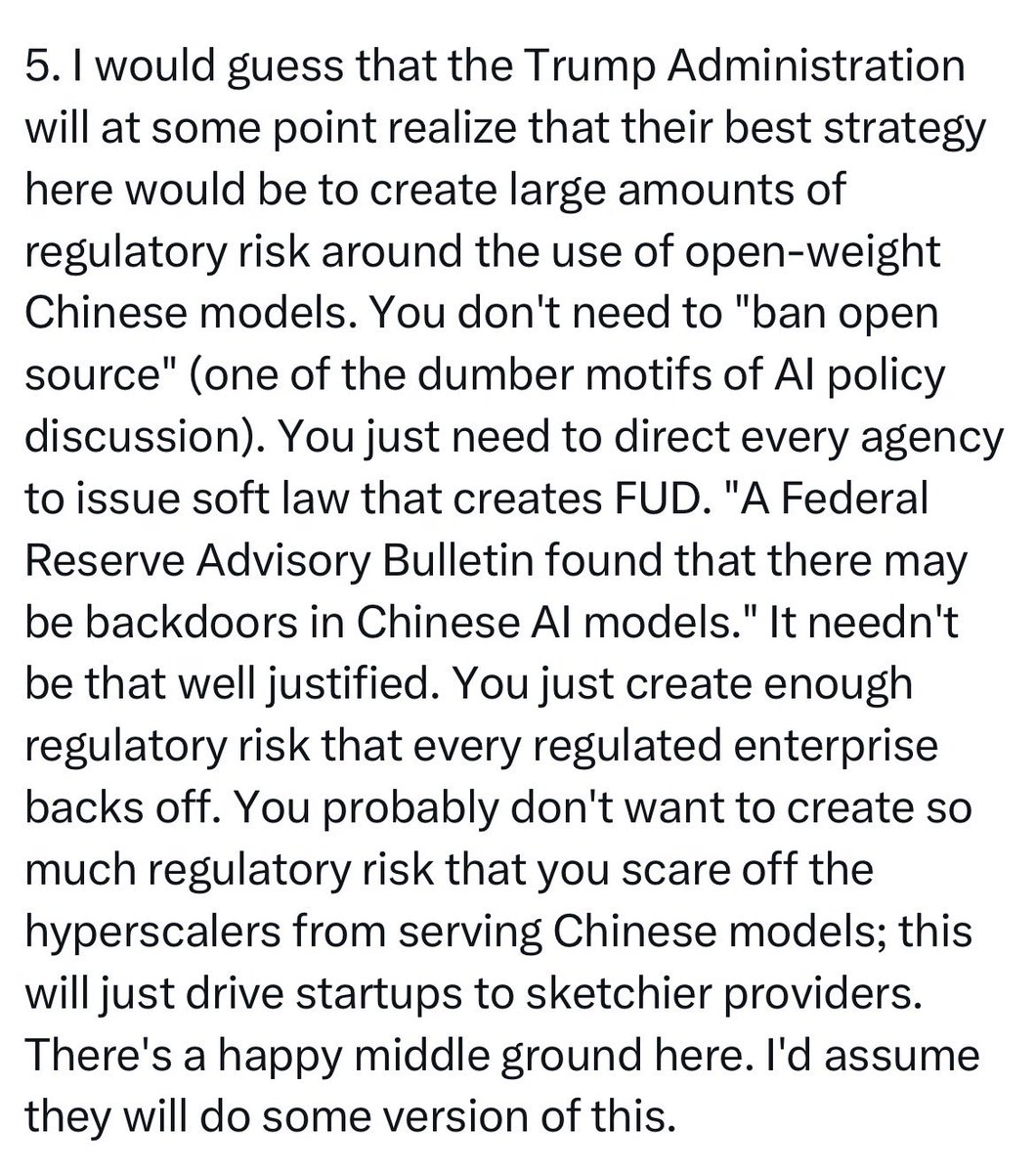
I’m not sure whether Dean Ball is confessing to a regulatory capture strategy or simply predicting this will happen (he now says the latter). Either way, the weaponization of regulatory uncertainty as a competitive tool should be completely unacceptable.
He argues there’s no need to ban Chinese open-source models — just direct agencies to issue soft-law warnings that create enough FUD so regulated enterprises back off. “It needn’t be that well justified.”
Wrong. Regulatory decisions should always be well justified and grounded in facts, logic, and evidence, not the deliberate exploitation of fear and uncertainty. Implementing a surreptitious policy through manufactured doubt — rather than strong and explicit justification — corrodes the rule of law and invites future abuse against anyone.
We are at a critical inflection point in AI policy. The leading closed labs, already a duopoly in terms of AI model revenue, want the government to eliminate their open source competition. They have laid their cards on the table. It is time for the rest of Silicon Valley — the vast majority that still values open competition — to do the same.
$PLTR CEO Alex Karp: “Every enterprise we deal with is unhappy with every LLM for tokenmaxxing.”
The next competitive advantage in AI isn’t more tokens.
Efficiency, cost per token, and real business outcomes are becoming more important than simply generating more tokens.
🏃♂️ I've gamified my own run so I can race my own ghost with the Meta Ray-Ban Display.
I built a web app for the glasses, loaded a previous GPX from Strava, and dropped game mechanics on top.
Pick up coins when you keep pace, sprint zones reward extra points if you push, and a mini leaderboard on the lens shows how you're tracking against your past self in real time.
Best part: it actually works. Seeing your ghost 20 m ahead is a way stronger nudge than any number on a watch. 😅
The weird thing right now is the public markets don't have access to the growth side of software. Right now the trade is to sell SaaS and buy semis (the raw material of AI). What you don’t have yet in the public markets are the AI native software companies and therefore, you’re comparing the practical values of owning say a Salesforce vs the mythical value of owning a company that’s growing 10x (without having seen the actual financials). And everyone is always going to want the myth.
These SaaS stocks aren’t going to trade in a sane fashion until the next generation of AI companies go public and investors can decide how to price a 10% revenue growth company with 30% cash flow vs 300% revenue growth company with negative 100% cash flow and SBC that will blow your mind.
Until then, you’re walking hand in hand with your significant other looking over your shoulder. You know the meme.
$XYZ's headcount will revert back to pre-COVID levels at 6,000 employees.
Here is Jack's stupidity in headcount over the years.
2019: 3,835
2020: 5,477
2021: 8,521
2022: 12,428
2023: 12,985
2024: 11,372
2025: 10-12,000
He's using AI as a excuse to mask his failure
Brilliant hardware thesis, Chamath. But the $5T market isn't in the actuators or the batteries; it's in the Context.
Hardware + Base AI = The Interaction Layer (soon to be a $20k zero-margin commodity).
The real bottleneck to mass adoption isn't joint mobility. It’s transferring tacit human knowledge (factory quirks, unwritten safety rules, spatial memory) into the machine.
A humanoid is useless without a localized Spatial Context Graph. The C-I-M (Context-Interaction-Memory) architecture applies to atoms, not just bits. The winner won't be the one who builds the body, but the one who maps the Context.
@jainarvind Huge respect for what you guys have built, but I think context graphs that truly capture decisions and, by extension, enable the compounding learning loop will not be done in a single, universal platform…just as theres there’s no universal enterprise ontology
Master of none
My annual letter:
https://t.co/5axz7jVwOb
This year I discuss corgis, compute, and Cold War; the Texas State Fair; DSA; Neue Sachlichkeit; disfiguring the physical past and the end of history; Germanic obedience; Antichrist; wisecracks; Pascal’s Wager; romantasy; and croissants.
But do people understand? Why the heck would you create your ERP ,when you’re good at building chocolate / planes / cars / farming ?It’s just such a “inside out tech view”. What could happen though , is that , the cost of software continues to go down , and that’s understandable
LLMs make it easier to build custom software, but that alone does not justify replacing systems that already work. The real issue is whether the time and money spent will create a lasting competitive advantage.
Rebuilding standard systems like CRM or HR tools rarely clears that bar. Even if AI speeds up development, the payoff is small, and the opportunity cost is huge. Every hour spent recreating Salesforce or Workday is an hour not spent building the proprietary capabilities that actually move the business forward. That tradeoff is the real constraint.
We saw this in the cloud era. Companies bought standard CRM and HR systems and focused their energy on the software that defined their customer experience and gave them an edge.
AI lowers the barriers to custom development, but it does not change this basic logic. The smart strategy is to invest in the areas where innovation creates true differentiation and customer value, not in systems that are easy to rebuild but don't move the competitive needle.
You went 🍌🍌 for Nano Banana. Now, meet Nano Banana Pro.
It’s SOTA for image generation + editing with more advanced world knowledge, text rendering, precision + controls. Built on Gemini 3, it’s really good at complex infographics - much like how engineers see the world:)