One of the biggest misconceptions in crypto is that privacy and compliance are opposites.
They're not.
In the traditional world, banks, businesses, and individuals don't publish every transaction, account balance, or financial relationship for everyone to see.
Privacy is normal.
The challenge is bringing that same expectation on-chain without sacrificing accountability.
That's where the conversation is shifting:
Not public vs private.
But how can users maintain privacy while still enabling verification when it's legitimately required?
What do you think is the bigger challenge for crypto adoption today?
• Lack of privacy
• Lack of compliance
One zk-bug in the base layer.
One emergency hard fork.
One chain thrown into chaos.
That’s the hidden cost when privacy is hardcoded into the blockchain.
Veilnyx took the smarter route.
Privacy now lives inside your smart contracts and SDK, fully modular and guarded by selective disclosure in case of an undetected bug.
You control exactly what gets revealed, and only to the Revokers you trust.
Everything else stays invisible, fully compliant, and runs perfectly on any EVM chain with zero wallet changes or forced upgrades.
No more chain-wide upgrade.
Just scalable, battle-tested privacy built for DeFi, payments, and AI agents.
Powered by @Palliora.
What’s the one privacy failure that still keeps you up at night?
1/3
Want computations you can actually trust without trusting any single party?
Meet the Verifiers, the integrity engine of Palliora.
They independently validate that every computation was executed exactly as the Compute Contract specified without ever seeing the raw private data.
This is how Palliora delivers verifiable results in a fully decentralized network.
Most AI wants your data.
Palliora gives you the keys.
We created the first decentralized layer where humans and AI collaborate without giving up control:
• Data stays fully private
• Every result is cryptographically verifiable
• You earn real rewards for your compute
• No middlemen. No surveillance.
This is the infrastructure for confidential AI and private DeFi at a global scale.
Want to be part of the shift?
https://t.co/bKym6lo3bA
Zcash just hard-forked again after a soundness bug.
@veilnyx_hq Plug-and-play Groth16 + SeDe on existing chains, no fragile base-layer issue, just seamless private DeFi that actually scales. Privacy comes from proven zk-Groth16 proofs that shield transactions by default (addresses, amounts, and flows stay hidden).
Compliance is handled through Selective De-Anonymization (SeDe) via decentralized guardians revealing only illicit flows when authorized, while everyone else stays fully private.
No hard forks.
No workflow changes.
Just scalable privacy that works with existing EVM chains, DeFi, payments, and AI agents.
5/
Key differences that prevent “Zcash-style” upgrade messes:
Plug-and-play, not base layer: Privacy lives in smart contracts + SDK. Bugs get fixed with contract upgrades or SDK patches; no chain-wide hard forks are required for most issues.
Proven, audited zk primitives + threshold crypto: We use battle-tested Groth16 zk-SNARKs with selective disclosure (SeDe) via decentralized guardians/revokers. Less custom circuit complexity = smaller attack surface.
https://t.co/jaRdLO7Kuu
Privacy is becoming infrastructure, not a niche feature.
As more financial activity moves on-chain, users will expect systems that protect strategies, balances, and transaction flows by default.
The smartest DeFi users are going dark.
Not because they have something to hide, but because they have everything to protect.
Veilnyx delivers complete confidentiality for every swap, lend, yield, payment, and dApp move with selective disclosure only when you choose.
Privacy without compromises.
Compliance without friction.
Testnet live → https://t.co/31vSy5WdG8
Powered by @palliora
Shielded transfers were only the beginning.
What if every DeFi action, swaps, lending, yield, and payments could run privately by default while remaining fully compliant?
That’s what we’re building at @veilnyx_hq.
Programmable privacy, designed to scale.
Powered by @palliora
this unlocks a fully trustless compute pipeline. A dApp can now submit an encrypted compute request without exposing inputs to any single party and no manual settlement. For more research details https://t.co/KmIhImAnUv that we presented at Finacial Cryptography ‘26
Compute Contracts are now live on Manas testnet. 🚀
Define execution, coordinate Guardians, and settle outcomes, all enforced on-chain.
This enables a fully verifiable pipeline:
encrypted input → threshold decryption → execution → DA layer → settlement
Explore → https://t.co/TA6scLd4dO
How it works → https://t.co/4axY8JV0Wg
Now live in production:
Valorae → https://t.co/srw0daigsh
Lynra → https://t.co/mFBKgJlFMk
Build with it:
Palliora SDK (GitHub) → https://t.co/V15DgbrFtx
Official NPM package → https://t.co/VSvv1osu67
Wrapped up a strong day at The Programmable Economy: AI & Blockchain Redefining Markets at @cornell_tech.
The discussions underscored a clear shift toward verifiable infrastructure for the emerging agent economy.
The “AI on Blockchain Rails” panel, moderated by @Gary_Weinstein_, highlighted why privacy and verifiability are becoming foundational requirements.
Proud to have @amitchax representing @palliora, where we are building the privacy-enhancing stack spanning ZK, MPC, FHE, and TEEs to enable secure, auditable human–AI coordination.
Grateful to the organizers @CTBlockchainNYC, @CUBlockchain, @theBBFund, and @initc3org, and to everyone who contributed to a thoughtful and forward-looking conversation.
The next phase of market infrastructure is being built with verifiability at its core.
The past few days have been intense, but I wanted to give some updates as we continue to work on this. Our priority is our users, and every decision we are making is aimed at an orderly return to normal market conditions and the best possible outcome for everyone involved.
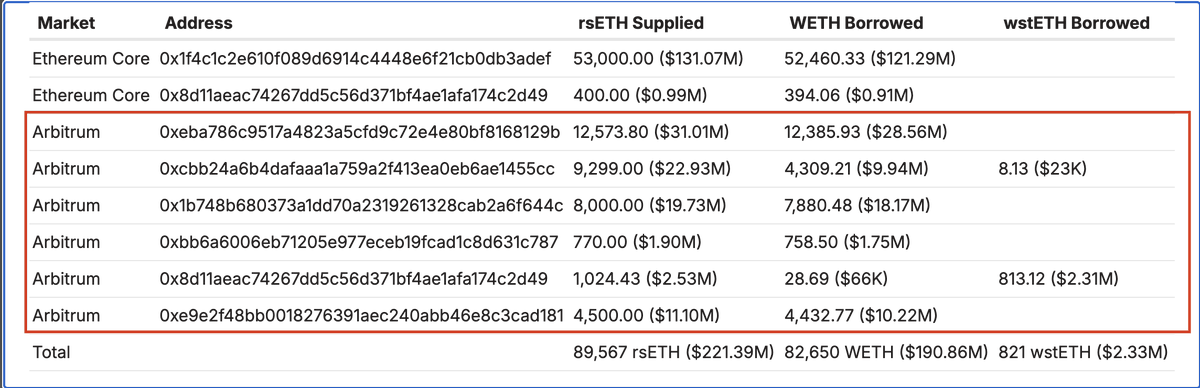
Working around the clock, the team has made progress on multiple paths forward with several partners. The Arbitrum Security Council also recovered $70 million in ETH, which could meaningfully reduce the potential exposure, and multiple discussions and solutions are being considered. I am confident we will move towards a strong resolution.
Reviewing what happened and learning from it matters. But pointing fingers is not something that gets us to the other side of this.
Every bit of my energy right now is focused on the outcome for Aave users and the protocol. Aave has been my life's work, and this is an important moment for DeFi as much as it is for Aave. I am deeply grateful for the support and collaboration we have received from builders and partners across the industry.
We’ll get through this together and we’ll continue to publish updates on @aave as they happen.
Onchain finance needs threat-resistant privacy
→ Real-world & institutional finance cannot move onchain without privacy
→ To prevent misuse (e.g. laundering of hacked funds), the only viable solution is to build threat-resistant privacy
More in my op-ed in Forbes 👇
I'm a member of the Security Council & I can tell you we did not make this decision lightly, there were countless hours of debates, technical, practical, ethical and political.
But all it takes for evil to triumph is for good men to do nothing, so today, we decided to do something.
I'm not going to discuss the moral or legal long-term implications of this action, but now that the Security Council has acted, the primary focus should be on making Arbitrum end users whole by coordinating with AAVE, especially since the markets are still frozen. Unlike the Ethereum markets, which were unfrozen just a few minutes ago due to the zero chance of a Layer 1 reversal. The Arbitrum DAO should take immediate action to contain significant user losses in Aave's Arbitrum markets.
https://t.co/Dcu5Pn0RJW
The Arbitrum Security Council has taken emergency action to freeze the 30,766 ETH being held in the address on Arbitrum One that is connected to the KelpDAO exploit. The Security Council acted with input from law enforcement as to the exploiter’s identity, and, at all times, weighed its commitment to the security and integrity of the Arbitrum community without impacting any Arbitrum users or applications.
After significant technical diligence and deliberation, the Security Council identified and executed a technical approach to move funds to safety without affecting any other chain state or Arbitrum users.
As of April 20 11:26pm ET the funds have been successfully transferred to an intermediary frozen wallet. They are no longer accessible to the address that originally held the funds, and can only be moved by further action by Arbitrum governance, which will be coordinated with relevant parties.
Thrilled to announce: @amitchax, Founder & CEO of @palliora, will speak at the AI Blockchain Conference 2026 on April 24 at @cornell_tech in NYC!
We’re building private verifiable compute for secure Human-AI coordination.
See you there!
@CTBlockchainNYC@initc3org@theBBFund
We delivered at the Delaware FinTech Innovation Forum 2026.
@amitchax expertly moderated the FinTech demos, including @Nethermind's standout presentations on Compliant Privacy on Public Blockchains and Privacy-Preserving Regulated Tokenization (powered by @Ethereum), plus live demos from @Dune and @IncaDigital.
Insightful panels on the future of banking & payments, AI, fintech partnerships, and cryptocurrency & prediction markets rounded out an incredible day, featuring leaders like @CaitlinLong_, @Circle, @Citi, @Vanguard_Group and more.
@palliora is proud to be right at the centre of blockchain, AI, tokenisation, and privacy-preserving intelligent finance.
Huge thanks to @PhiladelphiaFed & @UDelaware for hosting at the FinTech Innovation Hub!
DeFi protocols keep adding liquidity, but user activity remains fully visible.
Veilnyx gives protocols and users real privacy without sacrificing compliance:
- Plug-and-play privacy layer for existing DeFi, payments, and dApps
- Private cross-chain transactions with multi-asset support.
- Decentralized selective disclosure for regulators
- Powered by @Palliora's verifiable compute
The privacy layer DeFi has been waiting for is live in https://t.co/6HDk3sJdy6