Culturetends to argue that it forbids only that which is unnatural.But frm biological perspectivenothing is unnatural.Whatevr is posible is by definition also natural.A truly unnatural behavior 1 that goes aginst the lawsof nature,simply cannot existso it wud need no prohibition
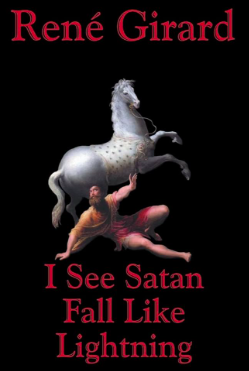
A deep dive on Rene Girard's I Saw Satan Fall Like Lightning (1hr 41min).
We discuss how he views Bible myths as distinct from other myths, how Satan is the representation of the vicious cycle of desire, and why our modern world is fixated on victims. Peter Thiel also comes up!
“Expressed in the language of Hermetic philosophy, the ego-personality’s coming to terms with its own background, the #shadow, corresponds to the union of spirit and soul in the unio mentalis, which is the first stage of the coniunctio. What I call coming to terms with the #unconscious the #alchemists called ‘meditation.’ Ruland says of this: ‘Meditation: The name of an Internal Talk of one person with another who is invisible, as in the invocation of the Deity, or communion with one’s self, or with one’s good angel.’¹²⁸ This somewhat optimistic definition must immediately be qualified by a reference to the adept’s relations with his spiritus familiaris, who we can only hope was a good one. In this respect Mercurius is a rather unreliable companion, as the testimony of the alchemists agrees. In order to understand the second stage, the union of the unio mentalis with the body, psychologically, we must bear in mind what the psychic state resulting from a fairly complete recognition of the shadow looks like. The shadow, as we know, usually presents a fundamental contrast to the #conscious personality. This contrast is the prerequisite for the difference of potential from which psychic energy arises. Without it, the necessary tension would be lacking. Where considerable psychic energy is at work, we must expect a corresponding tension and inner opposition. The opposites are necessarily of a characterological nature: the existence of a positive virtue implies victory over its opposite, the corresponding vice. Without its counterpart virtue would be pale, ineffective, and unreal. The extreme opposition of the shadow to #consciousness is mitigated by complementary and compensatory processes in the unconscious. Their impact on consciousness finally produces the uniting symbols.
Confrontation with the shadow produces at first a dead balance, a standstill that hampers moral decisions and makes convictions ineffective or even impossible. Everything becomes doubtful, which is why the alchemists called this stage nigredo, tenebrositas, chaos, melancholia. It is right that the magnum opus should begin at this point, for it is indeed a well-nigh unanswerable question how one is to confront reality in this torn and divided state. Here I must remind the reader who is acquainted neither with #alchemy nor with the #psychology of the unconscious that nowadays one very seldom gets into such a situation. Nobody now has any sympathy with the perplexities of an investigator who busies himself with magical substances, and there are relatively few people who have experienced the effects of an #analysis of the unconscious on themselves, and almost nobody hits on the idea of using the objective hints given by #dreams as a theme for #meditation. If the ancient art of meditation is practised at all today, it is practised only in religious or philosophical circles, where a theme is subjectively chosen by the meditant or prescribed by an instructor, as in the Ignatian Exercitia or in certain theosophical exercises that developed under Indian influence. These methods are of value only for increasing concentration and consolidating consciousness, but have no significance as regards effecting a synthesis of the personality. On the contrary, their purpose is to shield consciousness from the unconscious and to suppress it. They are therefore of therapeutic value only in cases where the conscious is liable to be overwhelmed by the unconscious and there is the danger of a psychotic interval.
In general, meditation and contemplation have a bad reputation in the West. They are regarded as a particularly reprehensible form of idleness or as pathological #narcissism. No one has time for self-knowledge or believes that it could serve any sensible purpose. Also, one knows in advance that it is not worth the trouble to know oneself, for any fool can know what he is. We believe exclusively in doing and do not ask about the doer, who is judged only by achievements that have collective value. The general public seems to have taken cognizance of the existence of the unconscious psyche more than the so-called experts, but still nobody has drawn any conclusions from the fact that Western man confronts himself as a stranger and that self-knowledge is one of the most difficult and exacting of the arts.”
¹²⁸ Cf. Lexicon, p. 226
~C.G. Jung, “Self-Knowledge,” Mysterium Coniunctionis (CW 14), § 707-709
📷: Italian edition of Jung's book, Mysterium Coniunctionis (Vol. 14 of The Collected Works of C.G. Jung)
[Bold emphases my own.]
Welcome to the Great Emboldening, where ideas and actions that might have been unthinkable, objectionable, or reputationally risky in the past are now on the table, Charlie Warzel writes. https://t.co/h50Enb05g6
I just gave to MADRE! MADRE strengthens grassroots women's organizations confronting war, disaster and their aftermath. They meet urgent needs, build safer communities, and advocate for lasting change and just solutions. Give today at https://t.co/pebJv9EVpV
Gender fluidity, operating from this fluidity allows for more freedom in just being. To flow and move beyond gender constructs in society which can be unconsciously limiting. Placing subconscious narratives that come with being tied to male or female genders
"#Science is no better than the human mind that creates it." ~Polly Young-Eisendrath, Ph.D., Jungian analyst
On the next episode of Speaking of Jung: Interviews with Jungian Analysts
The mind of the artist is significant, for she is the disruptor of stagnant ideas. For Change, innovation and new ways of seeing and being we need the archetype of the artist









![jungianLaura's tweet photo. “Expressed in the language of Hermetic philosophy, the ego-personality’s coming to terms with its own background, the #shadow, corresponds to the union of spirit and soul in the unio mentalis, which is the first stage of the coniunctio. What I call coming to terms with the #unconscious the #alchemists called ‘meditation.’ Ruland says of this: ‘Meditation: The name of an Internal Talk of one person with another who is invisible, as in the invocation of the Deity, or communion with one’s self, or with one’s good angel.’¹²⁸ This somewhat optimistic definition must immediately be qualified by a reference to the adept’s relations with his spiritus familiaris, who we can only hope was a good one. In this respect Mercurius is a rather unreliable companion, as the testimony of the alchemists agrees. In order to understand the second stage, the union of the unio mentalis with the body, psychologically, we must bear in mind what the psychic state resulting from a fairly complete recognition of the shadow looks like. The shadow, as we know, usually presents a fundamental contrast to the #conscious personality. This contrast is the prerequisite for the difference of potential from which psychic energy arises. Without it, the necessary tension would be lacking. Where considerable psychic energy is at work, we must expect a corresponding tension and inner opposition. The opposites are necessarily of a characterological nature: the existence of a positive virtue implies victory over its opposite, the corresponding vice. Without its counterpart virtue would be pale, ineffective, and unreal. The extreme opposition of the shadow to #consciousness is mitigated by complementary and compensatory processes in the unconscious. Their impact on consciousness finally produces the uniting symbols.
Confrontation with the shadow produces at first a dead balance, a standstill that hampers moral decisions and makes convictions ineffective or even impossible. Everything becomes doubtful, which is why the alchemists called this stage nigredo, tenebrositas, chaos, melancholia. It is right that the magnum opus should begin at this point, for it is indeed a well-nigh unanswerable question how one is to confront reality in this torn and divided state. Here I must remind the reader who is acquainted neither with #alchemy nor with the #psychology of the unconscious that nowadays one very seldom gets into such a situation. Nobody now has any sympathy with the perplexities of an investigator who busies himself with magical substances, and there are relatively few people who have experienced the effects of an #analysis of the unconscious on themselves, and almost nobody hits on the idea of using the objective hints given by #dreams as a theme for #meditation. If the ancient art of meditation is practised at all today, it is practised only in religious or philosophical circles, where a theme is subjectively chosen by the meditant or prescribed by an instructor, as in the Ignatian Exercitia or in certain theosophical exercises that developed under Indian influence. These methods are of value only for increasing concentration and consolidating consciousness, but have no significance as regards effecting a synthesis of the personality. On the contrary, their purpose is to shield consciousness from the unconscious and to suppress it. They are therefore of therapeutic value only in cases where the conscious is liable to be overwhelmed by the unconscious and there is the danger of a psychotic interval.
In general, meditation and contemplation have a bad reputation in the West. They are regarded as a particularly reprehensible form of idleness or as pathological #narcissism. No one has time for self-knowledge or believes that it could serve any sensible purpose. Also, one knows in advance that it is not worth the trouble to know oneself, for any fool can know what he is. We believe exclusively in doing and do not ask about the doer, who is judged only by achievements that have collective value. The general public seems to have taken cognizance of the existence of the unconscious psyche more than the so-called experts, but still nobody has drawn any conclusions from the fact that Western man confronts himself as a stranger and that self-knowledge is one of the most difficult and exacting of the arts.”
¹²⁸ Cf. Lexicon, p. 226
~C.G. Jung, “Self-Knowledge,” Mysterium Coniunctionis (CW 14), § 707-709
📷: Italian edition of Jung's book, Mysterium Coniunctionis (Vol. 14 of The Collected Works of C.G. Jung)
[Bold emphases my own.]](https://pbs.twimg.com/media/Gpo0TofWYAAtj7c.jpg)


