@ishaantharoor Check the facts first!! France 24 has reportedly stated that the Union had conducted an anti-India seminar 48 hrs before the incident; this was a preplanned political conspiracy. The strike was also pre-planned by the employee against SETE and Paris City Hall!
We had an upper middle class Swaminarayana neighbor. By the time he passed away He had gone to Char dham, 12 Jyotirlinga, Kailash ManSarovar, Offered Dhwaja Dana and Brahmin Bhoj at Dwarika multiple times and organized Bhagwat Katha at Rishikesh and Ramayana Katha at Rameshwaram. He never missed Ekadashi fast in his life. During Shravana he and his wife used to go at Shivalaya at 5 in the morning for bili puja. And he never ate food with onion or garlic. These are the things that Swaminarayana devotees do.
I doubt 99% of people questioning his Hindu credentials have done atleast one of this activity. And if you need Shastras to tell you that then I doubt your credentials as Hindu.
It has been four days since the Eiffel Tower case, yet not a single piece of evidence or proof has emerged showing that BAPS pushed women aside or discriminated against them. This is the reality: not a single credible piece of evidence has been presented so far.
@priyaakulkarni2@BAPSParis BAPS monks follow BRAHMACHARYA.
The world’s longest epic- Mahabharata is of Hinduism and it quotes “Brahmacharyam Strisangrāhītyam”
Meaning: Brahmacharya (for males) means abstaining from contact with the females and vice versa for females.
@MeghalHparmar BAPS monks follow BRAHMACHARYA.
If it were to be an absurd practice then why would the world’s longest epic- Mahabharata quote“Brahmacharyam Strisangrāhītyam” meaning brahmacharya (for males) means abstaining from contact with the females and vice versa for females?
It has been four days since the Eiffel Tower case, yet not a single piece of evidence or proof has emerged showing that BAPS pushed women aside or discriminated against them. This is the reality: not a single credible piece of evidence has been presented so far. Now any Argue?
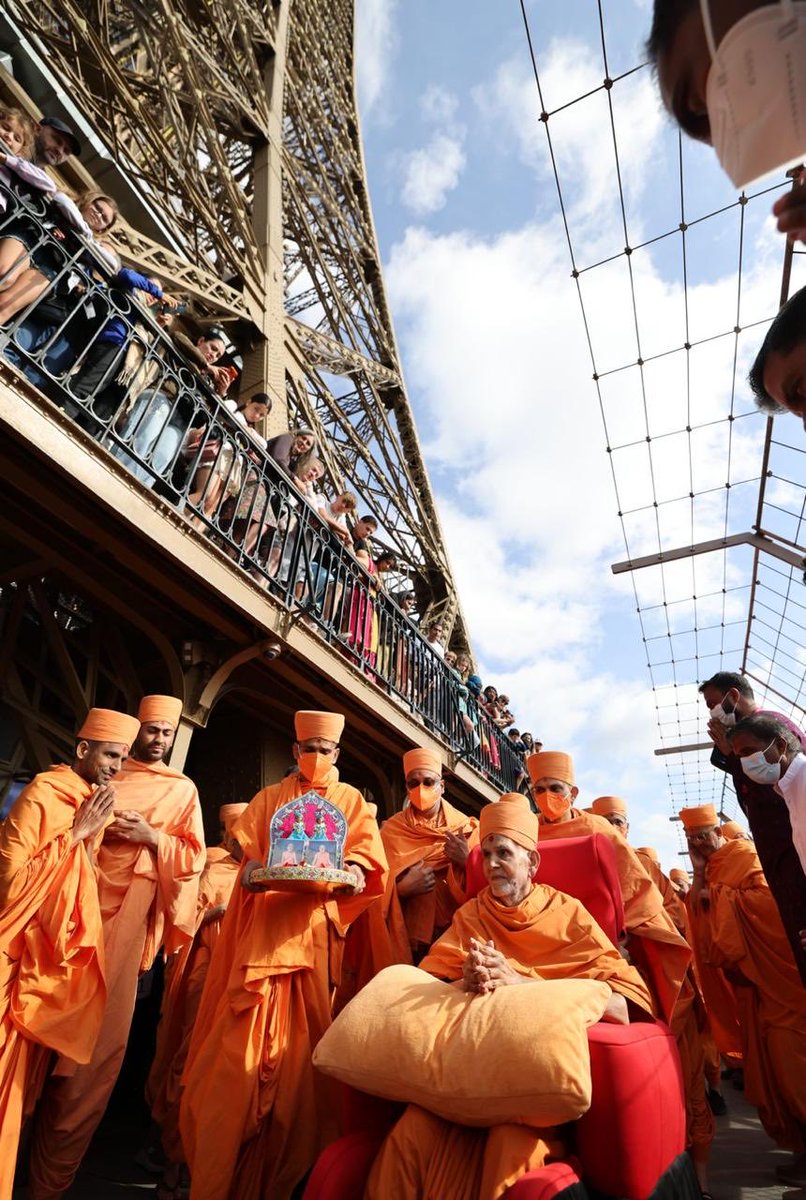
@GarvSeSecular@mitali_bha78166@AFP The entire point of the picture is to explain that no woman was denied access or asked to remain “invisible “ . The mess was created by the management of Eiffel tower. The BAPS organisation had never asked to hide the female staff.
@Reuters I joined X as I had to respond. What I read saddened me and does not reflect what I saw. I helped organise the visit to the Eiffel Tower, one of my favourite places. Many visitors were there and, to my knowledge, no one was prevented from visiting. The photo speaks for itself.
I have been thinking about the recent visit of BAPS Swaminarayan monks to the Eiffel Tower, and it brought back an experience of my own that I have never quite known how to articulate.
Some time ago, I was staying at an accommodation where Swaminarayan monks were also living next door. They followed a practice of not “seeing” women, which meant that, at certain hours, I could not access some common areas.
My first reaction was indignation. I remember thinking: Is this not exactly why women have to try twice as hard to be considered half as good? As someone who has always been outward-looking and travelled extensively, I was even tempted to write an X thread about how such seemingly regressive practices could thrive in the 21st century.
And then something unexpected happened.
The monks cooked their own food — simple, beautiful sattvic meals. Their sahayaks began leaving breakfast, lunch and dinner for me too, checking whether I needed more or less. Once, in passing, I mentioned that I particularly liked one of the desserts. Somehow, that comment reached the monks, and they began making extra desserts because they had heard that I loved them. The day I left, they even packed me a meal for the road.
The care was difficult to explain. It was quiet and completely unselfconscious — simply an attentiveness to whether I had eaten, whether I needed something, whether I was comfortable.
My initial irritation slowly transformed into a feeling I have experienced very few places outside my own home: the feeling of being cared for almost as one is cared for by one's parents.
It made me question my own assumptions.
Sometimes, a practice that appears exclusionary to us may have a very different meaning within the spiritual framework of those who follow it. That does not mean every practice is beyond scrutiny. If women are asked to temporarily leave a space when Swamis visit, it is entirely legitimate to ask why, whether they have a choice, whether they feel humiliated, and whether anyone is actually being harmed.
But perhaps we should investigate such questions without deciding the answer beforehand.
There is, however, another responsibility — particularly when such traditions travel abroad.
Practices that have evolved within a specific cultural and spiritual context can lose not merely perspective, but context itself, when transplanted into another society. In Bharat, someone may understand a monk's practice through familiarity with its traditions, vocabulary, discipline and philosophy of renunciation. In Paris, London or New York, someone encountering it for the first time may have none of that context.
What is understood internally as spiritual discipline can therefore appear externally as discrimination or humiliation.
This is something BAPS must be conscious of. When traditions enter public spaces abroad, intentions alone are not enough. The host society encounters the action, not the internal reasoning behind it. There is therefore a responsibility to explain, contextualise and, where appropriate, adapt how such practices are conducted in shared public spaces.
That does not mean abandoning religious beliefs.
It means recognising that religious freedom and cultural sensitivity must travel together.
My experience taught me not to judge unfamiliar traditions solely by their outward appearance. But it also taught me that those who carry traditions across cultures have an equal responsibility to ensure that unfamiliarity does not become needless offence.
We should be able to hold both truths at once: traditions deserve scrutiny, women deserve dignity, and unfamiliar practices deserve understanding before condemnation.
Baps have said that they didn't ask for female employees to be removed.
I won't criticise them until I've seen proof that they asked for female employees to be removed
@sadhavi You are talking about the organisation that comes first in a disaster relief effort, even paying attention to their food, to nail cutters, the best example is the Kutch earthquake, so there is a difference btw humanity and spiritual practices, which promotes our Hindu religion.
Calling it backward doesn’t make a false allegation true
Who amplified this misinfo to malign Hindus and Sanatani sect owe an apology. Video clearly show French women security officer present as part of the Guru’s security. claim that women were removed simply does not hold up.
Where is the proof that women were restricted or removed ?
Here is another picture from the Eiffel Tower premises, where women can clearly be seen standing & watching those sanyasis
When Al Jazeera & Rana Ayyub cry inequality, Hindus must see through the agenda
Women were barred during the BAPS delegation’s visit is a blatant lie, they’re clearly visible in the background
BAPS is a global Dharmic organisation that built West Asia’s first traditional Hindu stone temple
P.S: You may not agree to their views or gurus & they can say the same to yours. Again social media is not the place knit-pick rituals & debate
@Caroline_Pinet@franceinfo Ma’am misogyny becomes a point of discussion when women are excluded. But here at the BAPS Paris mandir celebration, women have been at the forefronts leading every event and activity. I hope you dont fall prey to false news.
https://t.co/HrHtY0Rt9B
@CerfiaFR If you are here to make such big claims, do you have any information to back this? When the SETE itself accepted that it was their mistake? The organisation is in no way responsible for making the women “invisible “ this was never the request or ask.