Co-founder Leonata
Built Software that doesn’t talk back, leak data, or need the cloud.
Offline. Private. Sharp.
Because not everything needs 70B parameter ego
Beyond Memory: Why Knowledge Graphs Should Think, Not Just Retrieve...(good dog)
It's finally a popular topic #trending
https://t.co/81AJwKsUmR #AI#knowledgegraphs
Personal brand time! Let’s go. I launched a little insta last night all things Farm, Neuro spicy and AI what a mix huh?
#farmlife#ai#personalbrand#amytalkstech
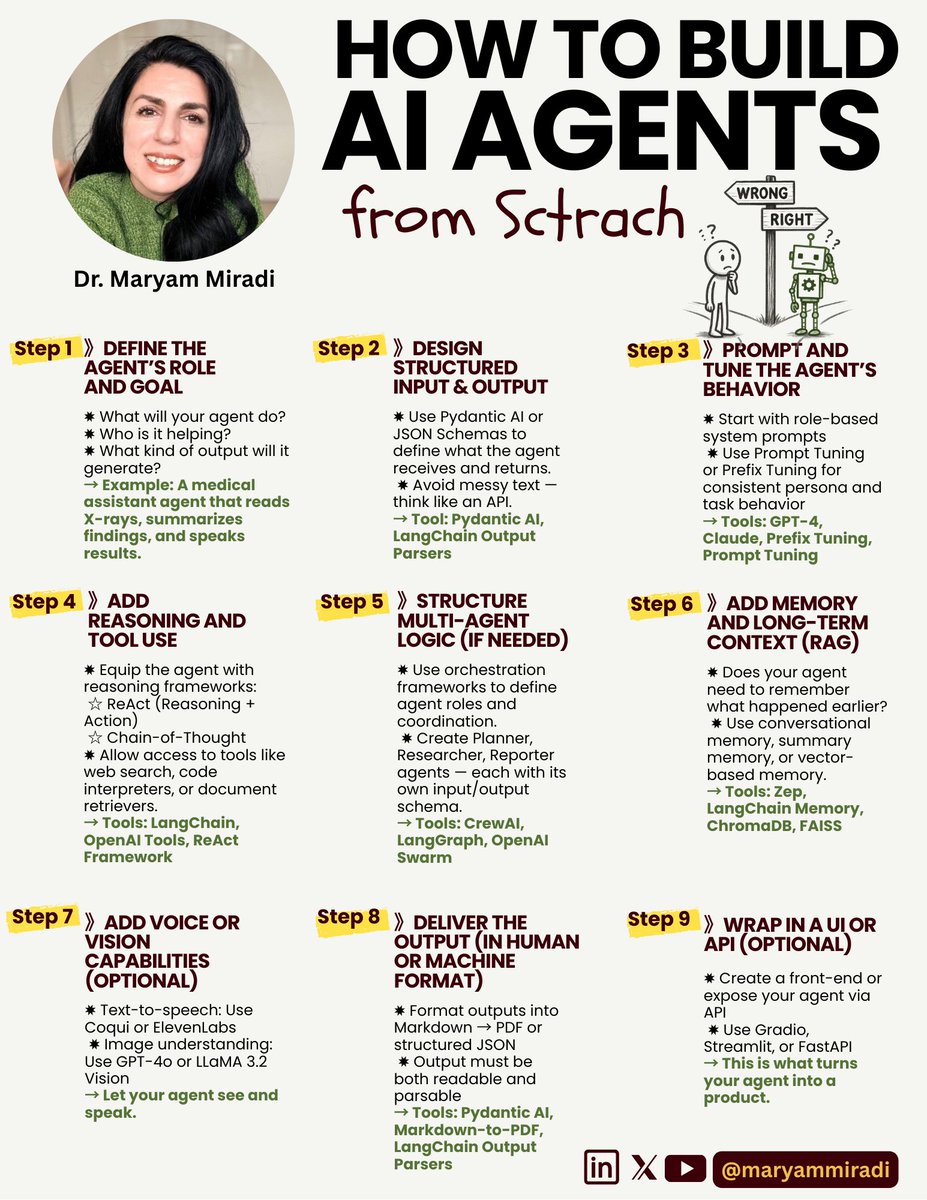
🛠️🧭 How to Build AI Agents from Scratch – Even If You’ve Never Done It Before
This is 9 Step roadmap from prompt to UI.
》Step 1: Define the Agent’s Role and Goal
✸ What will your agent do?
✸ Who is it helping?
✸ What kind of output will it generate?
→ Example: A medical assistant agent that reads X-rays, summarizes findings, and speaks results.
》Step 2: Design Structured Input & Output
✸ Use Pydantic AI or JSON Schemas to define what the agent receives and returns.
✸ Avoid messy text — think like an API.
→ Tool: Pydantic AI, LangChain Output Parsers
》Step 3: Prompt and Tune the Agent’s Behavior
✸ Start with role-based system prompts
✸ Use Prompt Tuning or Prefix Tuning for consistent persona and task behavior
→ Tools: GPT-4, Claude, Prefix Tuning, Prompt Tuning
》Step 4: Add Reasoning and Tool Use
✸ Equip the agent with reasoning frameworks:
☆ ReAct (Reasoning + Action)
☆ Chain-of-Thought
✸ Allow access to tools like web search, code interpreters, or document retrievers.
→ Tools: LangChain, OpenAI Tools, ReAct Framework
》Step 5: Structure Multi-Agent Logic (if needed)
✸ Use orchestration frameworks to define agent roles and coordination.
✸ Create Planner, Researcher, Reporter agents — each with its own input/output schema.
→ Tools: CrewAI, LangGraph, OpenAI Swarm
》Step 6: Add Memory and Long-Term Context
✸ Does your agent need to remember what happened earlier?
✸ Use conversational memory, summary memory, or vector-based memory.
→ Tools: Zep, LangChain Memory, Chroma
》Step 7: Add Voice or Vision Capabilities (Optional)
✸ Text-to-speech: Use Coqui or ElevenLabs
✸ Image understanding: Use GPT-4o or LLaMA 3.2 Vision
→ Let your agent see and speak.
》Step 8: Deliver the Output (in Human or Machine Format)
✸ Format outputs into Markdown → PDF or structured JSON
✸ Output must be both readable and parsable
→ Tools: Pydantic AI, Markdown-to-PDF, LangChain Output Parsers
》Step 9: Wrap in a UI or API (Optional)
✸ Create a front-end or expose your agent via API
✸ Use Gradio, Streamlit, or FastAPI
→ This is what turns your agent into a product.
≣≣≣≣≣≣≣≣≣≣≣≣≣≣≣≣≣≣≣≣≣≣≣≣≣≣
⫸ꆛ Want to build Real-World AI agents?
Join My 𝗛𝗮𝗻𝗱𝘀-𝗼𝗻 𝗔𝗜 𝗔𝗴𝗲𝗻𝘁 𝟰-𝗶𝗻-𝟭 𝗧𝗿𝗮𝗶𝗻𝗶𝗻𝗴 TODAY!
➠ Build Real-World AI Agents for Healthcare, Finance, Aviation, Smart Cities
➠ Learn 4 Framework: LangGraph | PydanticAI | CrewAI | OpenAI Swarm
➠ More Tools: Hugging Face, Foloim, ElevenLabs, Gradio and more
➠ Work with Text, Audio, Video and Tabular Data
👉𝗘𝗻𝗿𝗼𝗹𝗹 𝗡𝗢𝗪 (𝟰𝟱% 𝗱𝗶𝘀𝗰𝗼𝘂𝗻𝘁):
https://t.co/5i2v1fIrhJ
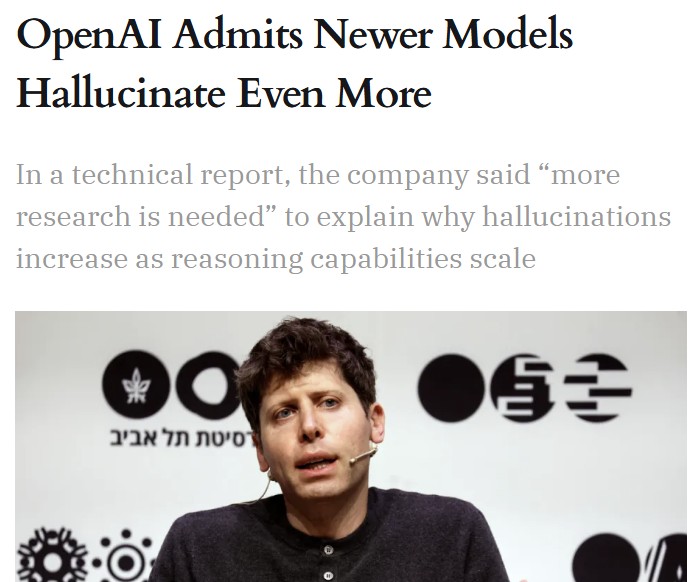
Avoid using ChatGPT for academic work. It's newer models hallucinate even more.
Instead, try Bohrium: an AI app that integrates Deep Seek with multiple academic databases.
Answers your questions with references to published papers and lets you chat with papers too – for free
Hoping you see this @sama I have deterministic ai that I think would solve many of your scaling and learning issues.
NodeRAG and Leonata come at the graph-based reasoning problem from radically different angles:
》NodeRAG: Graph as Enriched Memory
✸ Persistent Heterograph: NodeRAG pre-processes a corpus into a reusable heterograph, storing structured representations of semantic units, relationships, summaries, and more.
✸ LLM-enhanced Indexing: It uses LLMs to build the graph, but at query time, retrieval is powered by shallow Personalized PageRank and dual search (vector + symbolic), not re-generation.
✸ Retrieval-optimized: Its focus is on low-latency, high-precision retrieval for multi-hop QA and LLM augmentation. It’s like giving LLMs a structured, query-friendly brain.
》Leonata: Graph as Dynamic Reasoner
��� Query-Time Graph Construction: Instead of indexing a corpus, Leonata builds a brand new knowledge graph on the fly for every query.
✸ No LLM, No Embeddings: This is striking—it means it’s operating with deterministic graph logic rather than probabilistic language modeling.
✸ Built-in Ontological Reasoning: From what I’ve seen, it’s closer to symbolic AI, where logical consistency, ontological constraints, and explainability are first-class citizens.