O problema dessas fábricas brasileiras indo para o Paraguai e outros países é que esse investimento é estrutural e de longo prazo. Mesmo que um presidente bom “arrume o Brasil”, o custo de desfazerem a decisão é IMENSO. São gerações para reverter o estrago do PT.
One big difference between now and then is that today’s fundamentals are backing up the valuations. While the 5-year CAPE ratio above raises eyebrows, booming earnings are so far keeping valuations in check. In fact, the chart below showing the forward P/E against high yield credit spreads suggests that valuations are quite reasonable today.
Segue uma atualização das taxas das NTN-B, com base nos dados da Anbima, e das inflações implícitas calculadas pela Eytse Estratégia.
As implícitas de médio e longo prazo estão, em geral, entre 5,5% e 6,5% ao ano. Isso significa que, quando comparados títulos de vencimento semelhante e carregados até o vencimento, a inflação realizada precisa superar patamares elevados para que as NTN-B apresentem retorno superior ao dos prefixados.
O resultado é uma menor atratividade relativa e uma demanda mais fraca por esses papéis, o que se soma a outros fatores: (i) concorrência das debêntures incentivadas; (ii) elevado custo de oportunidade representado pelo CDI; (iii) maior percepção de risco de mercado diante do cenário político-eleitoral doméstico e da alta dos juros globais; (iv) entidades de previdência já bastante carregadas em NTN-B; e (v) fundos multimercados com menor patrimônio e menor orçamento de risco.
O principal vetor doméstico capaz de deslocar de forma persistente para baixo as curvas de juros nominais e reais seria um ajuste fiscal forte e crível. Esse cenário, porém, não se materializará os próximos meses e, talvez, nem nos próximos anos.
A política fiscal e parafiscal vem atuando na contramão da política monetária, ao estimular a demanda agregada, elevar a taxa neutra de juros e contribuir para a desancoragem das expectativas de inflação.
Enquanto isso, o Tesouro deveria reduzir o risco (medido pelo DV01) ofertado nos leilões de títulos prefixados, como fez na semana passada, para evitar pressão adicional sobre a curva nominal.
Caso volte a realizar leilões de recompra, o foco deveria estar nos títulos prefixados, e não nas NTN-B. A recompra de prefixados tenderia a comprimir as taxas nominais e abrir espaço para a queda das implícitas. Já uma recompra concentrada em NTN-B comprimiria as taxas reais, elevaria ainda mais as implícitas e enfraqueceria a demanda por esses papéis.
Vale enfatizar que a dificuldade de colocação das NTN-B não parece refletir uma percepção de risco de crédito soberano. O Tesouro vem colocando com facilidade LFT de prazo longo e com deságios reduzidos. A emissão média semanal total de títulos está em torno de R$ 32 bilhões, compatível com o ritmo de execução do PAF, enquanto o colchão de liquidez permanece bastante robusto.
Palantir CEO Alex Karp on what customers actually want, the real business of frontier labs, and the importance of open source models:
“What the technical customers want is control over their compute, their models, their data stack, and their alpha. They want to know they own the means of production, and it's not being transferred to someone else.”
"Who owns the data? Are the prompts secure? Is this being transferred to you?"
"If it was so valuable, and I can make you a billion dollars, wouldn't I say I'll make you a billion dollars and I want 30%? Why are they charging for tokens if it's so valuable?"
I just published my article on how hyperscalers like $AMZN, $MSFT, and $GOOGL will benefit in the token optimization era and why I believe the companies will re-rate much higher.
https://t.co/CQjUnFH3FD
One of the most underappreciated ways to play the AI semiconductor buildout may be through materials rather than chips themselves.
As the industry races to produce more advanced semiconductors, demand isn’t just rising for GPUs and wafer fab equipment, it’s rising for the critical materials that make modern chips possible. (1/6)🧵
Druckenmiller on why most investors can't sell losers:
"if the reason i bought a stock is no longer the case, i don't care what i paid for it."
"if i bought it at 60 and it's 50 because the market discovered the problem before me, i have no emotion whatsoever."
"after a while you develop enough confidence that you're not afraid to clean the slate and start over. because you have the confidence that you'll be successful again."
"you're not going to sit there in a lazy position that you're not that sure about anymore. just clean house."
"i don't care what i paid for a stock. it's absolutely irrelevant to my investment process going forward."
then on buying back higher than he sold:
"i don't like it. but i'm perfectly willing to buy something back higher than i sold it. some people can't get themselves to do it. i can."
this is the exact same principle behind properly managing strategies. if the edge isn't there anymore, turn it off. don't sit in it hoping it recovers just because you spent three months building it. clean house. start fresh. the next opportunity doesn't care about your sunk costs.
📈Backtesting Stocks - ONE filter to rule them all 🌟
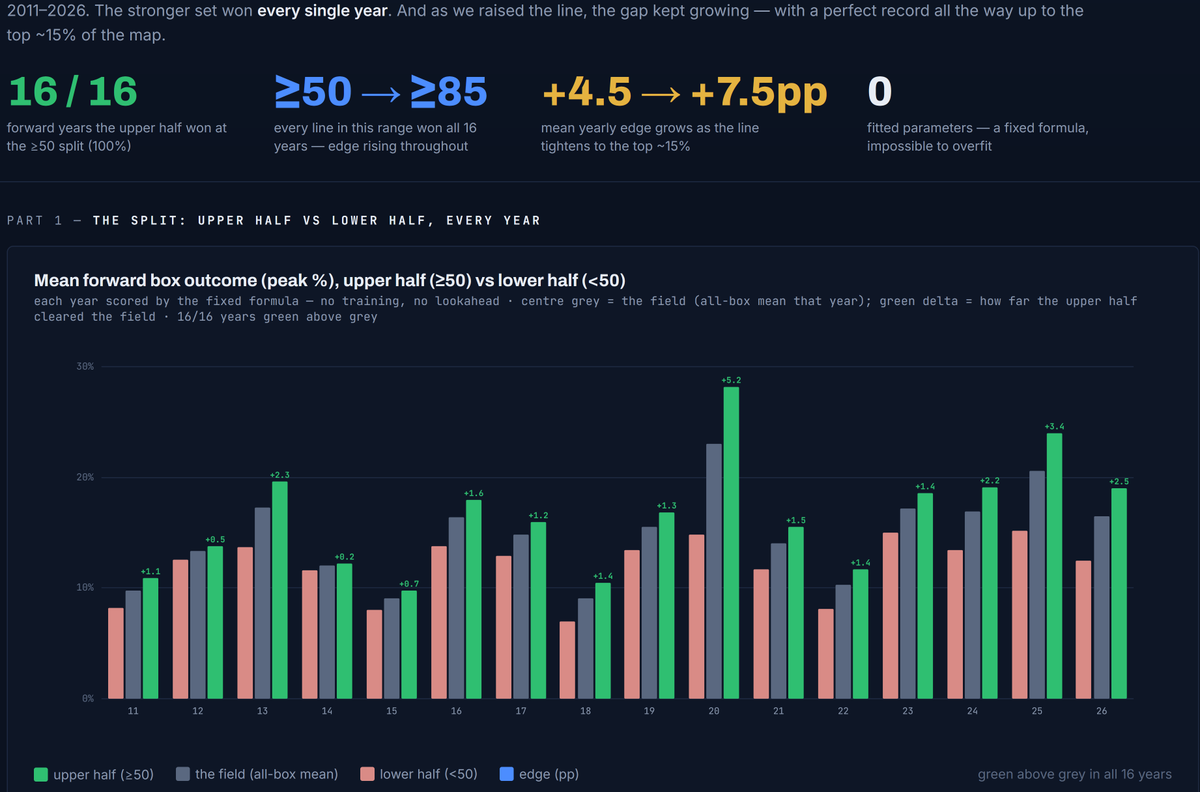
During a recent backtesting, one of the most interesting findings was a prerequisite that universally improved the results of every system/strategy indicator - U&R, flat base breakouts, pullback to ascending moving averages etc.
Regardless of your strategy, if you restrict yourself to the top 50% of industry groups (by relative strength) - you results improve in EVERY year when compared to the same strategy without the industry constraint.
Further, if you restrict yourself to the lowest 50% of industry groups, your results will be worse than the baseline in EVERY year.
To practically apply this rule, there are 149 industry groups in @finviz_com . On a weekly and monthly basis, restrict yourself to the top 74 industry groups without exception and before anything else.
https://t.co/Vg7MbkAK06
That's it - no. If this then that, no complex formula.... but after 1000's of tests across 300+ unique strategies, this was undefeated.
As @RealSimpleAriel likes to say "stick to leading stocks in leading groups".... the screenshot below is the scientific, quantified proof to "stick to leading groups" ... 16 years EVERY strategy undefeated ... top 50% of industries beats the baseline (all industries) and the bottom 50% ... and it is monotonic.
BRL woke up this morning with a bout of indigestion and local duration sold off – hardly surprising given cognitive dissonance in yesterday’s statement which failed to justify the rate cut, stretched long positioning both in rates and BRL, and Kevin-the-Hawk’s talons overhead.
📰Brazilian malls: The Illusion of "NTN-B+Spread"
🗞️Brazilian malls were supposed to behave like NTN-B + spread + growth. But long-term TSR tells a different story. The problem was not asset quality — it was overstated FFO and poor capital allocation.
https://t.co/CNMbrNR8iL
Elon Musk criou, em um único dia, 4.400 novos milionários.
Quase 400 deles ultrapassaram os US$ 100 milhões.
Não são banqueiros nem investidores de risco. São funcionários da SpaceX: soldadores, técnicos, mecânicos e até funcionários da cantina. Durante vinte anos, a empresa pagou gente de todos os níveis com ações, não só com salário alto. Quem produziu colheu.
Juan Hernandez, imigrante mexicano, aceitou um emprego de soldador por US$ 28 a hora em 2015, sem nem saber direito o que era a SpaceX. Recebeu uma pequena participação de US$ 10 mil e pôde comprar mais por desconto em folha. Hoje sua fatia vale US$ 880 mil.
Trevor Hise ignorou os conselhos dos pais para pegar um emprego “seguro” na General Electric. Escolheu a SpaceX, ficou 12 anos e acumulou mais de 100 mil ações. Ao preço da listagem, são US$ 13,5 milhões. Aos 37 anos, ele já pode se aposentar. Palavras dele: “A magnitude disso é ridícula.”
O detalhe mais eloquente veio antes mesmo da abertura de capital: mais de 100 funcionários se uniram discretamente para contratar uma gestora de fortunas capaz de cuidar de até US$ 5 bilhões. Muitos nunca tinham precisado de wealth manager na vida.
Há décadas os IPOs de empresas de tecnologia enriquecem programadores. Desta vez, o dinheiro chegou ao chão de fábrica. Isso é capitalismo de verdade: quem arrisca, quem trabalha e quem entrega valor colhe frutos proporcionais.
A esquerda odeia esse tipo de história. Porque ela prova que a verdadeira ascensão social não vem de dividir a miséria alheia, mas de criar riqueza que eleva quem tem coragem de construir.
KKKKKKK FARIA LIMA PRECISA SER OTIMISTA COM BRASIL, RAPAZ, NÃO CRITIQUE ELA. CRITIQUE SUA CAPACIDADE DE ANALISAR INCENTIVOS ANTES DE SAIR ACREDITANDO NOS OUTROS. PARA QUEM VÃO VENDER TRILHÕES DE ATIVOS EM CDI E IPCA+ SE A DÍVIDA PÚBLICA COMERÇAR A SER QUESTIONADA SERIAMENTE?
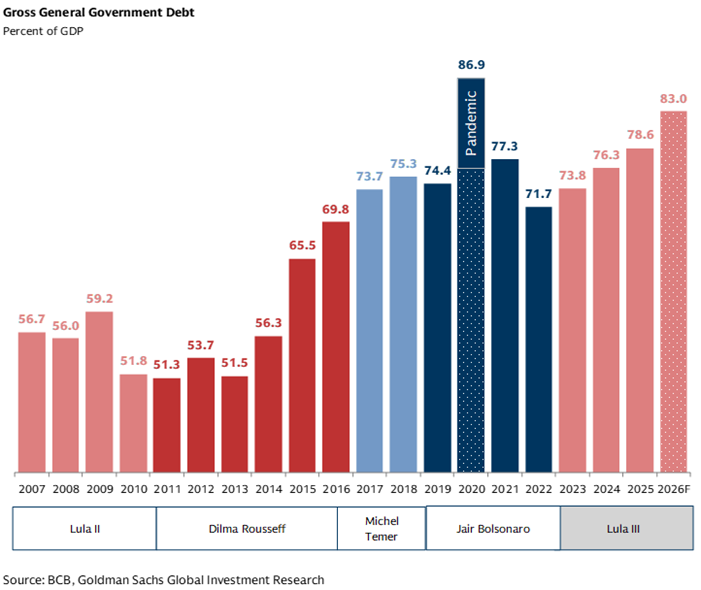
Meu Deus olha aonde estamos chegando, com esse fiscal do Lula simplesmente papel IPCA 2035 hoje batendo 8.00% , na Dilma a recordista mundial de derrubada de PIB tinha batido 7.70%
como economistas sérios que apoiam esse governo olham isso ?
Brasil é o novo Banco Master do mundo ?
para 10 anos + inflação o México paga 4.70% , África do Sul paga 4.25% e os outros emergentes pagam menos de Inflação + 3.00%