$GOOG my #1 pick on #Quantum
Among all the companies developing quantum computers, I am most bullish on Google. They rarely make many public announcements because they don't need to, but once they do, it will be a blockbuster for sure. I don't know when their next announcement will be, but I am highly anticipating it.
During an interview with Salesforce founder and CEO Marc Benioff at the Dreamforce 2025 event on Thursday, October 16, 2025, Sundar Pichai discussed quantum computing [video link below, timeline 34:00–35:00]:
Sundar Pichai: "We make these long-term bets. Waymo... Two weeks ago, I'd gone to Santa Barbara in our quantum lab. I met with the team. Again, it's another journey we've been at for more than 10 years. I think we have the leading quantum lab in the world. I finished spending my day there, and the following Tuesday morning, I found out our Chief Scientist won the Nobel Prize for Physics this year. And this is the second year in a row...
We believe in that kind of deep, fundamental R&D and a view of translating that into real products. That same quantum computing team—no different from our TPU teams—plans to have commercially available, real, at-scale quantum computers in a few years, and I think they will get there."
Marc Benioff: "In 10 years, quantum is real, is your point?"
Sundar Pichai: "At least. I for sure think so. I am very, very bullish and confident on it."
https://t.co/FbhbM8dI4j
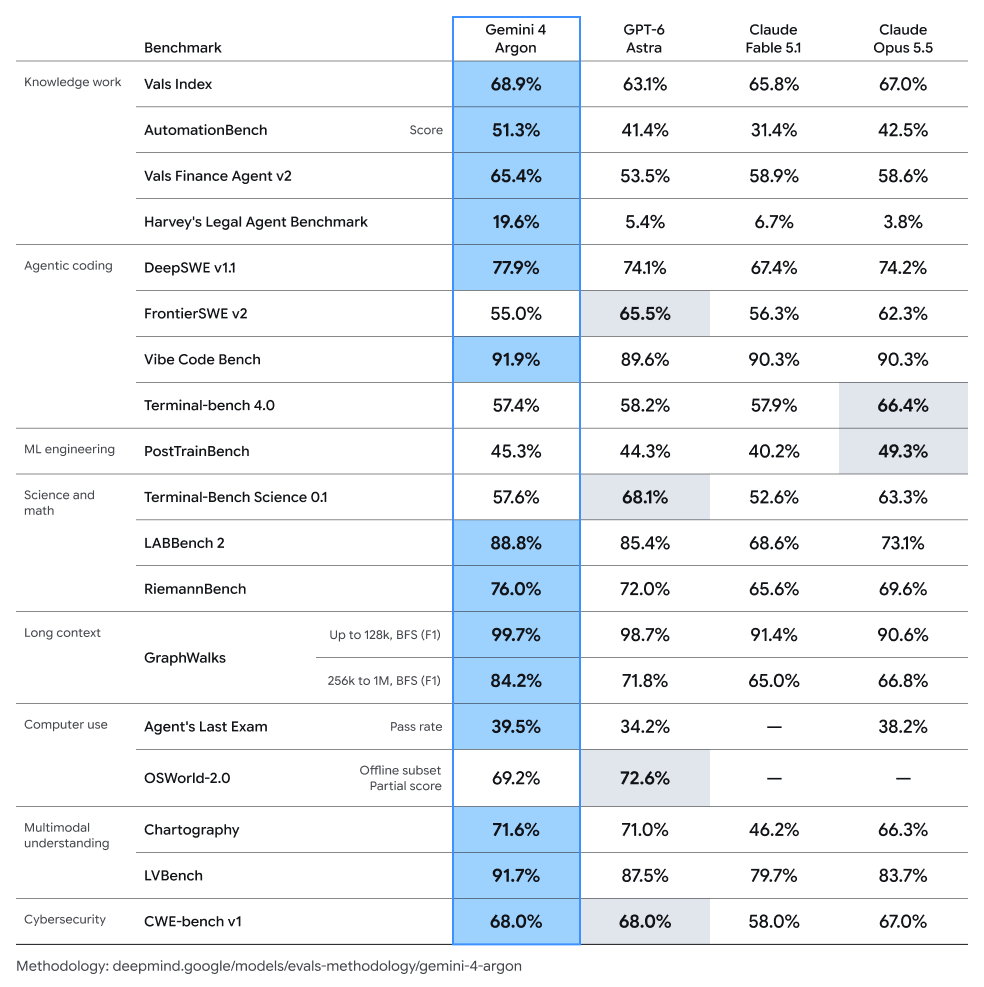
Lots of discussion out there about our next model(!), so I wanted to give an early look as soon as possible. Introducing Gemini 4 Argon!
It shows frontier performance in complex workflows, cyber defense and software engineering. Teams are using it extensively at Google, from coding to quantum computing, great feedback.
Here’s a look at the benchmarks:
$BBD.B 🚀 Moody’s upgrades Bombardier’s credit rating to Ba2 from Ba3 with a Positive Outlook—its second upgrade in 12 months—driven by strong deleveraging, robust free cash flow, and growing Services & Defense momentum toward investment grade! #Bombardier https://t.co/lOJG6f4dGh
We watched the full 26-minute @BottomFinders video on $COUR . First, credit where it’s due: the video gets the broad opportunity right.
#Coursera is better understood as an #AI-skilling and workforce-development platform than as a traditional education company. The video also correctly picked up on the depressed chart, improving gross margins, learner growth, the importance of Udemy and the possibility that the stock is trying to form a base.
We ran the video through our own Glassbox methodology, which separates reported facts, calculated figures, reasonable inference and claims that cannot yet be independently verified.
The strongest part of the video was the strategic framing. Coursera reported Q1 revenue of $195.7M, up 9% year over year, added 7.6M new learners, and reached 205M registered learners before the Udemy transaction closed. Q1 GAAP gross margin improved to 55.5%, with non-GAAP gross margin at 56.6%. Those are useful and relevant facts.
The Udemy combination also materially changes the company. Coursera now describes a combined platform reaching approximately 290M learners and 18,000 enterprise customers, with more than $1.5B of combined 2025 revenue and an expected $115M of annual run-rate cost synergies within 24 months, with a significant majority expected during the first year.
Where we differ is mainly on data hygiene and how confidently some conclusions were presented.
The video repeatedly described COUR as “highly profitable.” That is not the cleanest description. Q1 produced $13.5M of adjusted EBITDA, $14.6M of operating cash flow and $3M of free cash flow, but the company also reported a $20.5M GAAP net loss and a $25.3M operating loss. The more accurate description is: improving adjusted profitability and positive operating cash flow, but still GAAP loss-making.
The share-count discussion also needs updating after the all-stock Udemy merger. COUR had approximately 169.3M shares outstanding before the close, and former Udemy holders now own roughly 41% of the combined company on a fully diluted basis. Our post-merger forensic estimate is therefore around 287M shares, not a simple 138M-share scarcity story.
That creates a direct arithmetic issue in the video. It quoted a 138M float, approximately 20.64M shares short, and short interest of 7.85%. Those figures do not reconcile: 20.64M divided by 138M is about 15%, not 7.85%. That usually means different providers are using different pre-merger and post-merger denominators.
The claim that institutions are secretly accumulating while deliberately pushing the stock down is also stronger than the visible evidence supports. Institutional sponsorship is clearly present, but reported holdings are not the same thing as live buying. Form 13F data reflects quarter-end positions and can be filed up to 45 days later, so it cannot prove that institutions are actively buying #COUR today. A proprietary supply-and-demand signal may be useful, but the methodology needs to be shown before it can be treated as proof of institutional control.
The biggest omission, in our view, was Coursera’s up to $500M share-repurchase authorisation, announced on May 18. The company said it expects to fund repurchases from existing cash and operating cash flow. At a roughly $5.30 share price and a calculated post-merger share base of around 287M, the company’s equity value is around $1.52B, making the authorisation equivalent to roughly one-third of the market capitalisation. That is central to the post-merger share-structure debate.
To be fair, the video did mention Coursera’s approximately $789.8M of cash and no debt, but I think it underweighted how important that balance sheet is. The combination of large cash reserves, zero debt, positive operating cash flow and a $500M repurchase authorisation is one of the strongest parts of the COUR thesis.
One other area worth tightening is Enterprise. Revenue grew 7%, but net retention was 90% and down 300 basis points quarter over quarter. Calling that “healthy” is generous. It is better described as continued Enterprise growth with retention pressure inside the existing customer base.
Technically, we agree that the chart is interesting around $5 and that a base may be developing. We simply would not call the bottom fully confirmed yet. The structure looks compressed and potentially constructive, but the more meaningful trust reset comes through reclaiming the moving-average resistance above the current price.
Overall, this was a useful discovery video, and the host identified the right company for several of the right reasons. The strategic direction was stronger than the ownership, float and market-maker analysis.
Our Glassbox conclusion is simple:🧐
The bullish COUR thesis does not need a secret institutional-manipulation story. The reported facts are already powerful enough: a cash-rich, debt-free AI-skilling platform, newly combined with Udemy, carrying 290M learners, 18,000 enterprise customers, a $115M synergy target and a $500M buyback authorisation.
That is the real story worth following.🗞️
Research only. NFA. #swazcharts #TriFusionAI #NYSE #Tradingview #AI #EdTech
Had an awesome conversation with Christian Weedbrook @_cweedbrook, founder and CEO of @XanaduAI, on the latest episode of Original & Unconventional @oaupod.
We talked about:
👉 Christian’s unconventional journey — from film school dropout to physicist, and now founder and CEO of one of the world’s leading quantum computing companies.
👉 Quantum computing and the future of technology
👉 Whether Canada is prepared for the age of quantum computers
👉 The opportunities and risks that come with this technology
👉 The realities of building a deep-tech company
👉 How life has changed since Xanadu went public in March
👉 What becomes possible when humanity gains an entirely new computational paradigm
As a bonus, Christian gave us a tour of the lab where Xanadu’s quantum computer is located… pictured here 👇
Looking forward to sharing the full episode soon.🙌
In the meantime, subscribe to our YouTube channel and hit the notification bell 🔔 so you don’t miss this episode when it drops.
🔗 https://t.co/2SB4I3LqsG
#quantum #quantumcomputer #ai #deeptech #canada #toronto #tech #robotics #science #stem
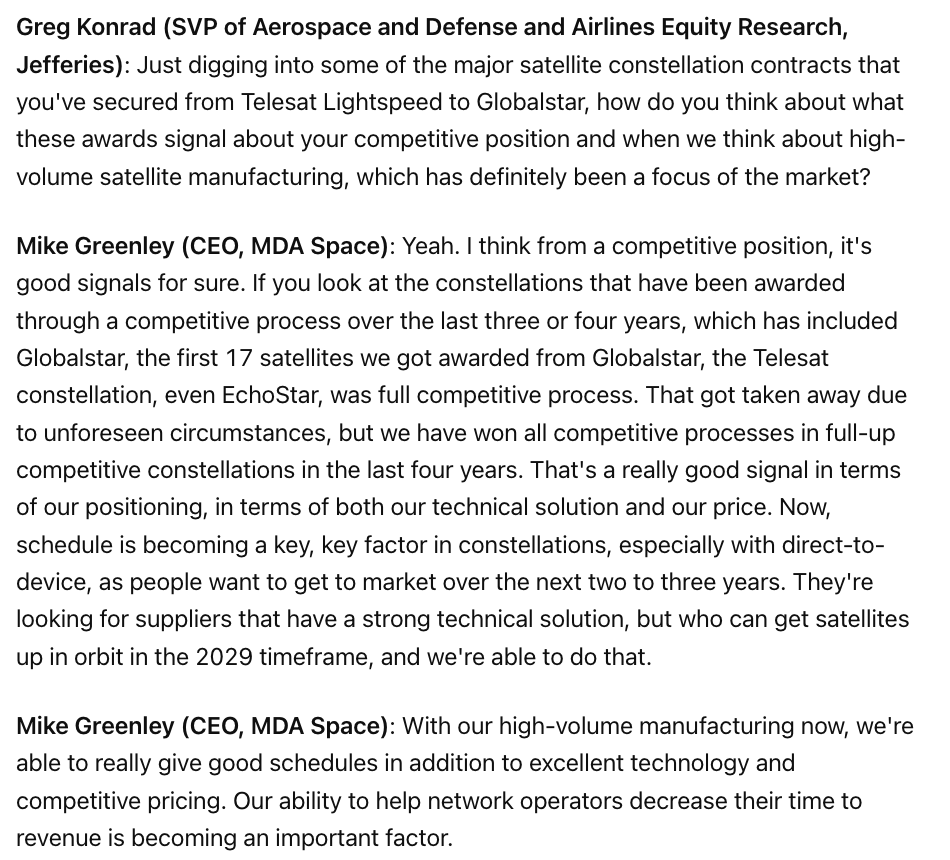
Great to get more colour from $MDA around their future ambitions during the Jeffries Space Virtual Summit yesterday. Some notes:
- $MDA won every full competitive constellation process it entered over the last 4 years: $GSAT, $TSAT, and $SATS (before cancellation). Speaks to how game changing the $SATX acquisition was.
- Pipeline is massive relative to revs: $40b CAD total pipeline, with around $30b CAD in satellite systems. Mgmt emphasizing this is 25x 2025 revenue. They also reiterated that they've been downselected for $10b of that (this is over the next 5 years and is not currently reflected in their backlog).
- Sovereignty demand is a real tailwind they been seeing over the last 12-18 months with scheduling becoming a major consideration for D2D constellations. Govs, militaries, MNOs, etc. are looking at suppliers who can get them into orbit over the next 2-3 years. With the inauguration of the Montreal facility which will able to produce roughly 400 sats per year, $MDA is extremely well positioned.
- 🚨 Mgmt's target is 4-6 constellation customers (currently have 2 anchor customers). They also spoke about the stickiness of these customers that would need to go through replenishment/expansion cycles every 5-10 years.
- $MDA moving into more recurring revenue avenues. Geointelligence via MDA CHORUS (set to launch by EOY), Robotics via MDA SKYMAKER, and more interestingly selective equity stakes in pieces of space infrastructure, on communication networks around the world.
- $MDA eyeing M&A in US, continental Europe, and other parts of the world to increase global footprint. Note they already have smaller operations in US, UK, and little bits of Europe.
All of this while analysts are projecting a modest ~11% CAGR through 2029. It's only a matter of time before the market finally catches up🚀
Full transcript here: https://t.co/O1XbPqSWYk
Xanadu and Oak Ridge National Laboratory (@ORNL) are collaborating to bring PennyLane (@PennyLaneAI) to Frontier, one of the most advanced computing systems in the world.
🔗👇
Today is a monumentous day for quantum computing and cryptography. Two breakthrough papers just landed (links in next tweet). Both papers improve Shor's algorithm, infamous for cracking RSA and elliptic curve cryptography. The two results compound, optimising separate layers of the quantum stack. The results are shocking. I expect a narrative shift and a further R&D boost toward post-quantum cryptography.
The first paper is by Google Quantum AI. They tackle the (logical) Shor algorithm, tailoring it to crack Bitcoin and Ethereum signatures. The algorithm runs on ~1K logical qubits for the 256-bit elliptic curve secp256k1. Due to the low circuit depth, a fast superconducting computer would recover private keys in minutes. I'm grateful to have joined as a late paper co-author, in large part for the chance to interact with experts and the alpha gleaned from internal discussions.
The second paper is by a stealthy startup called Oratomic, with ex-Google and prominent Caltech faculty. Their starting point is Google's improvements to the logical quantum circuit. They then apply improvements at the physical layer, with tricks specific to neutral atom quantum computers. The result estimates that 26,000 atomic qubits are sufficient to break 256-bit elliptic curve signatures. This would be roughly a 40x improvement in physical qubit count over previous state-of-the-art. On the flip side, a single Shor run would take ~10 days due to the relatively slow speed of neutral atoms.
Below are my key takeaways. As a disclaimer, I am not a quantum expert. Time is needed for the results to be properly vetted. Based on my interactions with the team, I have faith the Google Quantum AI results are conservative. The Oratomic paper is much harder for me to assess, especially because of the use of more exotic qLDPC codes. I will take it with a grain of salt until the dust settles.
→ q-day: My confidence in q-day by 2032 has shot up significantly. IMO there's at least a 10% chance that by 2032 a quantum computer recovers a secp256k1 ECDSA private key from an exposed public key. While a cryptographically-relevant quantum computer (CRQC) before 2030 still feels unlikely, now is undoubtedly the time to start preparing.
→ censorship: The Google paper uses a zero-knowledge (ZK) proof to demonstrate the algorithm's existence without leaking actual optimisations. From now on, assume state-of-the-art algorithms will be censored. There may be self-censorship for moral or commercial reasons, or because of government pressure. A blackout in academic publications would be a tell-tale sign.
→ cracking time: A superconducting quantum computer, the type Google is building, could crack keys in minutes. This is because the optimised quantum circuit is just 100M Toffoli gates, which is surprisingly shallow. (Toffoli gates are hard because they require production of so-called "magic states".) Toffoli gates would consume ~10 microseconds on a superconducting platform, totalling ~1,000 sec of Shor runtime.
→ latency optimisations: Two latency optimisations bring key cracking time to single-digit minutes. The first parallelises computation across quantum devices. The second involves feeding the pubkey to the quantum computer mid-flight, after a generic setup phase.
→ fast- and slow-clock: At first approximation there are two families of quantum computers. The fast-clock flavour, which includes superconducting and photonic architectures, runs at roughly 100 kHz. The slow-clock flavour, which includes trapped ion and neutral atom architectures, runs roughly 1,000x slower (~100 Hz, or ~1 week to crack a single key).
→ qubit count: The size-optimised variant of the algorithm runs on 1,200 logical qubits. On a superconducting computer with surface code error correction that's roughly 500K physical qubits, a 400:1 physical-to-logical ratio. The surface code is conservative, assuming only four-way nearest-neighbour grid connectivity. It was demonstrated last year by Google on a real quantum computer.
→ future gains: Low-hanging fruit is still being picked, with at least one of the Google optimisations resulting from a surprisingly simple observation. Interestingly, AI was not (yet!) tasked to find optimisations. This was also the first time authors such as Craig Gidney attacked elliptic curves (as opposed to RSA). Shor logical qubit count could plausibly go under 1K soonish.
→ error correction: The physical-to-logical ratio for superconducting computers could go under 100:1. For superconducting computers that would be mean ~100K physical qubits for a CRQC, two orders of magnitude away from state of the art. Neutral atoms quantum computers are amenable to error correcting codes other than the surface code. While much slower to run, they can bring down the physical to logical qubit ratio closer to 10:1.
→ Bitcoin PoW: Commercially-viable Bitcoin PoW via Grover's algorithm is not happening any time soon. We're talking decades, possibly centuries away. This observation should help focus the discussion on ECDSA and Schnorr. (Side note: as unofficial Bitcoin security researcher, I still believe Bitcoin PoW is cooked due to the dwindling security budget.)
→ team quality: The folks at Google Quantum AI are the real deal. Craig Gidney (@CraigGidney) is arguably the world's top quantum circuit optimisooor. Just last year he squeezed 10x out of Shor for RSA, bringing the physical qubit count down from 10M to 1M. Special thanks to the Google team for patiently answering all my newb questions with detailed, fact-based answers. I was expecting some hype, but found none.
It’s official.
$CHAC shareholders have approved the deal with Xanadu. Next stop: XNDU.
Upon closing, the combined company is expected to begin trading under $XNDU on @Nasdaq and the @tsx_tsxv on March 27, 2026.
$CHAC #QuantumComputing#Quantum#XNDU#SPACNews
Get the details here: https://t.co/38jikWTGkO
IONQ has been aggressively pursuing acquisitions—stacking up a unique tech portfolio through multiple M&A deals.
While this creates an impressive-looking combination on paper, that uniqueness is likely fragile when facing true hard-core breakthroughs from the giants (e.g., a major Google quantum leap). In such a scenario, acquired synergies could crumble fast.
In the quantum field, I still believe $GOOG and $IBM are better bets than $IONQ.
Some thoughts about 2026:
#Quantum After ~2 years of hype, quantum computing stocks have gone quiet—markets are bored. Expect tepid performance through 2026 unless a major breakthrough hits.
If it comes, it'll likely be from Google, IBM, or Amazon—not small pure-plays. A big Google announcement, for example, could crush smaller quantum names. $GOOG $IBM $AMZN // $IONQ, $RGTI
#Space This year's new darling? Space stocks. We've already seen 50%+ moves in quite a few, and the hype train is just getting started—fuelled by policy tailwinds, orbital compute advances, and SpaceX IPO buzz. $MDA $FLY $RDW $AVIO $BWXP $MCHP $RKLB
#AI. No debate: AI + robotics remain mainstream kings. Google becomes the world's most valuable company this year. Google Glasses x Warby Parker launch in 2026 will ignite wearable AI hardware—a new platform that gradually overtakes smartphones. $GOOG $AMZN $TSLA $WRBY
Today on the blog we present results showing the operation of new dynamic circuits for quantum error correction, going beyond their static counterparts by using fewer couplers, removing correlated errors & utilizing a different type of quantum gate. More →https://t.co/1qRmjXeYO6
Last month, @XanaduAI Founder and CEO Christian Weedbrook was in Singapore to sign a memorandum of understanding (MOU) with the Agency for Science, Technology and Research (@ASTARsg). 🔗👇
Today, we are announcing that we have entered into a definitive agreement to acquire @confluentinc. This is a decisive step that accelerates our hybrid cloud and AI strategy. Learn more: https://t.co/iDGA9WeuDW
Xanadu Quantum Technologies and Crane Harbor Acquisition Corp. announce confidential submission of a draft registration statement on Form F-4 in connection with the proposed business combination.
Read more here: https://t.co/0t2T5dBPYg
$IONQ has just created a dizzying array of new titles. It seems the 'X' in CXO wasn't enough, so they created a multitude of 'Presidents', 'CEOs', and 'EVPs' instead. Many of these job titles sound either vague in their responsibilities or appear to overlap with those of other executives. IONQ clearly has a title inflation problem lately, just like its shares outstanding.
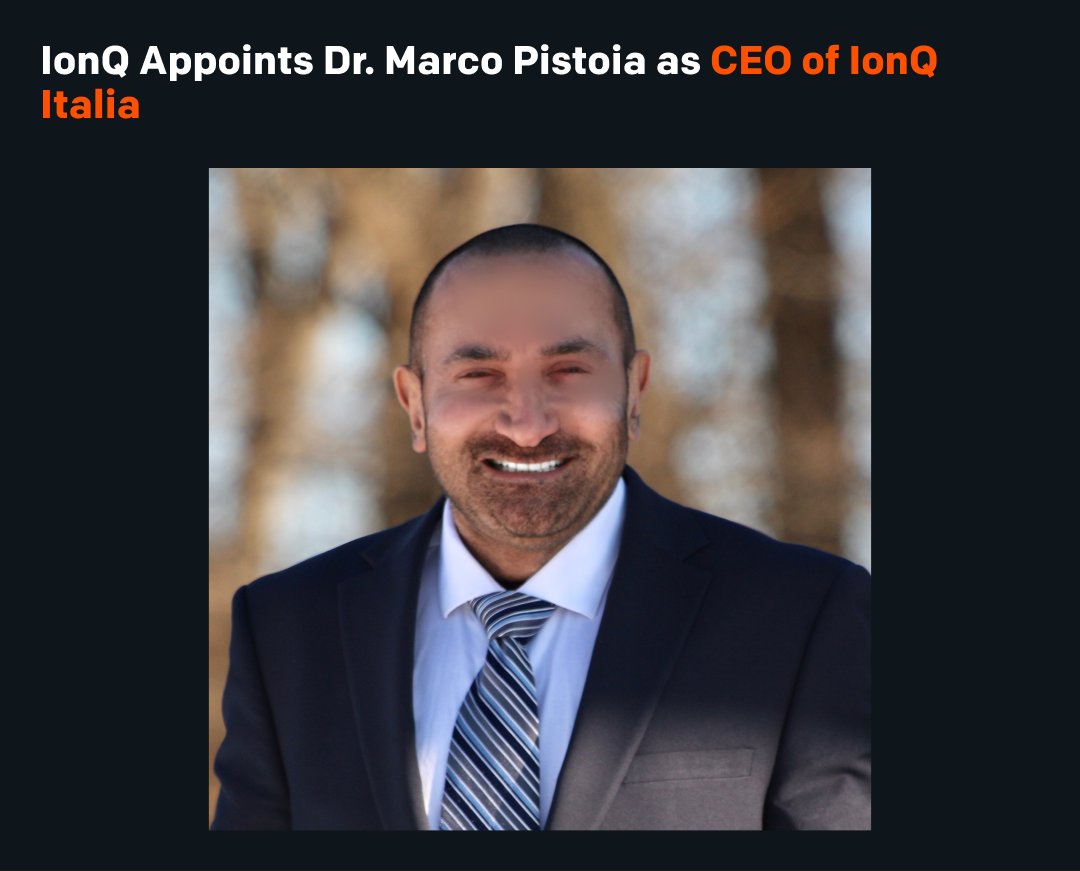
IonQ has named Dr. Marco Pistoia as CEO of IonQ Italia, where he will expand quantum adoption across Italy’s enterprise, government, and research communities.
Dr. Pistoia brings deep expertise in quantum algorithms, applications, and secure communications that will help accelerate Italy’s leadership in the field.
Link: https://t.co/3dy0qEeHLi #QuantumComputing #QuantumNetworking #QuantumSensing
$IONQ It is very interesting to see that IONQ made an equity investment into this drone company, and named Jordan Shapiro, President and General Manager of IonQ’s Quantum Networking, Sensing & Security division, to join Heven AeroTech’s Board of Directors.
However, IONQ deliberately downplayed their equity investment in Heven AeroTech, using the vague term "partner" instead. At the same time, they also did not disclose the investment amount or the deal terms in the news announcement.
IonQ announced a new partnership with @HevenDrones to bring quantum tech to hydrogen-powered Unmanned Aerial Systems (UAS). Heven will integrate our quantum computing, networking, sensing, and security technologies into its UAS, enhancing resilience, stealth, and operational performance in GPS-denied environments.
Link: https://t.co/chnbrIOBKg
#QuantumComputing #QuantumNetworking #QuantumSensing #QuantumSecurity #Aerospace