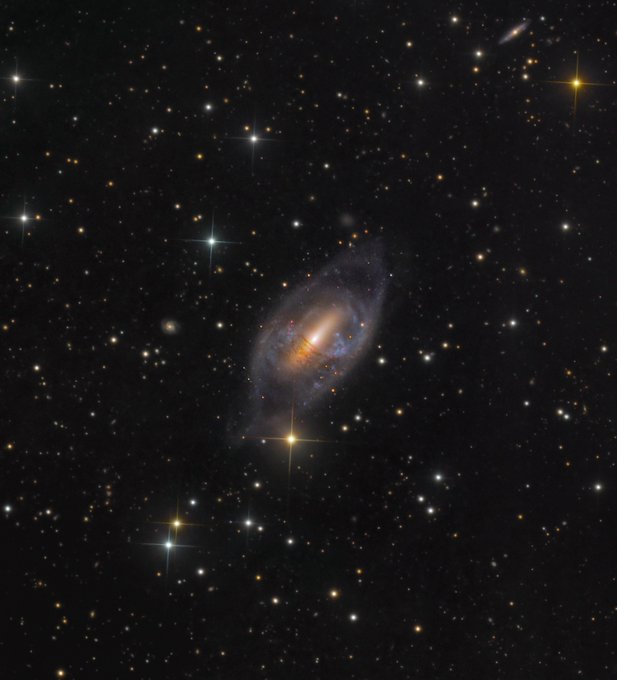
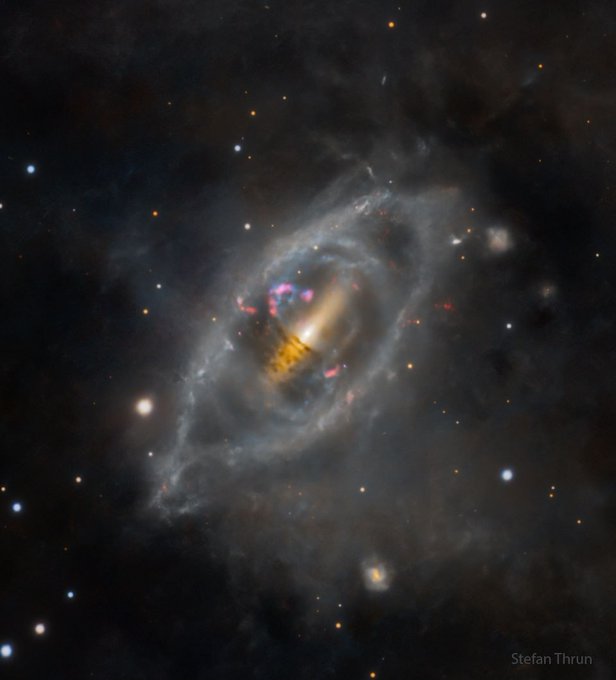
🪐 NGC 2685 is an unusual galaxy, better known as the "Spindle Galaxy" or a "polar-ring galaxy." It is located approximately 40 million light-years from Earth in the constellation Ursa Major, and its size is estimated at 50,000 light-years.
The galaxy is unique because a ring of gas, dust, and stars orbits it, positioned almost perpendicular to the plane of the main disk.
Scientists believe that this structure may have formed as a result of a collision or the capture of material from another galaxy—an event that occurred in the distant past.
🚨: What does a BLACK HOLE actually sound like?
NASA turned this supermassive monster in galaxy M87 into pure audio.
It’s real data. Turn the volume up.
🛰️ The International Space Station travels nearly 28,000 km/h about 8 times faster than a speeding bullet! 🌍
At that incredible speed, it circles Earth roughly once every 90 minutes, never stopping as it races around our planet. 🚀✨
Like a butterfly just emerging from its cocoon and not yet spreading its wings, the gas-and-dust nebula L1527 unfolds the drama of a star being born. The two glowing “wings” are cavities the young protostar has already carved through the surrounding cloud with its outflows. Hidden in the body of the butterfly is the star itself: a tiny, still-unlit lamp only about 100,000 years old.
By cosmic standards it is an infant. It greedily swallows material from a dense disk that we see almost edge-on — a dark stripe across the nebula’s neck. For now its only source of heat is its own gravitational contraction. But as the core grows denser and hotter, the moment draws nearer when thermonuclear reactions will ignite. Then a real star will emerge from this cocoon: a red or orange dwarf with roughly 20–40 percent of the Sun’s mass.
The scale bar in the lower right is 800 astronomical units — about 120 billion kilometers. All this grandeur lies just 450 light-years from Earth, in the Taurus nebula, one of the nearest stellar nurseries to us.
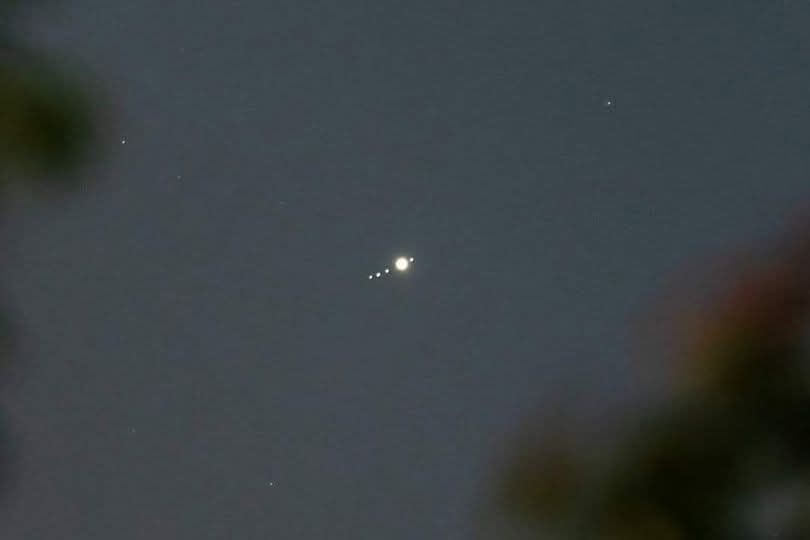
Look closely—Rhea, Dione, Mimas, and Enceladus are all visible alongside Saturn in this impressive capture from Vince Laine.
Vince combined separate stretches for Saturn and its moons to bring out the details of the ringed planet while revealing four of its orbiting worlds in the same composite.
Captured from his backyard observatory in Pennsylvania with a Celestron NexStar 9.25".
📷 Celestron NexStar 9.25" + Focus Motor
📷 Moon Township, PA
How many moons did you spot before reading the caption? 📷
#Celestron #Saturn #SaturnsMoons #Astrophotography #PlanetaryImaging
These "frost flowers" aren't just frozen water they wick up heavy ocean salt to form hyper-saline miniature habitats where polar microbes actively thrive inside the crystals.They form through desublimation, flash-freezing straight from a gas into solid geometric spikes the second warm vapor hits the blistering sub-zero air.If the wind stays dead silent, you get a masterpiece of natural engineering. If a breeze hits, this entire miniature world vanishes in seconds.
The Seyfert galaxy NGC 5283, featuring an active galactic nucleus, as captured by the Hubble Telescope ✨
The supermassive black hole at its center draws in vast amounts of gas, swirling it into an accretion disk that shines with intense brightness. It appears as though radiation from the nucleus permeates the entire object.
However, unlike more distant quasars, the structure and outer regions of this Seyfert galaxy remain distinguishable beyond its brilliant central core. This object is located 170 million light-years from Earth.
🪐
The sandstone relief of Queen Amanitore, a powerful ruling queen (Kandake) of the ancient Kushite Kingdom who reigned from Meroë in the 1st Century AD. Originating from the archaeological site of Wad ban Naqa in present-day Sudan, this piece is part of a bark pedestal and is housed in the Egyptian Museum of Berlin...
The Candaces of Meroe were the queens or queen-mothers of the ancient Kingdom of Kush, a powerful Nubian civilization that flourished in what is now Sudan. The title "Candace" (or Kandake) referred to the ruling queen or queen regent, and the women who bore this title played significant roles in governing and shaping the history of Kush, particularly during the period when Meroe was the capital city, roughly from 284 BC to 314 AD.
The Kingdom of Kush, known for its wealth, military strength, and cultural influence, had a distinctive approach to leadership in which royal women often wielded considerable power. The Candaces were not merely ceremonial figures but powerful rulers in their own right and some governed independently of male kings. During the period around 170 BC and later, several Candaces ruled alone, demonstrating the centrality of female leadership in Kushite society.
Meroe, located along the Nile River, became the capital of Kush after the decline of Napata, the previous center of the kingdom. It was a thriving hub of trade, culture, and metallurgy, particularly known for its iron production. The wealth and strategic location of Meroe contributed to the prosperity of the kingdom and the prominence of its rulers, including the Candaces.
Candaces played pivotal roles in both the political and military spheres of Kush. They were not only involved in the administration of the state but also led armies and defended the kingdom from external threats. One of the most famous Candaces, Amanirenas, led a resistance against the Roman Empire in the 1st Century BC. She successfully fought off Roman advances into Kushite territory and negotiated a favorable peace treaty with the Roman Emperor Augustus. This feat is a testament to the strength and leadership capabilities of the Candaces, particularly in a time when the Roman Empire was expanding and subjugating many other regions.
The Candaces were also important figures in the religious life of Kush. They were often associated with the worship of the kingdom's gods and played key roles in religious rituals, further enhancing their influence and authority. The queen was seen as a divine figure, embodying both political and spiritual power. In some representations, the Candaces are depicted with symbols of authority, such as crowns and scepters, and their images are often found in temples and monumental art, showcasing their revered status.
The period during which the Candaces ruled independently, around 170 BC and onwards, marks a significant chapter in the history of Kush, where the matriarchal line held sway over the kingdom. This era is notable for its demonstration of how women in Kushite society could hold the highest offices of power and command respect as sovereign rulers. Their reigns were characterized by stability, military success, and economic prosperity, as Meroe continued to thrive as a cultural and trade center, connecting Africa with the Mediterranean and beyond.
#archaeohistories
Saturn rotates incredibly quickly despite being the second-largest planet?
A Saturnian day lasts roughly 10.7 hours
That rapid rotation contributes to Saturn's noticeably flattened shape at its poles.