Rigel is a blue supergiant star located in the constellation Orion roughly 864 light-years from Earth. It’s one of the biggest and brightest stars visible to the naked eye.
This is Rigel compared to the Sun.
@NASAEarth@NASA Nature may depend on sea ice, but science helps us understand the changes. 🐧🧊
NASA’s satellite data gives us a powerful window into the past and a better chance to protect these incredible penguins for the future.
Captured a video yesterday morning using three cameras from a parking lot
Falcon Heavy carrying the Roman Space Telescope as it transited across the Sun. ☀️🚀🔭
📸 A breathtaking moment captured yesterday morning.
Falcon Heavy, carrying NASA’s Nancy Grace Roman Space Telescope, was photographed transiting directly across the Sun. ☀️🚀
Shot from a parking lot using three cameras a truly incredible capture of a historic mission 🔭
Cosmic masterpiece: the Pillars of Creation illuminated by newborn stars, their brilliance piercing through clouds of dust and gas in breathtaking infrared detail.
Credit: NASA, ESA, and the Hubble Heritage Team
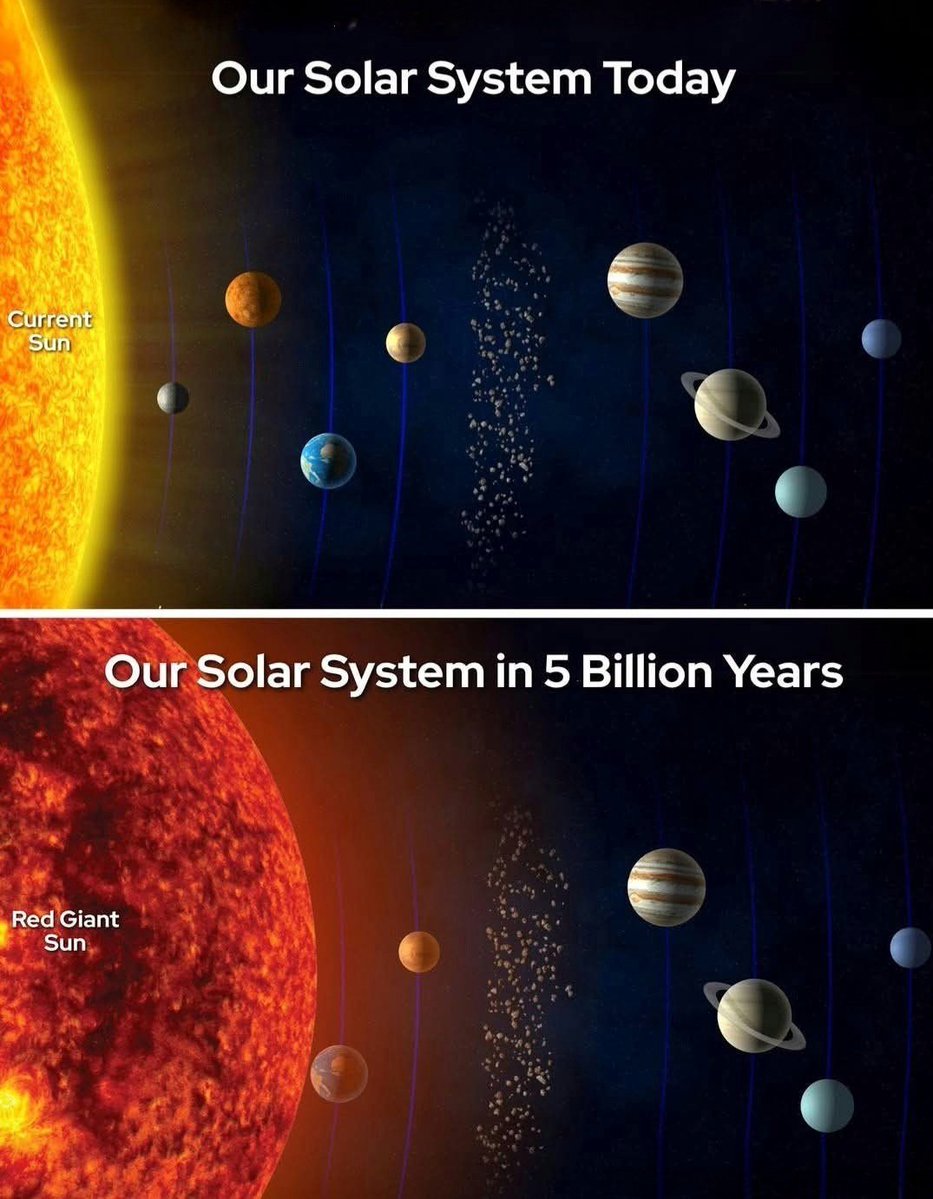
☀️ One day, the Sun will become a massive red giant. Here's what the solar system will look like when that happens.
Mercury and Vanus will be gone. And Earth might also be swalled by the Sun.
The Sun may seem eternal, but its life is already halfway over. Right now, it's in a stable phase, burning hydrogen into helium at its core. But in about 5 billion years, that fuel will run out.
What happens next is dramatic: the Sun’s core will shrink while its outer layers swell, transforming it into a red giant. During this phase, the Sun could grow large enough to swallow Mercury, Venus, and likely Earth itself. Even if Earth narrowly escapes being consumed, the intense heat and solar winds will strip its atmosphere, boil the oceans, and leave it barren and uninhabitable.
This red giant phase will last about a billion years. Eventually, the Sun will shed its outer layers, creating a glowing planetary nebula and leaving behind a white dwarf an incredibly dense stellar remnant that will cool over trillions of years. It’s the natural end for stars like ours, and while it spells doom for the inner solar system, it also marks a new beginning. The material expelled into space will one day help form new stars and planets.
By then, perhaps humanity will have moved on, watching from afar as our old star breathes its final light.
source: NASA
@VarticaKapri Absolutely, a sudden stop would be catastrophic the atmosphere, oceans and everything not firmly attached to the ground would keep moving at Earth’s rotational speed
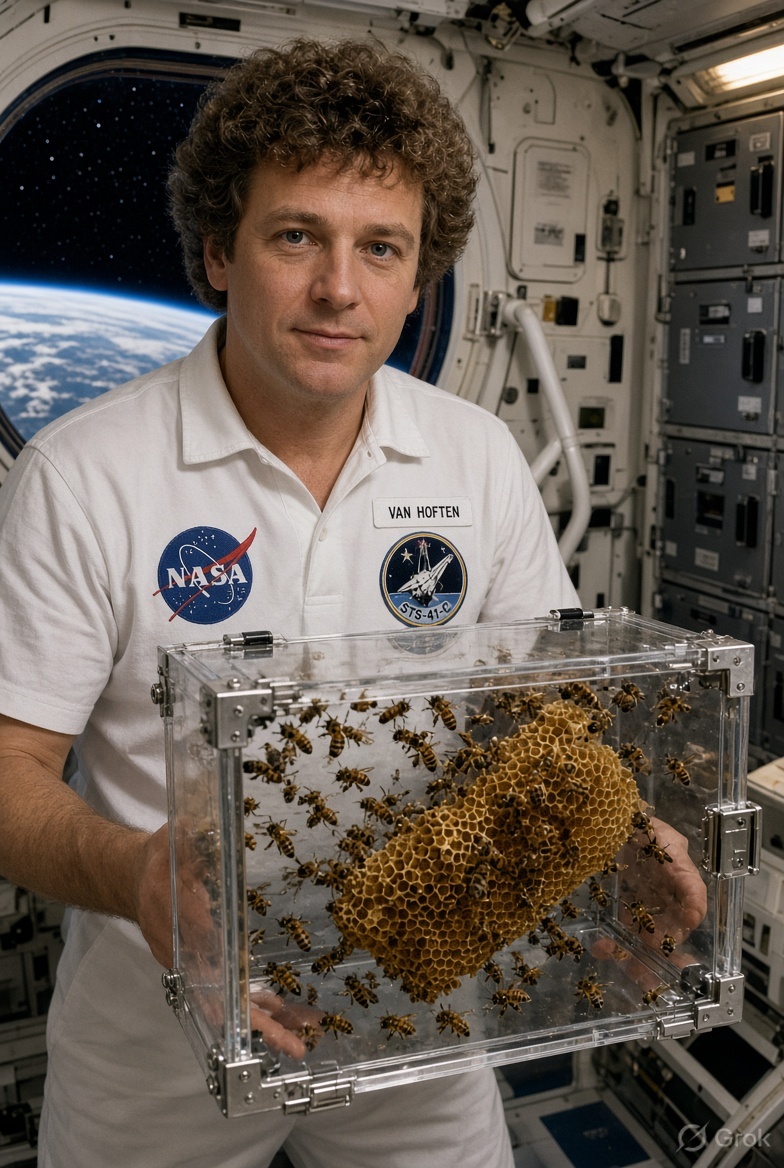
Thousands of honeybees travelled into space aboard NASA's Space Shuttle Discovery in 1984 for an experiment that sounds unusual even today. The space agency sent 3,301 bees into microgravity to see whether they could survive and, more importantly, build their famous honeycomb without the pull of gravity. The 7-day mission got off to a difficult start, with some bees crashing into the walls as they tried to fly. But within days, they adapted to their new surroundings. By the end of the mission, the bees were flying normally and had built around 200 cm of honeycomb in space.
NASA wanted to find out how bees work without gravity
The experiment was part of the STS-41C mission and had two main goals. Researchers wanted to see how honeybees behaved and survived in microgravity. They also wanted to compare the honeycomb built in space with honeycomb made by bees on Earth.
The bees initially kept hitting the walls
The bees survived the launch, but flying in space was clearly a new experience for them. During one of the early observations, some bees tried to fly but collided with the walls of their enclosure. However, their behaviour changed as the mission continued. By the seventh day, the crew reported that the bees had adapted to zero gravity and were flying confidently.
Bees built 200 cm of honeycomb in space
The bees did not just survive their time in space. They also got to work. The bees in the space enclosure built about 200 cm of honeycomb during the mission. Researchers found that the honeycomb made in microgravity had some differences. The cells had smaller average diameters and thicker walls than those studied on Earth. However, the bees were still able to build cells of normal depth and use some of them to store sugar syrup.
It was also reported that bee mortality during the flight was lower than expected. Video from the mission also showed bees flying faster in weightlessness than they usually do on the ground.
The experiment also gave researchers a chance to study how an insect colony organises itself when a familiar environmental cue is removed. The findings suggested that bees could rely on behavioural adaptation rather than gravity alone to coordinate their activity.
Most of the bees survived the mission. The queen also laid around 35 eggs, although the eggs did not hatch after returning to Earth. The reason for this was not known.
In 1984, NASA sent 3,301 bees into Space to test how they built honeycomb without gravity; from hitting on walls to building 200cm honeycomb; highlights of 7-day mission 🐝🚀
Read the full details in the thread 👇
Al-generated image for representation purpose.