@craigsuperstar@AliR_Ahmadi >>Technically, yes, but if it didn't benefit both, why would they agree to it?<<
Because countries can agree to a bad compromise when the alternative is worse. That question does not measure support or approval.
@charlesmurray >>I couldn't find any hint that he was Jewish. His parents were Protestants.<<
Get a hint. His mother's dad was Jakob Peltz. It is a hint, not proof. There is no proof his parent were Protestants either.
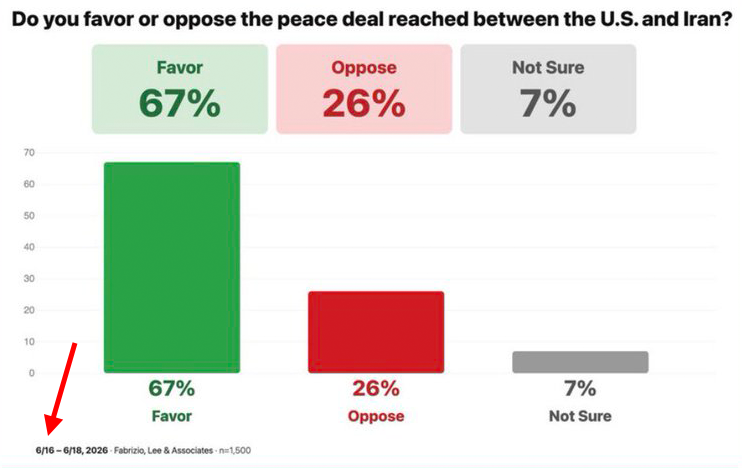
@mboyle1 >>OVERWHELMING SUPPORT, 67 percent...<<
The poll was fielded June 16–18. The MOU text was published June 17. So the poll question was written, and many responses came before the MOU text was public. This question was not polling the MOU actual text but the phrase "peace deal".
@PressSec The poll was fielded June 16-18. The MOU text was published June 17. So the question was written before the text was public, and many responses came before people could read it. This was not polling the actual MOU text; it was polling the phrase "peace deal".
@gbrew24 This is manipulation 😑 The "about equal for each" option does not mean "good for both". Equal can mean good, can mean bad. Better != support. The question does not measure support or approval.
@sethjlevy >>or good for both US and Iran.<<
This is manipulation 😑 The "about equal for each" option does not mean "good for both". Equal can mean mutually good, mutually bad, or just an even compromise. The question does not measure support or approval.
@AliR_Ahmadi >>the deal better for the US or good for both US and Iran.<<
That is not what the question says. The "about equal for each" option does not mean "good for both". Equal can mean mutually good, mutually bad, or just an even compromise.
Thoughts on Israel War #46: MOU #2 Ally vs Partner
Upon the agreement on the MOU between the US and Iran, the Trump admin and JD Vance, who led the negotiation team, anticipated backlash and criticism from Israel. Therefore, they prepared a massive media campaign in anticipation of criticism from Israeli ministers and Netanyahu himself.
The campaign started even before the MOU text was officially released.
The main problem with the campaign was that there was no public criticism of the MOU, nor of Trump or Vance, coming from Netanyahu or Israeli ministers. The reason was the government standdown order on the issue. Israeli government officials were ordered not to criticize the MOU, Trump, or Vance publicly.
It was too risky and too sensitive for Israel to publicly criticize the MOU, although it marked a 180 degree turn in the American approach to the Iran nuclear issue. The MOU also included American guarantees related to Lebanon and Hezbollah, although Israel is not a signatory.
Since there was no public criticism from Israel, and the Trump admin proceeded with the anti-Israel campaign anyway, it has the optics of a preplanned smear campaign. It was criticized not only by Democrats, but also by Republican senators and congressmen.
The clearest example showing that this was a campaign was the downgrade of the relations by using the transactional term "partner" in relation to Israel instead of the usual term "ally". Trump and Vance used "partner" in a downgraded, transactional way, often paired with correction and scolding.
The first major example came from Vance in a CBS interview published on June 10, 2026. He said Netanyahu governs a country that "has obviously been a very close partner" of the United States. Then he said that "even when we've been close partners", US and Israeli interests can be misaligned. He also said Israel had "been a good partner", but that when interests diverge, the US must choose American interests, "unfortunately for the Israelis".
The clearest Trump example came on June 17 at the G7. He said Netanyahu "gets a little excited sometimes", said Israel should use a "softer touch" in Lebanon, and then agreed that Israel was the "very small partner" while the US was the "big partner".
Trump said: "We've had an amazing partnership… we're the big partner and he's the very small partner".
In the same G7 remarks, Trump said: "They've been a good partner", then added that they "could do better". Later he said: "I love them as a partner. They were terrific, but they could do a much better job with Hezbollah".
This is the use of "partner", conditional praise, and past tense or past perfect framing.
Then Vance sharpened it further in the BlazeTV interview with Allie Beth Stuckey, released on June 19, 2026, saying Israel is "a good partner in the same way that the United Kingdom or France are good partners". This means Israel is not treated as a uniquely privileged ally, but as one partner among others whose interests may diverge from America's.
Trump and Vance are publicly downgrading the US-Israel relationship from a special alliance to a transactional partnership.
The wording pattern is clear: "partner", "close partner", "good partner", "very small partner", and "has been / we've been / they were" all place Israel in a dependent, conditional, past performance category.
Thoughts on Israel War #45: MOU #2 English vs Persian
As I suspected, the published Persian and English versions of the MOU differ in some important nuances. They are not direct translations of each other.
Nuclear weapons:
The English version says Iran shall not "procure or develop" nuclear weapons.
The Persian version says Iran will not "produce or acquire/purchase" nuclear weapons:
سلاح هستهای تولید یا ابتیاع نخواهد کرد
This is not the same. "Develop" is broader than "produce". The Persian wording leaves Iran more room to continue development work on components, while the English wording forbids development itself.
Lebanon clause:
The English version speaks about "ensuring" Lebanon's sovereignty and territorial integrity.
The Persian version says the parties will [guarantee] Lebanon's sovereignty and territorial integrity:
تمامیت ارضی و حاکمیت لبنان را تضمین کنند
This is also not the same. "Guarantee" is stronger than "ensuring". It gives Iran a stronger basis to claim that the U.S. must pressure Israel to withdraw from southern Lebanon, even though the MOU does not explicitly say "Israel must withdraw".
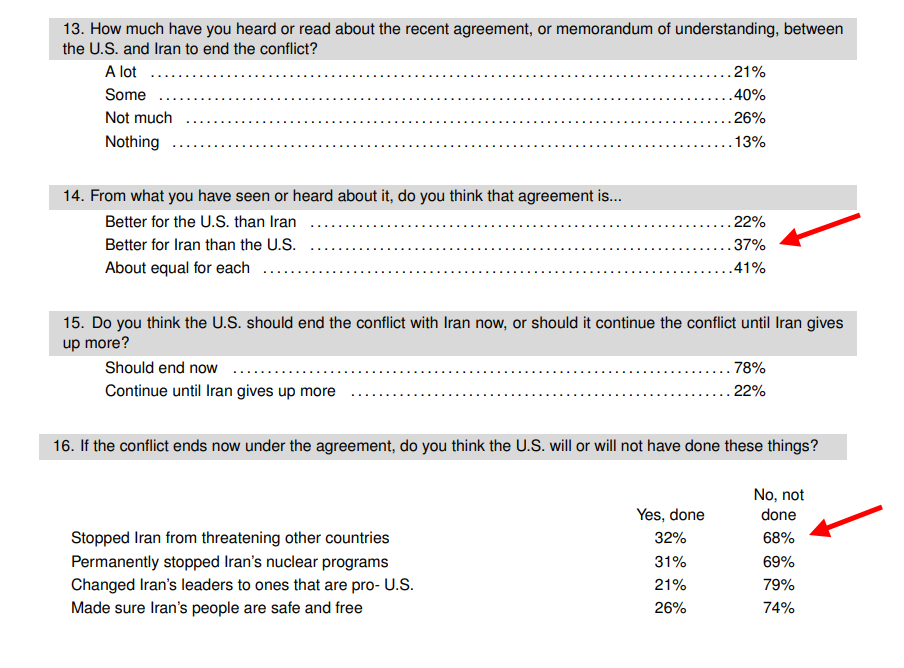
@alexbruesewitz@JDVance@X >>Meanwhile, 78% of Americans support the Trump administration<<
It's cherry picking the only question with problematic wording. See question 14, question 16. If the conflict ends now 68% think it will not stop Iran threatening other countries or nuclear programs.
>>She litterally has a thousand pages in front of her.<<
Listen, you seem like a serious guy. On the 0:20 - she says "work which is now widely viewed as a source of unintentional lab-leak".
[widely viewed] term means speculation. Without a proven lab-leak - those 1000 pages about Fauci and stuff is simply garbage.
@goulard_jp95744@Osint613 >>Even Bill Maher agrees it's a lab leak<<
Why should I care if person X or Y agrees? There was not a lab leak there. No, there is nothing proving that.
@goulard_jp95744@Osint613 >>If true (which I am sure it is).. How come domestic or foreign "Black-Ops" haven't taken him out yet?<<
If true? And if not? This is a classic conspiracy. There was no lab leak.
@alexbruesewitz@marklevinshow >>...in the media on June 17<<
The wording was extremely favorable. It described the MOU as stopping hostilities, reopening shipping etc while leaving out the controversial parts. So the result likely measures war fatigue and support for de-escalation, not real support.
@alexbruesewitz@marklevinshow The official version of the actual MOU appeared in the media on June 17. Quantus fielded its poll on June 16-17. That means most of the polling was conducted before the text was publicly revealed.
@AmitSegal >>meant to implement the peace deal—were canceled, with Iran citing the IDF’s actions<<
The Friday talks were canceled long before all this happened. It is simply now more convenient for all sides to blame Israel for that.
@alexbruesewitz >>I’ve been highlighting this for weeks, and Israeli sources are now confirming it.<<
Nothing is "confirmed" here. It is written this was CNN report. Learn to read.