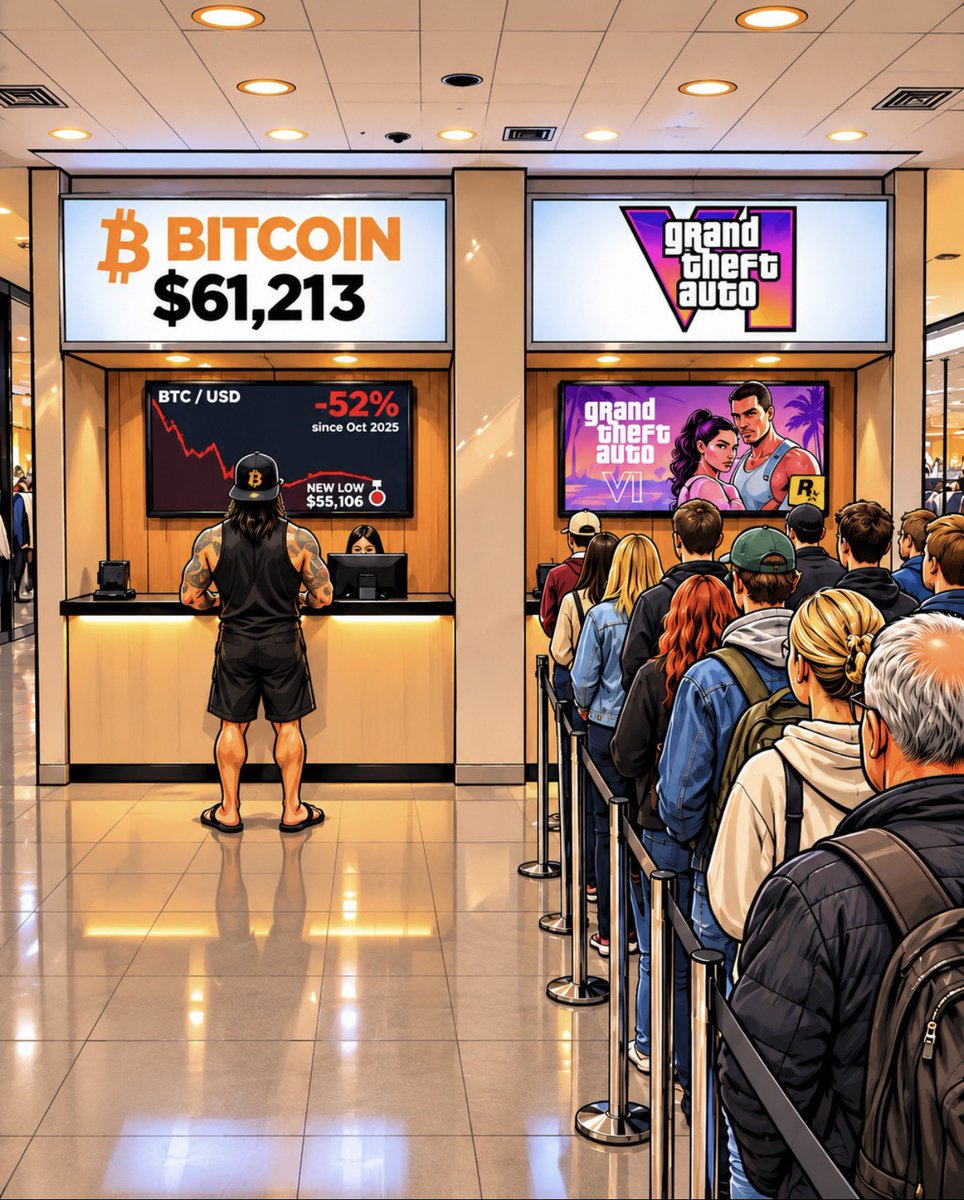
Me: I should make a serious educational series about the history of money.
Also me: [video]
So Debased, episode 1. The jokes are dumb. The history is real. Stay tuned for more in the series.
We’re living through an extraordinary period of technological innovation in Bitcoin, AI, and digital finance.
Yet millions of Americans still can’t afford a home, childcare, healthcare, or a dignified retirement.
The most important question in technology policy isn’t how we make these industries more successful, or what perks/tax breaks lawmakers can give an industry
It’s how we make these technologies work for everyday people. Because right now they are not feeling these benefits and only see how the rich are getting richer off of this tech.
FIDELITY SAYS QUANTUM COMPUTERS CANNOT CRACK BITCOIN
• Quantum-safe math exists, consensus is key.
• Early 2010 coins and reused keys at risk.
👉 Quantum is not an imminent risk.
HILARIOUS: Nvidia CEO Jensen Huang on his first day back after being reinstated: “This is my first day of work. I don't have a computer, so the IT department is going to give me a new PC. I'm hoping it's an RTX Spark.”
“I want to thank all of you. I'm terribly sorry for putting all of you through all of this. I've made some very terrible mistakes, and I'm going to work on coming back.”
An employee then RUNS UP and HUGS him as the packed lobby chants "Jensen! Jensen! Jensen!"
“Thank you all for the second chance. I'm going to be a better CEO the second time around.”
Prime numbers look random, yet their count follows a precise curve with small, stubborn ripples.
Bernhard Riemann explained the ripples in a short paper of 1859 that tied the primes to the zeros of a function of a complex variable.
Each zero adds one wave to the count. Riemann guessed that every zero inside the critical strip lies on a single vertical line, and he left it unproved. Computers have checked trillions of zeros without an exception, and the Clay Institute offers a million dollars for a proof.
For those who dont know what Reimann Hypothesis means :
Prime numbers (2, 3, 5, 7, 11…) are the building blocks of all numbers, and up close they seem to pop up completely randomly. However, if you zoom way out, we actually have a smooth formula that estimates roughly how many primes exist up to any huge number and it’s just never exact.
In 1859, a mathematician named Bernhard Riemann found a way to turn the prime numbers into a 2D map filled with special "zero" points, where each point acts like a wave that controls how far off our estimate can get.
The Riemann Hypothesis is the claim that every single one of those special points lines up on one exact straight line, with zero exceptions, all the way to infinity. If that’s true, it guarantees that prime numbers never clump up or vanish in weird ways and they stay spread out as cleanly and evenly as random coin flips, forever.
Years of progressive Bitcoin advocacy have taught me one thing: many lawmakers aren’t ignoring the technology. They’re raising legitimate concerns about fraud, corruption, and consumer protection.
If we want real progress, we need to start listening. https://t.co/Mfgquiew3f