/dream: @AnthropicAI is quietly rolling out Auto-Dream in Claude Code v2.1.83 🧠
Auto-Memory takes notes during your sessions. Auto-Dream consolidates them. Runs every 24h once enabled in /memory.
→ System prompt: https://t.co/xuIH5i7okO
→ OSS version: https://t.co/vtbOrGBj7r
This mental model helps me to decide when to use @AnthropicAI SKILLS or SUB-AGENTS. The key concepts that need to be considered for the choice are: I. Progressive Context Building, II. Role Encapsulation, III. Context Bandwidth
@arscontexta A skill graph is much more powerful as the vanilla flat skills list as it allows the agent progressively build up context for tonne applications. However, you might be better off using sub-agents if your tasks require ROLE SEPARATION and a LOW CONTEXT BANDWIDTH
@omarsar0 The framework is exciting, but I think 'self-improving' is a misnomer here. The multi-agent system doesn't improve itself—instead, it's used to improve a separate target system. In fact, the same multi-agent system could be applied to improve different systems.
#ClaudeCode and #Cowork change the economics of labor
Dario Amodei warns of a "white-collar bloodbath" but @levie and @garrytan point to the Jevons Paradox
Who will prevail will depend on the productivity multiplier and the elasticity of demand
Blog: https://t.co/FvweeR0fcL
@DarioAmodei warns of a "white-collar bloodbath" but @levaborhany and @garrytan point to the Jevons Paradox: Productivity Multiplier VS Elasticity of Demand
Who's right?
My take on the changing Economics of Labor: from @AnthropicAI's #ClaudeCode to #Cowork https://t.co/FvweeR0fcL
The Toolformer paper is underwhelming.
Teaching an LLM to use tools is exciting! but the tools considered are disappointing.
So much effort to choose between Wikipedia and a calculator?!
There are a few compelling insights though!
So, what should you take away?
A mental model I have of AI is it was roughly ~linear progress from 1960s-2010, then exponential 2010-2020s, then has started to display 'compounding exponential' properties in 2021/22 onwards. In other words, next few years will yield progress that intuitively feels nuts.
🎉 New paper 🎉 Introducing the Toolformer, a language model that teaches itself to use various tools in a self-supervised way. This significantly improves zero-shot performance and enables it to outperform much larger models. 🧰
🔗 Link: https://t.co/FvjzhysMze
I've worked on search problems for more than 20 years, and I've never been more excited.
Our work builds on cutting-edge information retrieval research using generative models. We take it one step further and deploy it to prod with @vespaengine.
https://t.co/WUmaoUooeG
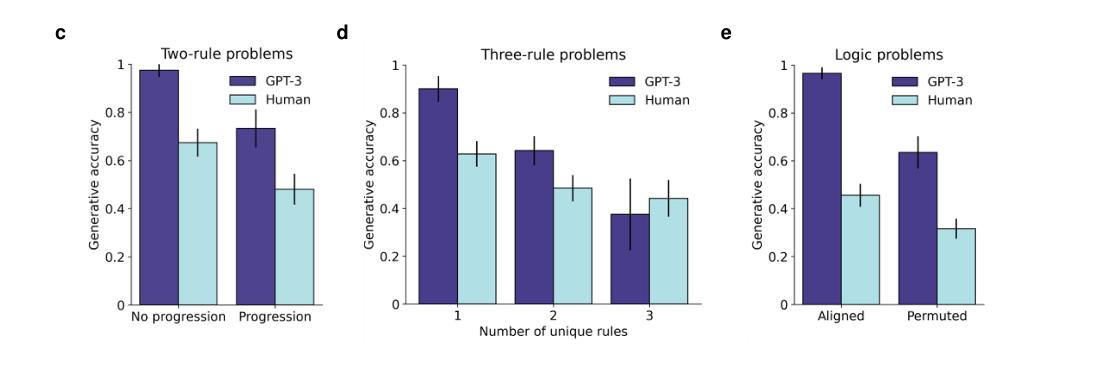
Emergent Analogical Reasoning in Large Language Models
https://t.co/b7WOoEIanp
Recent advent of large language models has reinvigorated debate over whether human cognitive capacities might emerge in such generic...
🧵 👇
@Embodied_AI Thanks Akseli for running the podcast, I'm enjoying it very much! I'm an NLP researcher trying to catch up with embodied cognition. I'm wondering, are there any online lectures or talks you would recommend? Thanks
Three years in the making - our big review/position piece on the capabilities of large language models (LLMs) from the cognitive science perspective.
Thread below! 1/
https://t.co/CwW9qwBpgo
While doing research in NLP I have been studying Cognitive Linguistics now for a while. I've tried to summarize what LLMs are missing from CL perspective:
Deficient by Design: What Large Language Models are missing from a Cognitive Linguistics Perspective https://t.co/tCJgz8jv29