#designmatters26 When Content Refuses to Sit Still
/ Andreas Refsgaard .@andreasref
Loving and Hating AI at the Same Time — Finding Creativity in Making Things That Solve Absolutely Nothing
An incredibly playful, experimental, and delightfully chaotic presentation by Andreas Refsgaard, exploring the weird, imperfect, and unpredictable side of generative AI.
Rather than using AI to build useful products, optimize workflows, or solve real-world problems, Andreas embraces its glitches, limitations, absurdities, and unexpected outcomes as creative material.
His central theme was simple: loving and hating AI at the same time.
AI opens up extraordinary creative possibilities, yet the internet is increasingly flooded with low-quality, mass-produced content — or what he calls "AI slop." He finds this both fascinating and deeply unsettling.
To express that contradiction, he even built a system that detects when he makes a vomiting expression and responds by generating AI images that appear to pour out of his mouth.
The presentation itself was intentionally unpredictable, filled with weird live demos, technical failures, audience participation, and projects that proudly solve absolutely nothing.
● Books by AI — A Bookstore Where Everything Is AI-Generated
Back in 2018, Andreas and his intern Miguel created Books by AI, an online bookstore selling books generated entirely by algorithms.
Everything was generated: the titles, author names, tables of contents, 200–300 pages of text, prices, and cover artwork.
This was long before today's powerful LLMs and image-generation tools. Andreas had to collect training data, train his own models, and build the entire system himself.
The resulting books were, unsurprisingly, not particularly good.
But that was part of the point.
Early character-level text-generation models produced strange words, broken sentences, and unexpected linguistic patterns. Rather than treating these as failures, Andreas appreciated their peculiar aesthetics.
He described one of the books as:
"It's not a good book. It's also not an uninteresting book."
To make these questionable books more appealing, he generated an entire army of fake reviewers, complete with AI-generated faces and enthusiastic five-star reviews.
Eventually, real customers started buying the books and leaving genuine reviews, creating a wonderfully confusing mix of synthetic and authentic social proof.
And here's the beautiful irony: some of the training data came from Amazon, while the resulting books were sold through Amazon's print-on-demand service.
As Andreas put it, he wanted to see "whether Amazon will sell its own vomit."
A perfect example of generative AI becoming both the medium and the subject of its own critique.
● When AI Misclassification Becomes Poetry
In 2019, Andreas experimented with combining image recognition and Google Search suggestions to generate poetry from everyday objects.
The concept was wonderfully simple.
Point your smartphone camera at something, let an image classifier identify it, and feed that classification into Google's autocomplete suggestions.
Photograph a banana, for example, and the system might generate lines such as:
"Can bananas kill you?"
"Can bananas be frozen?"
"Can bananas cause diabetes?"
The search suggestions accidentally become poetry.
One particularly memorable example came from a student who turned the camera toward his own upper body.
The image classifier had no category for human body parts, so it identified him as a "fur coat."
That unexpected classification triggered a series of questions about fur coats, their value, authenticity, and shedding.
The result was a strange, funny, and surprisingly poetic piece that Andreas could never have anticipated.
This reveals an interesting creative principle: AI getting something wrong doesn't necessarily mean the design has failed.
Sometimes the most interesting outcomes emerge precisely when a system misinterprets the world.
Andreas later developed more sophisticated versions using improved computer vision and GPT models. During the talk, he demonstrated a system that generated poetry about the audience and the conference space in real time.
One generated line described the venue beautifully:
"The room is trying to be a forest. Walls wearing plants to seem gentle."
A wonderful example of computational interpretation producing an unexpected perspective on a familiar environment.
● My Brows and Liquid Browser — When the Web Becomes Unstable
Another wonderfully absurd experiment was My Brows, a browser extension that replaces people's faces on websites with Andreas's own face.
It also replaces names, transforming ordinary news articles into an alternative reality where Andreas seems to be everywhere.
Then came Liquid Browser, a concept that challenges one of the fundamental assumptions of web design: that a website already exists before someone visits it.
Instead of retrieving predefined pages from a server, Liquid Browser generates websites on the fly based on whatever someone types.
During the live demo, the audience suggested random ideas, and the system attempted to generate an entirely fictional website in real time.
Clicking through links creates even more generated pages, producing an endless rabbit hole of synthetic content.
It's messy, unpredictable, and sometimes hilariously bad.
But it also raises a fascinating question for designers:
What happens to information architecture, navigation, and the very idea of a website when the interface and its content are generated at the moment of interaction?
The web is no longer necessarily a collection of fixed destinations. It can become a fluid, constantly changing experience.
● Generative Television — When the Audience Becomes the Content
Another experiment took this idea beyond the browser and into television.
Andreas imagined a TV that generates programs featuring the very people watching it.
He invited volunteers onto the stage, positioned them in front of a camera, and demonstrated a system that generates different television channels using the viewers themselves as the characters.
Switching channels doesn't simply reveal another prerecorded program. It creates another version of reality starring the same people.
The concept turns the traditional relationship between audience and content upside down.
Instead of choosing from programs someone else has produced, the viewers become part of the generative process.
It's an intriguing glimpse into a future where media experiences are not merely personalized through recommendations but generated dynamically around the viewer, their presence, and their immediate context.
● Arguing with Your Own AI Clone
The final project, also presented at Ars Electronica, explored a more provocative use of generative AI.
What would happen if you had to debate a difficult social issue with your own AI-generated clone?
The interaction begins with a photograph and a challenging question about a controversial topic.
You spend around 30 seconds explaining your position while the system generates a digital version of you in the background.
But here's the twist.
Your AI clone doesn't agree with you. It takes the opposite position and argues back.
Imagine facing a version of yourself that looks and sounds like you but challenges your beliefs.
By turning your own identity into the interface for disagreement, the experience creates an unusual opportunity for reflection.
It's not simply about generating a convincing digital human. It's about using AI to challenge assumptions, introduce alternative perspectives, and make people confront their own thinking.
● The Creative Value of Building Things That Solve Nothing
What ties all these projects together is Andreas's refusal to treat AI purely as a productivity tool.
In conventional product development, we usually strive for accuracy, reliability, predictability, and seamless user experiences.
But his work deliberately embraces the opposite.
Misclassification becomes poetry. Poorly generated language becomes an aesthetic. Fake reviews become a critique of digital authenticity. Websites emerge from nowhere. Television turns viewers into fictional characters. And your own digital clone becomes your opponent.
The glitches, limitations, and unpredictable behaviors aren't necessarily bugs to eliminate.
They're creative opportunities to explore.
In an era when generative AI makes it increasingly easy to produce almost anything, perhaps the more interesting design questions are not just what can we generate? or how efficiently can we generate it?
But why are we generating it? And what does the experience reveal about ourselves and the technology?
Andreas's work reminds us that experimentation doesn't always need a business case, a measurable outcome, or even a problem worth solving.
Sometimes, making something weird, useless, provocative, or completely ridiculous is precisely how we discover new possibilities.
A wonderfully funny, irreverent, and thought-provoking presentation — full of creative coding, playful experimentation, happy accidents, and a healthy dose of skepticism toward generative AI.
Sometimes the most interesting thing you can make with AI is something that doesn't solve anything at all.
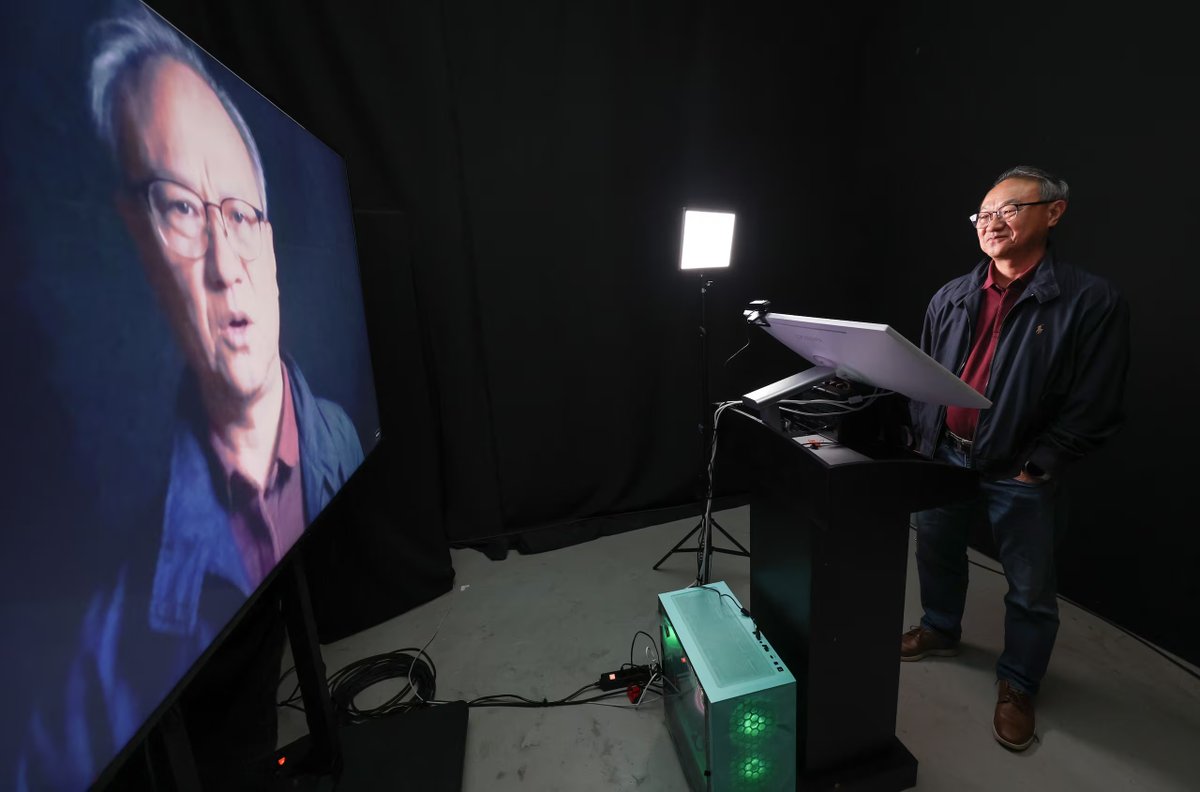
Wicked Mirror, created with Sofie Burgos-Thorsen, was recently exhibited at the Art Korea Lab AI-Convergence Festival in Seoul. The installation lets you debate an AI version of yourself that takes the opposite position on a wicked problem. 🔗Link to article in Chosun👇
Processing Community Day is back in Copenhagen!
Join us on Oct 24th at Danmarks Medie- og Journalisthøjskole for a free, one-day celebration of design, art, and code. The event is free, register at https://t.co/F6kddvkRKI
@ProcessingOrg@runemadsen@Stixan#p5#p5js
This is U-TV: Where you appear in the programmes, whichever channel you switch to. You’re both the audience and the content!
Had a talk out of town and finished the demo on the train. Thanks to Charlotte for trying it out with me.
Channel suggestions welcome! @fal#h3max
*Image is an AI-generated mockup (and my clone is obviously also AI-generated), will share real images of the setup once I get there!
More info at https://t.co/TNN8xoROcd
My new piece, Wicked Mirror, made with Sofie Burgos-Thorsen from INVI, is showing now at Ars Electronica in Linz, Austria, until September 13th.
Share an opinion, then debate a clone of yourself arguing the opposite, using your own face and voice!
I’m in Linz until Saturday 👋
@matthieu_ai@isidentical@fal I’d build a real-world fighting game: photograph two people doing their best punch, kick, flying jump, weird handstand, whatever. H3 Max turns them into high-fi arcade fighters and generates the battle. Tekken, but you ARE the characters.
So happy that my piece "Spreadsheet of You" is part of the @eccvconf Art Gallery 2026! Check out the website featuring the selected works for this edition, curated by
@elluba & @YSiglidis at https://t.co/PH08aBtZlZ
Our ECCV Art Gallery is now online 🥳
Check out the 52 accepted works, 12 spotlights and plan your schedule for the onsite gallery, tours and panels at #ECCV2026 next week
https://t.co/AKvEmzD6C5
Curated with @YSiglidis for @eccvconf#creativeAI
WTF?! This changes image generation forever! 🤯 PrismML just released Binary and Ternary Bonsai Image 4B!
That's right, 1-bit diffusion models are here. Only ~3GB in size (FLUX.2 Klein 4B is 16GB).
The most shocking part? It can run 100% locally in your browser. Try it now! 👇
Spreadsheet of You📊 A browser-based installation using uses face-api.js and official data from Statistics Denmark to calculate the most likely name, monthly income, expected time until death, etc. All client-side, no data is sent to external servers. Comment if you want to try?