We also get asked ALL the time what @Anam__AI means + why we called our model Cara, so we share a little on that too @benatanam
Try it here: https://t.co/bEro698jt4
We shipped Cara-4.1 Express this week: better lip sync, more expressive + way faster to connect.
#1 model across 6 metrics vs the market in blind human evals.
Why does it matter?? More natural convos = longer chats = better outcomes for our customers.
@Anam__ai Anam’s visual-quality lead over Tavus was not statistically significant. Evaluation code and methodology are public, so you can reproduce the results.
Results: https://t.co/Q6CLd9CwJw
Repo: https://t.co/Tm2Y70bXPU
Full results from our Cara-4.1 Express evaluations.
60 people held 960 blind conversations with avatars from @Anam__AI, Tavus, HeyGen and LemonSlice, rating each on six questions.
@Anam__ai Across all six questions, 73% of Anam ratings were positive vs 54% for Tavus. 53/60 raters scored Anam higher than Tavus; 51/60 than HeyGen.
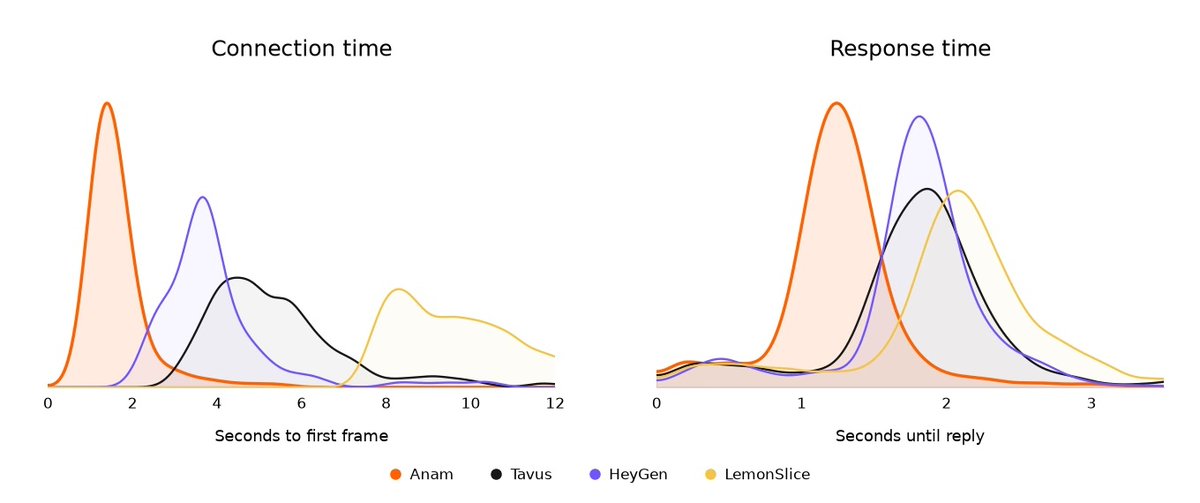
Median reply time: 1.24s vs HeyGen’s 1.82s.
Median connection time: 1.42s vs HeyGen’s 3.66s.
Cara-4.1 Express is now live at @Anam__AI
Faster and more expressive than cara-4 with better lip sync and stronger prompt adherence. It also handles much wider framings for custom avatars.
We ran blind human evals: 85% of raters scored Anam higher than HeyGen, 88% higher than Tavus and 92% higher than LemonSlice. The eval code is public and reproducible.
Try it in the Anam Lab: https://t.co/0TXpYwwjA2
@Anam_AI ran its new blind benchmark on a LiveKit pipeline, with the same speech recognition, LLM and voice for every provider, so the only thing that changed was the avatar.
If you're building a voice agent with LiveKit Agents, you can give it a face in a few lines of code.
Try it now: https://t.co/tlTCa5QvOD
AI avatars have looked realistic for a while.
The problem starts when you actually talk to them.
Anam's new Cara-4.1 Express responds in just 1.2 secs, handles interruptions, and makes eye contact feel natural.
This is getting surprisingly close to a real conversation.
AI avatars can look impressive in a demo.
Then you start talking to them, and the awkward pauses, expressions, or lip sync give them away.
That's what makes Cara-4.1 Express from @Anam__ai so interesting.
1.2s response time, better lip sync, and more natural reactions are aimed at making conversations feel less robotic.
The real test isn't how an avatar looks in a still frame.
It's how it feels in a conversation.
YOU COULD GET 25%+ MORE CONVERSIONS FROM YOUR AI SALES AGENT JUST BY GIVING IT A FACE.
Cara-4.1 express from @Anam__AI is a real-time face builders can add to their agent:
→ 70% prefer it to voice-only
→ 57% higher retention
→ real-time conversations in 70+ languages
this could literally lift conversion across every funnel. we're definitely testing it in ours.
Every AI avatar looks great for about 5 seconds.
Then you actually talk to it. dead eyes, lips a little off, that weird pause before every reply. the whole thing falls apart.
Anam just released Cara-4.1 Express and it’s the first one that looks like it’s trying to fix that part.
Conversational AI went text, then voice, now video. We trust a face more than a text box, and adding one to a text or voice agent drives a 44% increase in engagement.
What stands out to me:
– 1.2 seconds response time, 33% faster than the next best competitor
– you can interrupt it mid-sentence and it handles it like a real conversation
– 73% of ratings positive vs 54% for Tavus
– #1 overall in a blind benchmark with 60 raters and 960 conversations
Free to start: https://t.co/tEygAd5fOZ
the thing that makes an AI avatar feel real isn't just how it looks, it's how naturally it responds
Anam’s new Cara-4.1 Express model has better expressions, smoother lip sync, and came out #1 again in another blind test against its competitors.
I'm curious to see how developers use this for AI tutors and interactive assistants. it’s human nature, students pay more attention to a face
#AnamPartner