Friends, I am happy to share that I am now a @GoogleDevExpert for Flutter 🎉.
THANK YOU to everyone who supported me over the years. You all are amazing 💙.
It is even more special since I am now the first GDE not only for my country but also the Caribbean 🎉
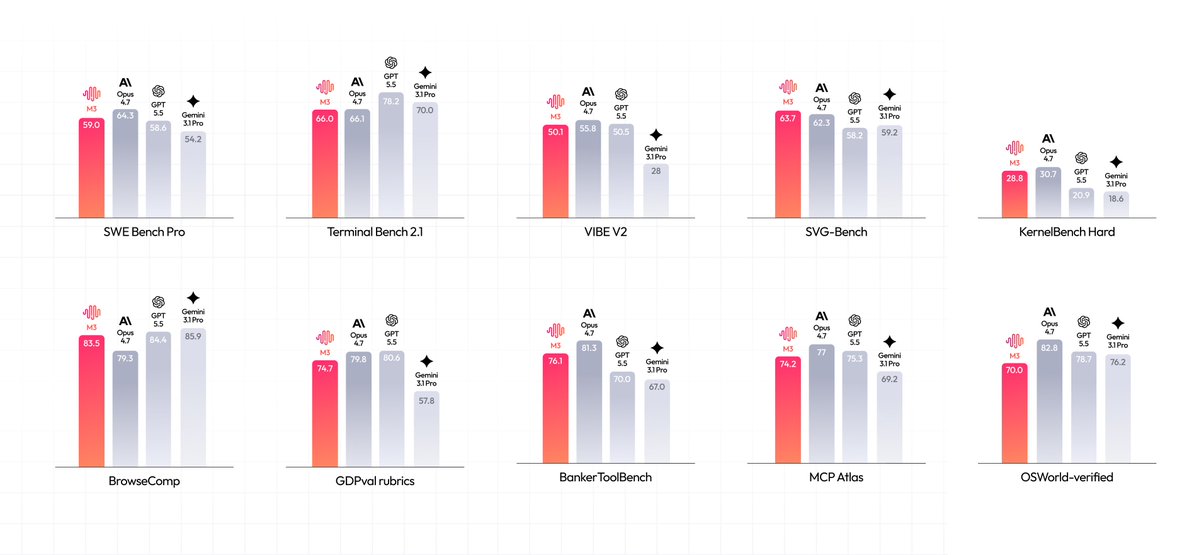
Congrats to @MiniMax_AI on the M3 launch — and great to see @visionagents_ai ship day-zero integration, with Tencent RTC recommended in the docs as the edge transport for the lowest end-to-end latency across China & Asia.
M3 for intelligence. Vision Agents for the agent loop. Tencent RTC for real-time transport.
@yacineMTB 100%, I think it's going to come down to cost and efficiency. We're already seeing the early stages of this with Google pushing Gemini 3.5 flash heavily during IO and positioning it as comparable levels of intelligence for a fraction of the cost, etc
Awesome to see the open models continuing to improve at a rapid pace. It really does feel like the gap between open and closed models is starting to narrow. Congrats on the release, @MiniMax_AI!
Congrats to the @MiniMax_AI team on the release of M3!
👉 A frontier-class open-weight model
👉 1M context window
👉 Native multimodality (image & video)
“Big accounts don’t support small accounts.”
I follow 40,000+ small accounts and put them into lists so everyone can have their Hermes or OpenClaw read them.
Look for my lists. “AI Community” lists are all small accounts.
"What changed is who their customer is becoming. The buyer is still a human writing the cheque, but the consumer of the API is increasingly an agent." https://t.co/M60w2jDPdV
@Pontifex@JuniperFolly Anthropic PMs making notes and then conferring quietly together. Thank you for your feedback, we can ship all of this by the end of Q4
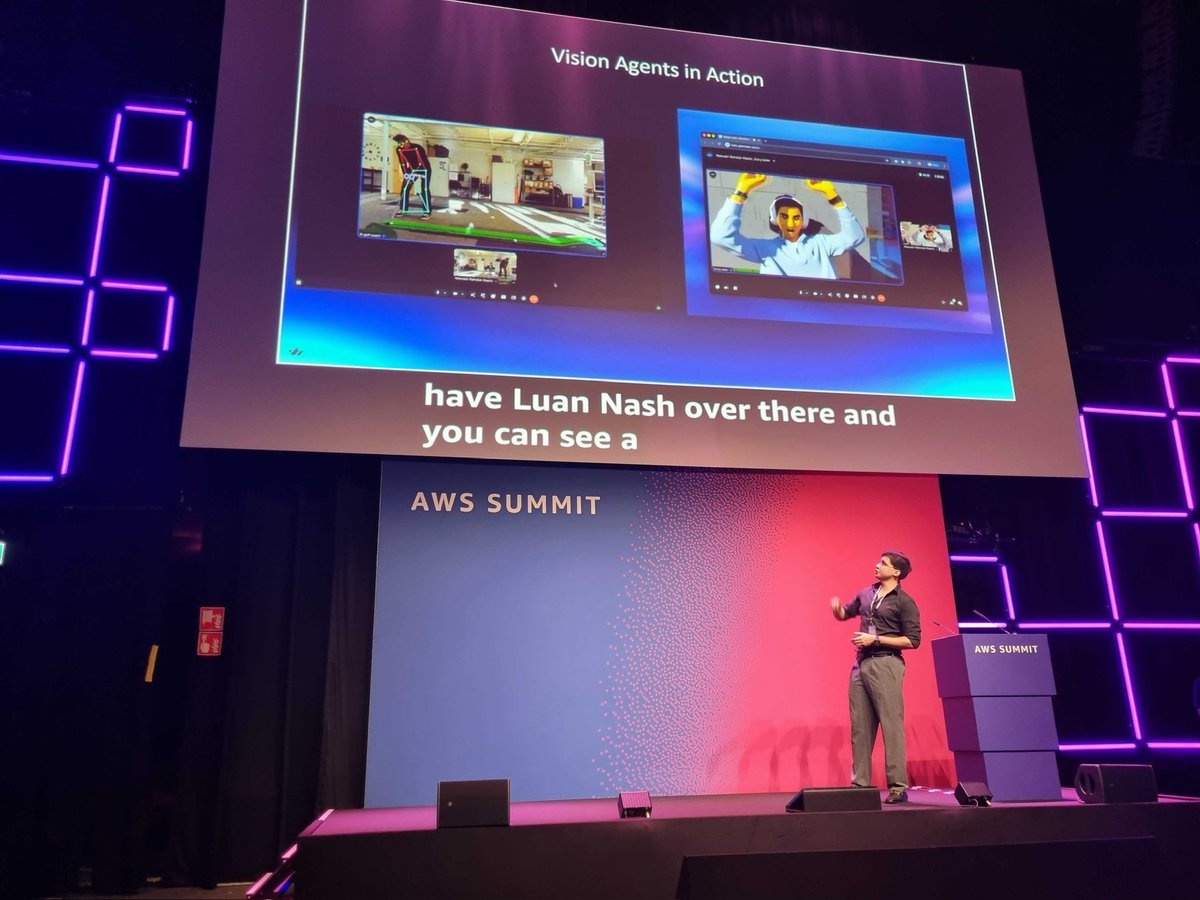
This week I had the opportunity to speak at the AWS Summit Amsterdam about building production voice AI agents with @visionagents_ai and Nova Sonic. Speaking on one of the RAI main stages was something else.
If you want to try it out yourself: https://t.co/wJ0hwFyQom
Excited to share our most powerful new Claude Code feature: dynamic workflows!
Mention "workflow" in a prompt and Claude will dynamically create an orchestration plan that it strictly follows, allowing you to confidently trust that every stage happens in the right order even across 100s of agents.
Introducing DiffusionBlocks: Block-wise Neural Network Training via Diffusion Interpretation
https://t.co/c9AvsRKybj
What if we didn’t have to hold an entire neural network in memory to train it?
Standard neural net training optimizes all parameters jointly. As a result, the memory required during training grows linearly with the depth of the network.
In our #ICLR2026 paper, we propose DiffusionBlocks, a principled framework to train networks one block at a time, drastically reducing memory requirements while matching end-to-end performance.
With DiffusionBlocks, we split the network into blocks and train them one at a time, so you only need memory for a single block.
How? We explicitly assign each block a role: to move the representation a little closer to the target than the block before it did. That role turns out to be precisely what a diffusion model does, step by step. Each block only needs to optimize its own objective and can be trained independently.
We validated this across five different architectures:
• ViT
• DiT
• Masked diffusion
• Autoregressive transformers
• Recurrent-depth transformers
In each case, performance is competitive with end-to-end training while using a fraction of the memory.
This perspective also extends naturally to recurrent-depth (Looped) transformers, which apply the same network iteratively and normally require expensive backpropagation through time (BPTT). Viewed through DiffusionBlocks, we can replace those multiple iterations with a single forward pass during training.
Read our paper and code, to learn more.
Paper: https://t.co/CRj96VGYQn
GitHub: https://t.co/eNW0K9Xh8E
🐟